

Pollinator Post 3/6/25 (1)

Back at the Regional Parks Botanic Garden again.
The first order of business is to ascertain that the American Winter Ants I saw on the Evergreen Currant, Ribes viburnifolium last time were no mere incidentals. I find them easily today, on the leaf..

… on the stem.

Somehow the ants do not show up well against the brick red flowers. The tiny flowers are loosely clustered, shallow and open-faced. The five stamens are spaced just far apart enough to allow the ant access to the nectar in the center.
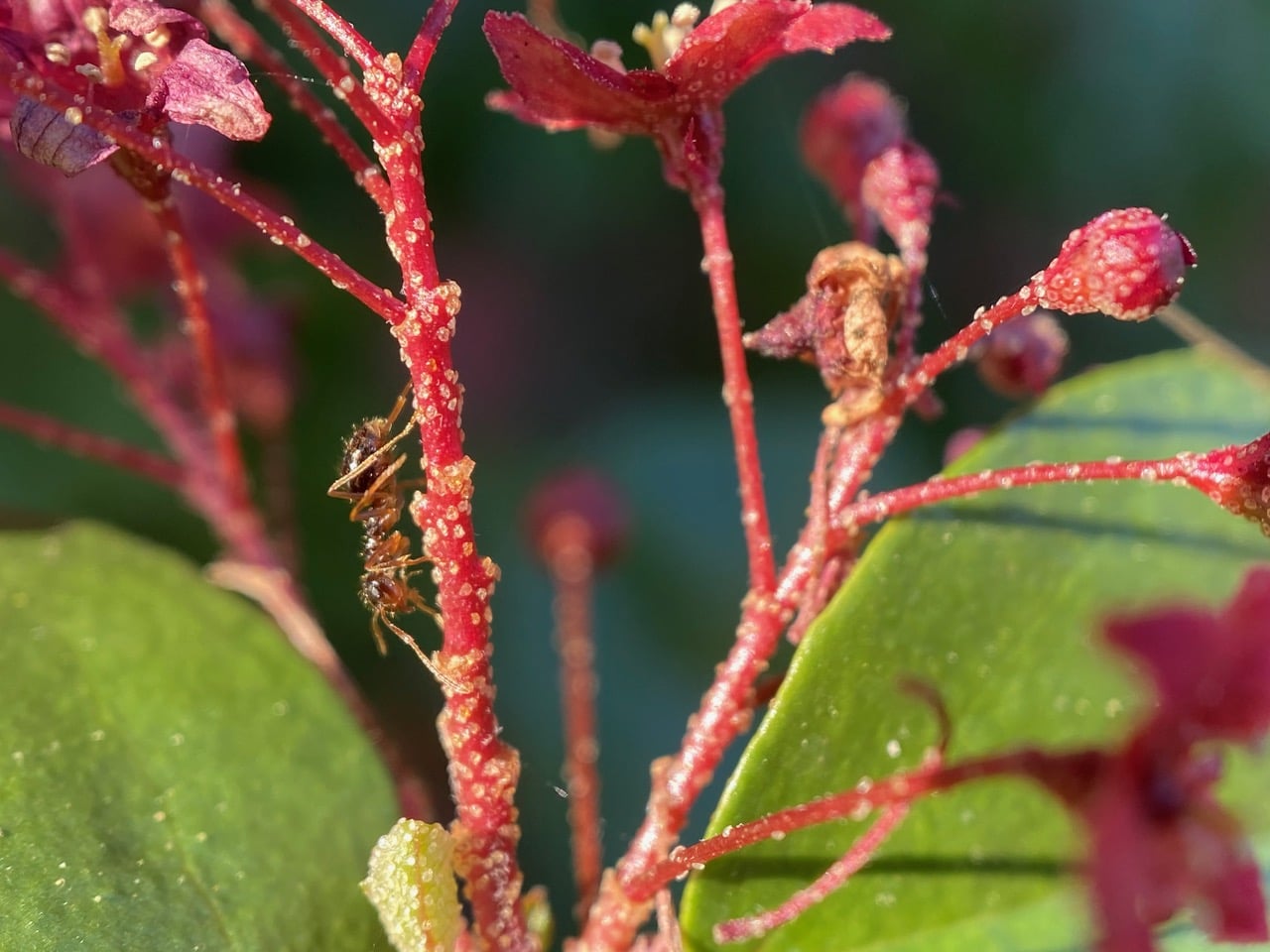
The ants are even more difficult to see when the plant is illuminated by the sun, and the flowers turn a different shade of red. Note the dried exudates from the scent glands dotting the red pedicels and flower buds.
The American Winter Ant, Prenolepis imparis is a widespread North American ant. A dominant woodland species, it is most active during cool weather, when most other ant species are less likely to forage. This species is one of a few native ants capable of tolerating competition with the invasive Argentine Ant, Linepithema humile. They are also aggressive toward other ants and produce abdominal secretions that are lethal to Argentine Ants. Prenolepis imparis is a generalist omnivore. Foragers are known for tending to aphids or scale insects from which they consume excreted honeydew, aggregating on rotting fruit, and exploiting protein-rich sources such as dead worms. The colony enters estivation (a hibernation-like state) and becomes inactive above ground for the warmer months, during which time eggs are laid and brood are reared. Reproductives overwinter and emerge on the first warm day of spring for their nuptial flight.
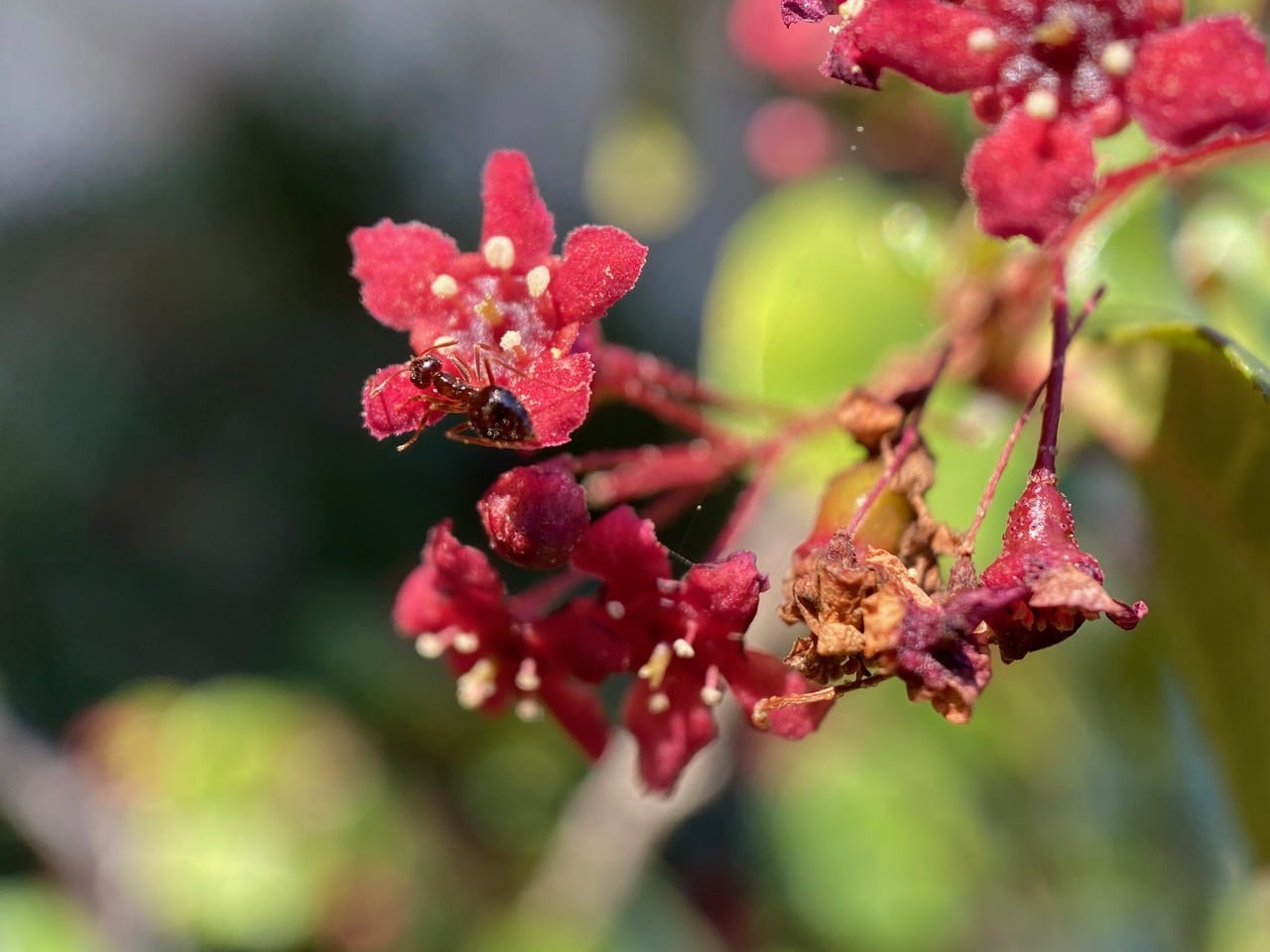
While hardly any other insects visit the Evergreen Currant, the ants are numerous, with their activity centered on the flowers. Because the flowers are clustered, the ants can easily move from one to the next, always in search of nectar.


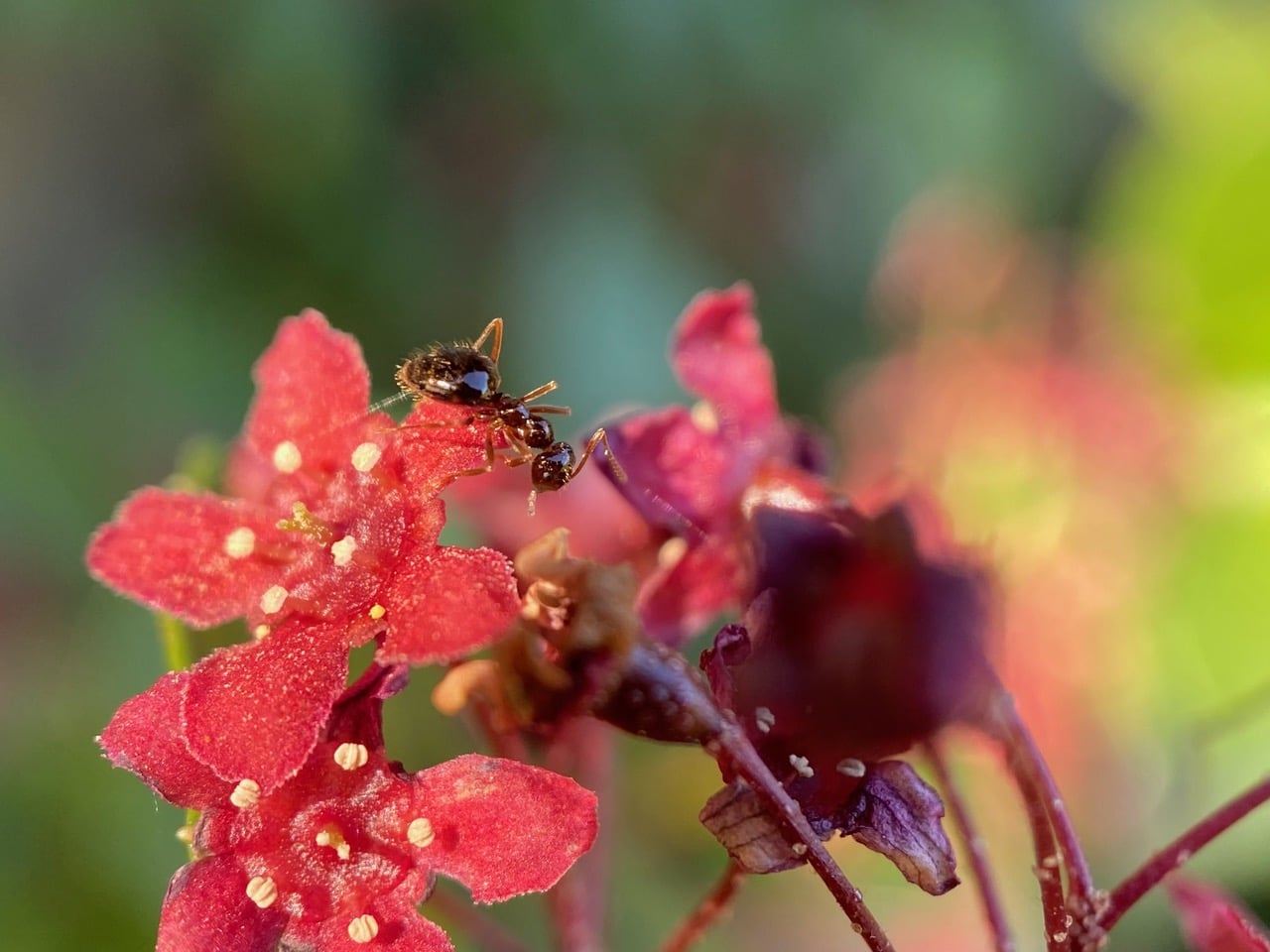
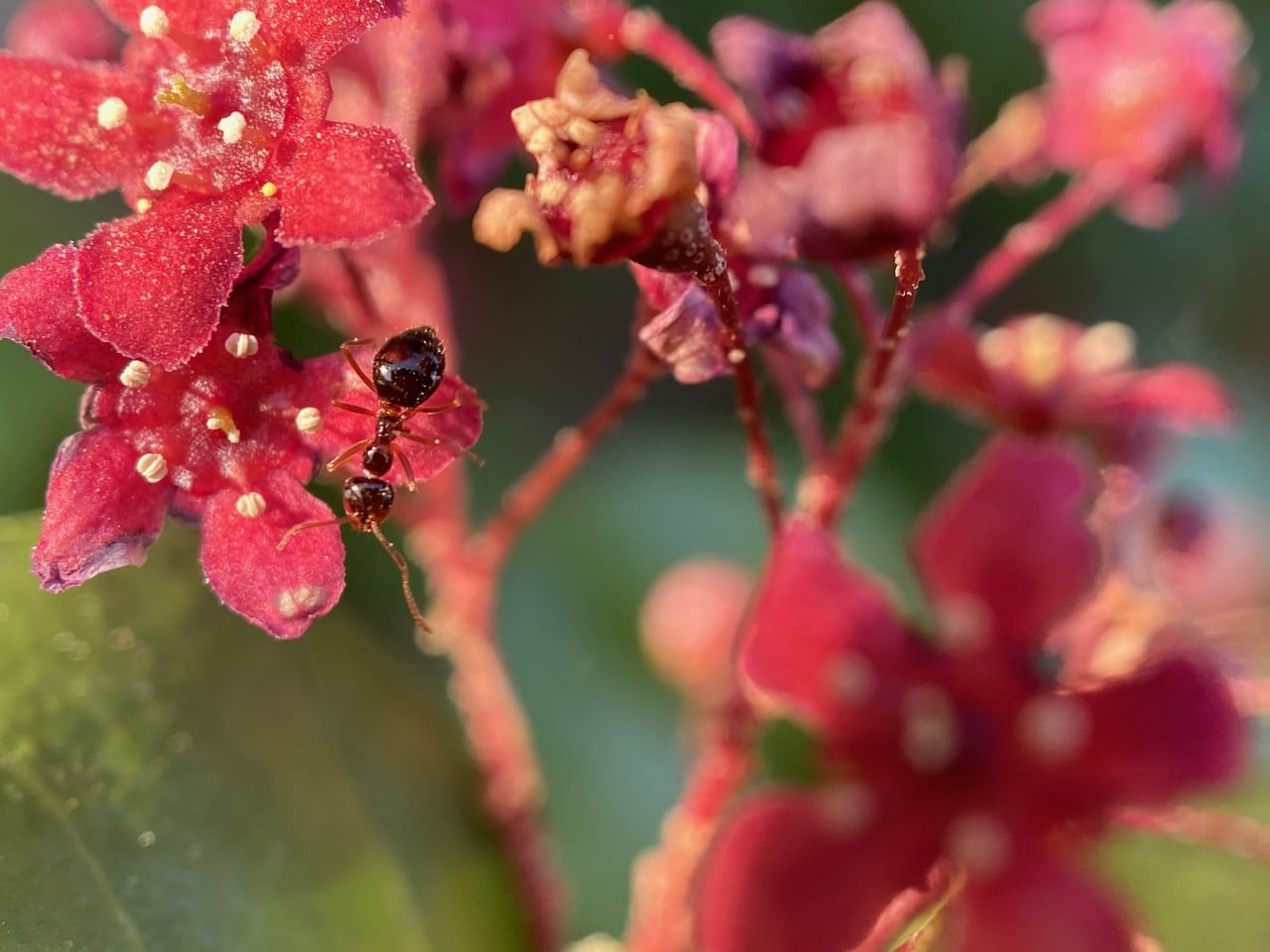

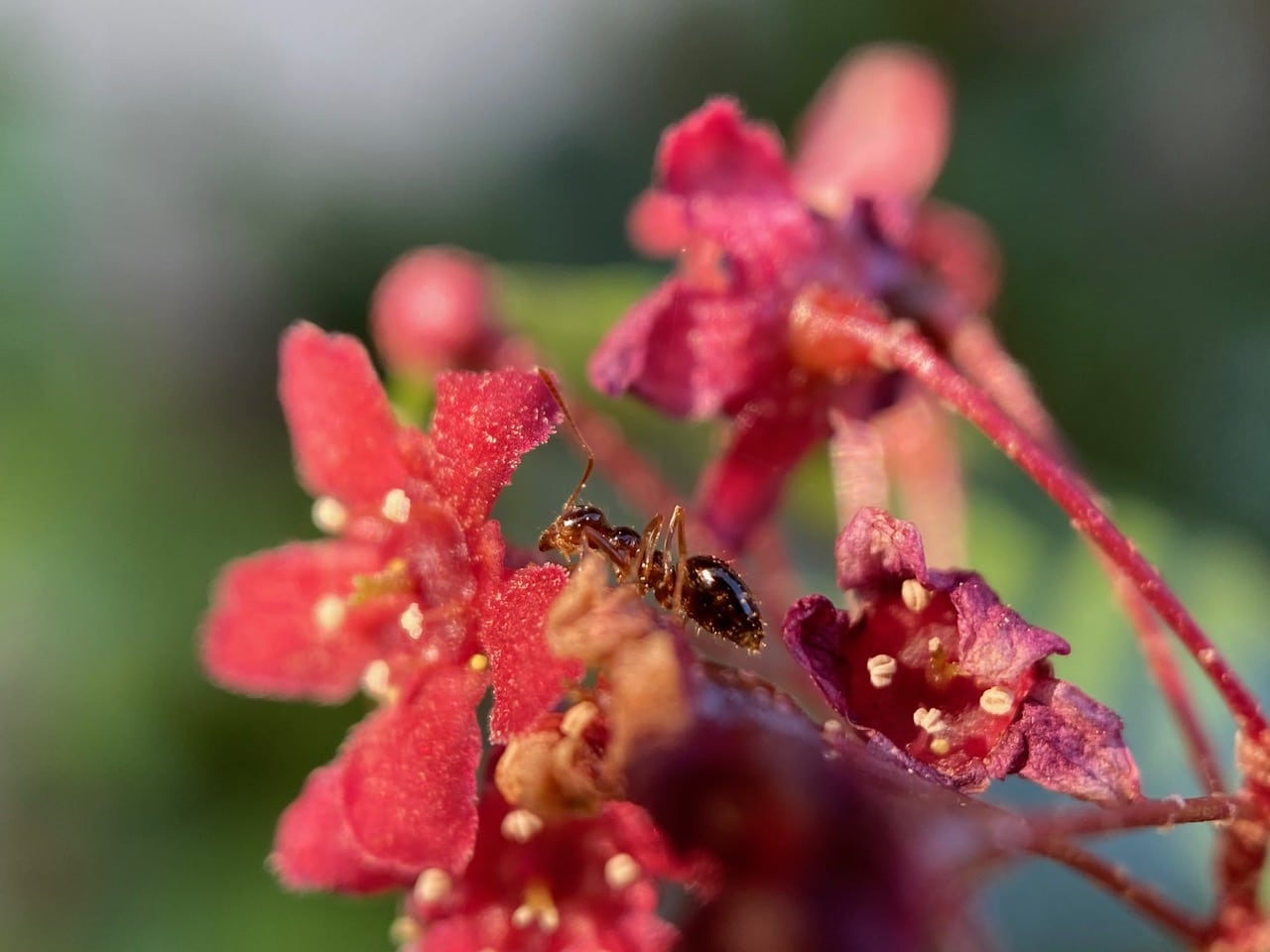
Are the American Winter Ants, active through the cold months, responsible for pollinating the early blooming Evergreen Currant? They seem to be a good match.
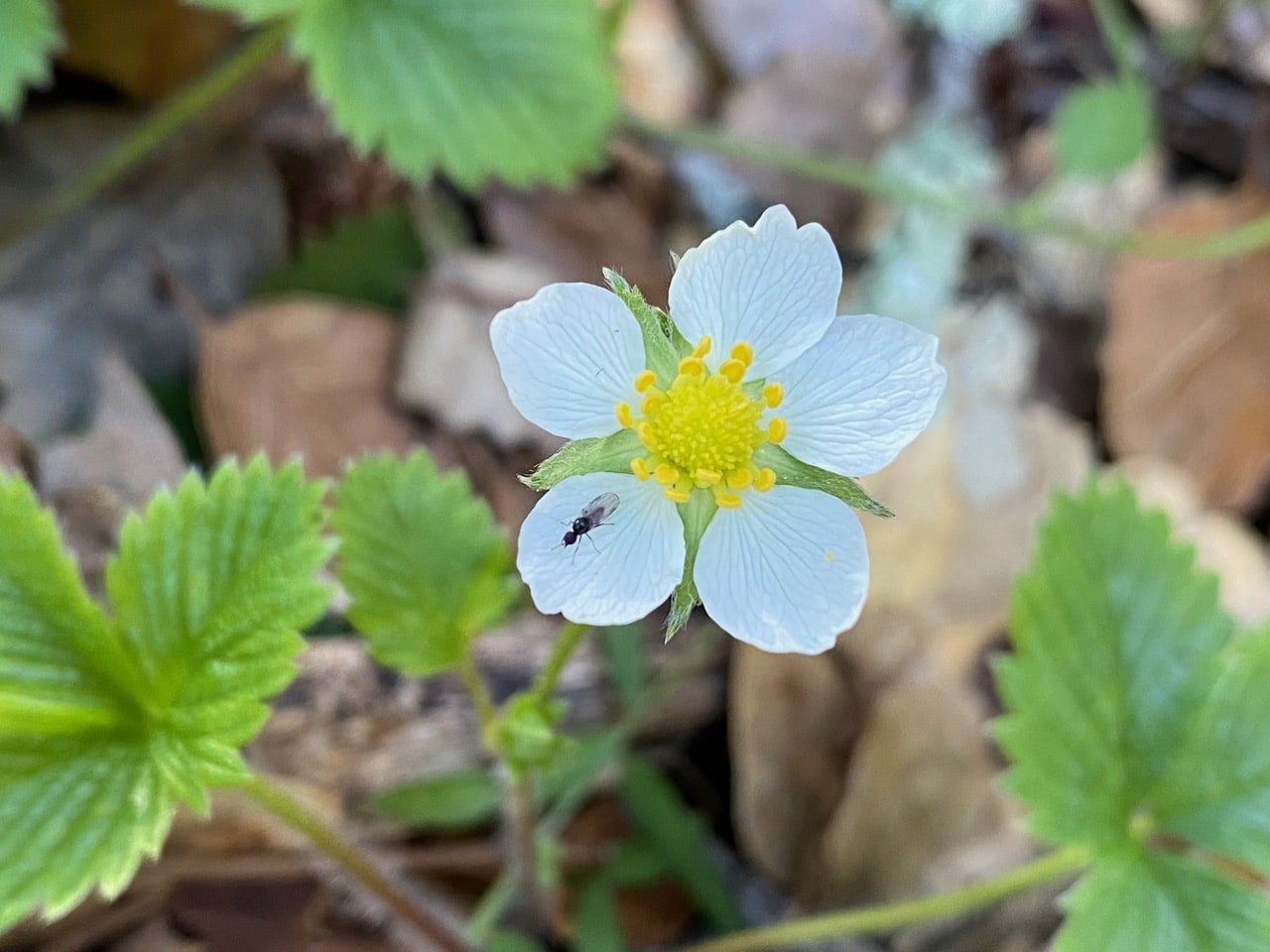
Ooh, there’s a tiny insect on the Wood Strawberry, Fragaria vesca.

Close-up of the Hybotid Dance Fly, Anthalia sp. (family Hybotidae) on the strawberry flower. The profile shows a pronounced humped thorax, and globular head mostly made up of eyes. The short proboscis points forward.
The Hybotid Dance Flies belong to the superfamily Empidoidea and were formerly included in the Empididae as a subfamily. Empididae generally have a thick beak pointing down, while Hybotidae have a thinner beak, or a thick beak pointing forwards or diagonally. Some crucial wing venation further distinguishes the two families. Precious little is known about the life cycle and biology of Hybotids because they are not considered of economic consequence. I have observed that they mostly feed on nectar and pollen, and may be important pollinators for small wildflowers such as Miner’s Lettuce, Wild Geranium, California Saxifrage, Buttercups and False Lily of the Valley.
Why the name “dance fly”? This is derived from the mating swarms of males of many species. They gather in clouds over prominent objects, each individual seeming to bounce or “dance” in mid-air. Many other flies do this, notably midges, but the Empidids and the Hybotids got the moniker.
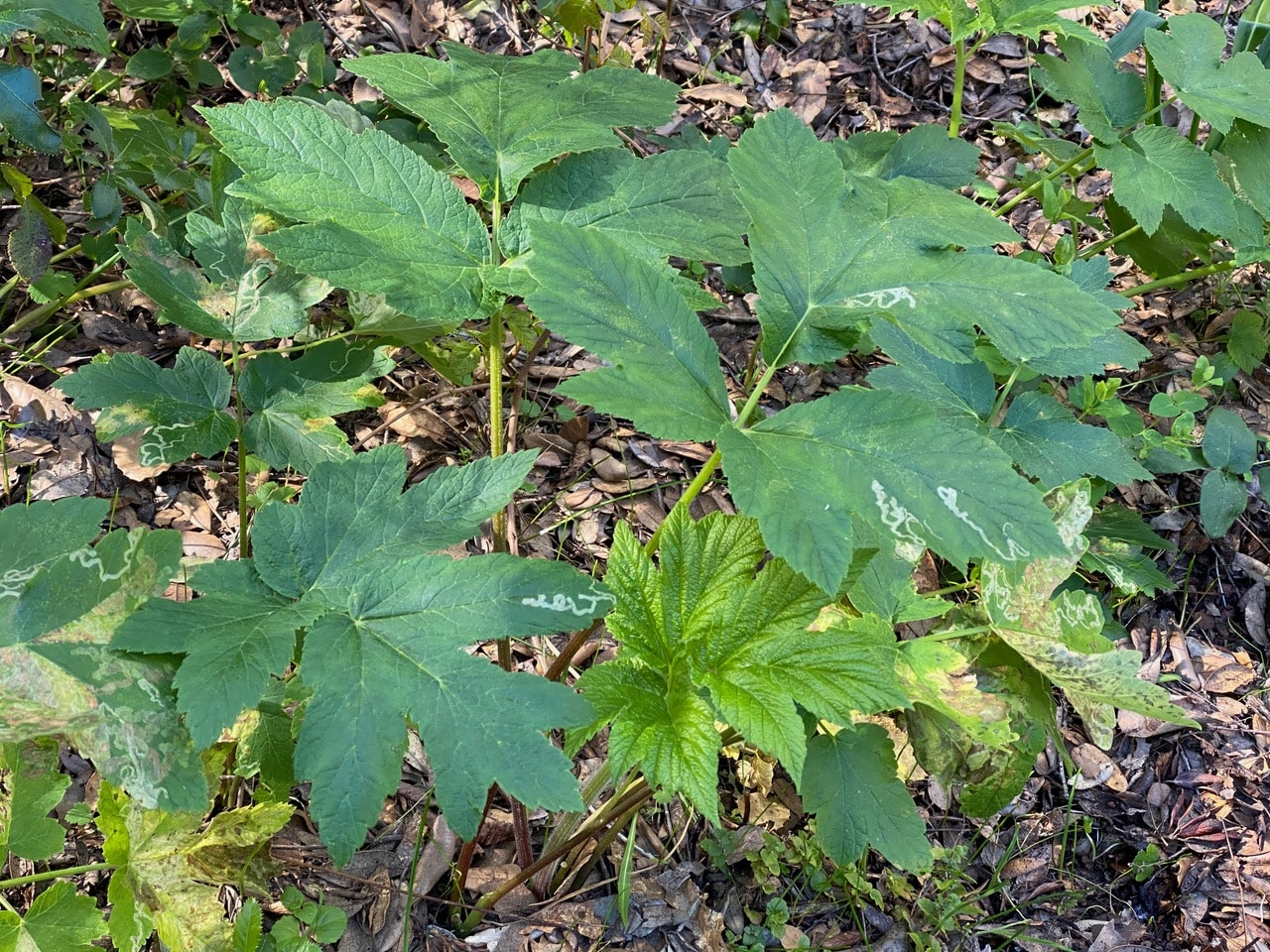
Leaf-miners have scribbled sinuous white lines on the leaves of this Cow Parsnip, Heracleum maximum.

Close-up of the Cow Parsnip leaf mines. It is made by the larva of a Leafminer Fly, Phytomyza sp. (family Agromyzidae). One can tell the tunneling history of the larva – as it grows, its tunnel gets bigger. Can you tell where the egg hatched and the tunneling and feeding began? Some species pupate in the leaf, while others exit to pupate in the soil.
The Agromyzidae are a family commonly referred to as the Leaf-miner Flies, for the feeding habits of their larvae, most of which are leaf miners on various plants. They are small flies, most species in the range of 2-3 mm. Agromyzidae larvae are phytophagous, feeding as leaf miners, less frequently as stem miners or stem borers. A few live on developing seeds, or produce galls. There is a high degree of host specificity. A number of species attack plants of agricultural or ornamental value, so are considered pests. The shape of the mine is often characteristic of the species and therefore useful for identification. Adults occur in a variety of habitats, depending on the larval host plants.
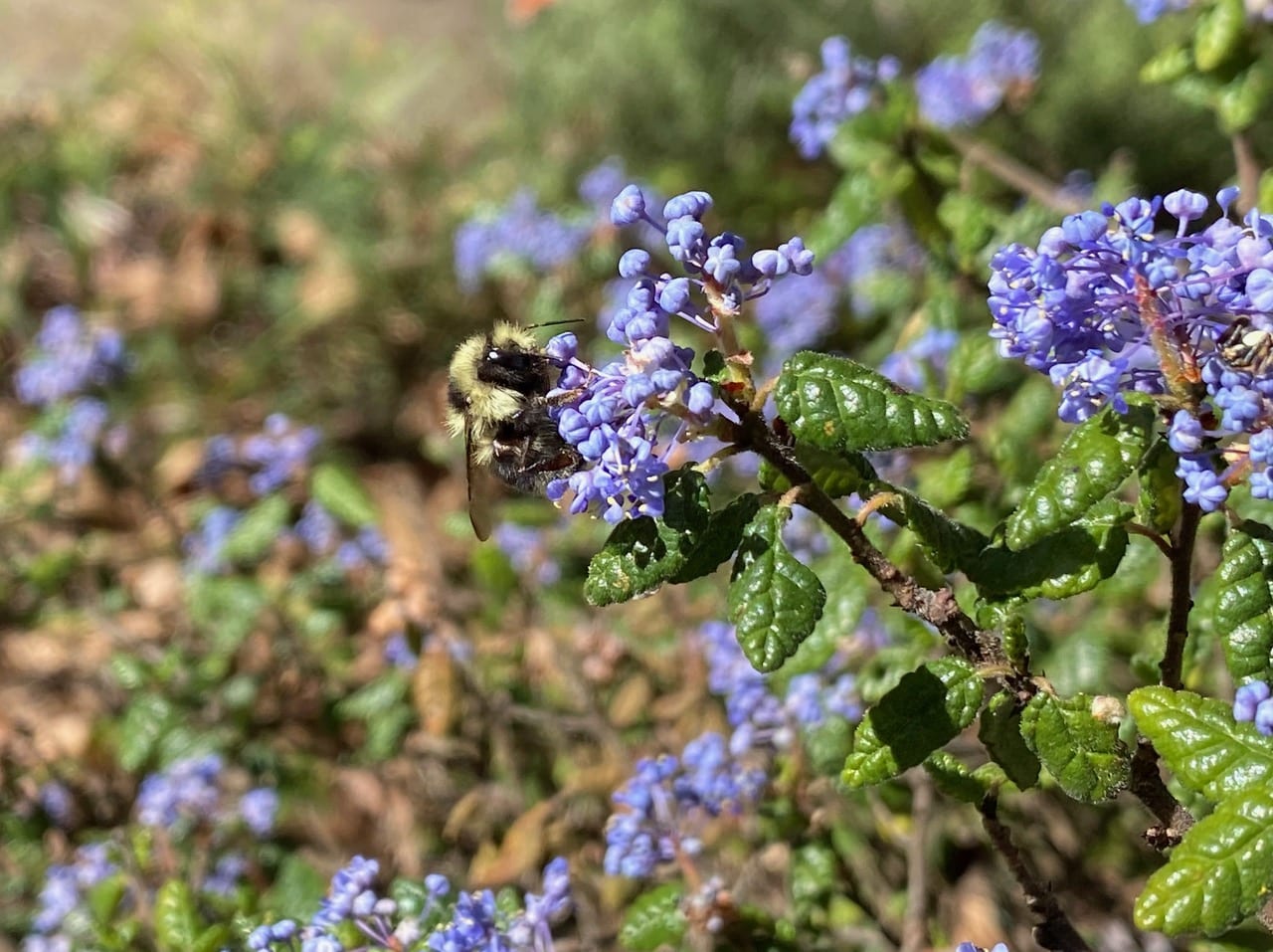
The La Cuesta Ceanothus, Ceanothus foliosus var. medius has started to bloom, attracting quite a few bees. This Black-tailed Bumble Bee, Bombus melanopygus (family Apidae) is taking nectar from the flowers.
Bombus melanopygus is a species of bumble bee native to western North America, widely distributed from the Pacific to the Rocky Mountains, and from Alaska to Baja California. The species is found in various habitats, including agricultural and urban areas. The bees feed on many types of plants, including manzanitas, Ceanothus, golden bushes, wild buckwheats, lupines, penstemons, rhododendrons, willows, sages, and clovers. They nest underground or aboveground in structures.
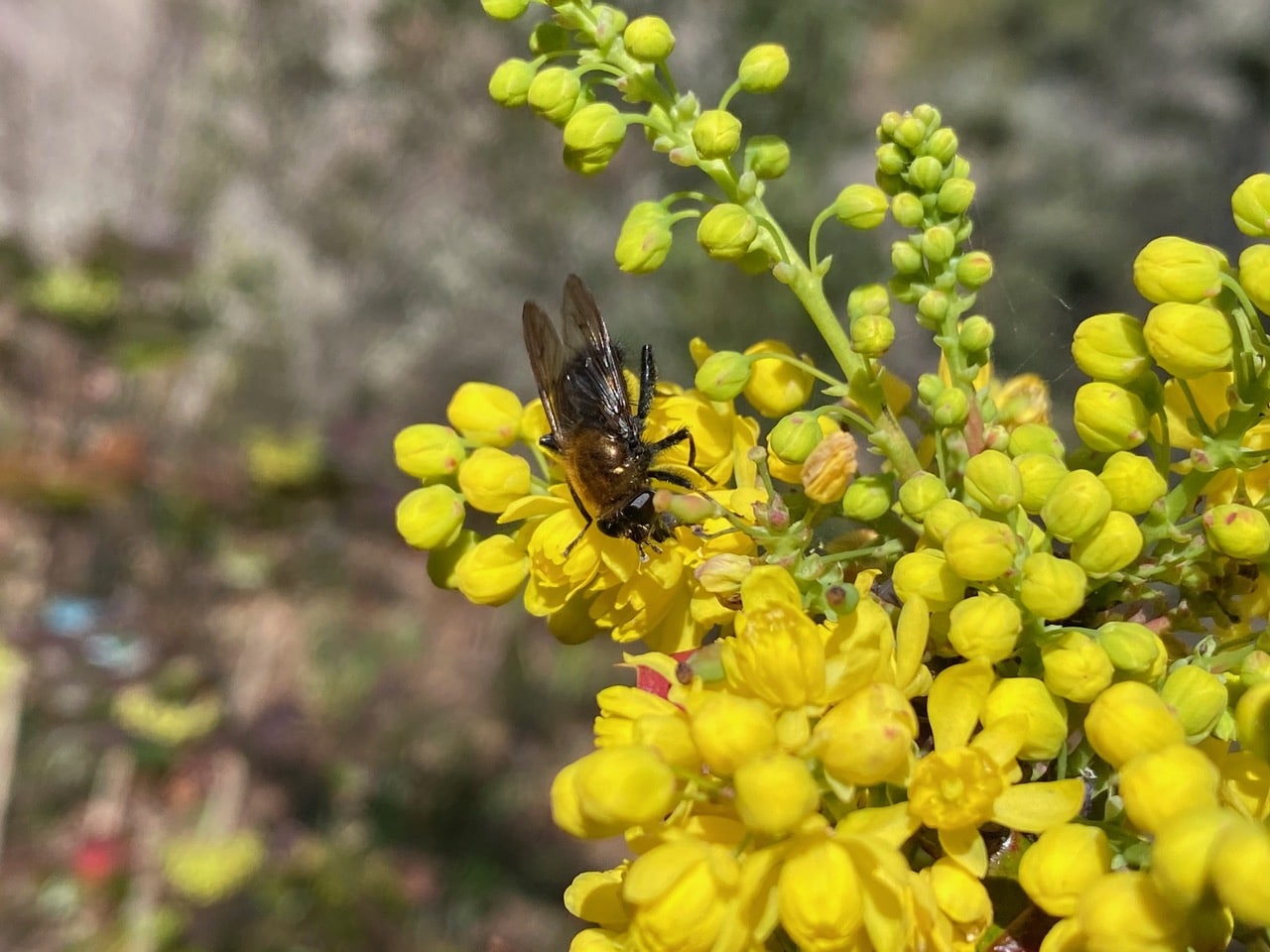
A Bumblebee Catkin Fly, Brachypalpus alopex (family Syrphidae) is foraging on a cluster of Oregon Grape flowers, Berberis aquifolium. Unusual for a hover fly, it holds its dark, smokey wings parallel to each other over the abdomen. Most Syrphids hold their wings at an angle to the body, fighter-jet style.
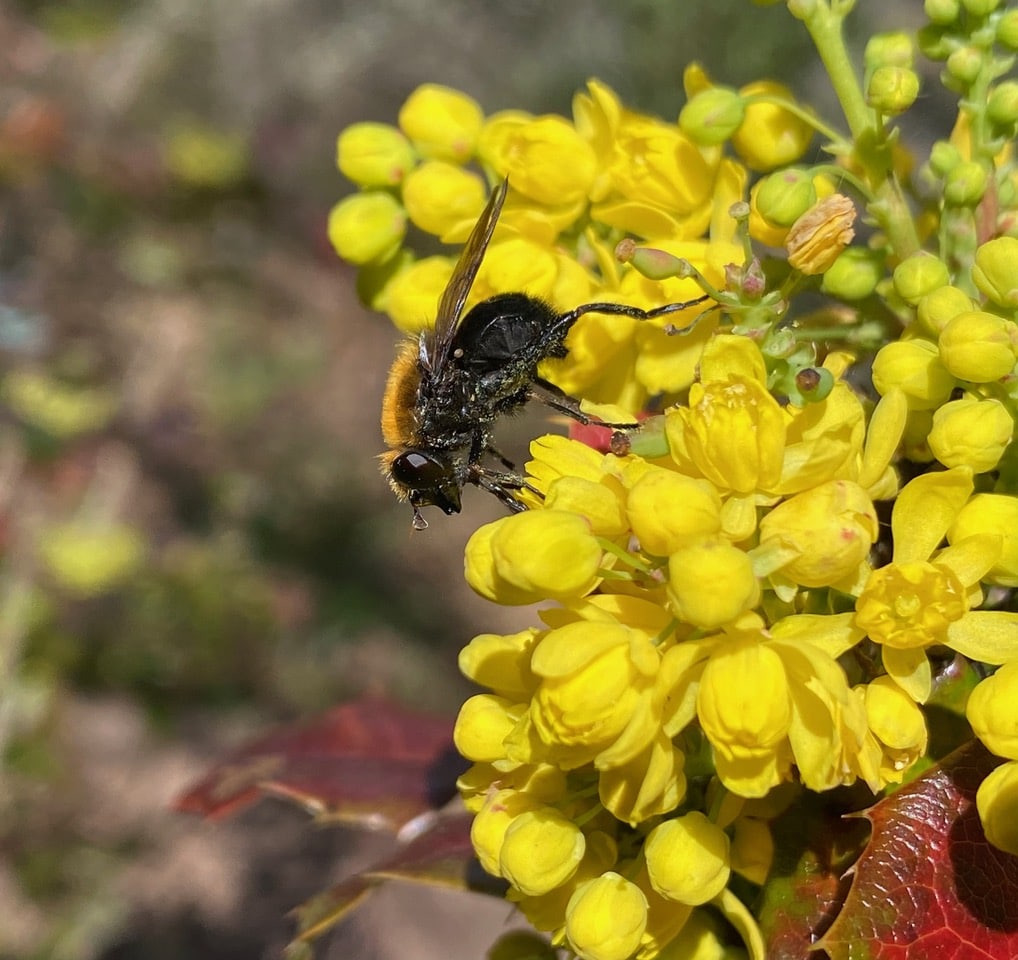
The fly is robustly built, like bumble bees. It has a black, fuzzy abdomen and black legs. Its bronze thorax is covered with a thin layer of short, rust-colored hairs.

The Bumblebee Catkin Fly, Brachypalpus alopex is an uncommon species of hoverfly. Hoverflies get their names from the ability to remain motionless while in flight. They are often found around and on flowers, feeding on nectar and/or pollen. The larvae of the Bumblebee Catkin Fly are of the rat-tailed type, feeding on decaying sap under tree bark. Rat-tailed maggots are so named for having a long tail-like siphon on their abdomen that helps them breathe in liquid or semi-liquid environment.
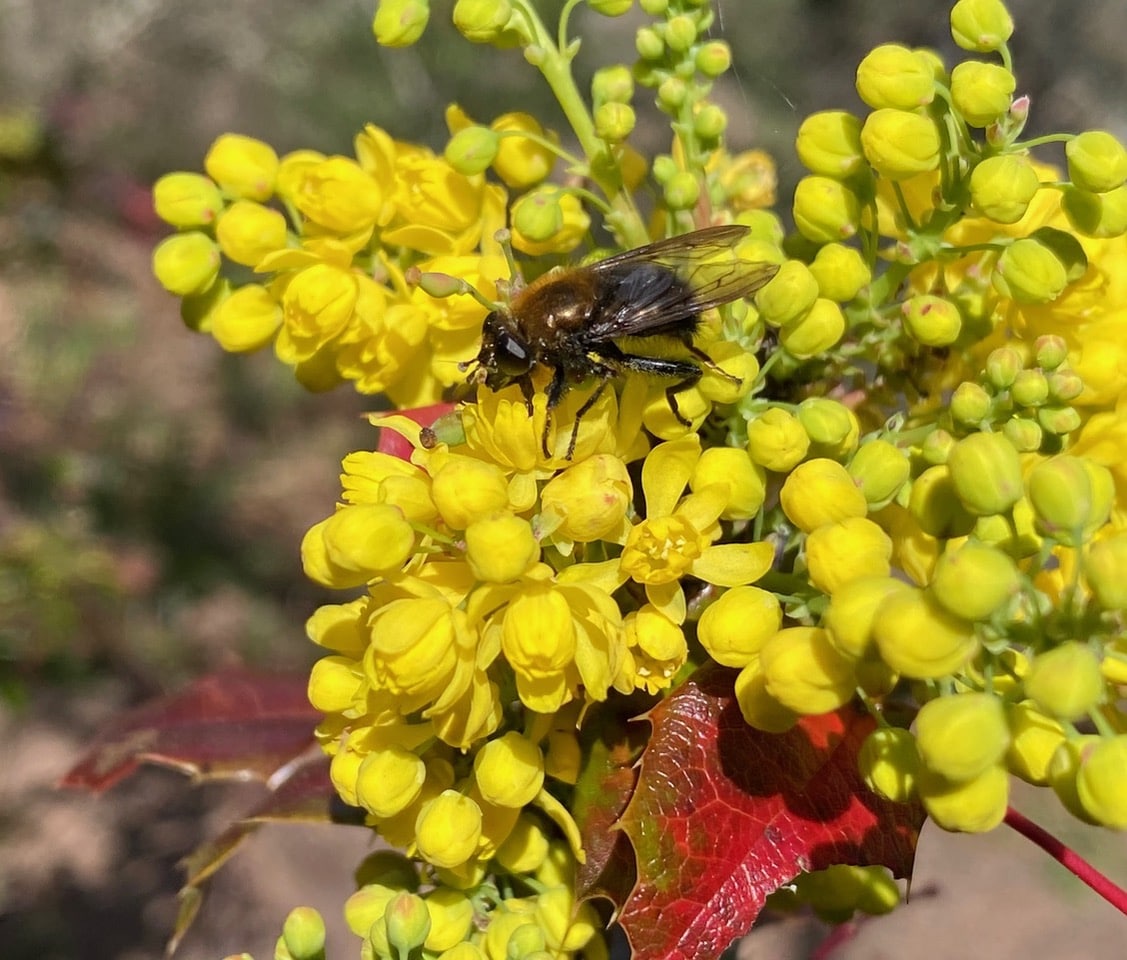
It is so hard to make out the details of the fly against this riot of colors!

In dappled shade, a Honey Bee is foraging on an inflorescence of Oregon grape flowers.
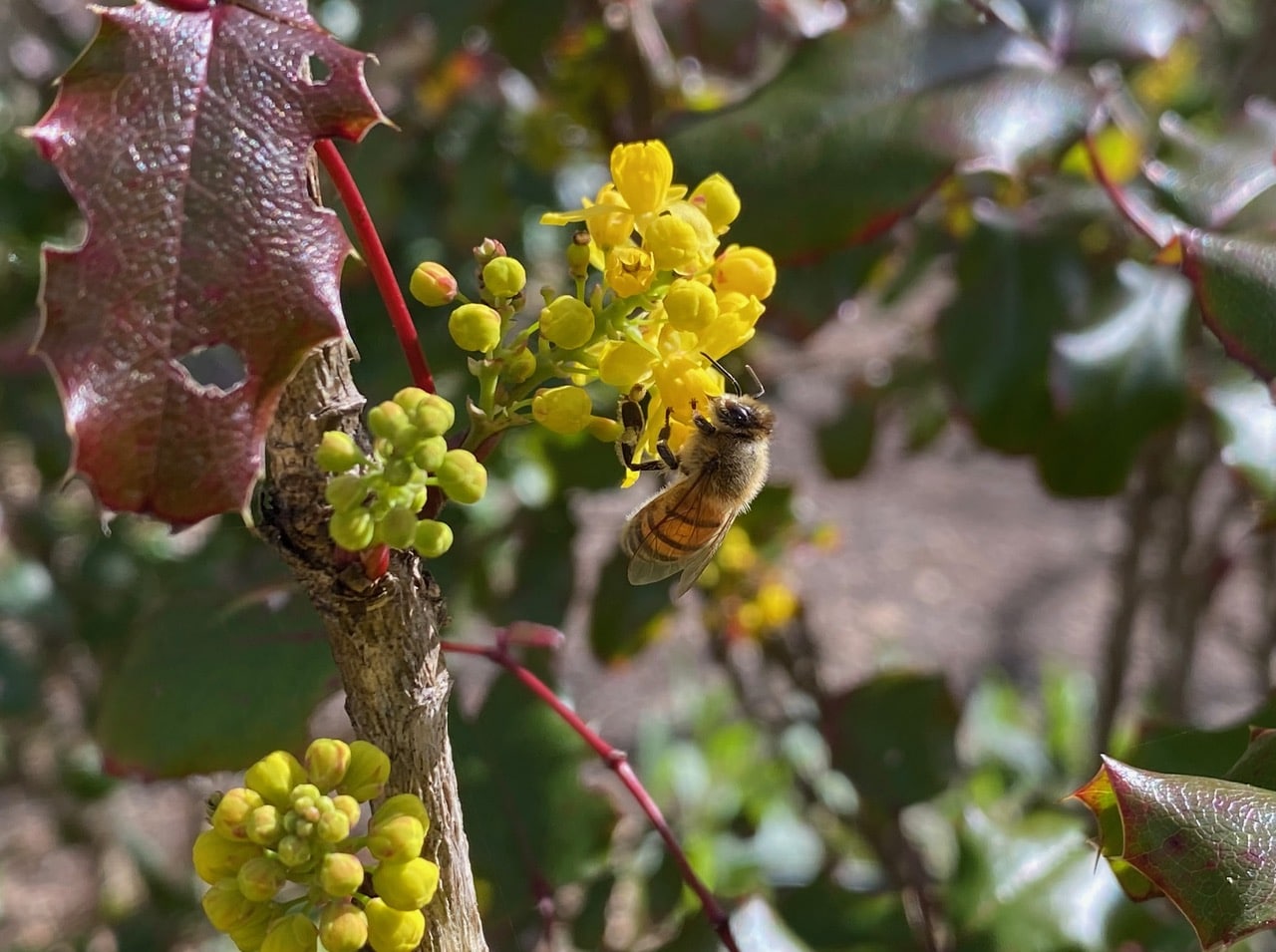
Watching honey bees forage, I am reminded of a fellow docent at the Oakland Museum Natural Sciences Gallery many years ago. Bud, a retired entomologist, taught me that every honey bee worker out foraging should be treated with respect – they are all little old ladies. Bud was absolutely correct. All Honey Bee foragers are female, and they are the oldest of their hive mates. How do honey bees get their job assignments within their social organization?
“A bee’s job is, first of all, determined by its sex. Male bees, or drones, don’t do any work. Making up roughly 10% of the colony’s population, they spend their whole lives eating honey and waiting for the opportunity to mate with the queen. The queen mates with up to 20 drones and will store their sperm in her spermatheca for the rest of her life. That’s where male duties end. Female bees, known as worker bees, make up the vast majority of a hive’s population, and they do all the work to keep it functioning. Females are responsible for the construction, maintenance, and proliferation of the nest and the colony. When a worker bee emerges as an adult, she immediately starts cleaning the cell from which she hatched. Her first 3 days are spent cleaning cells to prepare them for the queen’s next round of eggs. Then her hormones kick in to initiate the next phase of work: nursing the young. The worker bee spends about a week nursing the brood, feeding larvae with royal jelly. Next, the worker bee enters the third phase, as a sort of utility worker, moving farther away from the nest’s center. Here she builds cells and stores food in the edge of the nest for about a week. A worker’s hormone shifts into the final phase of work at around 41st day: foraging. This work is the most dangerous and arguably the most important. It’s only done by older bees who are closer to death. As the worker bee approaches her fourth week of nonstop work, she senses her end of days, and removes herself from the hive, so as not the become a burden to the colony. If she dies in the hive, her hive mates would have to remove her corpse. Thus is the life of a female honey bee during the active seasons of spring and summer, compulsively working from the day she’s born until the day she expires.” – excerpt from an article in National Geographic by Richie Hertzberg.
So, don’t forget to tip your hat to the “little old ladies” you see in the garden!
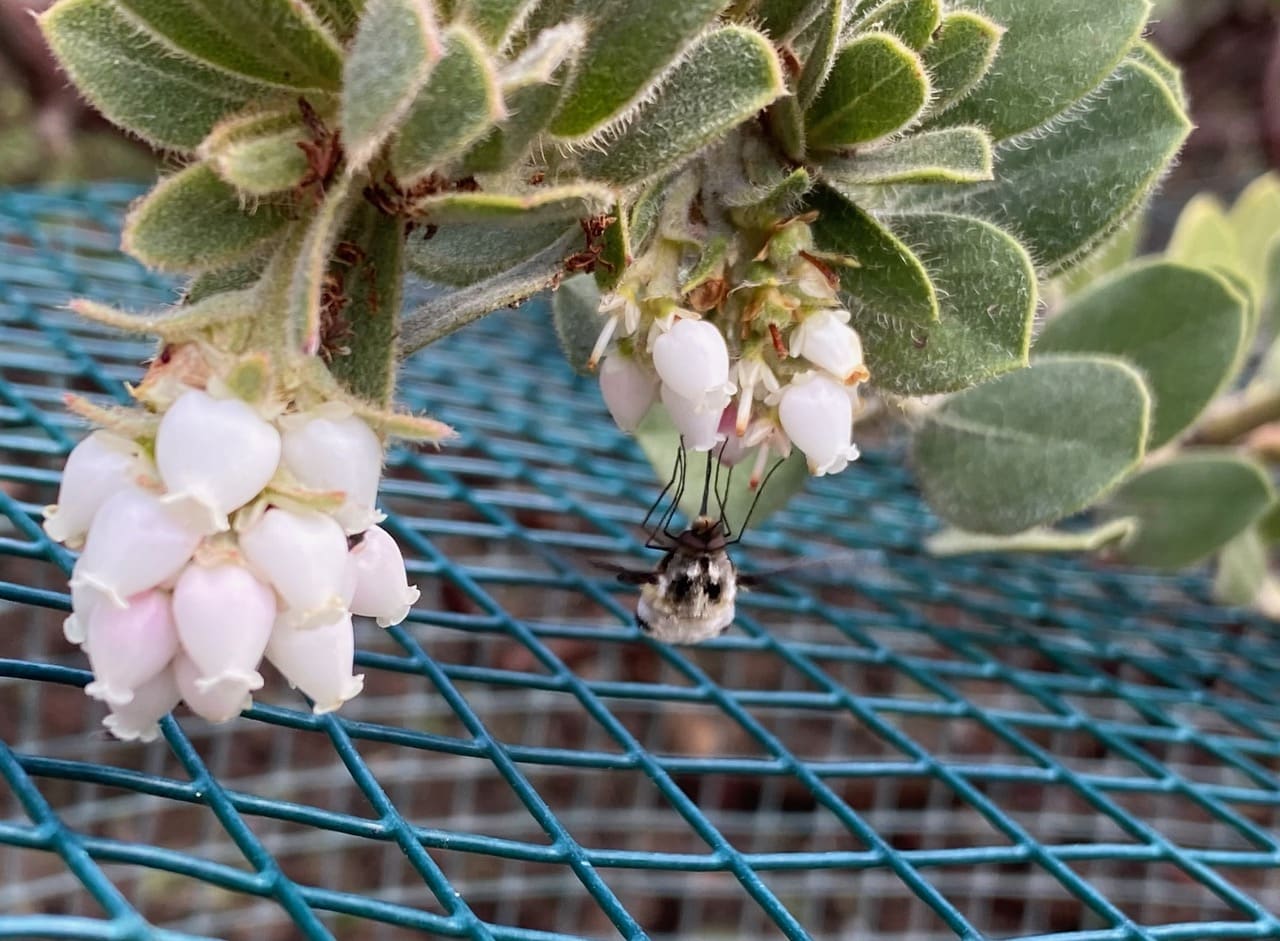
The Greater Bee Flies have become more common on the manzanita shrubs now. Sometimes it is hard to tell if it’s a bumble bee, a digger bee, or a Greater Bee Fly that is zipping around. They are all about the same size and rather fast flyers. But the way the bee fly feeds is quite different from the bees. It has a long, non-retractable proboscis that it inserts into the corolla while still hovering to stay in place. Sometimes it steadies itself by landing lightly with its long, skinny legs.
Bombylius major, commonly known as the Greater Bee Fly is a parasitic bee mimic fly in the family Bombyliidae. It derives its name from its close resemblance to bumble bees. Its flight is quite distinctive – hovering in place to feed, and darting between locations. The species has long skinny legs and a long rigid proboscis held in front of the head. Bombylius major is easily distinguished from the other local species of Bombylius for having wings with dark leading edge, hyaline trailing edge with sharp dividing border. This feature is visible even as the fly is hovering. Adults visit flowers for nectar (and sometimes pollen) from a wide variety of plant families, excelling at small tubular flowers, and are considered good generalist pollinators. Often the pollen is transferred between flowers on the fly’s proboscis.
The bee fly larvae, however, have a sinister side. They are parasitoids of ground-nesting bees and wasps, including the brood of digger bees in the family Andrenidae. Egg deposition takes place by the female hovering above the entrance of a host nest, and throwing down her eggs using a flicking movement. The larvae then make their way into the host nest or attach themselves to the bees to be carried into the nest. There the fly larvae feed on the food provisions, as well as the young solitary bees.
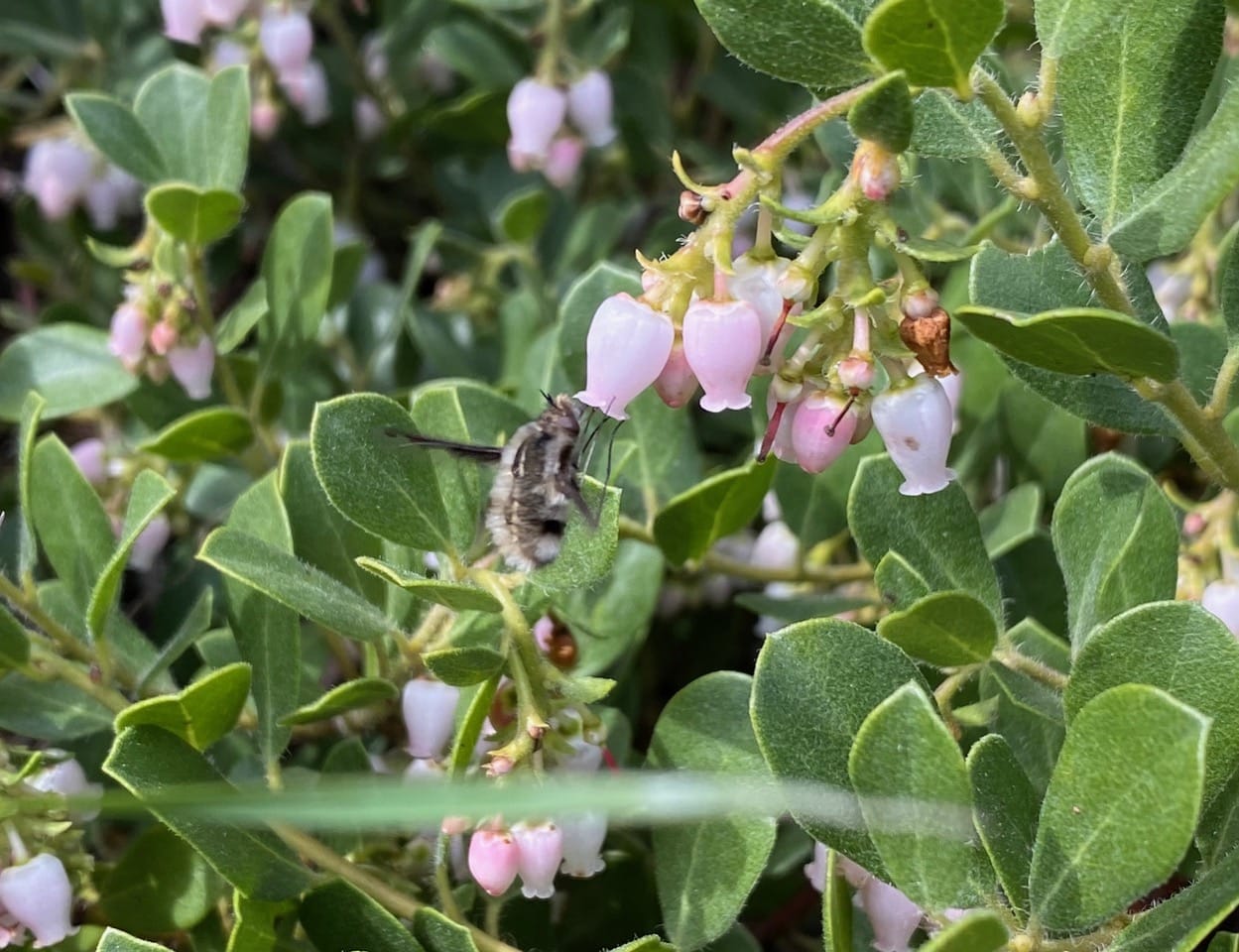
It is hard to get a clear photo of the bee fly while it is hovering in front of the flower. I switch to the video mode instead.