

Pollinator Post 3/22/25 (1)

I take a walk at Crab Cove, Alameda this late morning.
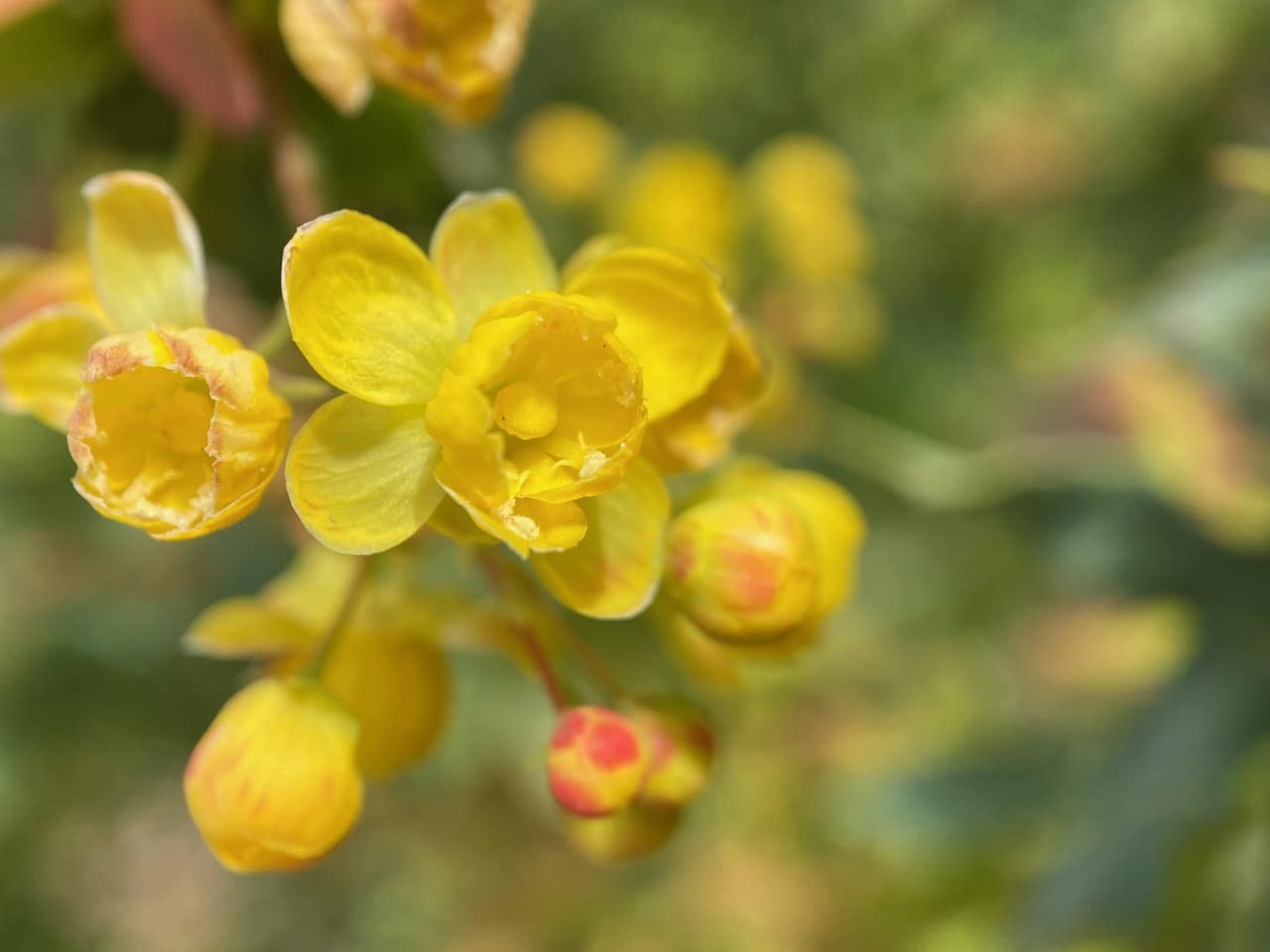
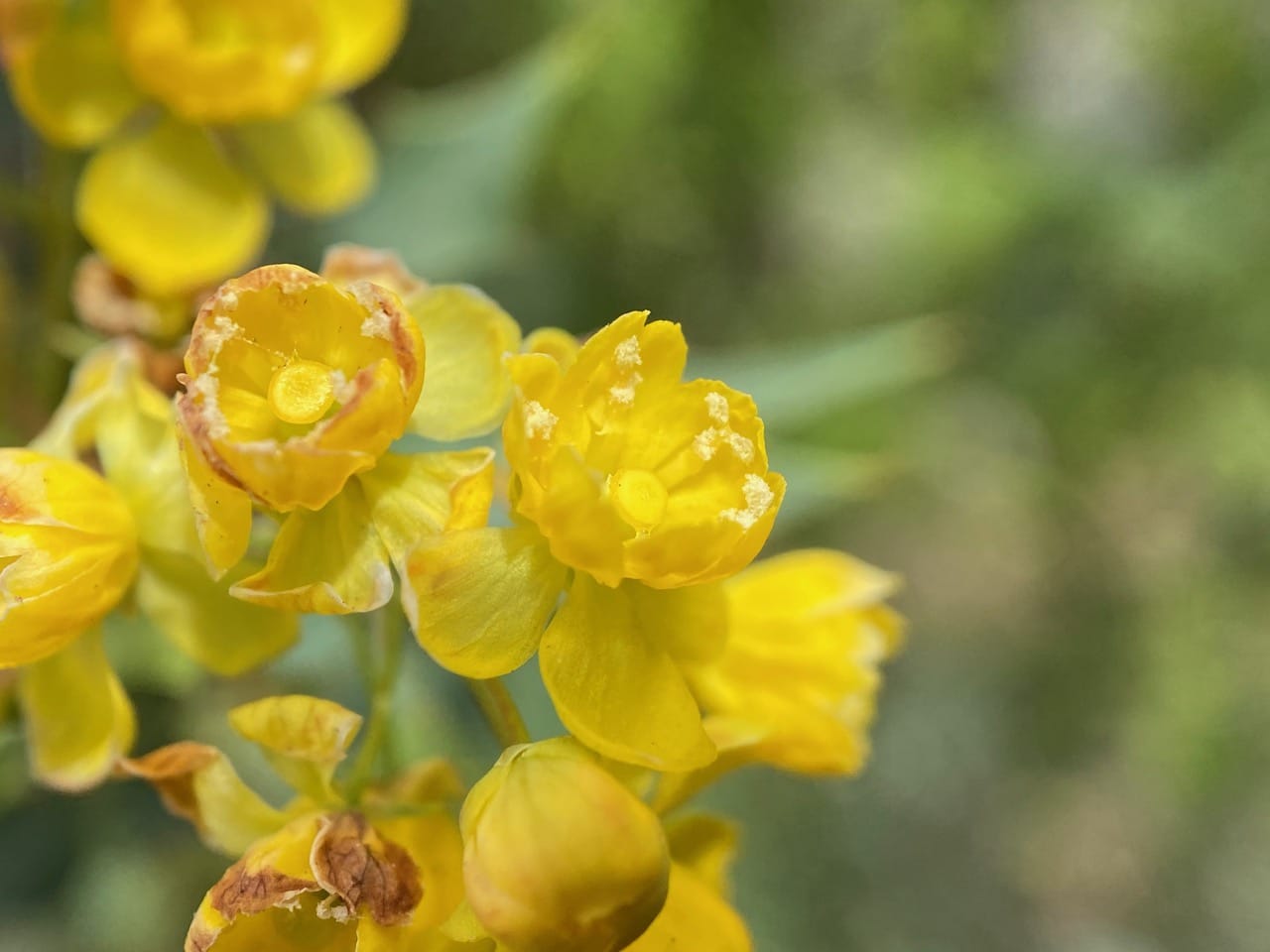
At the back of the visitor center, next to the parking lot is a small stand of Oregon Grape, Berberis aquifolium. It is in peak bloom now, but surprisingly there’s little insect action.
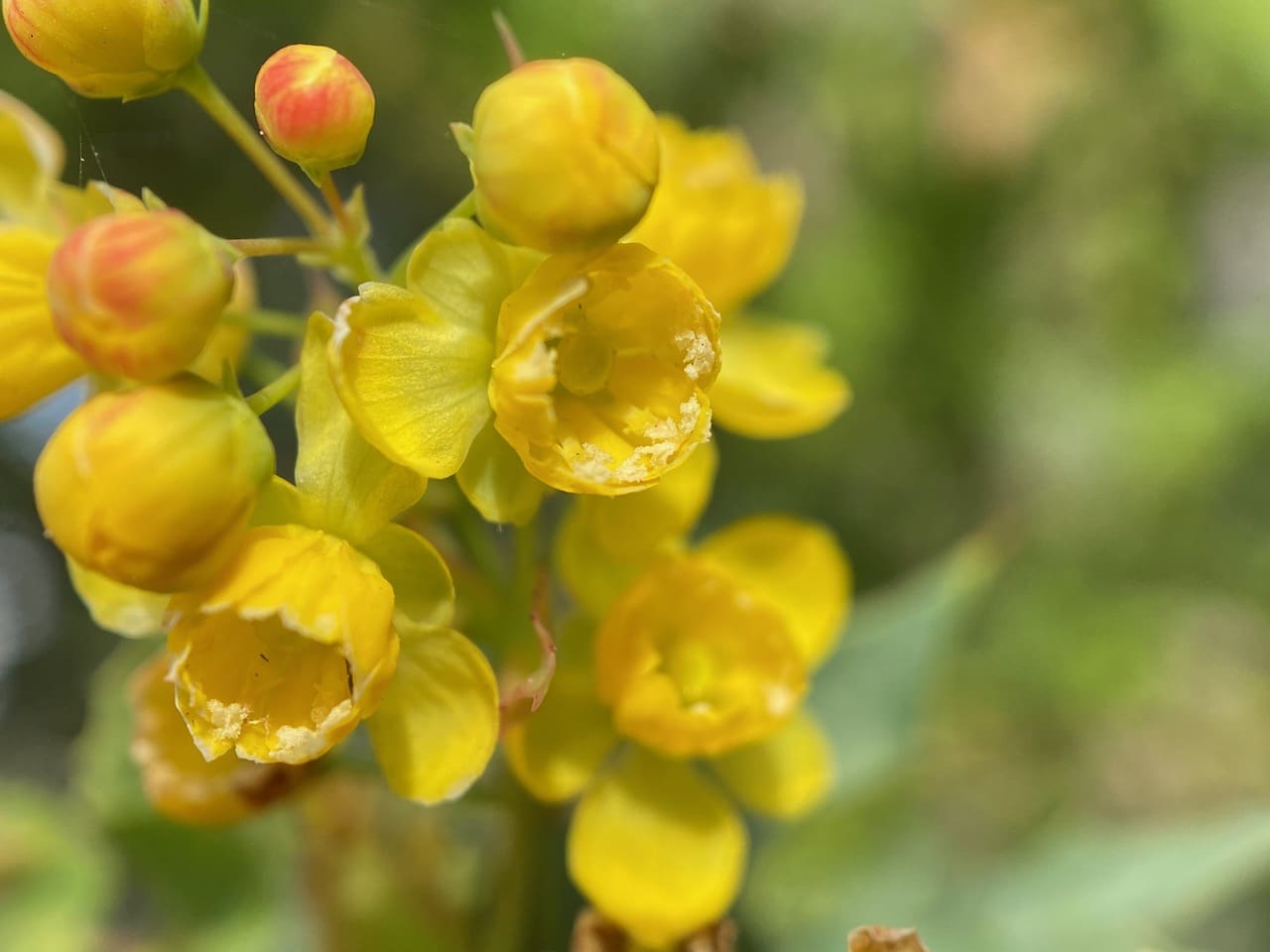
Oregon Grape or holly-leaved barberry, Berberis aquifolium (family Berberidaceae), is an evergreen shrub growing up to 10 feet tall, with pinnate leaves consisting of spiny leaflets. Woody-stemmed and spreading by rhizomes, the new growth in the spring emerges in a light green to soft coppery-red color; at the other end of the year the foliage responds to colder weather by taking on shades of bright red to burgundy, brightening up the winter landscape. In early spring, the plant is topped with sprays of small, tightly clustered bright yellow fragrant flowers in a long-blooming display that attract bees and other pollinators. Following the bloom are clusters of dusky blue, round to oblong berries that are the “grapes” that give the plant its common name.
Oregon Grape


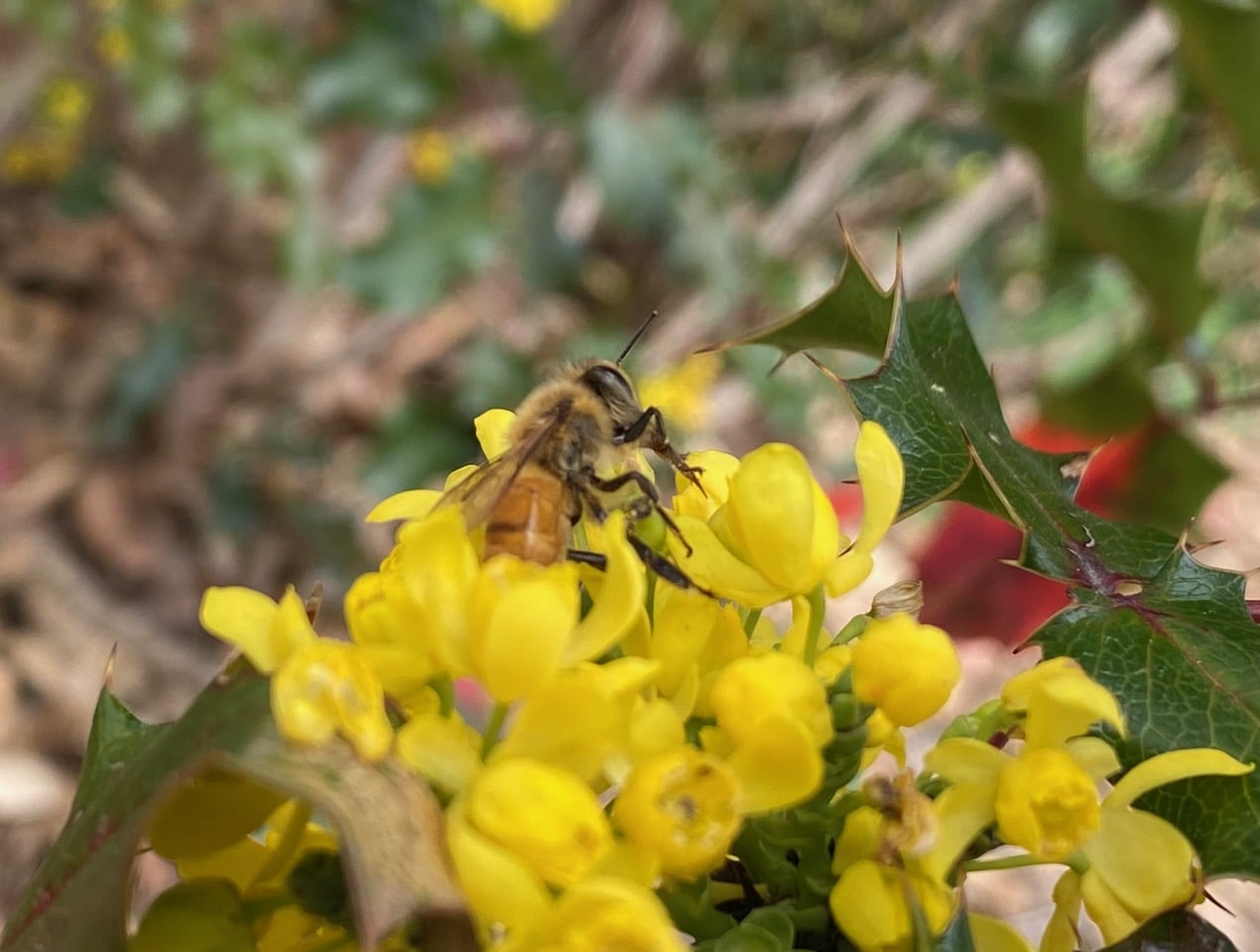





A Honey Bee, Apis mellifera (family Apidae) arrives to take nectar from the flowers.
Suddenly the bee grasps its tongue as it is lifted out of the flower.
The bee goes into a frenzy trying to wipe something off its tongue with its front legs.
The bee recovers its composure and continues to forage on the Oregon Grape flowers. What just happened there?
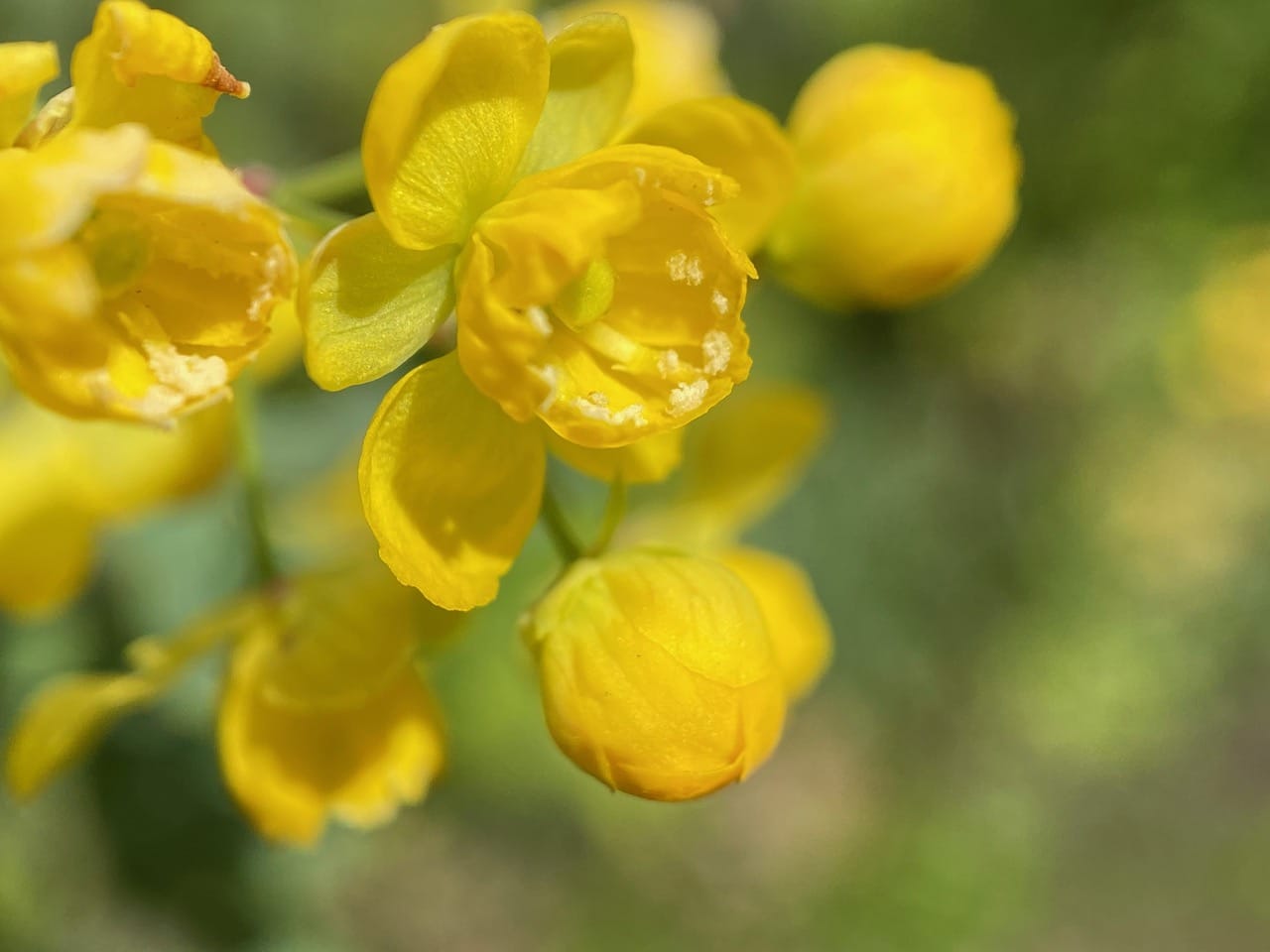
Oregon Grape flowers are borne in terminal clusters or spreading racemes. The fragrant, bright yellow flowers bloom in late winter or early spring. The 6 petals are enclosed by 6 sepals which are similar to the petals in appearance. The flower contains 6 stamens, which are opposite the petals. Each of the six stamens terminates in two spreading branches. The filaments of Berberis aquifolium are notable for having a distal pair of recurved teeth.
The stamens of Berberis flowers are known for their tactile sensitivity, also called seismonasty, where upon contact, the filaments spring forward, potentially depositing pollen onto an insect’s tongue or face, aiding in pollination. When an insect probes the flower for nectar, its tongue or other part of its body may touch the base of the stamen filaments. This causes the filaments to rapidly spring forward, bringing the pollen-bearing anthers into contact with the insect. Besides enhancing pollination, the snapping mechanism is also thought to help the flower conserve its resources. By scaring the insect away the flower reduces the costs of insects lingering too long and exhausting the nectar supply.
Another remarkable feature of the Berberis flower is that the pollen is sticky, held together by viscin threads. Viscin threads are sticky, filamentous structures that are found on the surface of pollen grains in certain plant families. These threads play a crucial role in pollination by making the pollen grains sticky and thus facilitating their attachment to pollinator for transport to other flowers. The viscin threads, which are made of sporopollenin, the same material as the pollen grain’s outer layer, are like “ropes” that fasten pollen grains together, or to the hairs of insects or other pollinators.
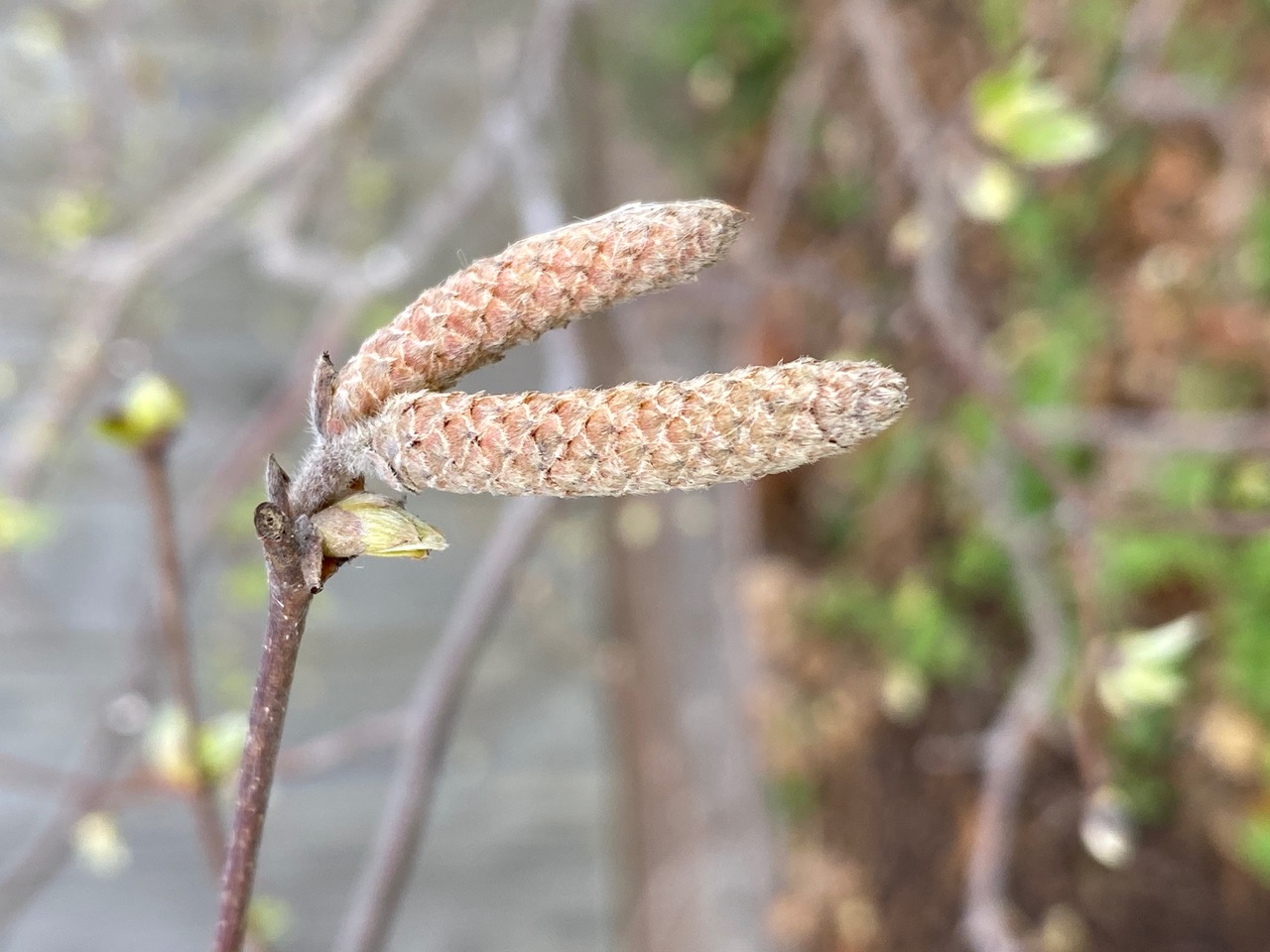
Growing in the native garden in the back of the visitor center is a compact Beaked Hazelnut, Corylus cornuta, only about 3 feet tall. A few male catkins are hanging from the tips of the bare branches.
The Hazelnut is monoecious, with separate male and female flowers borne on the same plant. The tree/shrub also exhibits dichogamy, with temporal separation of the male and female phases. The male flowers of Hazelnut show up before the female flowers, exhibiting protandry. As in many monoecious plants that are wind-pollinated, the flowers usually show up before the leaves emerge, increasing the odds that the wind will successfully transport the pollen grains from the dangling male flowers to a compatible female flower without leaf surfaces disrupting air flow and pollen delivery.
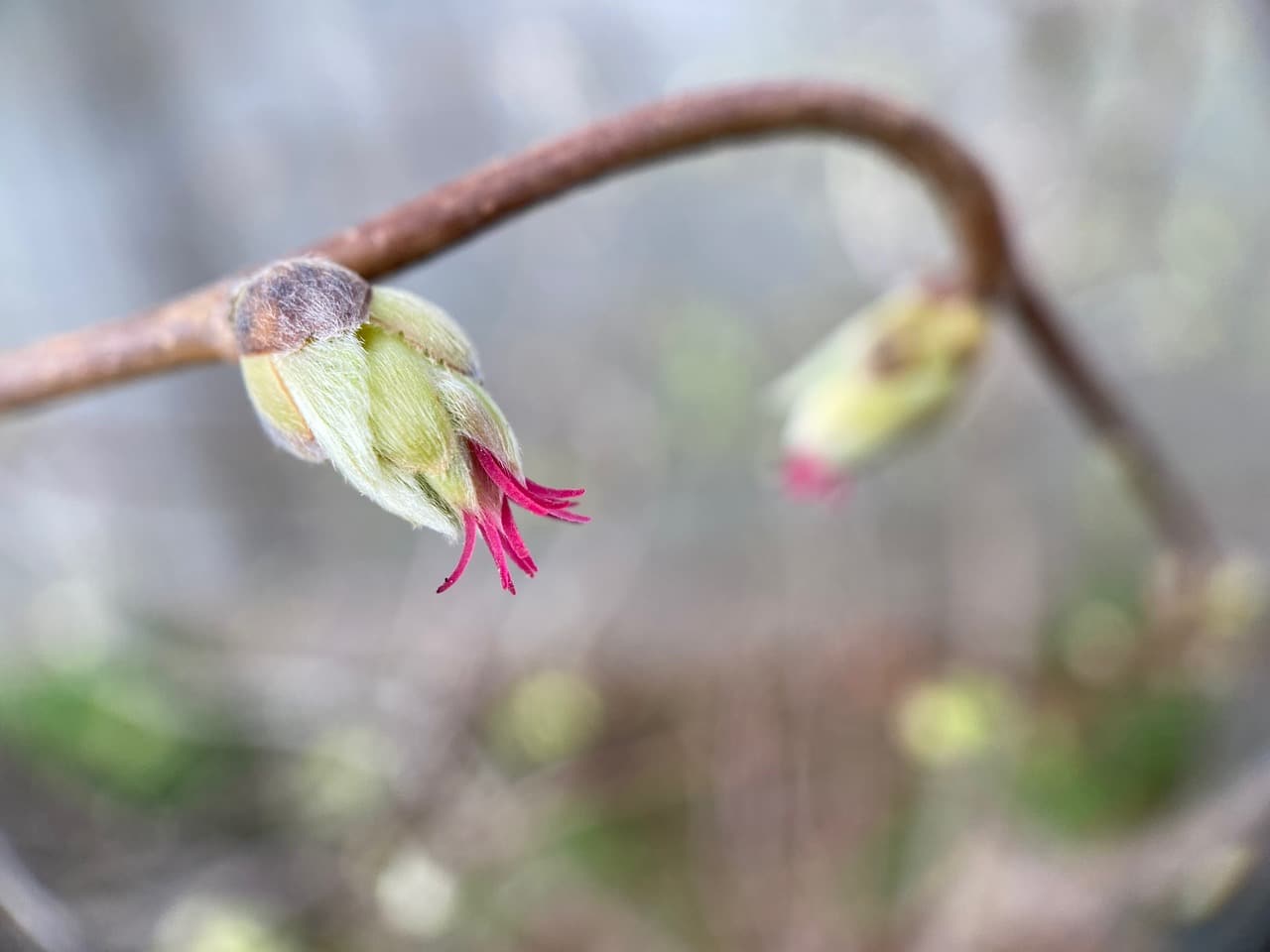
A few female flowers have started to bloom on the same plant.
The female flowers of the Beaked Hazelnut are inconspicuous, appearing as tiny, bud-like structures with a spray of red stigmas protruding from the center. They are found at the tips of the branches, often near the male catkins. After pollination, the female flowers will develop into the fruits/nuts in the fall. The nuts are enclosed in a husk with a tubular extension that resembles a beak, giving the plant its common name.
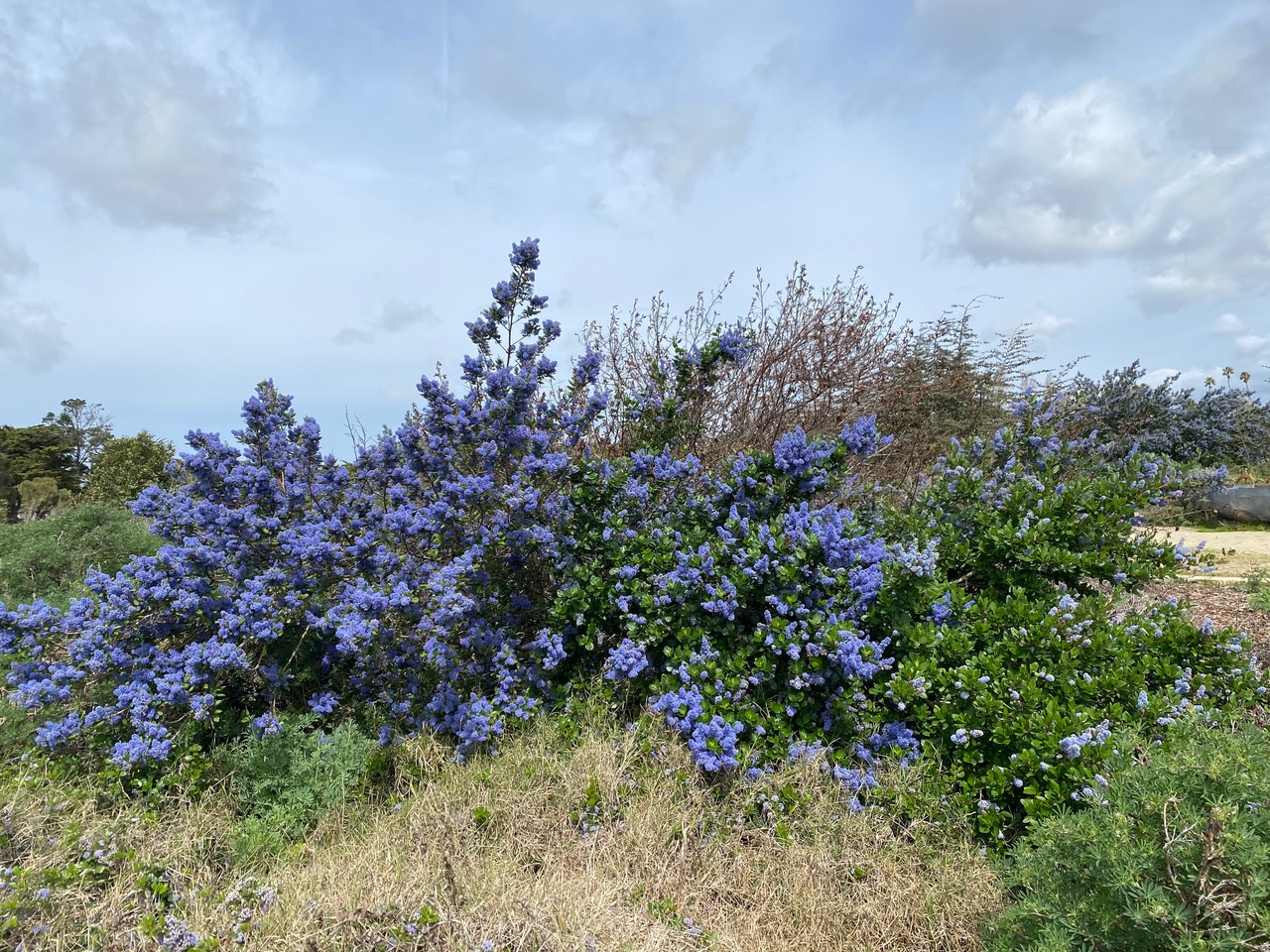
The native garden by the Bath House is a riot of blooming Ceanothus of various species. Some are tree-sized.
I especially love this prostrate Ceanothus that spills onto the footpath.
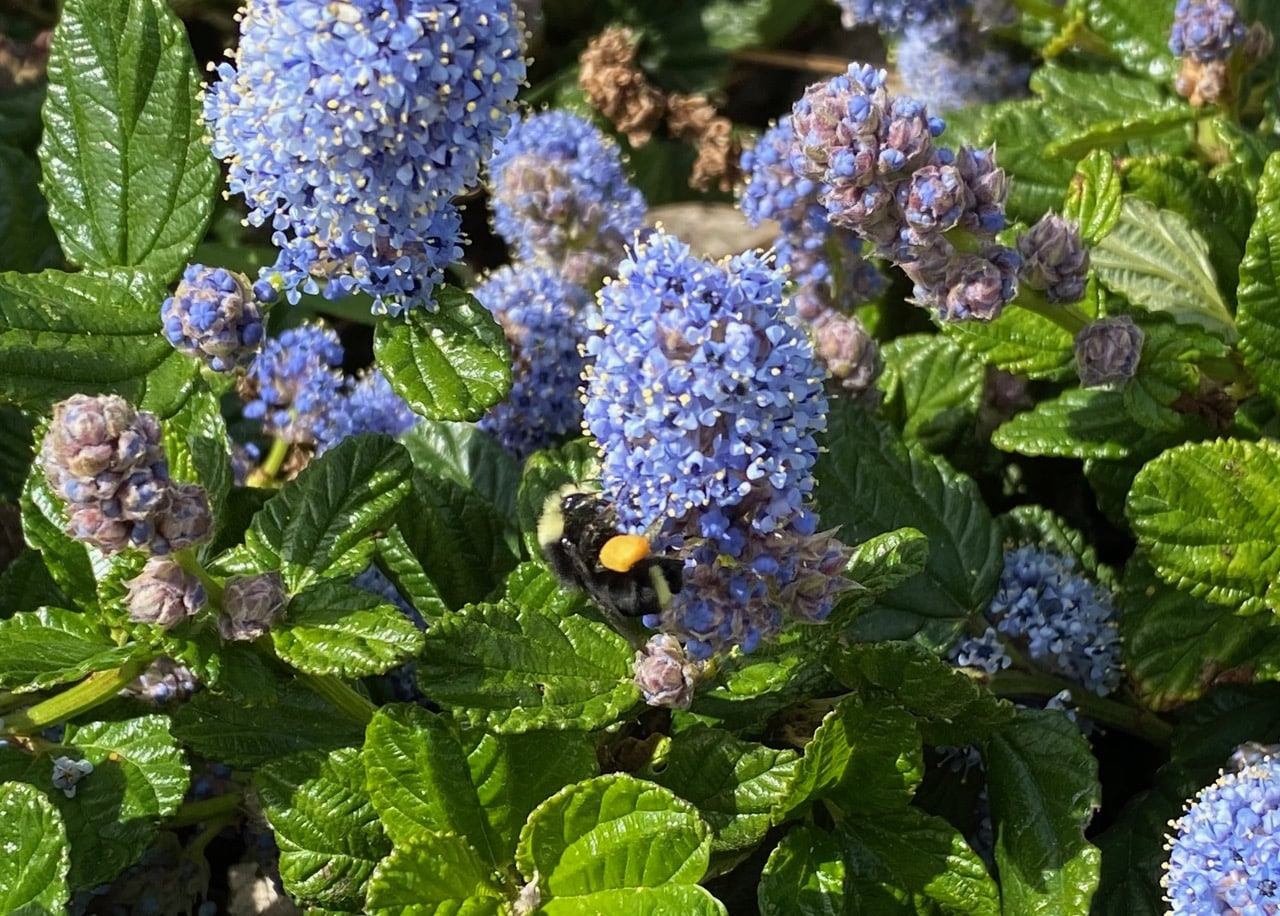
There is the usual cast of characters foraging on the Ceanothus flowers today. Most prevalent are the Honey Bees, Apis mellifera (family Apidae).
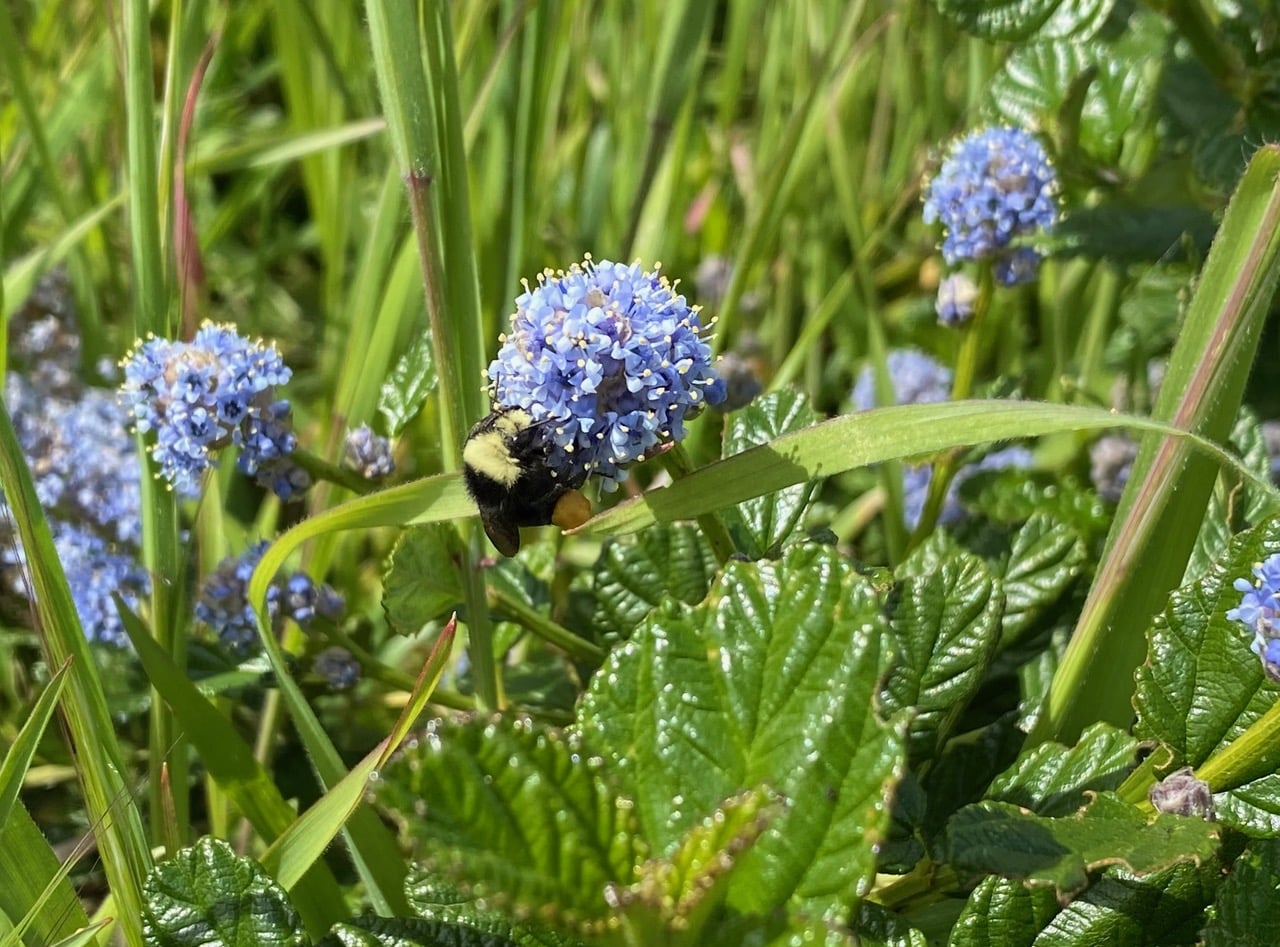
A Yellow-faced Bumble Bee, subgenus Pyrobombus (genus Bombus, family Apidae) with a huge pollen load is foraging on a cluster of Ceanothus flowers.
Another Yellow-faced Bumble Bee.
Such happy bees!
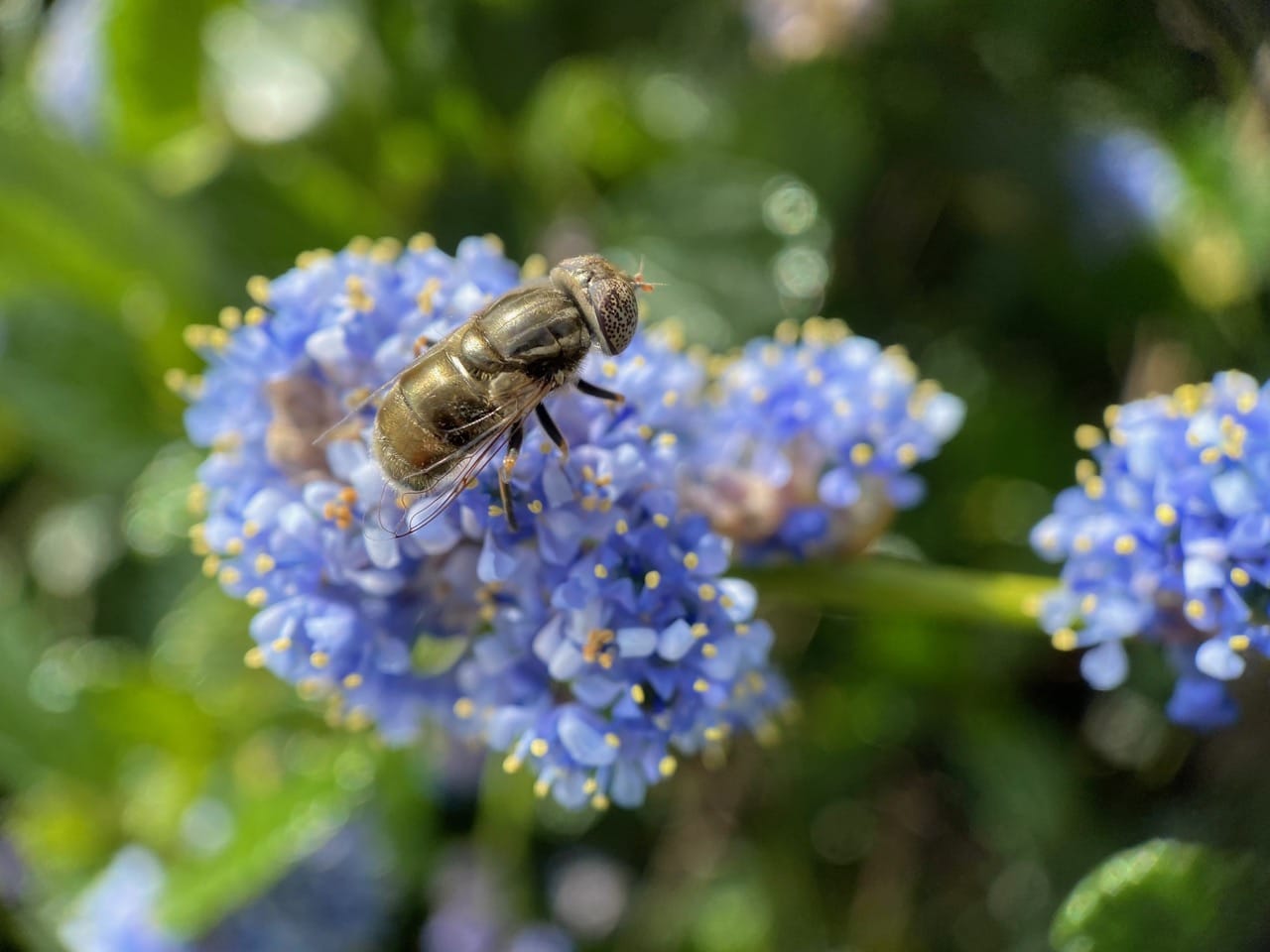
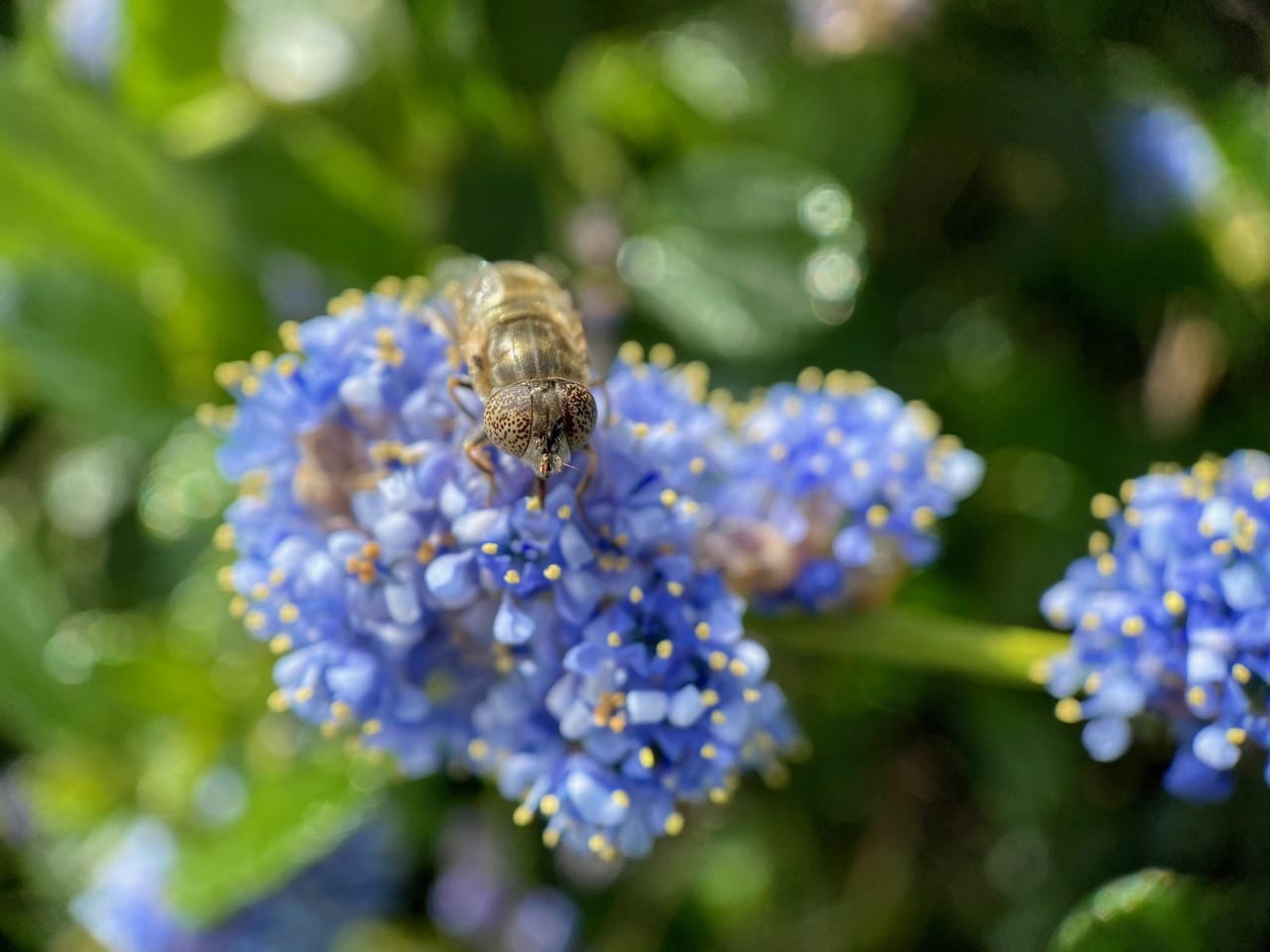
Hello, who’s this new comer? The fly’s body has a dull, metallic shine, but most distictive are its eyes! They are spotted! I remember seeing these flies here last summer – they are the Common Lagoon Fly, a type of hover fly.
The Common Lagoon Fly, Eristalis aeneus (family Syrphidae) is native to Europe, and widespread throughout Europe and the United States. It draws its common name from its habitat of lagoons, ponds, slow-moving rivers, streams and irrigation ditches. The larvae are commonly found along shorelines in rock pools containing large amounts of decaying seaweed. They develop in brackish as well as a variety of freshwater habitats. The adults fly very fast and low over ground vegetation, and feed on yellow composites and white umbellifers. The flight period is April to October, and the fly overwinters as an adult.
Alas, I never found out the reason for those spotted eyes.
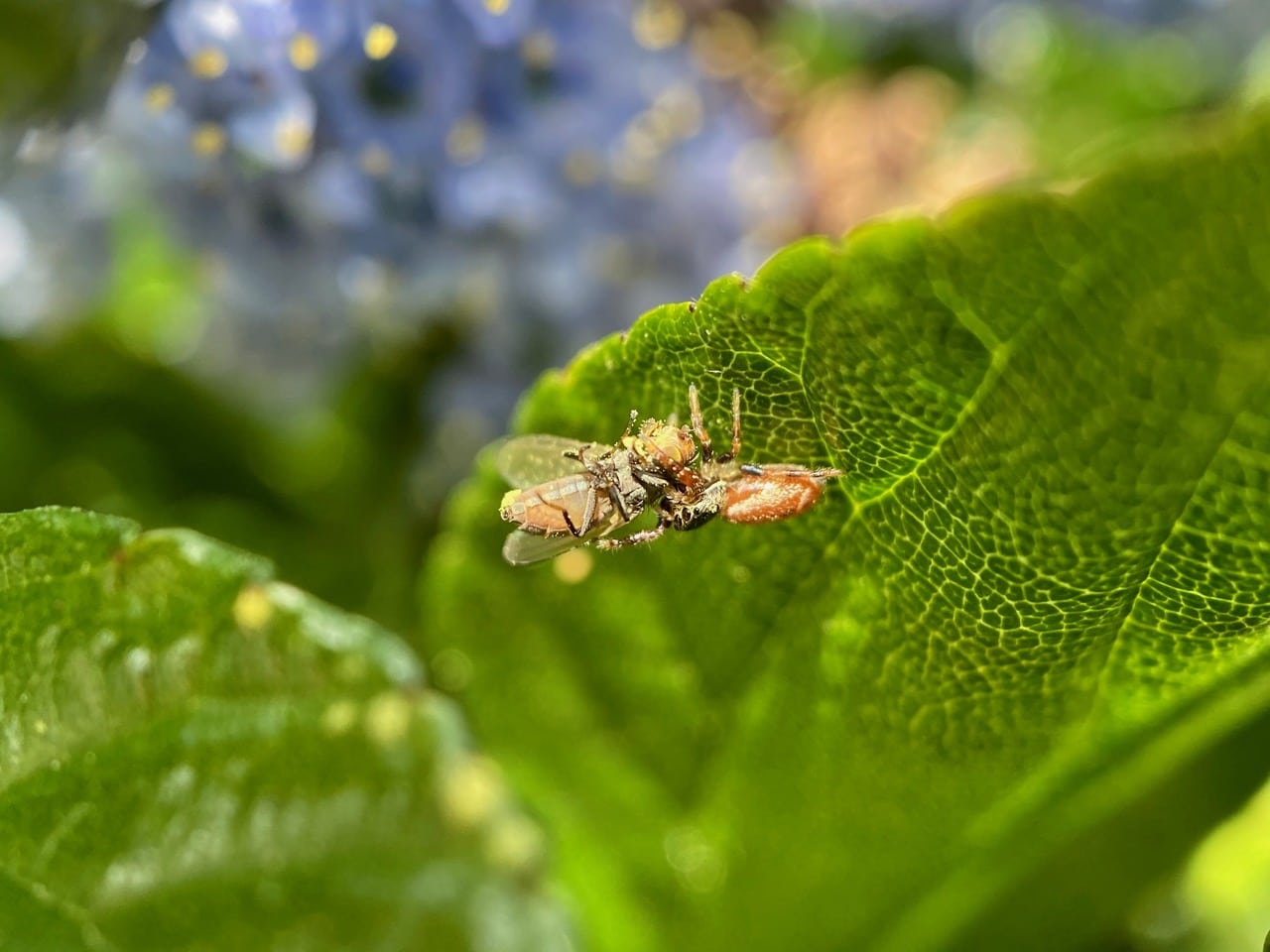
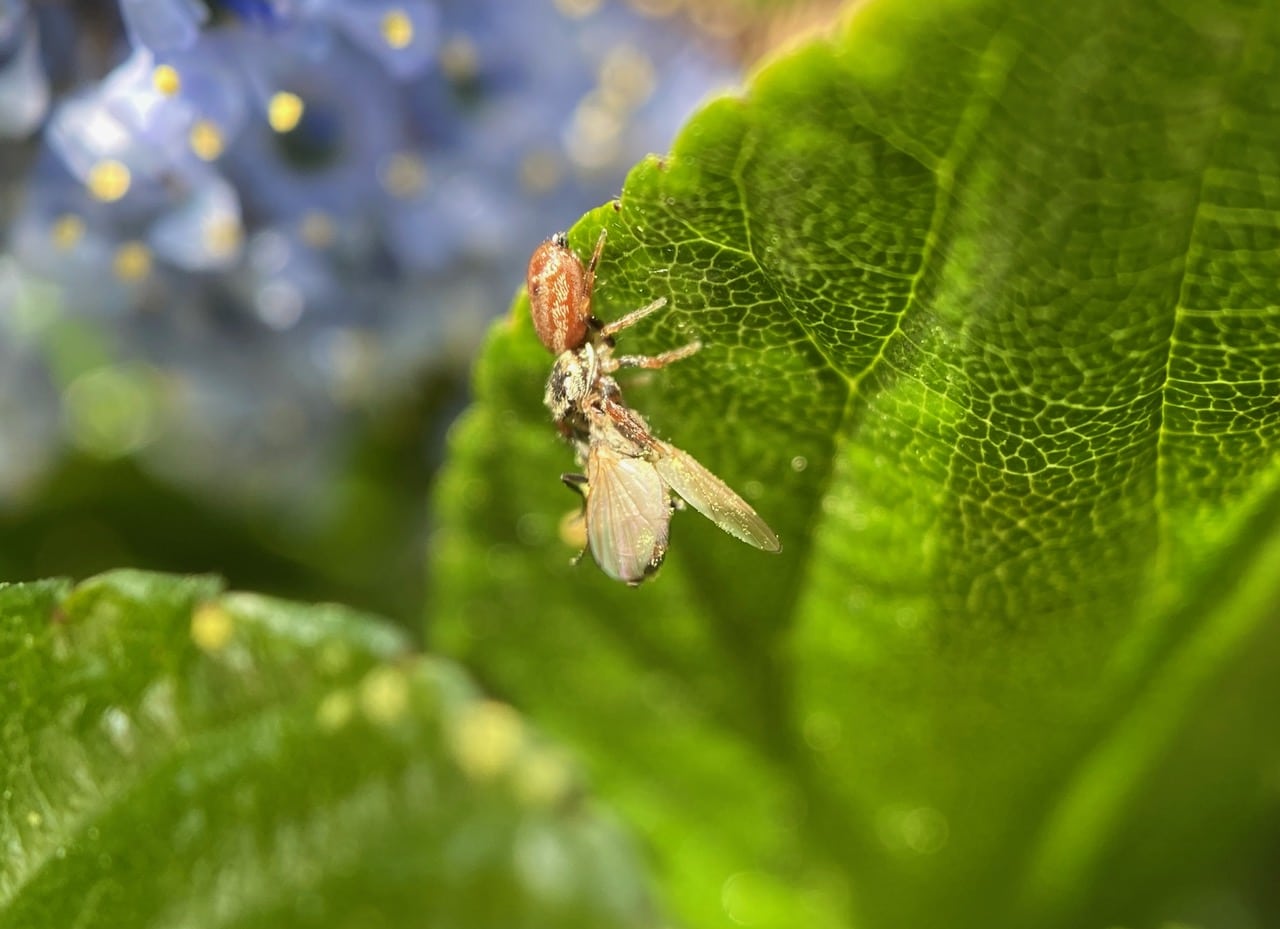
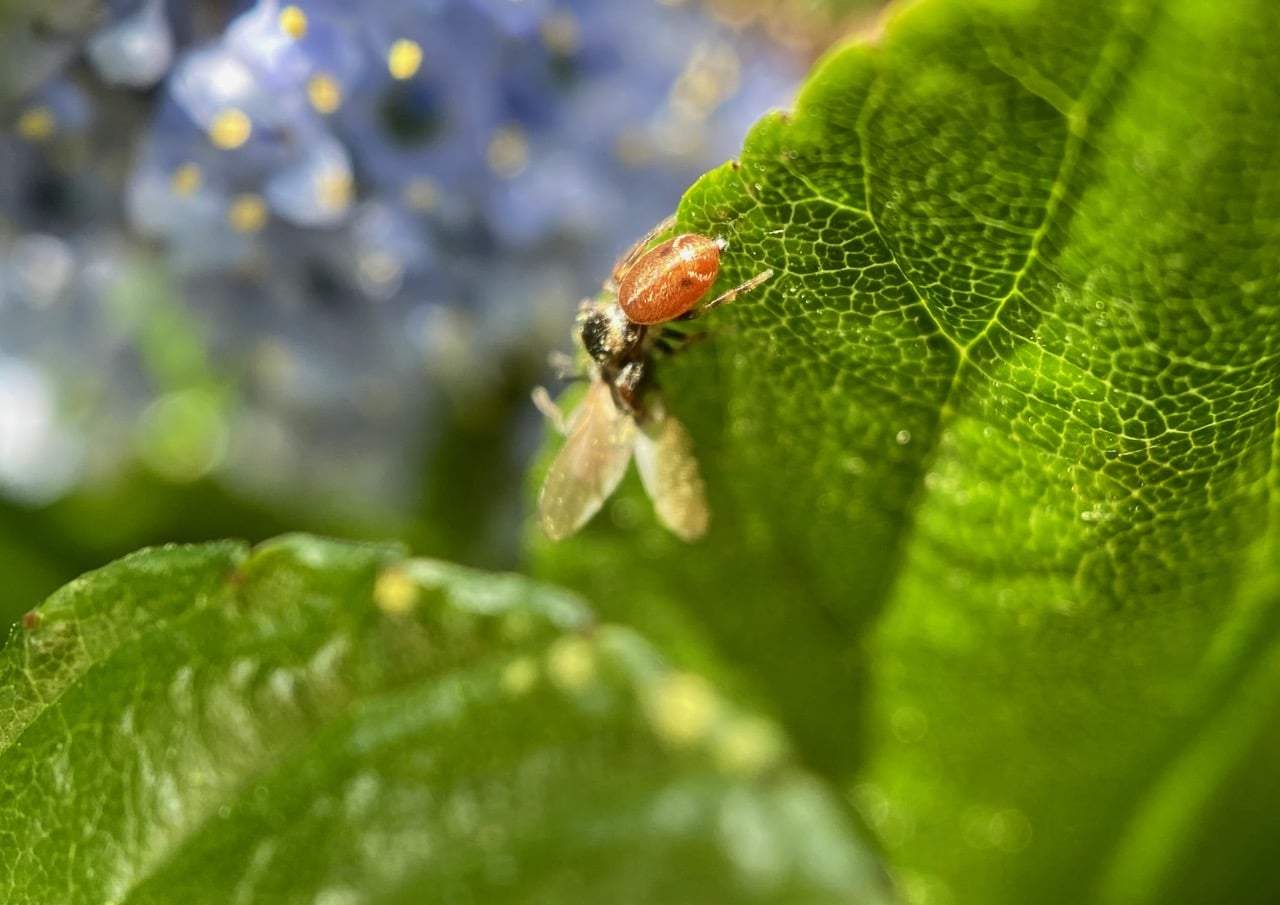
A little disturbance on a Ceanothus leaf draws my attention to a predation event. A tiny Jumping Spider (family Salticidae) has just caught what looks like a fly slightly bigger than itself. The little predator is trying to subdue its prey, struggling under its weight.
Ah, the fly is finally under control, probably dead from the spider’s venom.
Jumping spiders (family Salticidae) are free-roaming hunting spiders. They do not weave a web to catch prey. They stalk, then pounce on their prey. Just before jumping, the spider fastens a safety line to the substrate. It can leap 10-20 times their body length to capture prey. Their movement is achieved by rapid changes in hydraulic pressure of the blood. Muscular contractions force fluids into the hind legs, which cause them to extend extremely quickly. Jumping spiders are visual hunters. Their excellent vision has among the highest acuities in invertebrates. Since all their 8 eyes are fixed in place and cannot pivot independently from the body like human eyes can, jumping spiders must turn to face whatever they want to see well. This includes moving their cephalothorax up and down, an endearing behavior.
I catch a glimpse of the spider’s reddish, patterned abdomen as it disappears with its precious loot over the edge of the leaf. Bon appetit, little spider!
iNaturalist has helped identify the spider as a Leaf-beetle Jumping Spider, Sassacus sp. (family Salticidae). It is often difficult to tell whether a particular spider is an adult or an immature, judging by size alone. In the jumping spiders in the genus Sassacus, the adults are only about 3-5 mm. The genus name Sassacus was the last chief of the Pequot Indians, a Native American tribe of the Connecticut Valley that was vanquished in a war with English settlers in 1637. The iridescent color and very compact appearance of these spiders leads scientists to suspect that they are mimics of certain leaf beetles in the family Chrysomelidae. Many Chrysomelids don’t taste good, as they feed on poisonous plants and sequester those plant toxins for their own defense. They advertise their distastefulness to predators with bold black and white, yellow, orange, or red color patterns, or with brilliant metallic colors. One of the defining characteristics of the genus is the very short legs. The fourth pair of legs is still the thickest, with one or two pairs of spines, used in tackling prey. Like most jumping spiders, Sassacus engages in visual courtship displays. The twitching abdomen also produces an auditory stimulus as the male waves his front legs to garner the female’s attention.