

Pollinator Post 4/4/25 (1)
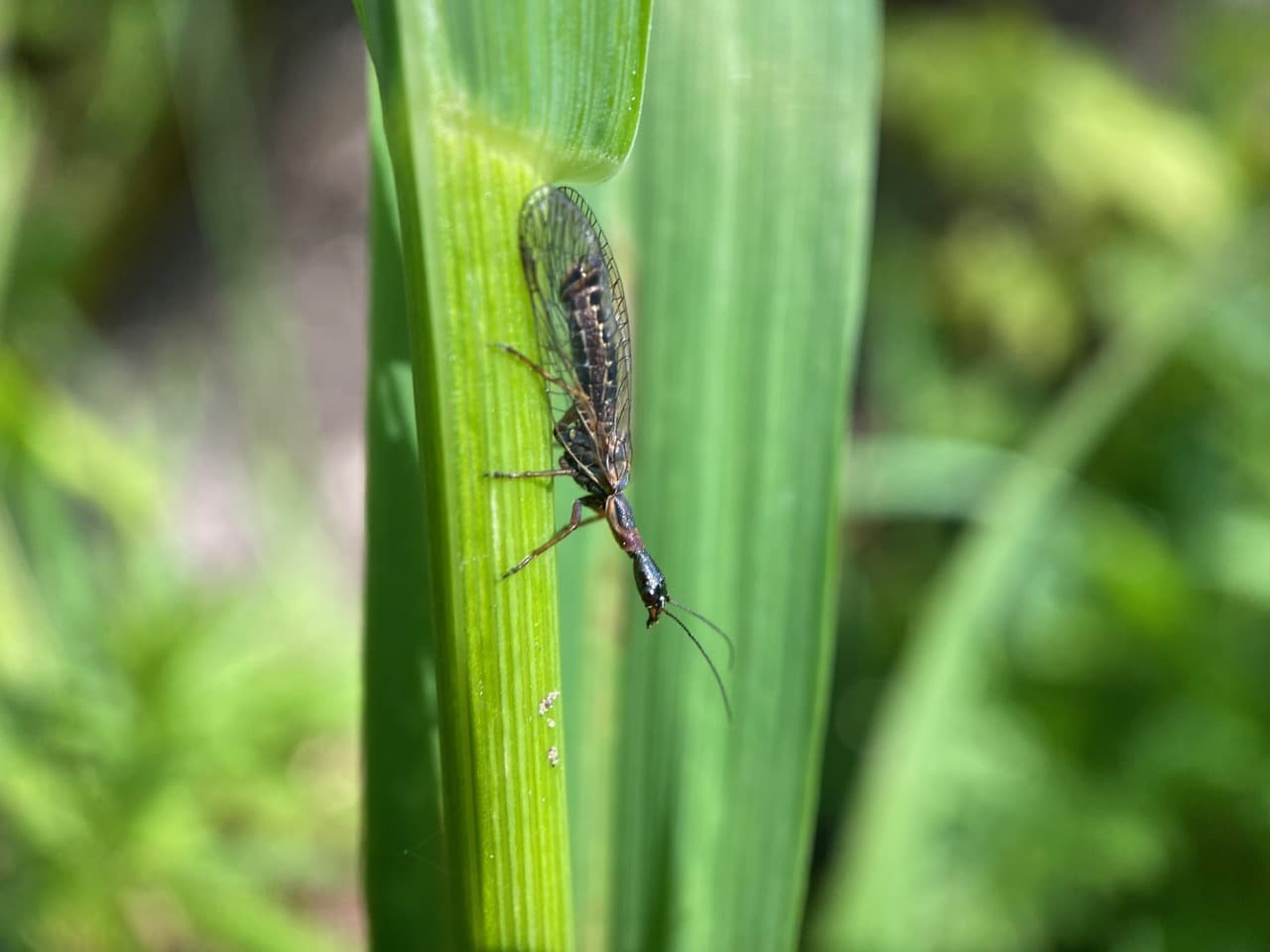
Among the weeds by the parking lot of the Tilden Regional Parks Botanic Garden, I spot a male Snake Fly (order Raphidioptera) perched on a grass.
Snakeflies are a group of predatory insects comprising the order Raphidioptera. They are a relict group, having reached their apex of diversity during the Cretaceous before undergoing substantial decline. Adult Snakefly has a notably elongated thorax which, together with the mobile head, gives the group their common name of snakefly. The body is long and slender and the two pairs of long membranous wings are prominently veined. The head is long and flattened and heavily sclerotized. The mouthparts are strong and relatively unspecialized, being modified for biting. The large compound eyes are at the sides of the head. Females have a large and sturdy ovipositor which is used to deposit eggs into crevices or under bark. Snakeflies are holometabolous insects with four-stage life cycle consisting of eggs, larvae, pupae and adults. Both adults and larvae are predators of soft-bodied arthropods such as aphids and mites.
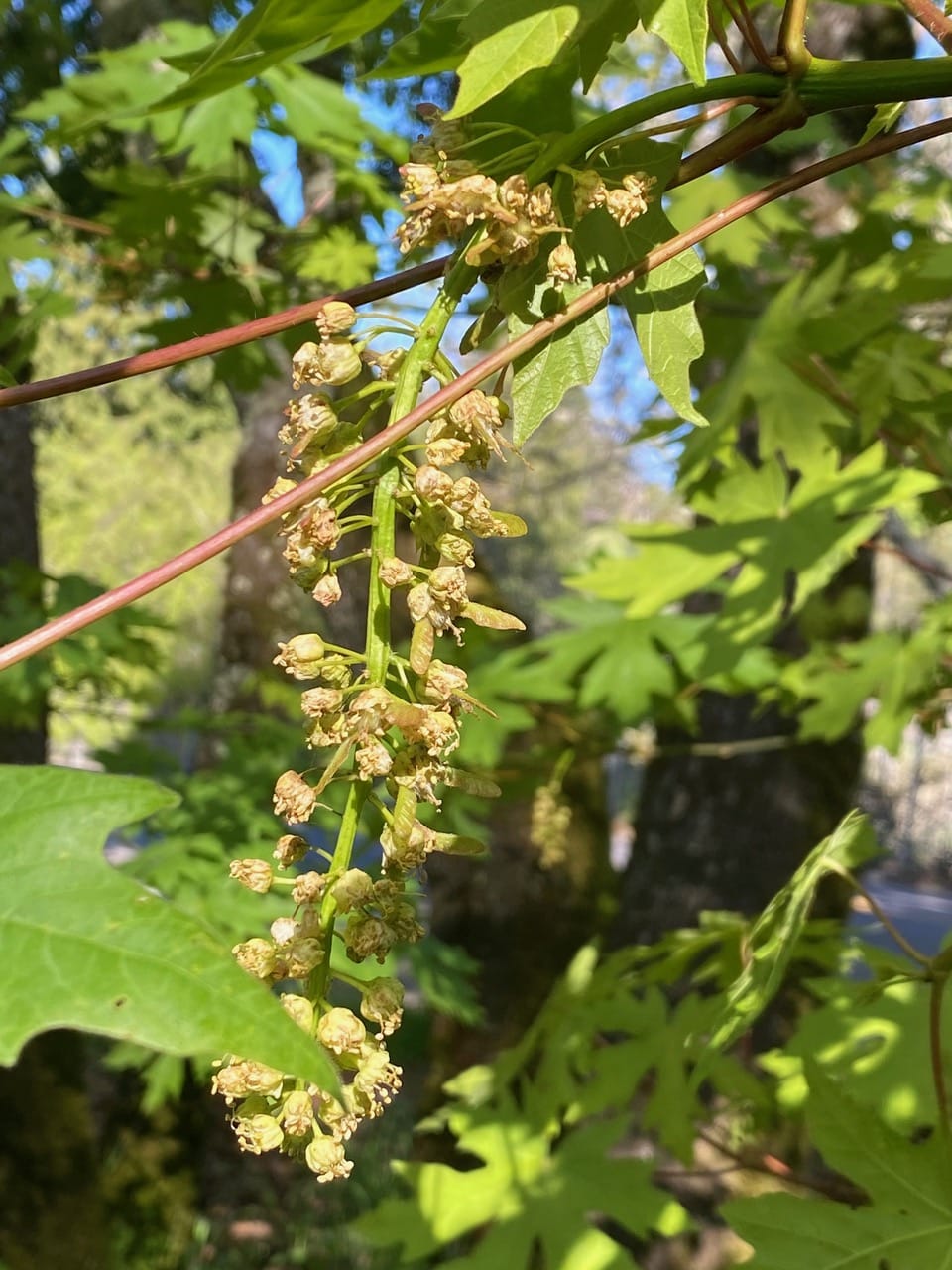
Hey, this hanging catkin of the Bigleaf Maple, Acer macrophyllum by the footbridge is already developing winged fruits!

After the flowers are pollinated, the female parts develop into samaras, or paired, double-winged fruits. Technically, the samaras are winged achenes, a type of fruit where a flattened wing of fibrous, papery tissue develops from the ovary wall. At maturity, the wings are up to 2 in. long, and shaped in an upside-down V. The long wings allow the samaras to “helicopter” down on windy days in the late fall, aiding in seed dispersal. Many small animals, including squirrels, chipmunks, and several species of birds cherish these seeds as a food source.

The Prickly Phlox, Linanthus californicus near the front gate of the garden is in glorious bloom. I stop to watch for insect visitors to the pretty pink flowers, expecting to see some Bee Flies. Instead, I spot a small Black-tailed Bumble Bees, Bombus melanopygus (family Apidae) perched awkwardly on a flower. Surely its tongue is not long enough to reach the nectar in the tubular part of the flower? Is the bee just taking a break to warm up in the sun?
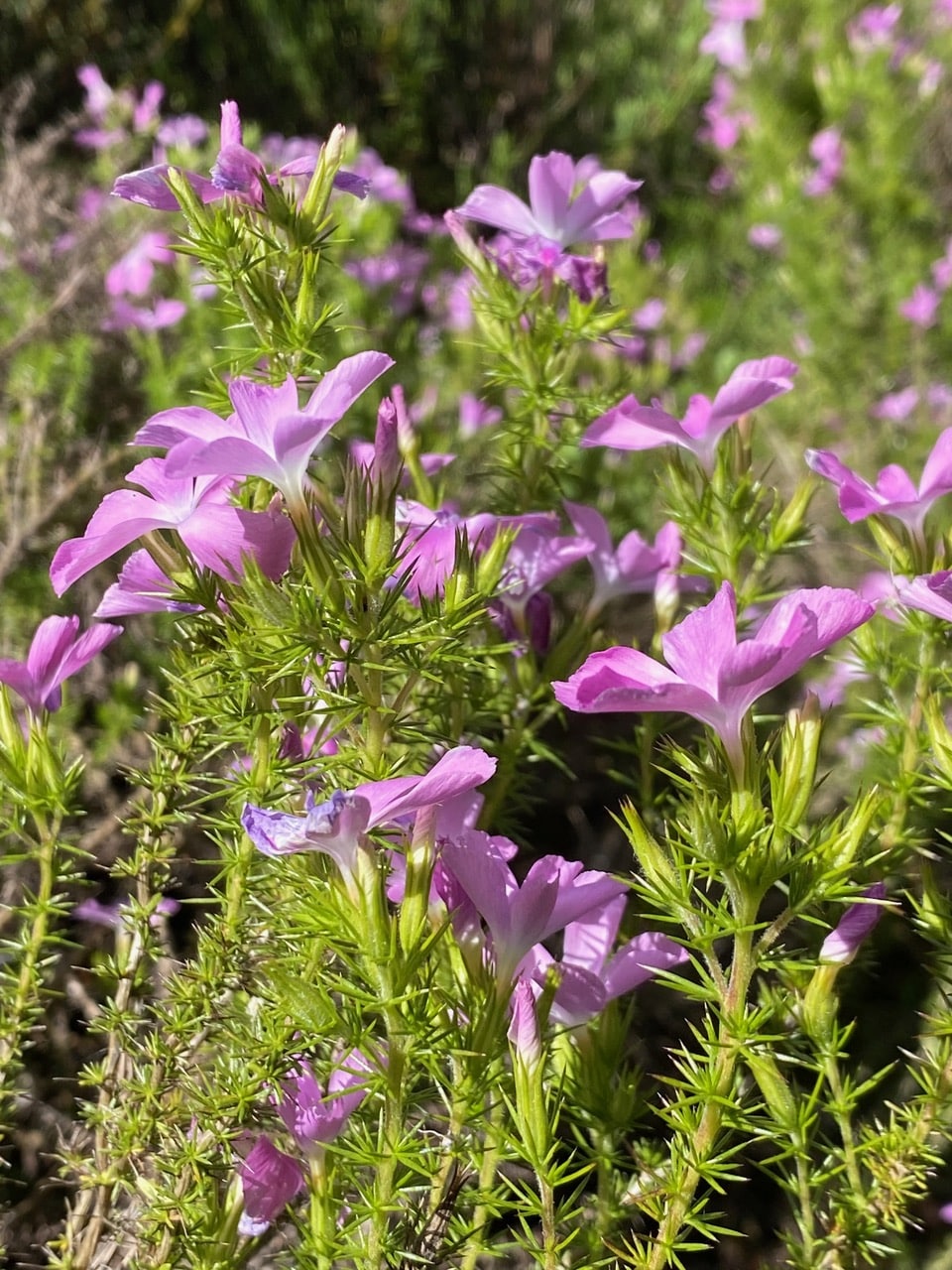
Phlox flowers in the genus Linanthus have five petals that are united at the base forming a tube, and then flare out into a flat-faced surface. One would expect the flowers to be pollinated by insects with long proboscis, such as the Bee Flies (family Bombyliidae) that can access the nectar in the tubes.
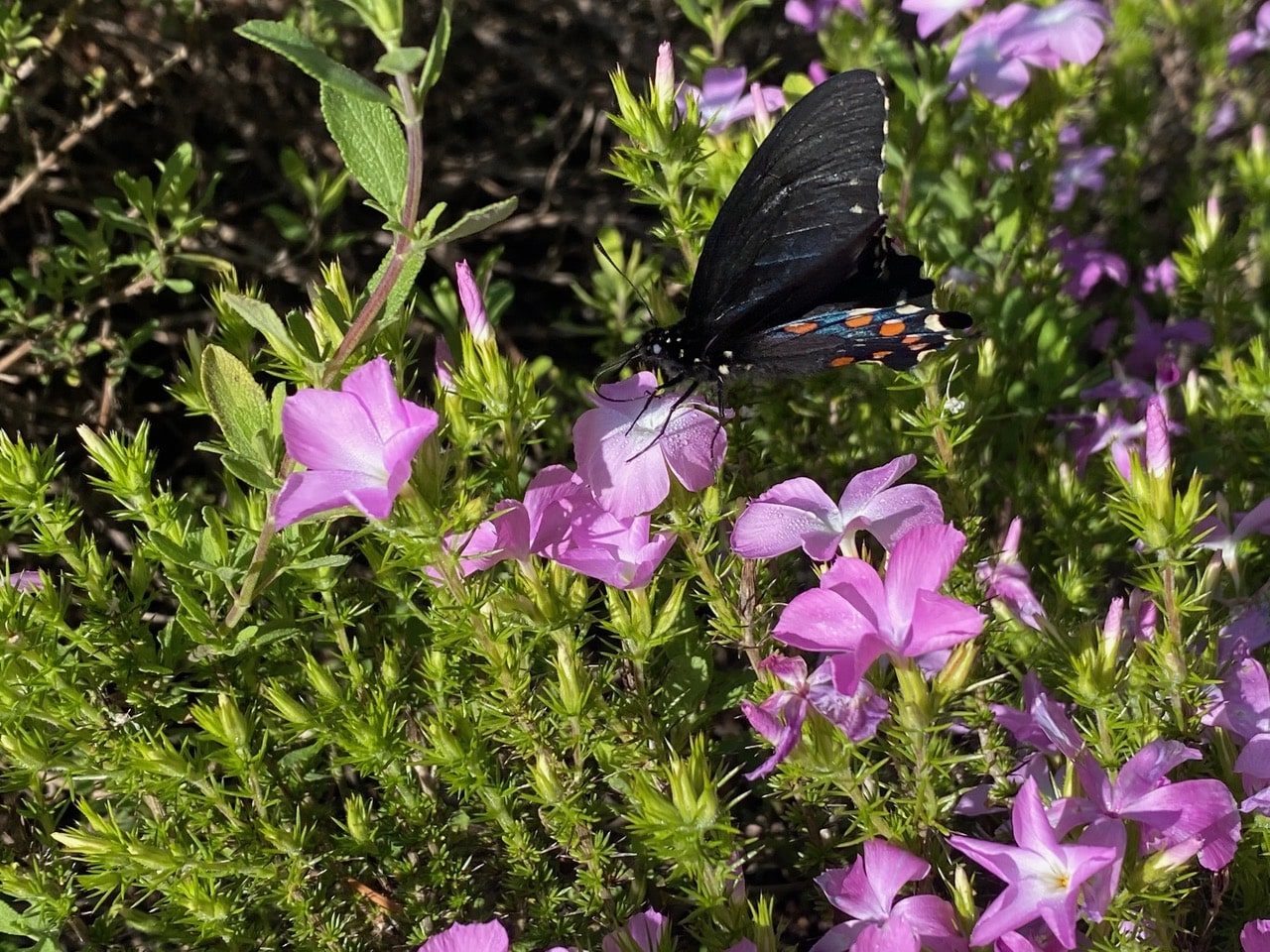
Just as I am pondering long-tongued insects, a Pipevine Swallowtail butterfly, Battus philenor (family Papilionidae) flutters unto the plant as if on command. Unrolling the long, coiled proboscis and aiming it into the narrow tube takes some skill!
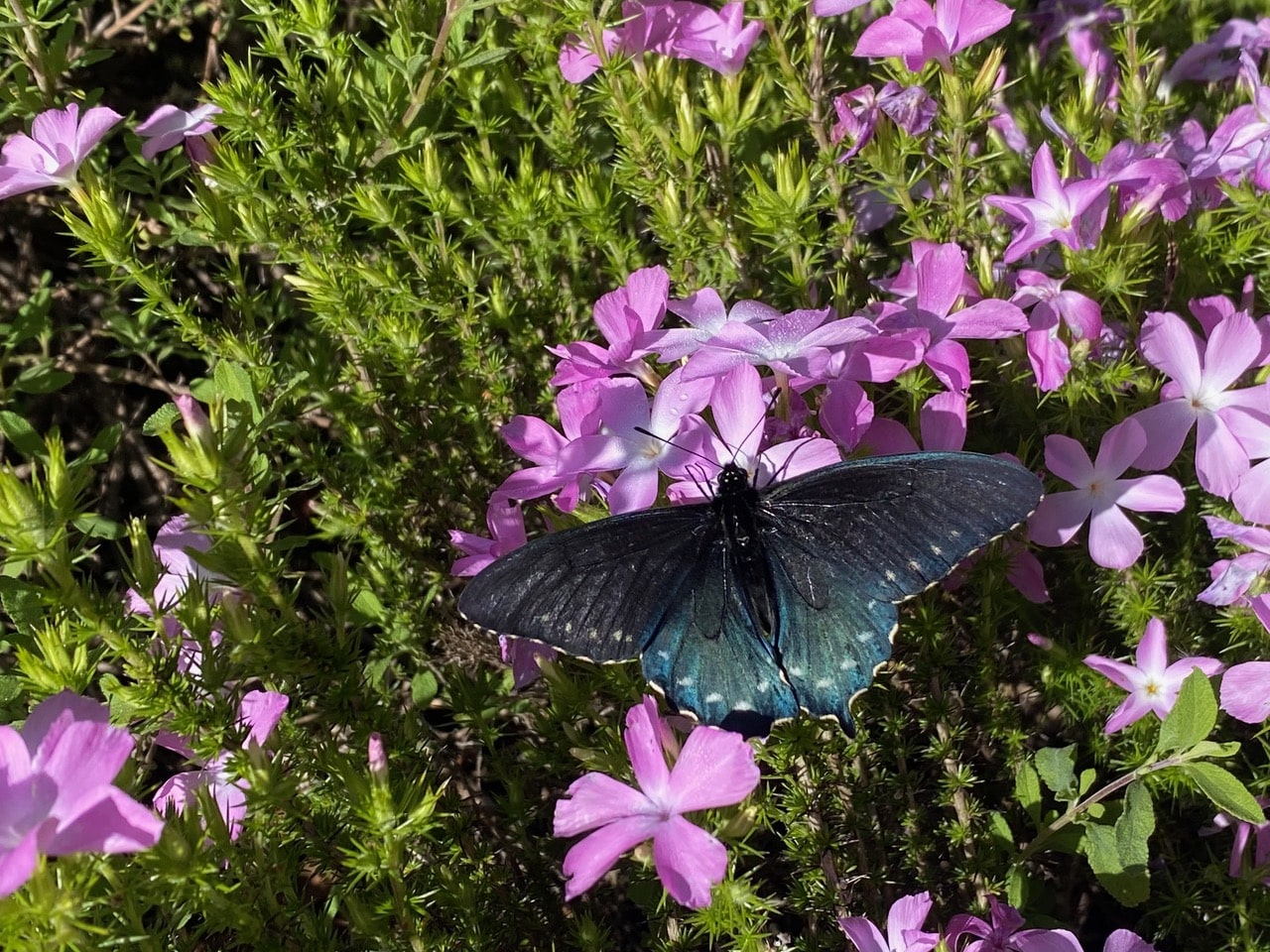
Pipevine Swallowtail adults have a wingspan from 2.75 to 5 inches. The dorsal wings of an adult male are black with vibrant blue iridescence on the hind wings. Female iridescence is duller in appearance. Bright orange spots are visible on the back end of the ventral wings. Adult males spend most of their time feeding and searching for mates. Females lay clusters of orange eggs on or under pipevine leaves (Aristolochia sp.) which contain aristolochic acids toxic to many vertebrate animals. The larvae feed on the leaves and sequester the toxins which are passed on to future pupa and adult butterflies. The bright orange spots present on larvae and adult butterflies are thought to serve as warnings to potential predators. Adult Pipevine Swallowtail butterflies feed on the nectar of a variety of flowers, notably thistle (Cirsium), Phlox species, and ironweed (Vernonia).
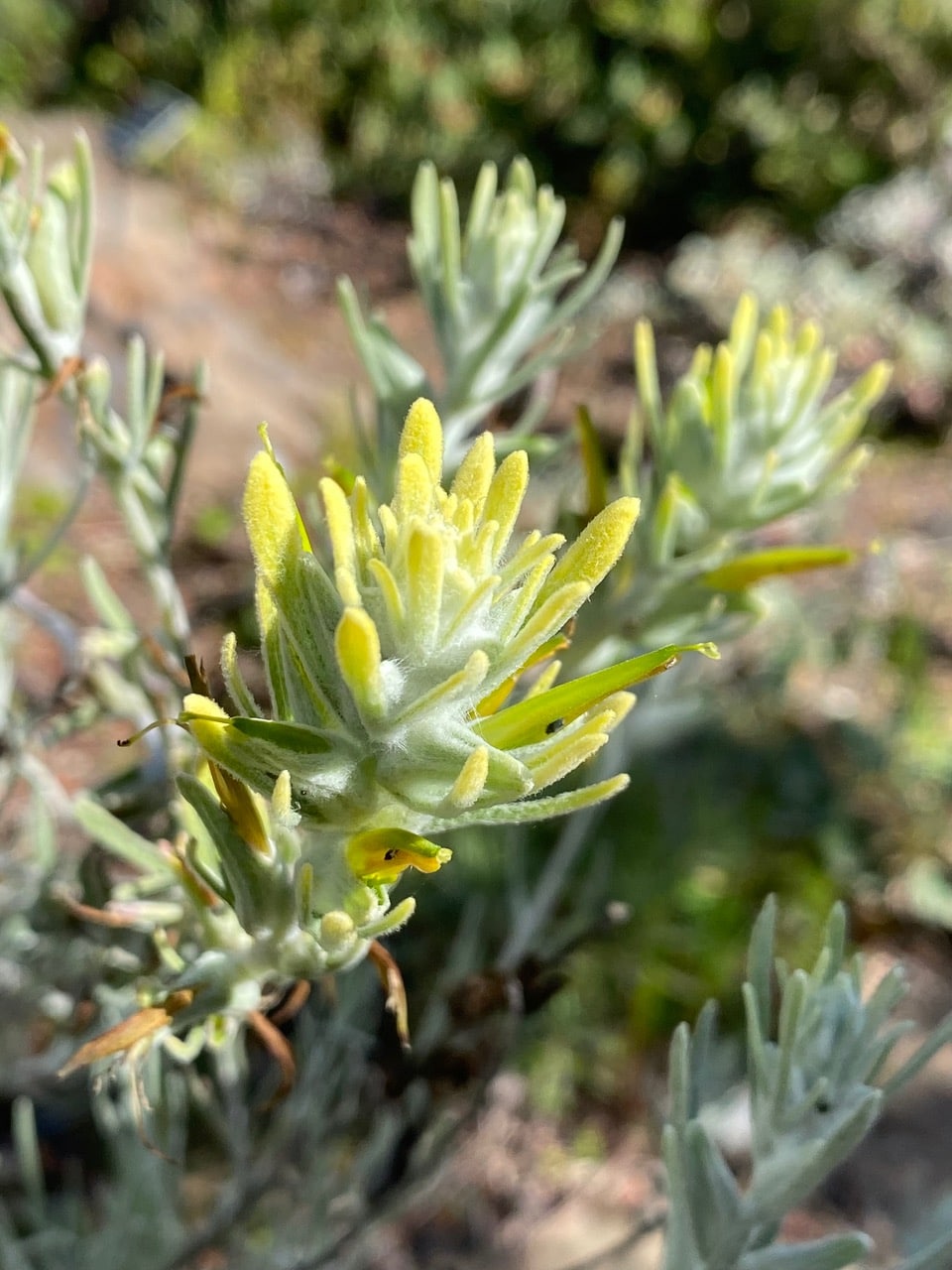
I have overlooked this Woolly Indian Paintbrush, Castilleja foliolosa for a long time. Its inflorescence is pale yellow, and its flowers are an inconspicuous green.

An Argentine Ant is checking out the bilobed stigma of the Woolly Indian Paintbrush protruding from the greenish-yellow tubular flower.
The Argentine Ant, Linepithema humile (family Formicidae) is native to Northern Argentina, but it has been inadvertently introduced by humans to many countries, and is now an established invasive species in many Mediterranean climate areas worldwide. The success of the species can be attributed to their lack of aggression between the colonies. There is no apparent antagonism between separate colonies of its own kind, resulting in “super-colonies” that extend across hundreds or thousands of kilometers in different parts of the their range. Genetic, behavioral, and chemical analyses show that introduced Argentine Ants on separate continents actually represent a single global supercolony.
The Argentine Ants are ranked among the world’s worst invasive animal species. In its introduced range, the Argentine ant often displaces most or all native ants and can threaten native invertebrates and even small vertebrates that are not accustomed to defending against the aggressive ants. This can, in turn, imperil other species in the ecosystem, such as native plants that depend on native ants for seed dispersal, or lizards that depend on native ants for food.
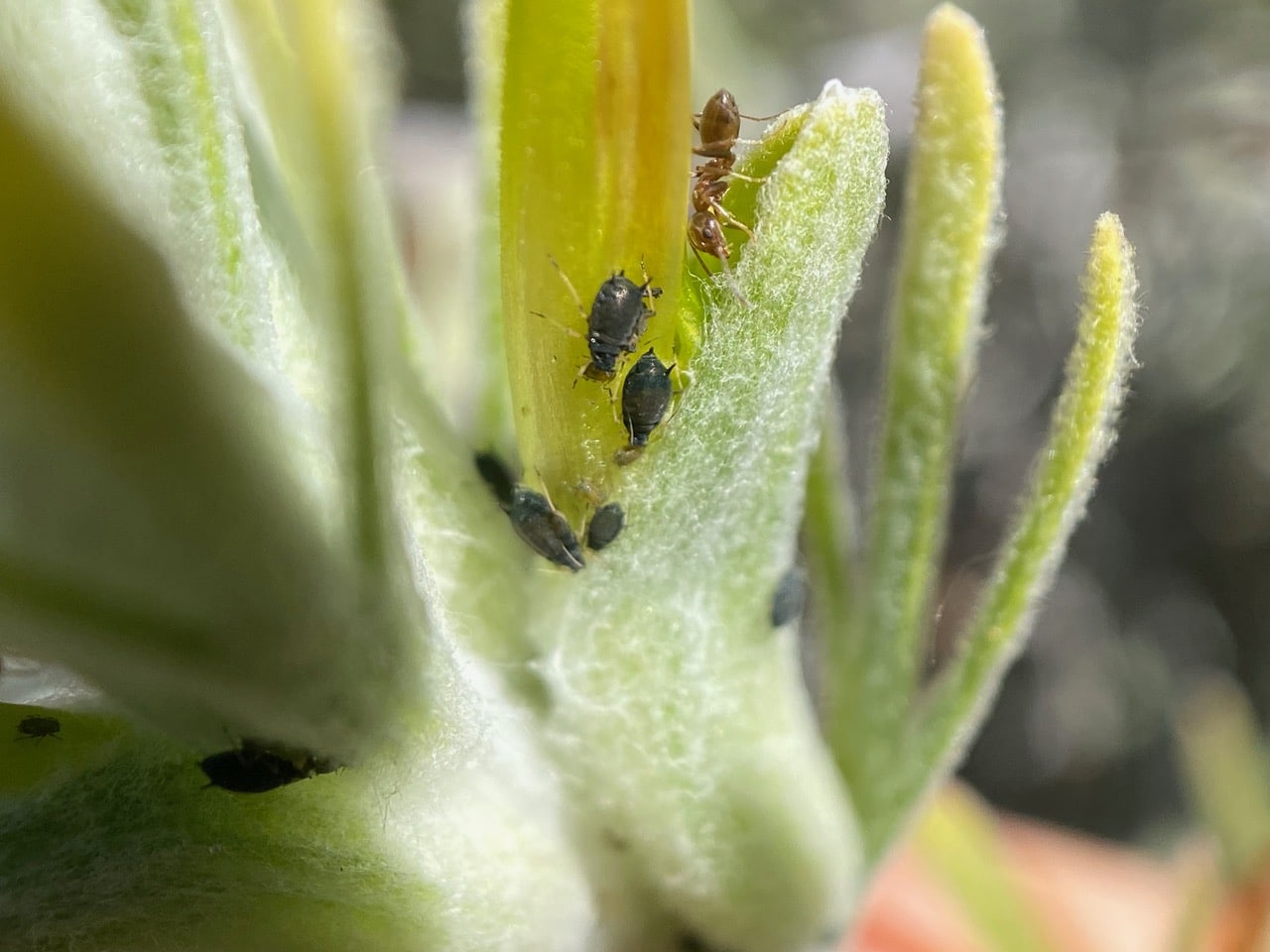
At the base of another flower, Argentine Ants are tending a small aggregation of very small, dark aphids.
Aphids are small sap-sucking insects in the order Hemiptera. A typical life cycle involves flightless females giving live birth to female nymphs, – who may also be already pregnant, an adaptation called telescoping generations – without the involvement of males. Maturing rapidly, females breed profusely so that the population multiplies quickly. Winged females may develop later in the season, allowing the insects to colonize new plants. In temperate regions, a phase of sexual reproduction occurs in the autumn, with the insects often overwintering as eggs.
Aphids usually feed passively on phloem of plants. Once the phloem vessel is punctured, the sap, which is under pressure, is forced into the aphid’s food canal. Aphids produce large amounts of a sugary liquid waste called “honeydew”. A fungus called sooty mold can grow on honeydew deposits that accumulate on leaves and branches, turning them black.
The life cycle of some species involves an alternation between two species of host plants. Some species feed on only one type of plant, while others are generalists, colonizing many plant groups. Some ants have a mutualistic relationship with aphids. The aphids produce honeydew, a sugary food for the ants; in exchange, the ants care for and protect the aphids from predators and parasites. Some ants will “milk” the aphids to make them excrete the sugary substance. The ants stroke the aphids with their antennae, stimulating them to release the honeydew. Aphid-herding ants make sure the aphids are well-fed and safe. When the host plant is depleted of nutrients, the ants carry their aphids to a new food source. If predatory insects or parasites attempt to harm the aphids, the ants will defend them aggressively. Some species of ants continue to care for aphids during winter. The ants carry the aphids to their nest for the winter months, and transport them to a host plant to feed the following spring.
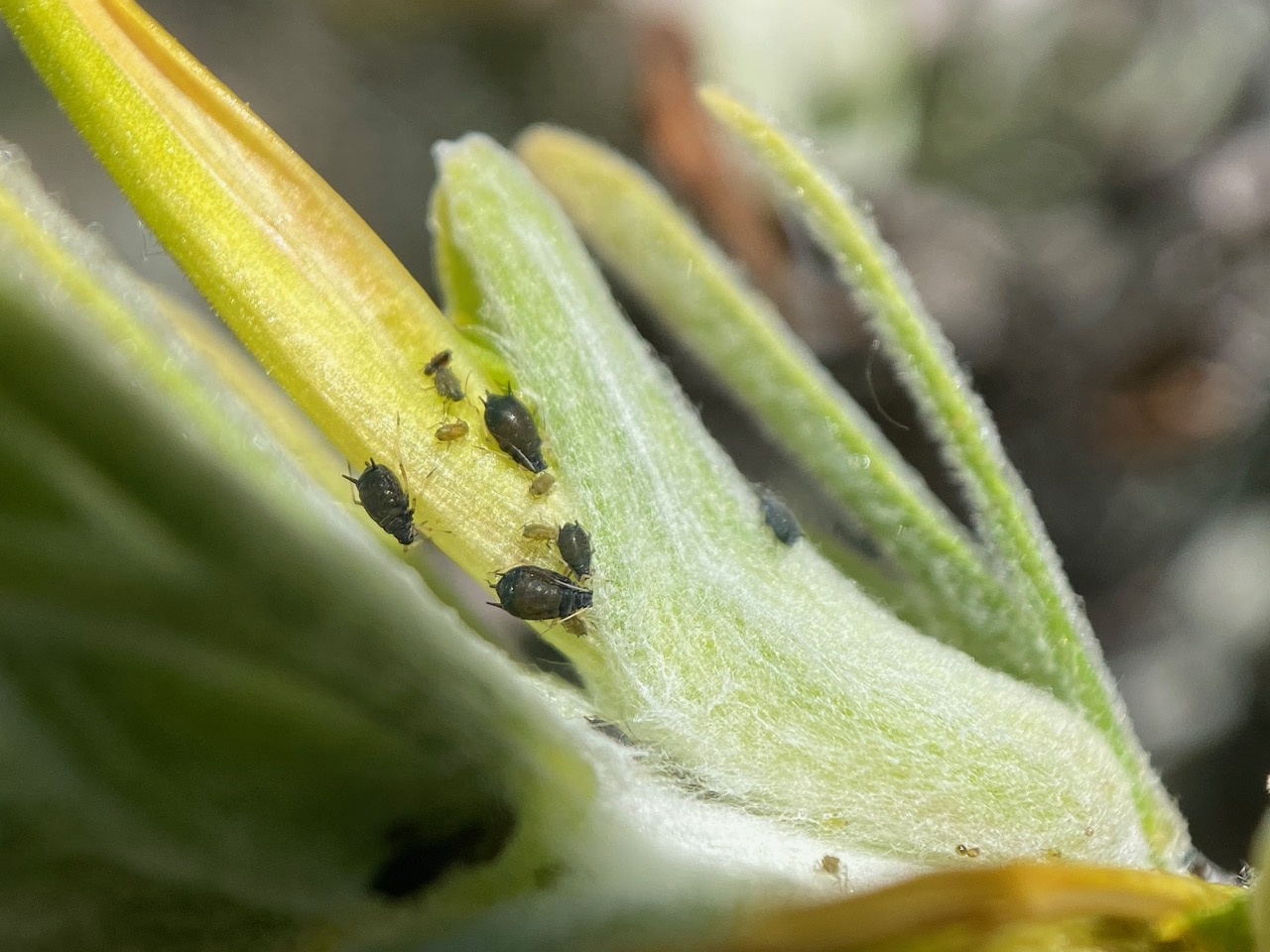
Wow, this appears to be the beginning of an aphid invasion. The adult aphids have given birth to tiny babies, clones of themselves.

In the back of the garden, the Twinberry Honeysuckle, Lonicera involucrata has produced many more of these charming paired tubular flowers subtended by a pair of reddish basal bracts.
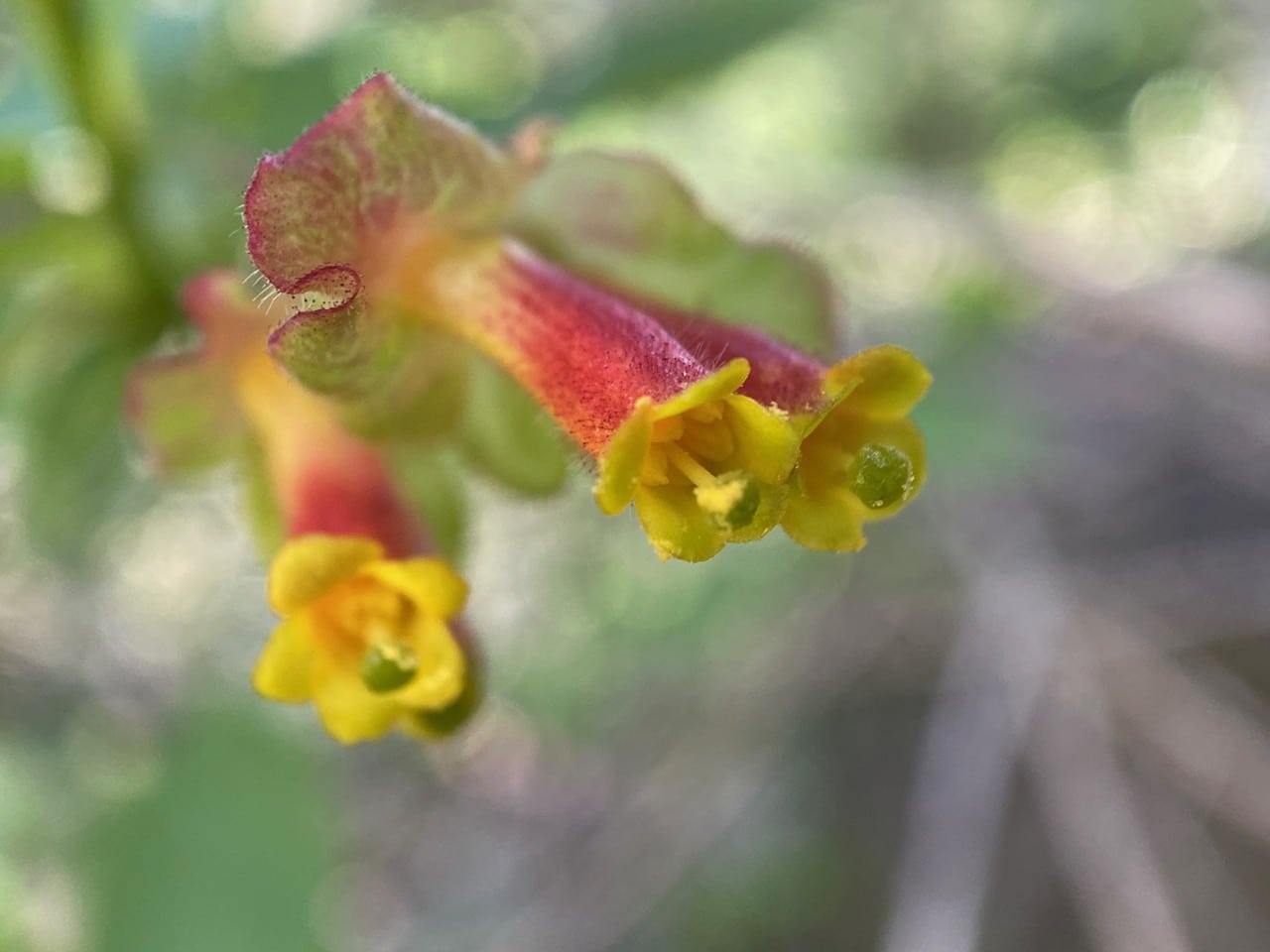
I discover something new today – the plant is not monoecious (i.e. separate male and female flowers borne on the same plant), as I have reported earlier. (It goes to show that I shouldn’t believe everything I read on Wikipedia.) The flowers are in fact bisexual – the stamens are hidden inside the tubular corolla behind the stigma. Some pollen has been deposited on the protruding green stigmas on these flowers here. How does the twinberry flower prevent self-fertilization when its pollen falls on its own stigma? Some plants have the ability to recognize their own pollen, and can abort the process of fertilization when necessary. Perhaps the twinberry is one of these?
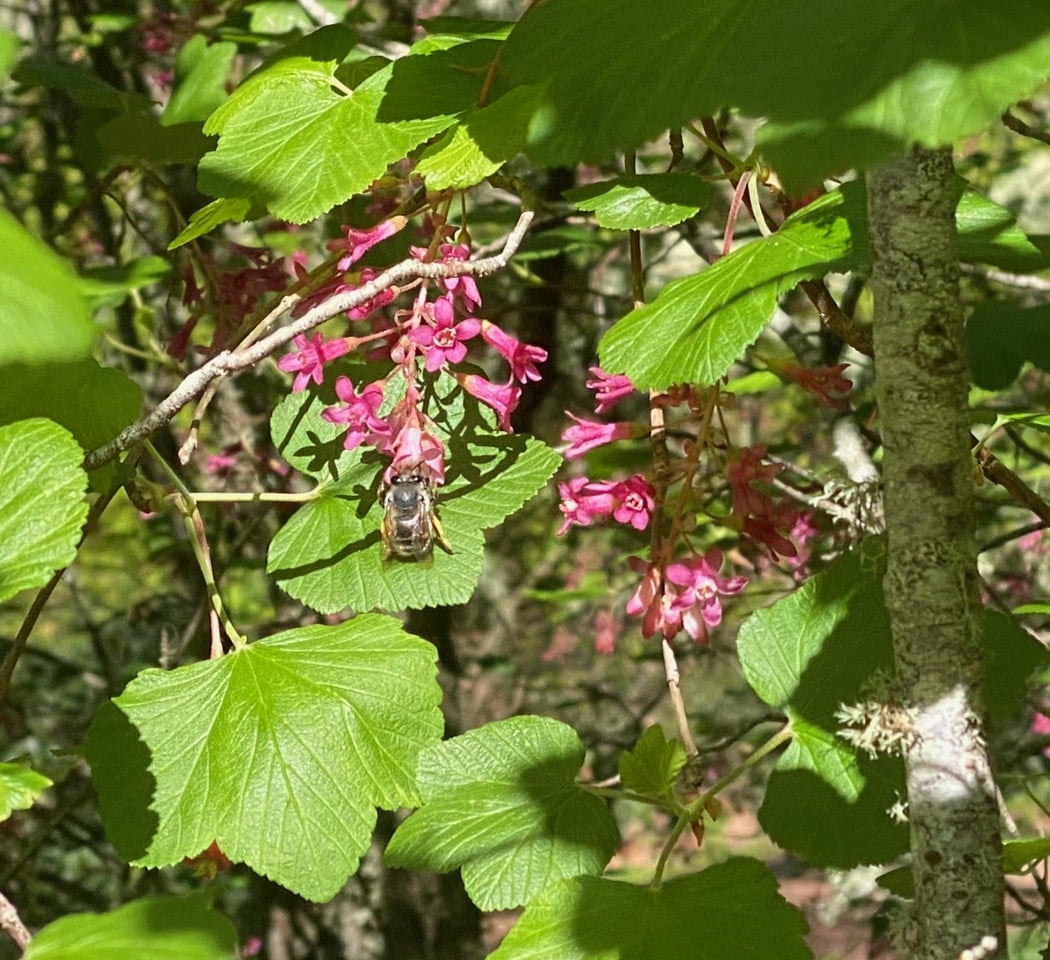 Although the Red-flowering Currant, Ribes sanguineum is approaching the end of its bloom time, the fading flowers are still a magnet for the Pacific Digger Bees, Anthophora pacifica (family Apidae). Most of the bees out foraging today are females bearing pollen on their hind legs. Their fast and erratic flights make photography quite the challenge.
 As their name implies, the Digger Bees nest in the ground, sometimes in huge aggregations. These fast and noisy flyers buzz around flowers, appearing to “hop” from flower to flower while foraging. The chubby, furry Digger Bees resemble the bumble bees in many ways, but are a lot noisier. They are a fearless, rowdy lot – fun to watch but a challenge to photograph. Male digger bees of many species have white or yellow integuments on their faces. Females have shaggy hairs on their back legs, used to carry pollen. Female Anthophora are capable of buzz pollination – i.e. they vibrate their wing muscles to shake pollen from the anthers of some flowers. Digger bees are generalist pollinators that visit an impressively wide range of plants. They are exceptionally effective pollinators and play an important role in maintaining wildflower diversity, in part because their long tongues allow them to pollinate deep-throated and tubular blossoms inaccessible to other bees.
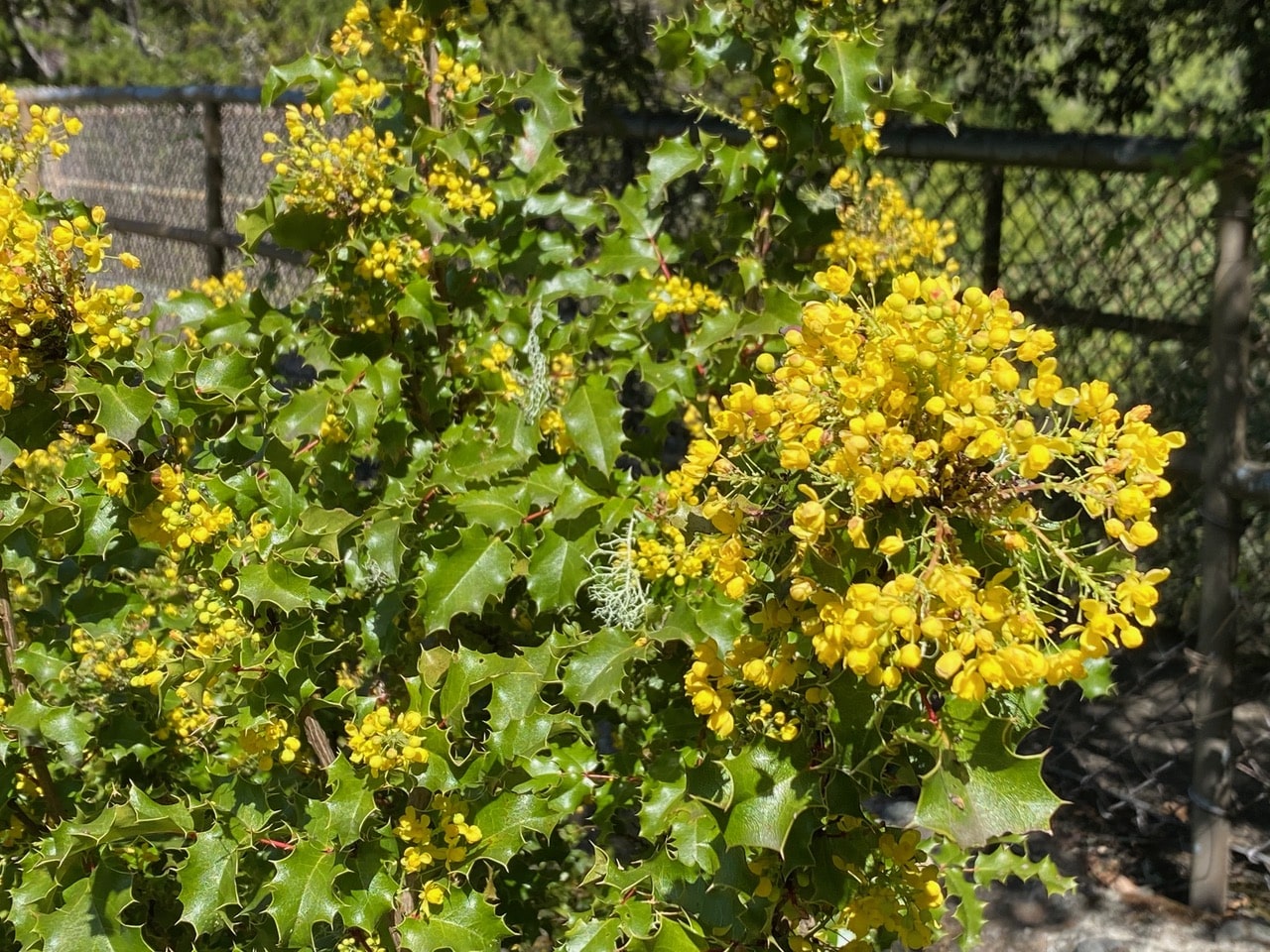
The Oregon Grape, Berberis aquifolium by the footbridge is still blooming well. Staring at these small flowers and wishing I could see the touch-sensitive stamens inside, I detect a movement.
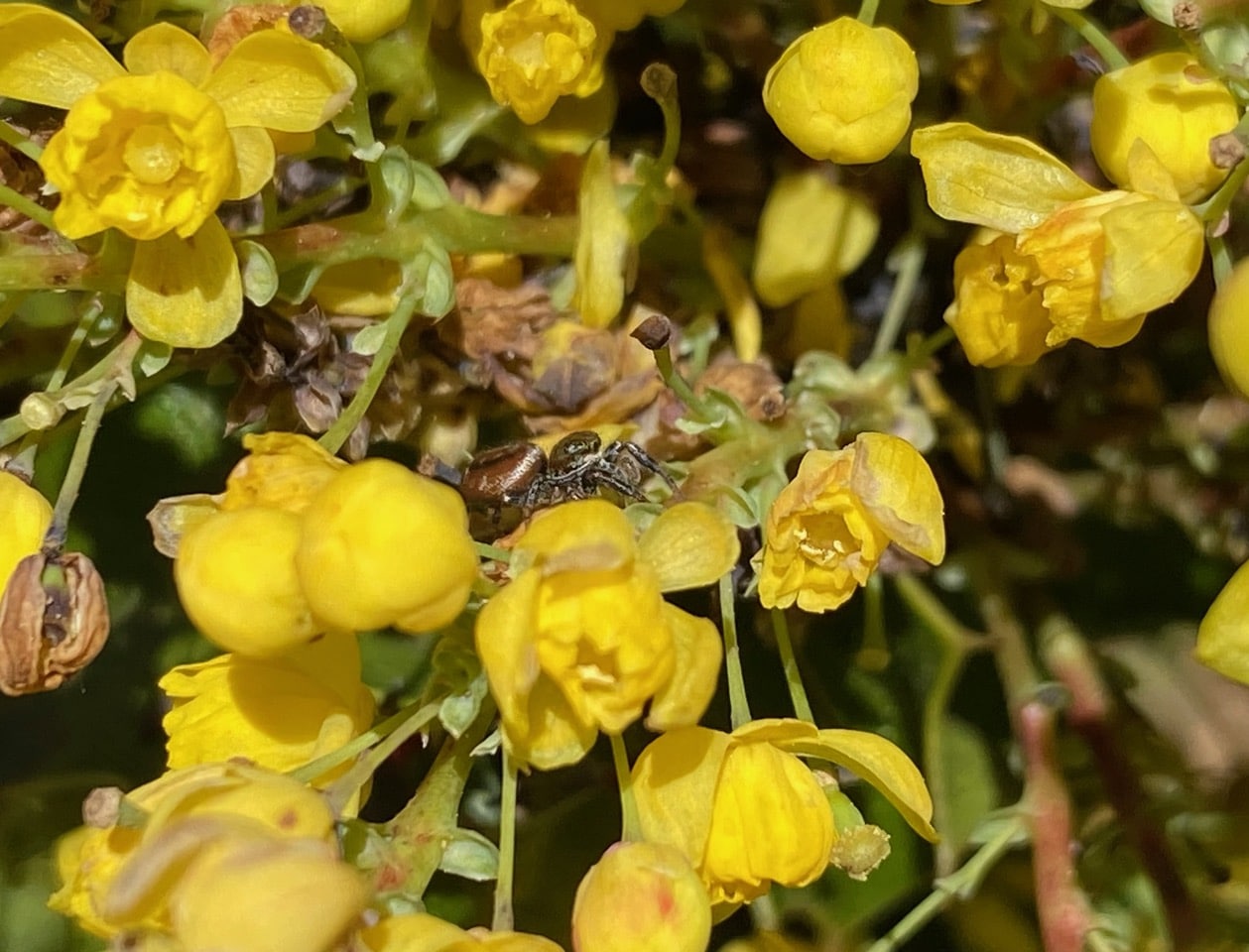
A small shiny Jumping Spider is hunting among the Berberis flowers.
Jumping spiders (family Salticidae) are free-roaming hunting spiders. They do not weave a web to catch prey. They stalk, then pounce on their prey. Just before jumping, the spider fastens a safety line to the substrate. It can leap 10-20 times their body length to capture prey. Their movement is achieved by rapid changes in hydraulic pressure of the blood. Muscular contractions force fluids into the hind legs, which cause them to extend extremely quickly. Jumping spiders are visual hunters. Their excellent vision has among the highest acuities in invertebrates. Since all their 8 eyes are fixed in place and cannot pivot independently from the body like human eyes can, jumping spiders must turn to face whatever they want to see well. This includes moving their cephalothorax up and down, an endearing behavior.
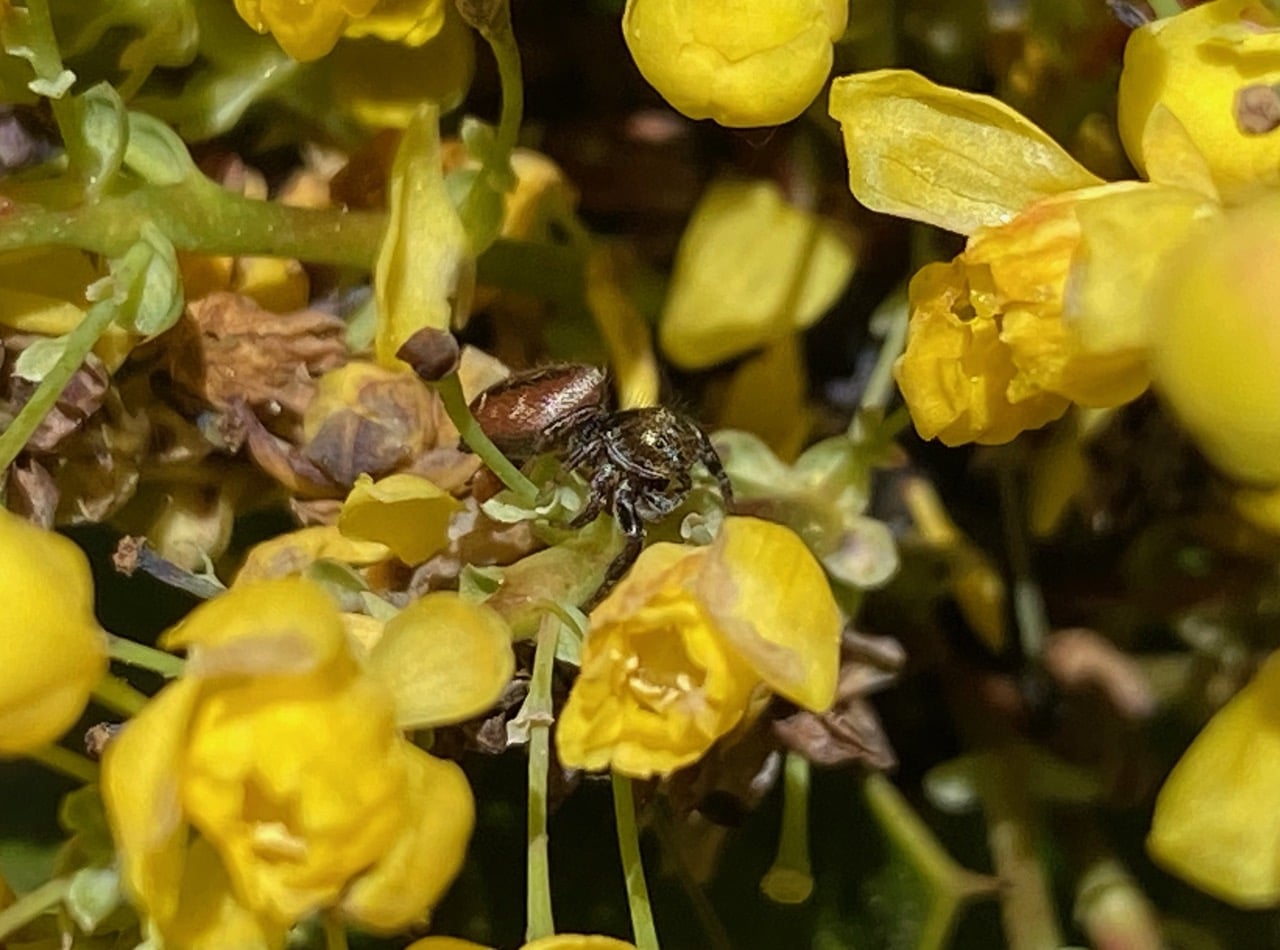
iNaturalist has helped identify the spider as a Leaf-beetle Jumping Spider, Sassacus sp. (family Salticidae). It is often difficult to tell whether a particular spider is an adult or an immature, judging by size alone. In the jumping spiders in the genus Sassacus, the adults are only about 3-5 mm. The genus name Sassacus was the last chief of the Pequot Indians, a Native American tribe of the Connecticut Valley that was vanquished in a war with English settlers in 1637. The iridescent color and very compact appearance of these spiders leads scientists to suspect that they are mimics of certain leaf beetles in the family Chrysomelidae. Many Chrysomelids don’t taste good, as they feed on poisonous plants and sequester those plant toxins for their own defense. They advertise their distastefulness to predators with bold black and white, yellow, orange, or red color patterns, or with brilliant metallic colors. One of the defining characteristics of the genus is the very short legs. The fourth pair of legs is still the thickest, with one or two pairs of spines, used in tackling prey. Like most jumping spiders, Sassacus engages in visual courtship displays. The twitching abdomen also produces an auditory stimulus as the male waves his front legs to garner the female’s attention.

As the spider vanishes into the tangle of flowers, I get a fleeting glimpse of its shiny, reddish abdomen with a pattern reminiscent of a female Johnson’s Jumping Spider.

There is a mesmerizing quality in the unfurling Sword Fern leaves, Polystichum munitum. Mathematics has helped to demystify that quality.
Fern fiddleheads, the curled tips of young fern fronds, are one of the many examples found in nature of the mathematical pattern known as the Fibonacci sequence. In this sequence, each number is the sum of the two preceding numbers, beginning with 1, 1, 2, 3, 5, 8, 13, 21, 34, and so on. The longer you keep calculating the numbers in the sequence, the closer the ratio between each pair of numbers comes to another important mathematical concept: the “golden ratio”, a ratio between two numbers that was thought to represent the most beautiful and natural proportions. The Fibonacci spiral and the golden ratio describe growth patterns all through the natural world, from the whorls of snail shells and the interlocking spirals of sunflower seeds, to the furled centers of succulents.
But it is not just a matter of esthetics. Because the spiral pattern doesn’t repeat in a neat, predictable way – because it increases in irregular, ever-larger loops, each of the unfurling fronds is offset just slightly from all the rest; none sits directly underneath another. In fact, the pattern is so irregular, it optimizes the amount of growth the plant can produce, without each uncurling frond blocking the other’s access to light and water. This in turn allows the fern to pack an astonishing number of leaflets into each tightly coiled fiddlehead, ready to burst into life a soon as spring arrives.
I will be transitioning over to my new email account at maych…@gmail.com. Please send all of your new emails to this new address.