

Pollinator Post 4/5/25 (3)

View from the bench at Siesta Nose, showing Siesta Valley to the east in a myriad shades of green.
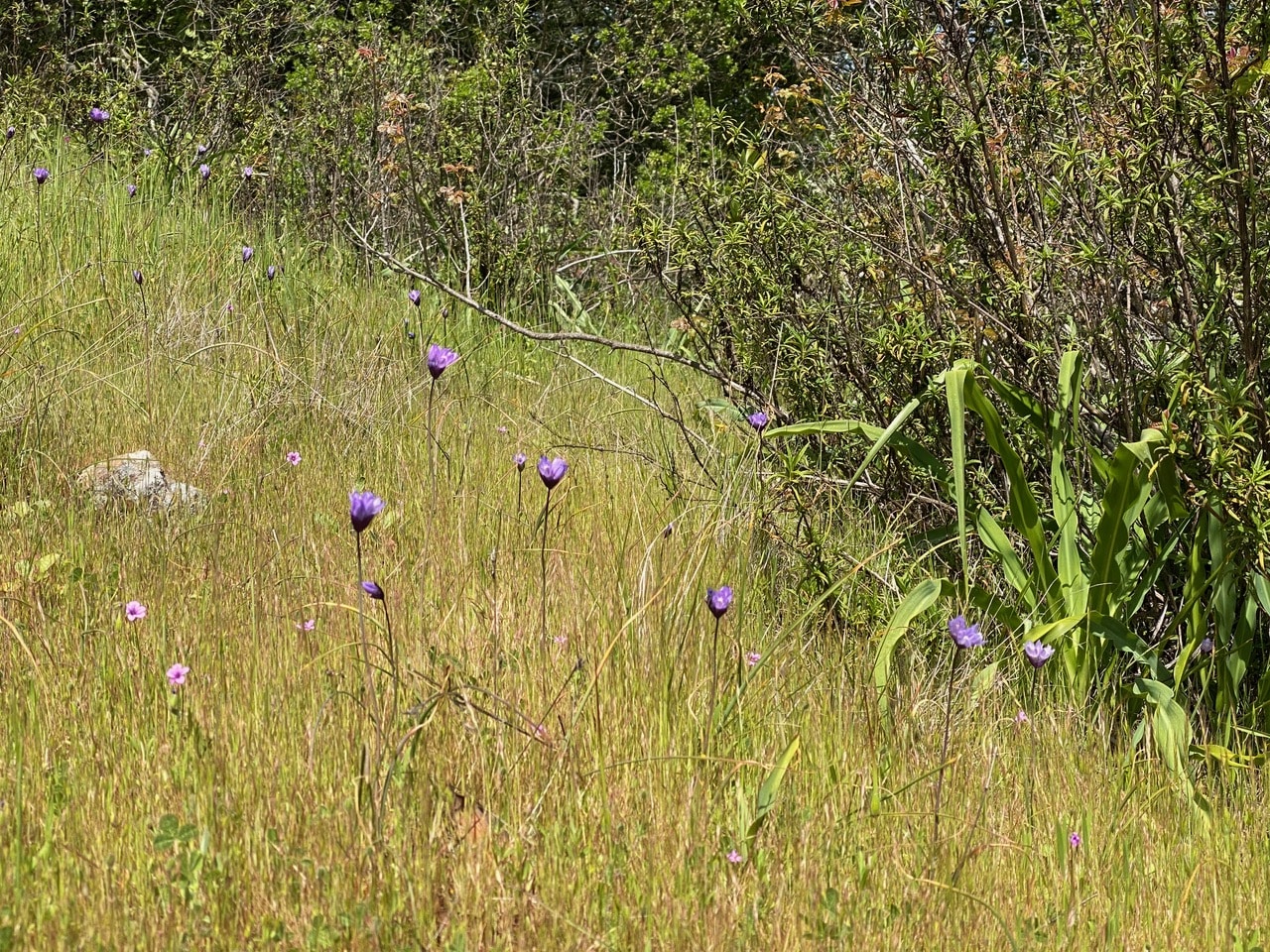

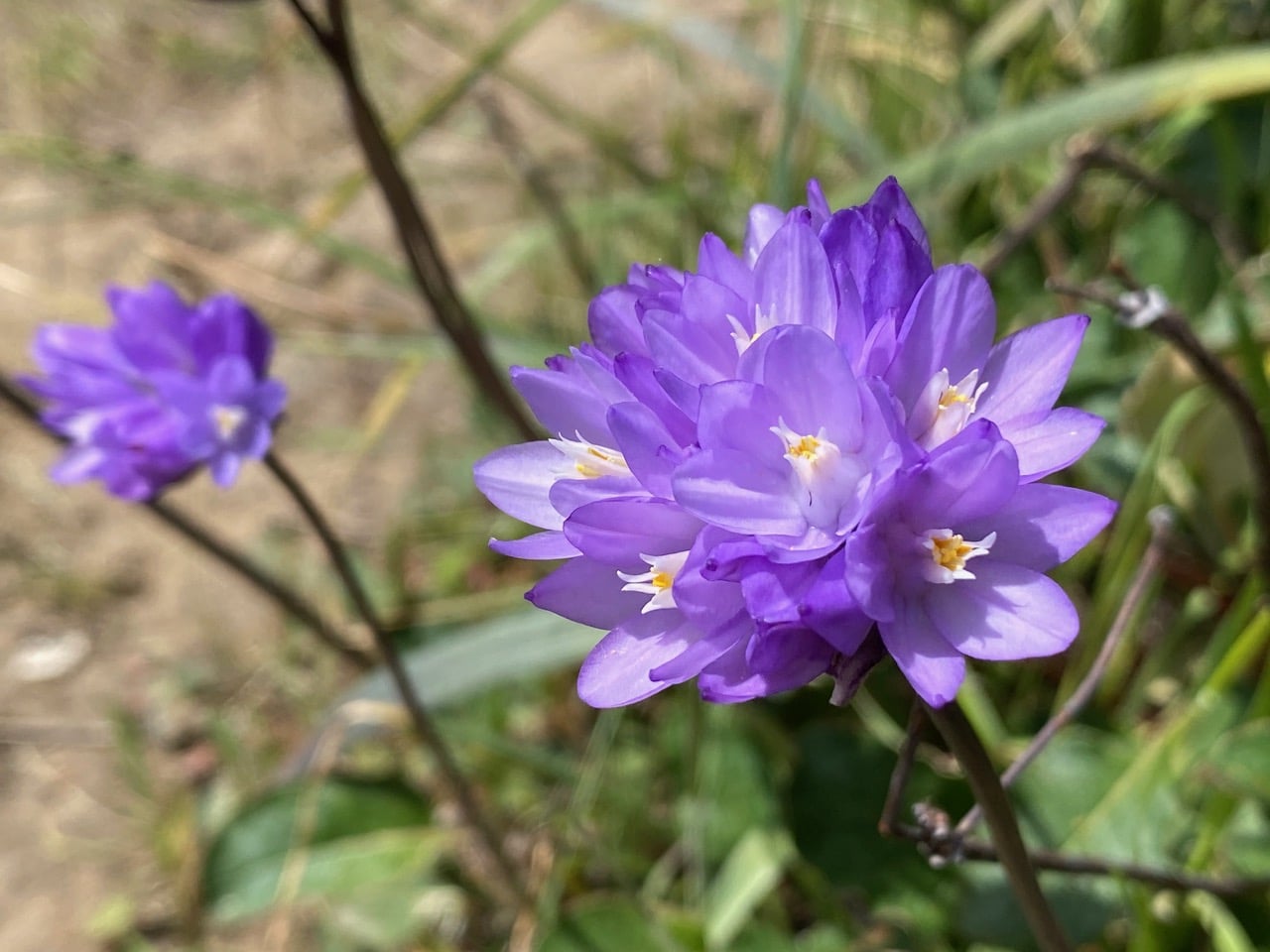






Across the trail, clusters of Blue Dicks, Dipterostemon capitatus have reared their cheery heads on the grassy hillside
Each Blue Dicks flower cluster contains 2 to 15 flowers. Each flower forms a cylinder at its base. Petal-like tepals spread open at the top of the corolla. There are 6 stamens Three forked, white filament sheaths grow from a wide base at the center of the flower, forming a sort of protective crown surrounding the reproductive parts. The anthers are bright yellow and produce yellow sticky pollen. The inconspicuous pistil is just shorter than the anthers and consists of a three-chambered superior ovary, a three-style and a three-crested stigma. The flower requires precision pollination – only insects with long proboscis can reach the nectar at the base of the flower.
That is the biggest cluster of Blue Dicks flowers I have ever seen! From where we sit, we can see a few Greater Bee Flies, Bombylius major (family Bombyliidae) probe for nectar from the Blue Dicks on the slope, hovering in front of each flower and aiming their long proboscis through the white “crown”. They are rather wary and fly away whenever I approach for a picture.
I scramble down the slope to check on a small bright patch California Goldfields, Lasthenia californica.
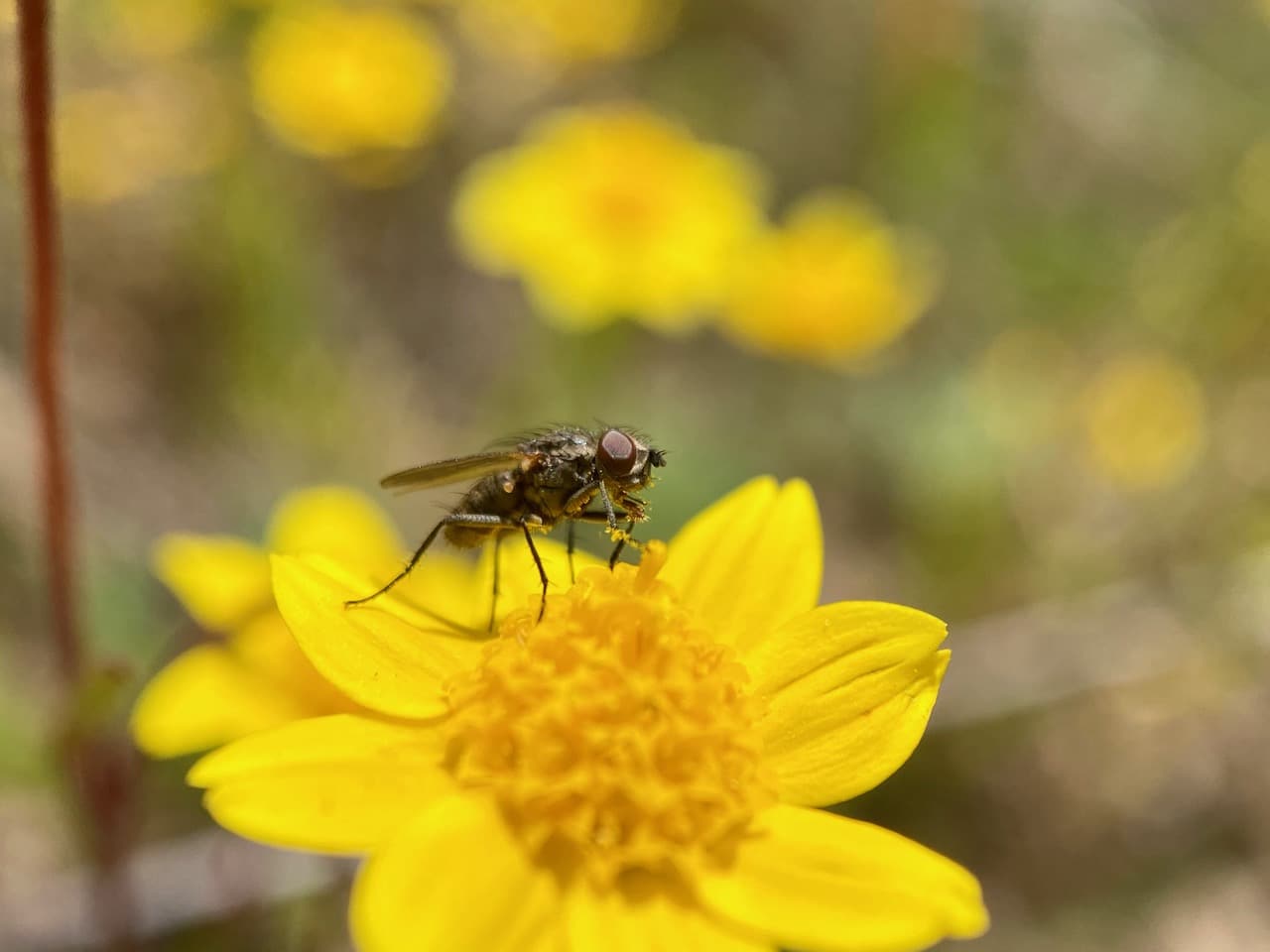
A small, dark, bristly fly is foraging on a Goldfields flowerhead, its legs mired in the sticky pollen. It appears to be a Woodlouse Fly (family Rhinophoridae).
These small, black, bristly flies are somewhat related to the Tachinidae. The larvae are mostly parasitoids of woodlice (pill bugs), beetles, spiders and other arthropods, and occasionally snails. Adult female deposits the eggs near woodlice. The first instar larva attaches itself to a passing woodlouse and enters the body of the freshly molted host. The larva feeds on the hemolymph and organs of the host until pupation, leading to the death of the host. Adult fly emerges from the pupa from inside the empty exoskeleton of the host. Adult Woodlouse Flies primarily feed on nectar and plant juices.

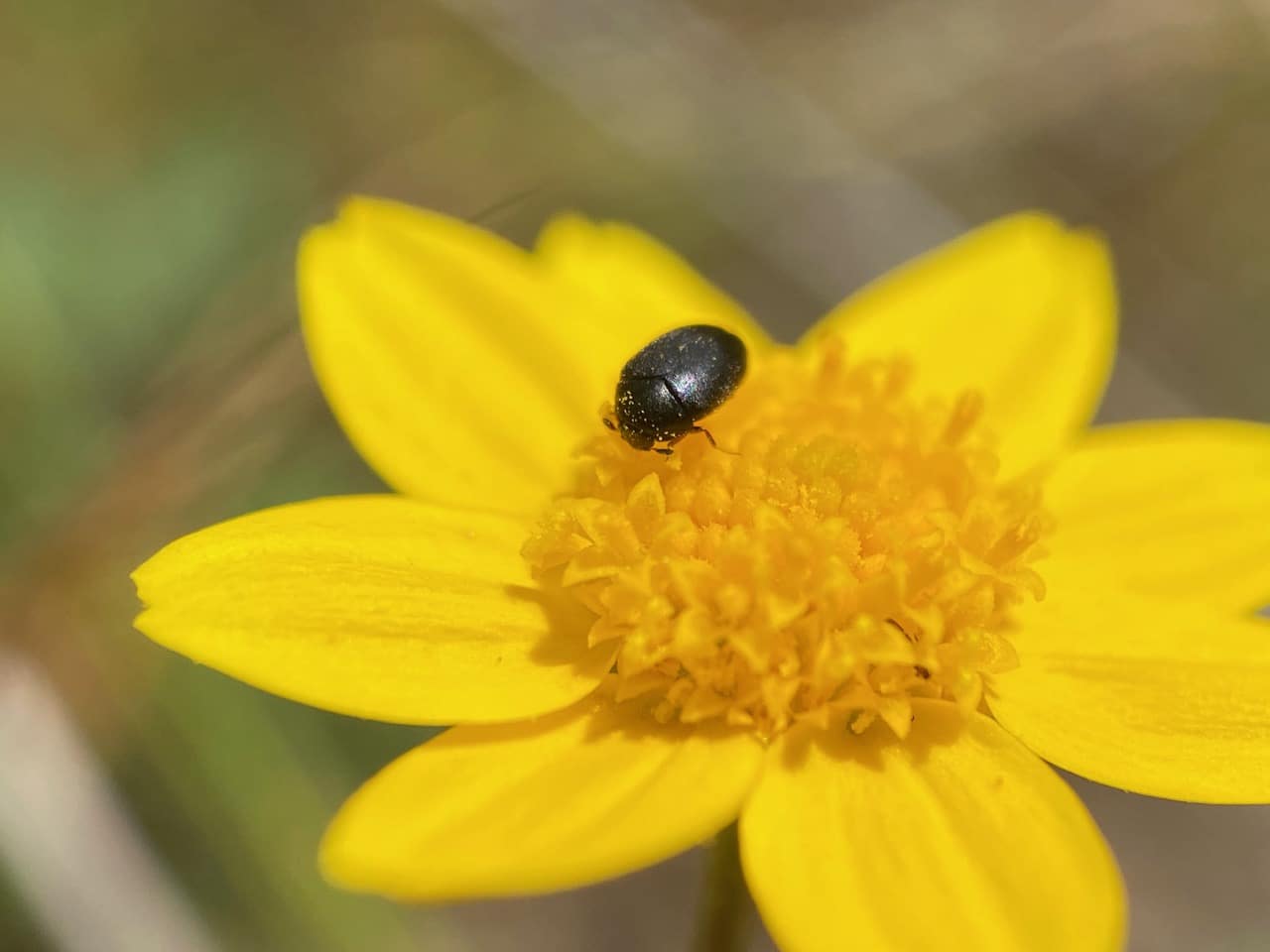
A Skin Beetle, Cryptorhopalum sp. (family Dermestidae) is feeding on the pollen of Goldfield flowers.
Dermestidae are a family of Coleoptera (beetles) that are commonly referred to as skin of carpet beetles. Ranging in size from 1 to 2 mm, the beetles typically have clubbed antennae that fit into deep grooves. Most Dermestids are scavengers that feed on dry animal or plant materials, such as skin or pollen, animal hair, feathers, dead insects and natural fibers. The larvae are used in taxidermy and by natural history museums to clean animal skeletons.
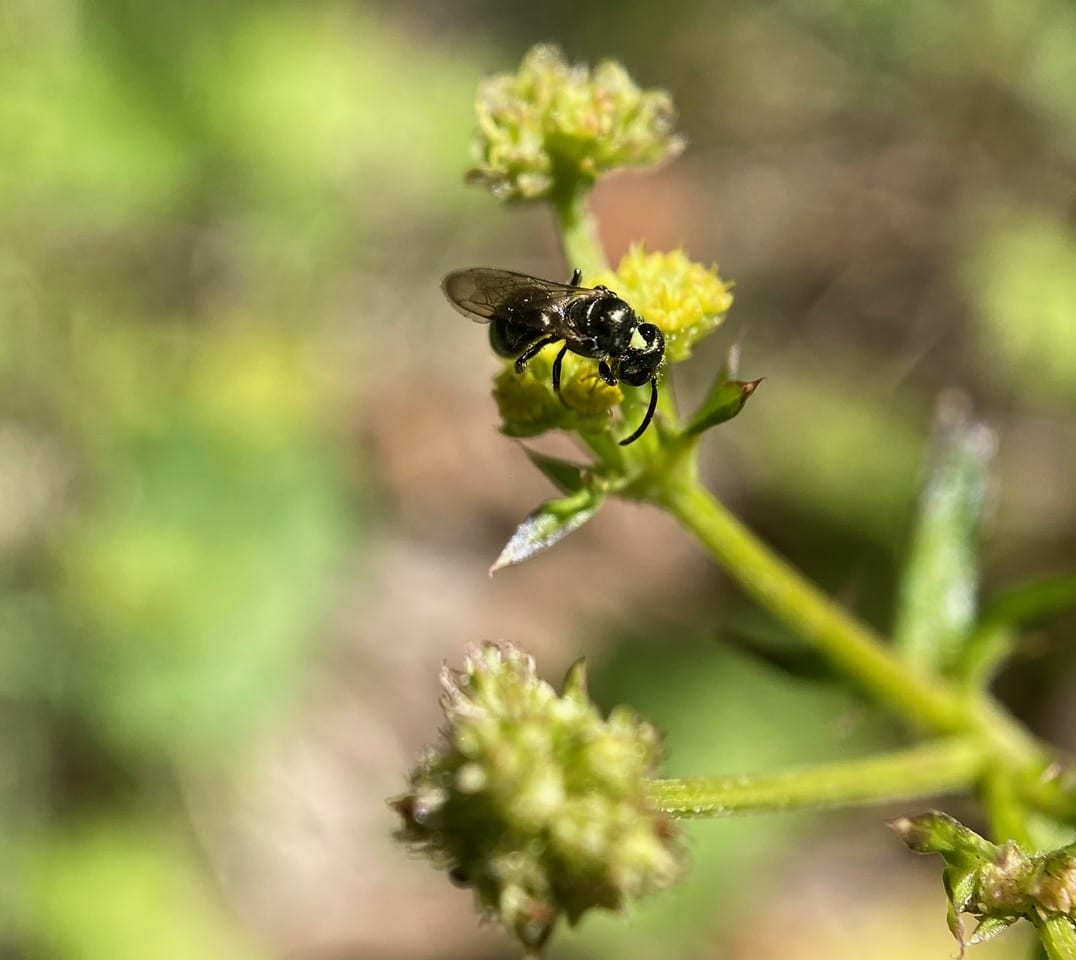
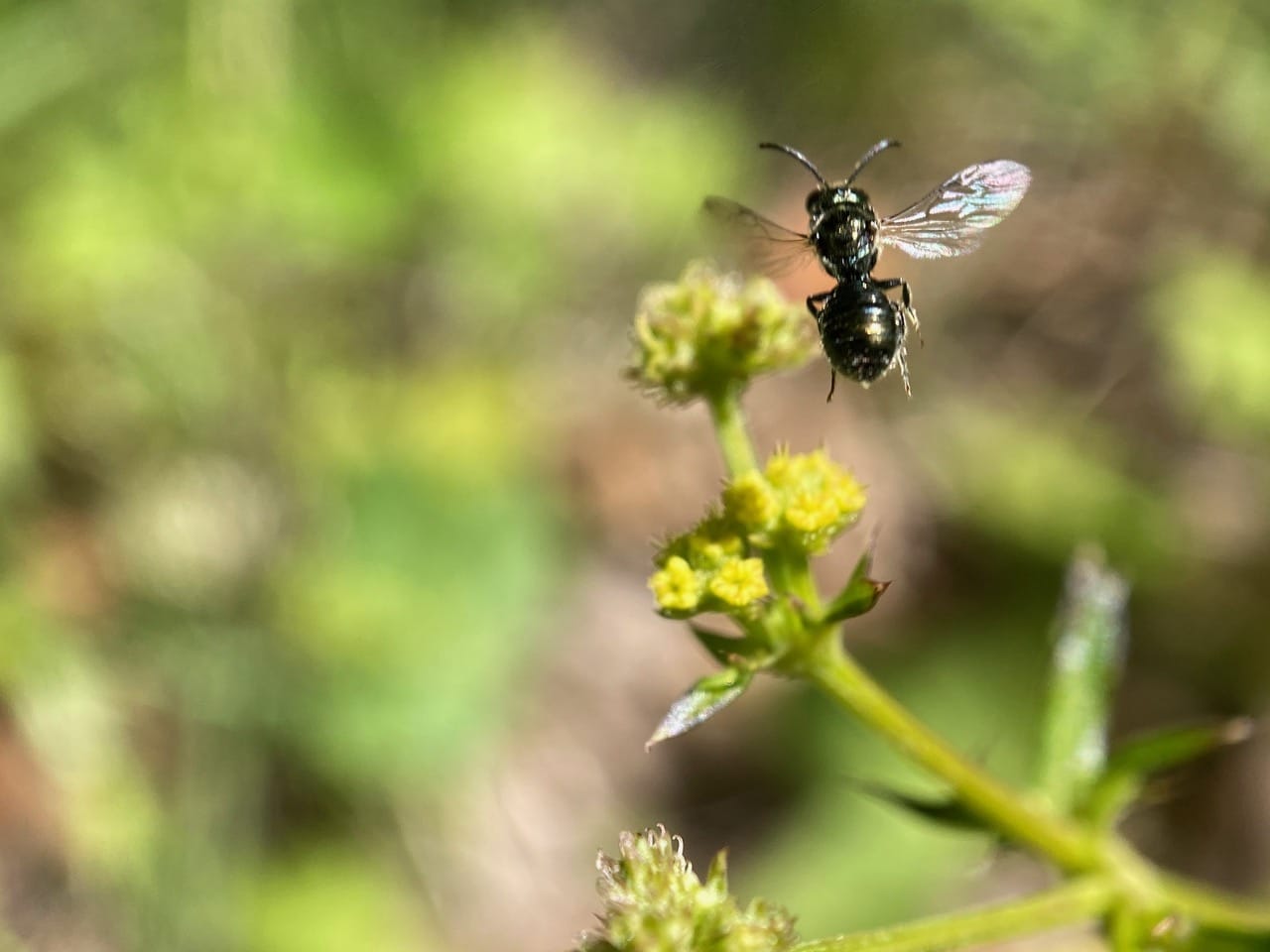
A Small Carpenter Bee, Ceratina sp. (family Apidae) is foraging on a cluster of flowers on Pacific Sanicle.
The Small Carpenter Bee genus Ceratina is closely related to the more familiar, and much larger Carpenter Bees (genus Xylocopa). Ceratina are typically dark, shiny, even metallic bees, with fairly sparse body hairs and a weak scopa on the hind leg. The shield-shaped abdomen comes to a point at the tip. Some species have yellow markings, often on the face.
Females excavate nests with their mandibles in the pith of broken or burned plant twigs and stems. While many species are solitary, a number are subsocial. Both male and female carpenter bees overwinter as adults within their old nest tunnels, emerging in the spring to mate. In the spring, this resting place (hibernaculum) is modified into a brood nest by further excavation. The female collects pollen and nectar, places this mixture (called bee bread) inside the cavity, lays an egg on the provision, and then caps off the cell with chewed plant material. Several cells are constructed end to end in each plant stem.

I am always amazed at how far a bee can bend its head. The bee’s head is connected to its thorax by a flexible, yet sturdy, articulation point, allowing for movement and flexibility in the head and thorax.
A bee’s “neck” can be very muscular. It is composed or multiple unique muscles made of various fibers. Direct and indirect muscles contract to control translation, rotation, pitch, and yaw, and have a variety of attachment sites. Bees have fixed eyes, and use their neck to move their whole head to see, and to accomplish a variety of other tasks. The bee uses its neck to stretch into flowers for nectar. Females use their neck muscles when collecting and constructing with nest materials. The innervated muscles also sheath and protect the vital dorsal aorta and the integral nerve cords connecting the brain with the body.
A lucky shot of the bee lifting off.
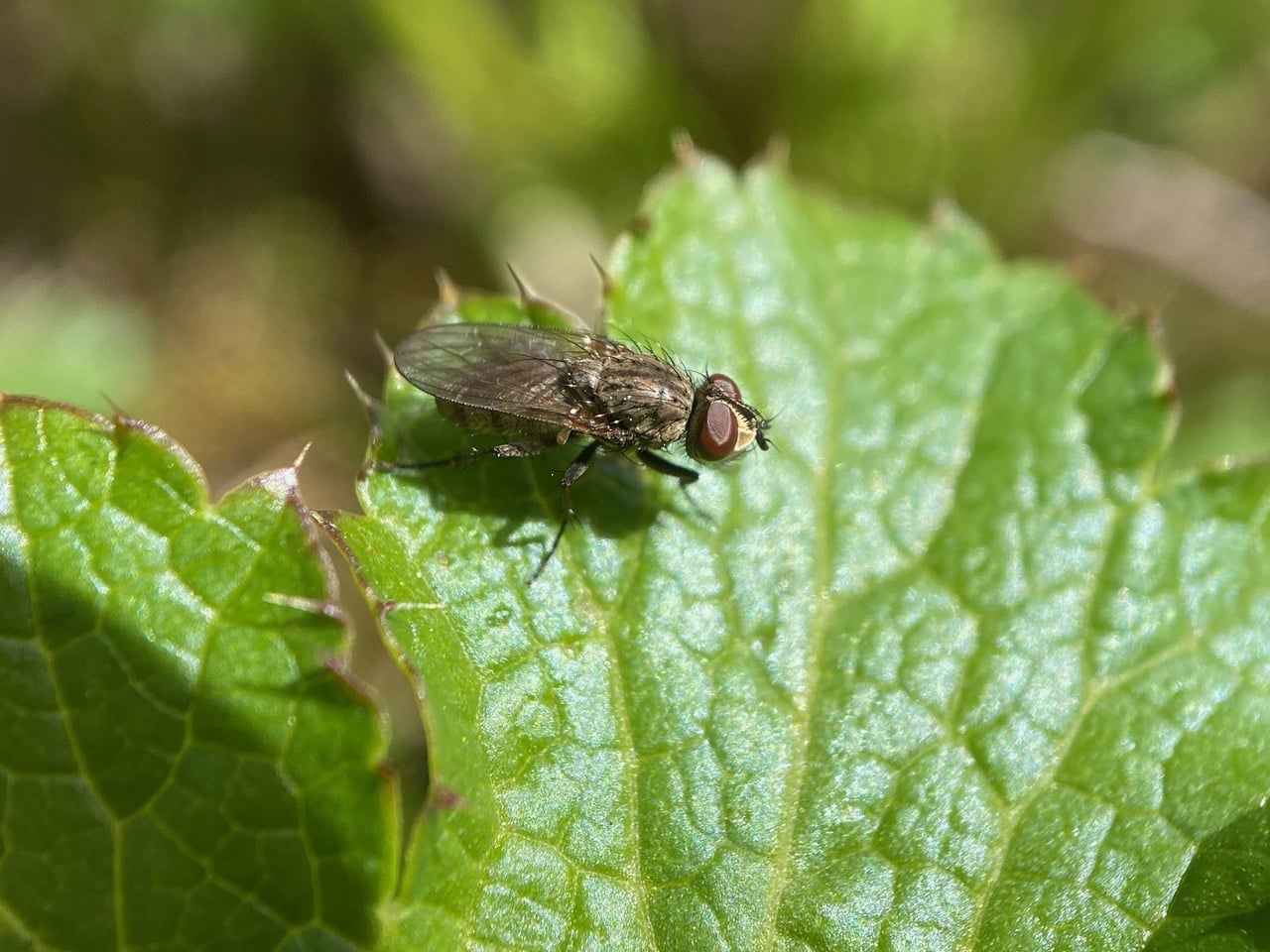
An unidentified fly is walking on a leaf of Pacific Sanicle.
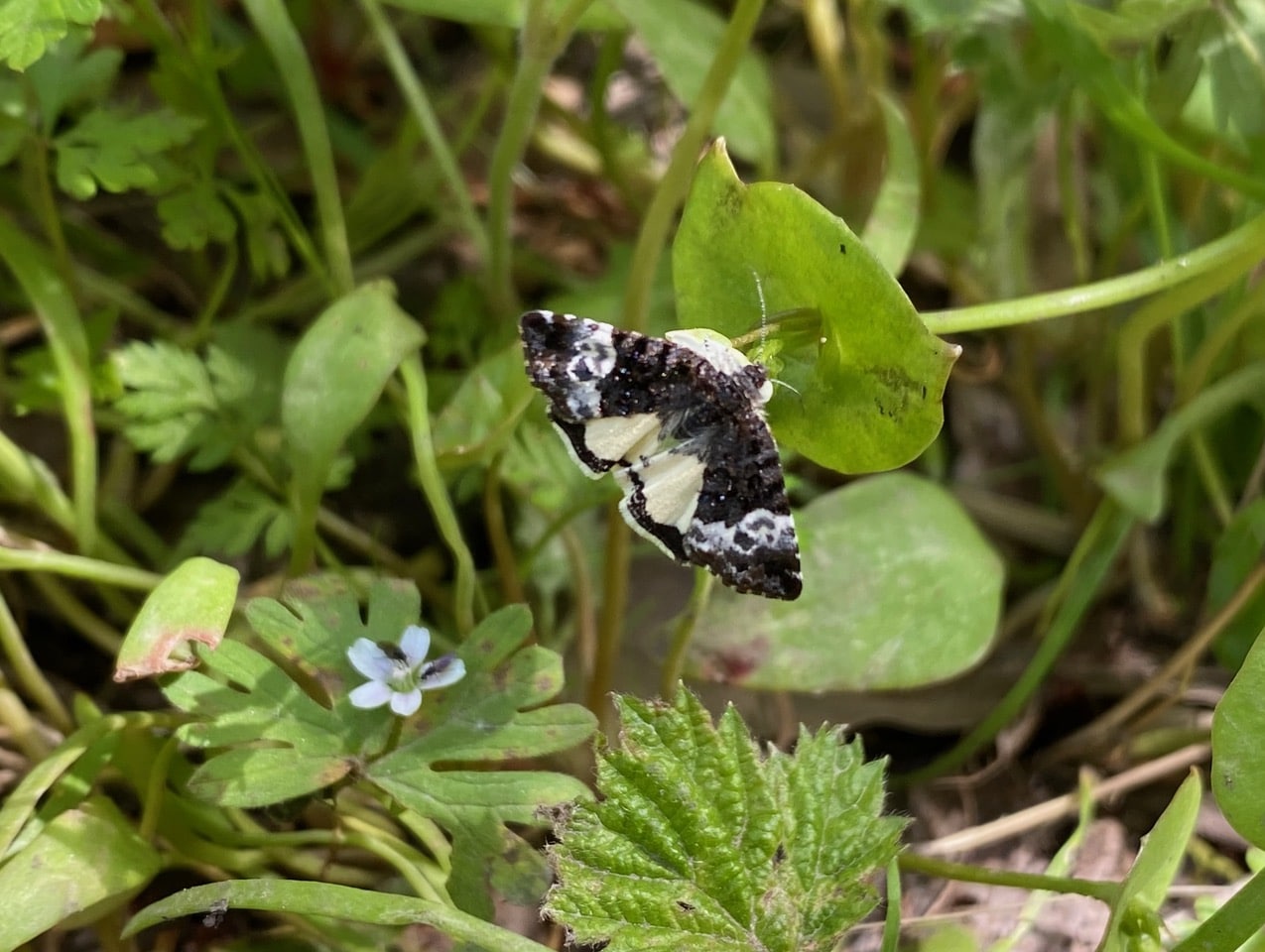
Wow, that’s a stunning moth on the Miner’s Lettuce, Claytonia perfoliata! iNaturalist has helped identify the moth as the White Annnaphila, Annaphila diva (family Noctuidae).
White Annaphila, Annaphila diva (family Noctuidae) is a small (forewing length 10-11 mm) day-flying moth that flies in the spring, during April and May. The species is found in the western part of the Pacific Northwest, extending to southern California west of the crest of the Sierra Nevada. The moth is common and widely distributed in moist riparian habitats along creeks at low to high elevations in the Coast Range and along the west slope of the Cascades. Adults’ forewings are black with white markings. Their hindwing are white bordered with black. The larvae are food plant specialist feeding on Miner’s Lettuce, Claytonia perfoliata (family Portulacaceae).
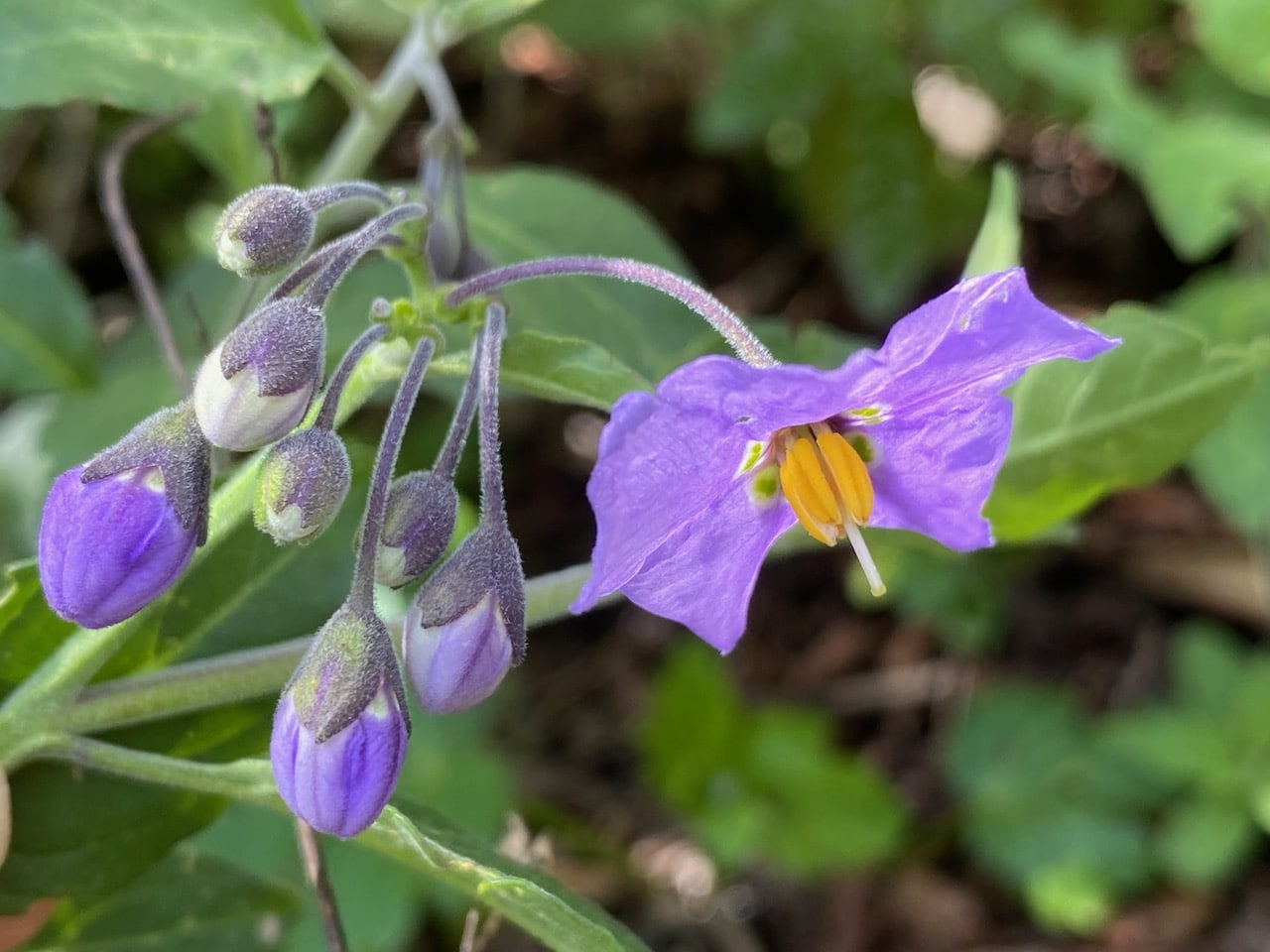
The Bluewitch Nightshade, Solanum umbelliferum has started to bloom.
Solanum flowers are often used as the standard model for the study of buzz pollination. The tubular anthers are clustered in the center of the open-faced flower, forming an anther cone surrounding a sturdy style, These anthers are poricidal, meaning they have a tiny opening or pore at their tip through which pollen is expelled. When the flower is shaken or vibrated at the appropriate frequency, the dry pollen is released through the pores, similar to the way salt shakers work. Solanum flowers tend to nod or droop, so pollen release is aided by gravity as well.
How does buzz pollination work? When a bumble bee attempts to collect pollen from a Solanum flower, it grasps the anther cone with its legs or mouthparts. Hanging upside down, the bee decouples its wings from its flight muscles in its thorax, so that when it vibrates those flight muscles, the wings don’t move, but its body vibrates violently. The bee’s buzz suddenly shifts from the low hum typical of flight to a fevered high pitch that is audible to a human ear. The vibration shakes the pollen out of the anthers onto the bee’s body. Very efficiently, the bee grooms the pollen into its pollen baskets for transporting to the hive. On subsequent visits to other flowers of the same species, the pollen that remains on its body might rub off on the protruding stigma, effectively pollinating the flower. Honey bees are not capable of buzz pollination. The technique is used mainly by bumble bees, carpenter bees, some digger bees, and sweat bees.
Approximately 6-8% of flowering plants are dependent on buzz pollination, many from unrelated families, representing examples of convergent evolution. The traits shared by these flowers include: pendant flowers, radial symmetry, reflexed petals, prominent cone of stamens with short robust filaments and poricidal anthers, a simple style that protrudes from the tip of the anther cone, and an absence of nectar. A prominent example of a buzz-pollinated flower in our native flora is the shooting star (Primula) in the primrose family.
An adult male Pacific Coast Tick, Dermacentor occidentalis (family Ixodidae) is resting on the leaf tip of a Bee Plant.
Ticks pick a place to wait by identifying well-used paths, resting on the tips of grasses and shrubs. They find their hosts by detecting animals’ breath and body odors, or by sensing body heat, moisture, and vibrations. Some species can even recognize a shadow. Ticks can’t fly or jump, but many species wait in a search position known as “questing”. Holding onto leaves or grass by their third and fourth pair of legs, they hold the first pair of legs outstretched, waiting to climb on to a passing host. When a host brushes the spot where the tick is waiting, it quickly climbs aboard. Recent research has shown that ticks are significantly aided by electrostatic forces (static electricity) when attaching to their hosts, allowing them to be passively attracted across air gaps to land on potential hosts due to the natural electrical charges animals accumulate on their bodies.
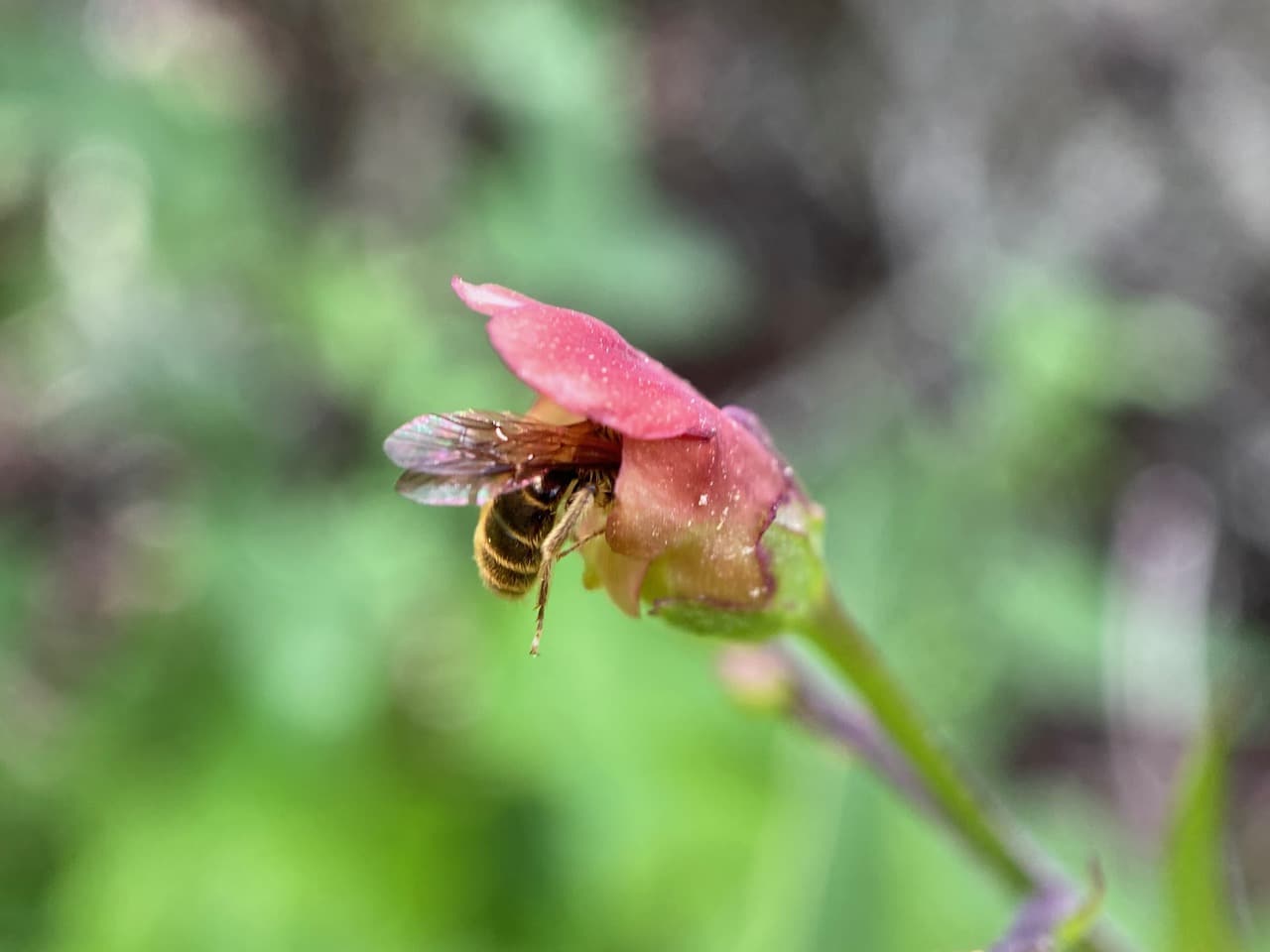
An insect has landed on a flower of Bee Plant, Scrophularia californica. Too big to enter the flower, it simply sticks its head inside, probably probing for nectar.
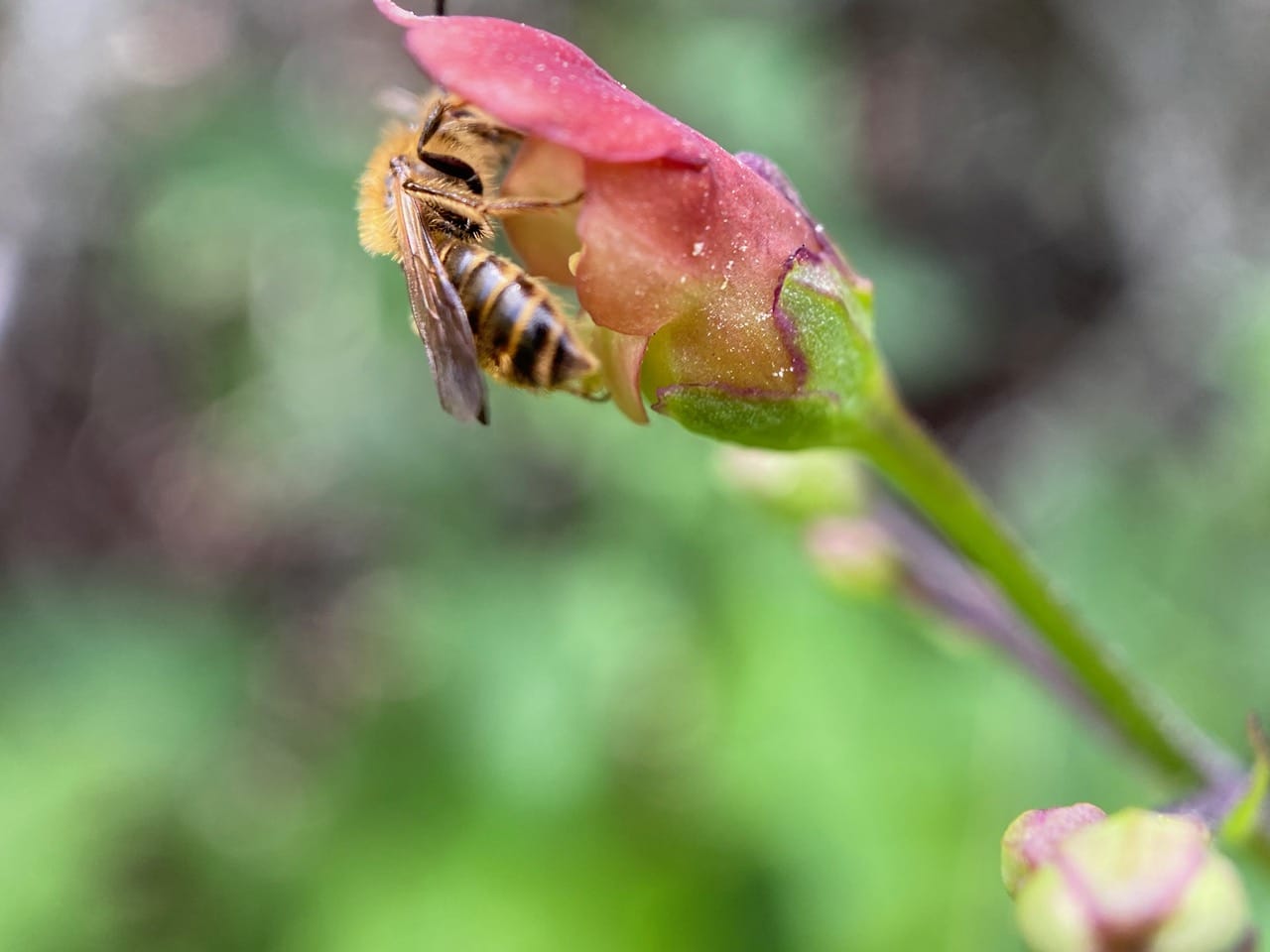
Ah, the bee is finally lifting its head out of the flower.
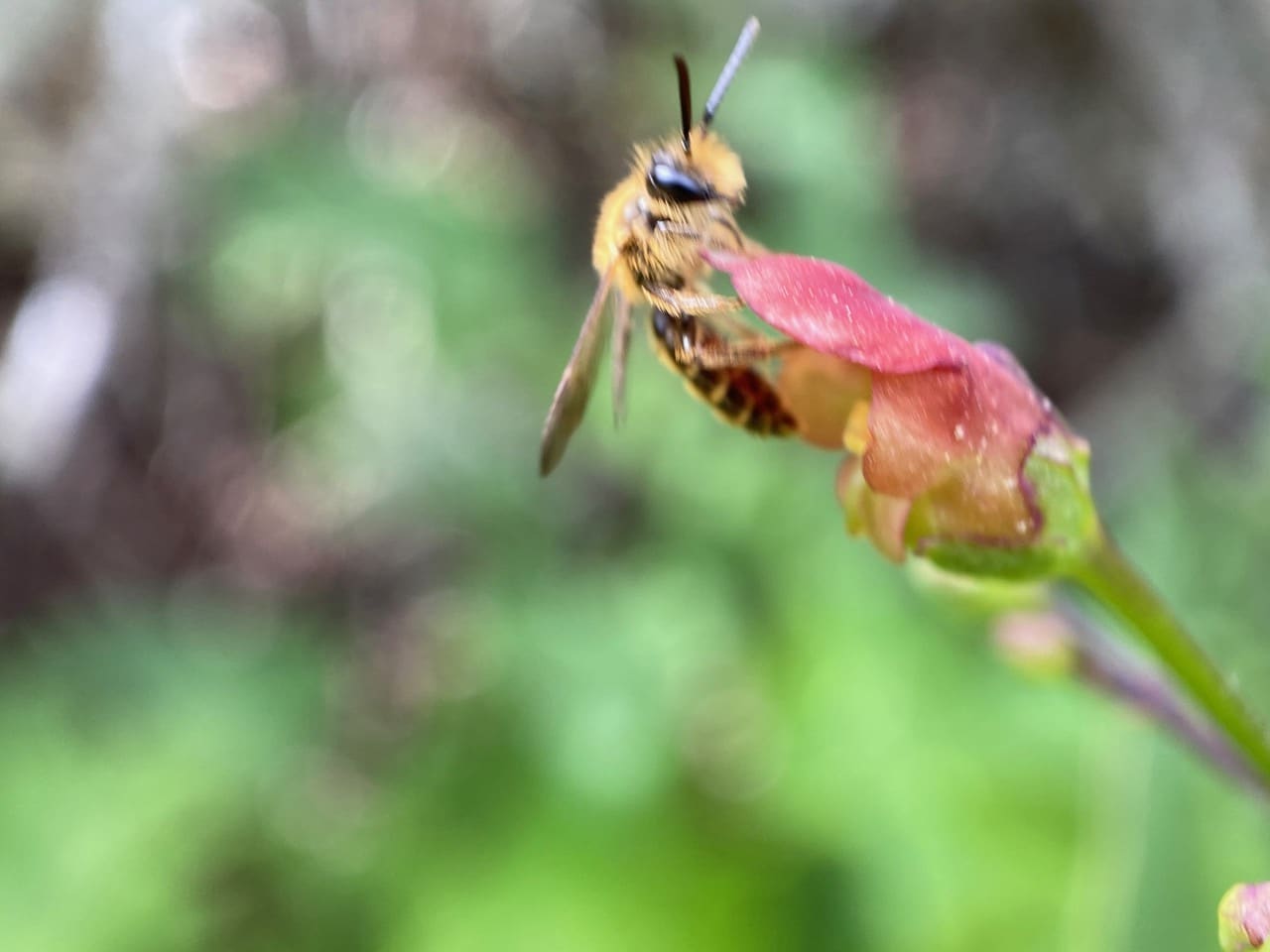
Before the bee flies off, I get a glimpse of its head. Ah, it’s a male Golden-haired Miner Bee, Andrena auricoma (family Andrenidae)
Bees in the family Andrenidae, commonly called miner bees or mining bees, are solitary ground-nesters. Andrenids are fairly small bees, usually dark-colored, and often banded. They are identified by the dense bristles (scopae) at the bases of the legs and the shin-like sections (tibias) of the legs, as well as by certain creases and grooves on the face and head and by unique wing venation. Many Andrenids resemble wasps – slender with long abdomen.
Most andrenids are specialist pollinators whose life cycle is timed to correspond precisely to the blooming of specific flowers.
The Golden-haired Miner Bee, Andrena auricoma (family Andrenidae) is found in western United States, and is relatively rare outside California. The female bees are 8-10 mm in length, and males are 6-9 mm long. The bees are generalist foragers, visiting flowers from many plant families.
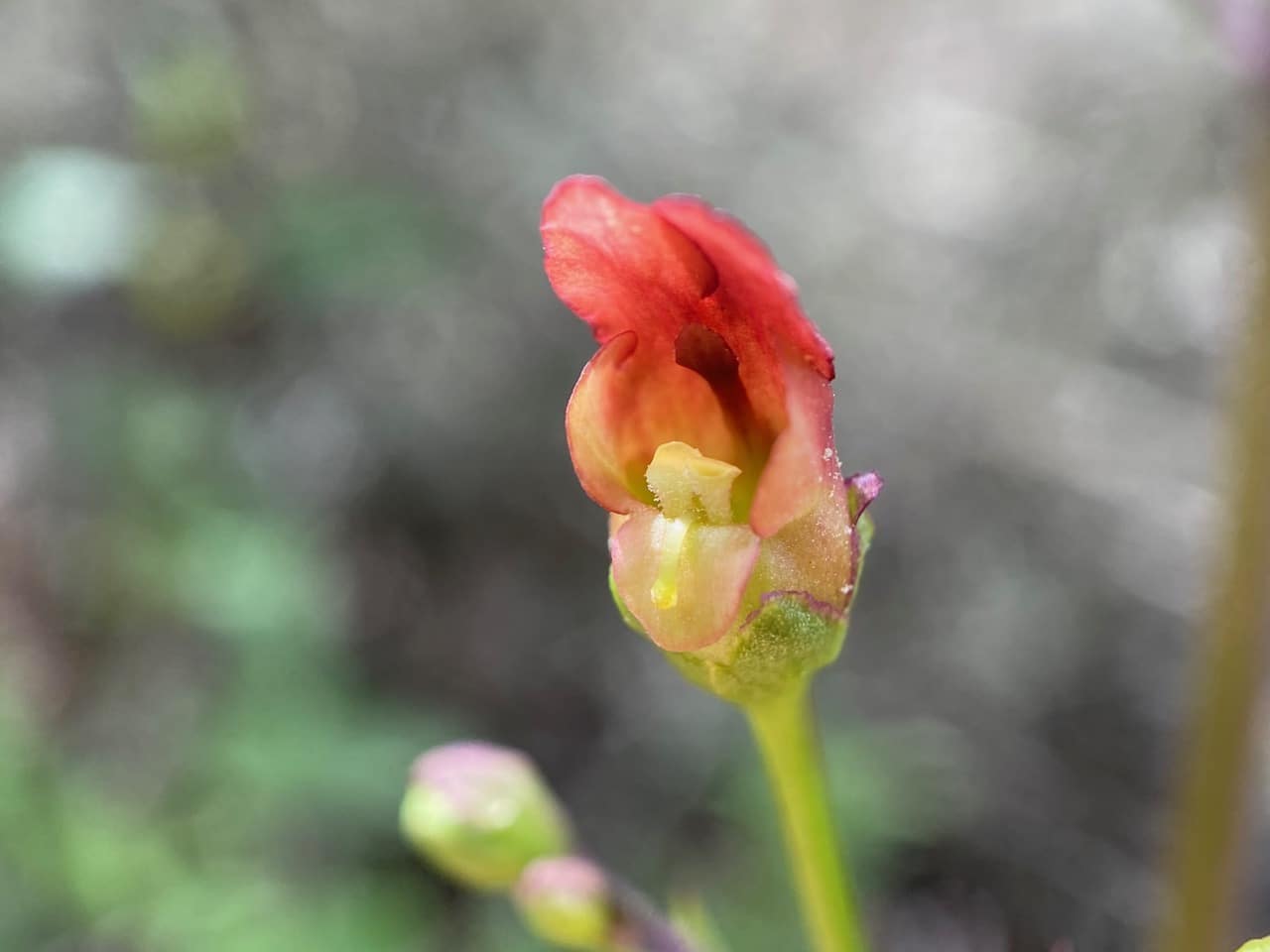
I take a close look at the Bee Plant flower after the bee has left. The flower is at the stage of transitioning from female to male phase.
The small, inconspicuous flower of the California Bee Plant is only about 1/4 in. in length, and displays bilateral symmetry, with two petals pointing up (like Micky Mouse ears) and three down; the latter sometimes appear as two petals to the sides and one down. There are 4 fertile stamens, more of less appressed to the lower portion of the throat and extending to the edge of the lower lobes. The fertile anthers are yellow (only two are visible here). The infertile fifth stamen is dark red, and mostly fused to the upper throat. There is a single style with a capitate stigma. The style is appressed to the lower portion of the tube and extends beyond the corolla, bending downward. The flower is protogynous, meaning the female parts (pistil) mature before the male parts (stamen).
The flower pictured here is at the stage of transitioning from the female to the male phase, still with a mature, receptive stigma. The stamens are not yet mature; only two of the four fertile anthers have been rolled out to the front of the throat, but are not yet dispensing pollen. Nectar is already produced to entice pollinators to visit and deposit pollen from other flowers. Dichogamy (temporal separation of the genders) is a floral strategy for avoiding self-pollination.
Blue-eyed Grass, Sisyrinchium bellum is blooming near the cattle gate at the Steam Train entrance.
Blue-eyed Grass, Sysyrinchium bellum is not a grass but an iris, native to California, western Oregon and northwestern Mexico. The perennial herb has a flower with 3 sepals and 3 petals that look alike (together called tepals) and that form a shallow saucer around the stamens and pistil. At the base of each blue petal is a bright yellow, fringed shape; together these form a yellow spot at the center of the flower. Dark blue lines converge on the yellow center, serving as nectar guides for pollinators. The flower is highly conspicuous to bees as they have maximum visual acuity for blue and yellow in the color spectrum. I have seen bees of all sizes visit the Blue-eyed Grass, from bumble bees to the smallest sweat bees. The flowers are also visited by many hover flies.
Close-up showing the reproductive structures of the Blue-eyed Grass.
There are three stamens, their filaments fused into a column around the pistil; the 6 anthers form a bright yellow scalloped umbrella on top. There is one pistil with an inferior, three-chambered ovary. The style is largely concealed by the filament column but can sometimes be seen as a tiny spire projecting from the top of the anther ring. The anthers release pollen before the style lengthens and protrudes. This is a case of protandry, whereby male parts of a flower matures before the female parts. The temporal separation of the sexes helps prevent self-pollination.