

Pollinator Post 6/10/25 (1)

I am thrilled to have been invited to visit a home garden in south Berkeley. Donna and Ken’s native plantings are about 4 years old, making up the majority of the plants in their lovely garden.
The first thing that catches my eye is a faded Lady Beetle pupa on a leaf of Manzanita. Closer inspection reveals that it is an empty pupa case from which the adult beetle has already emerged.
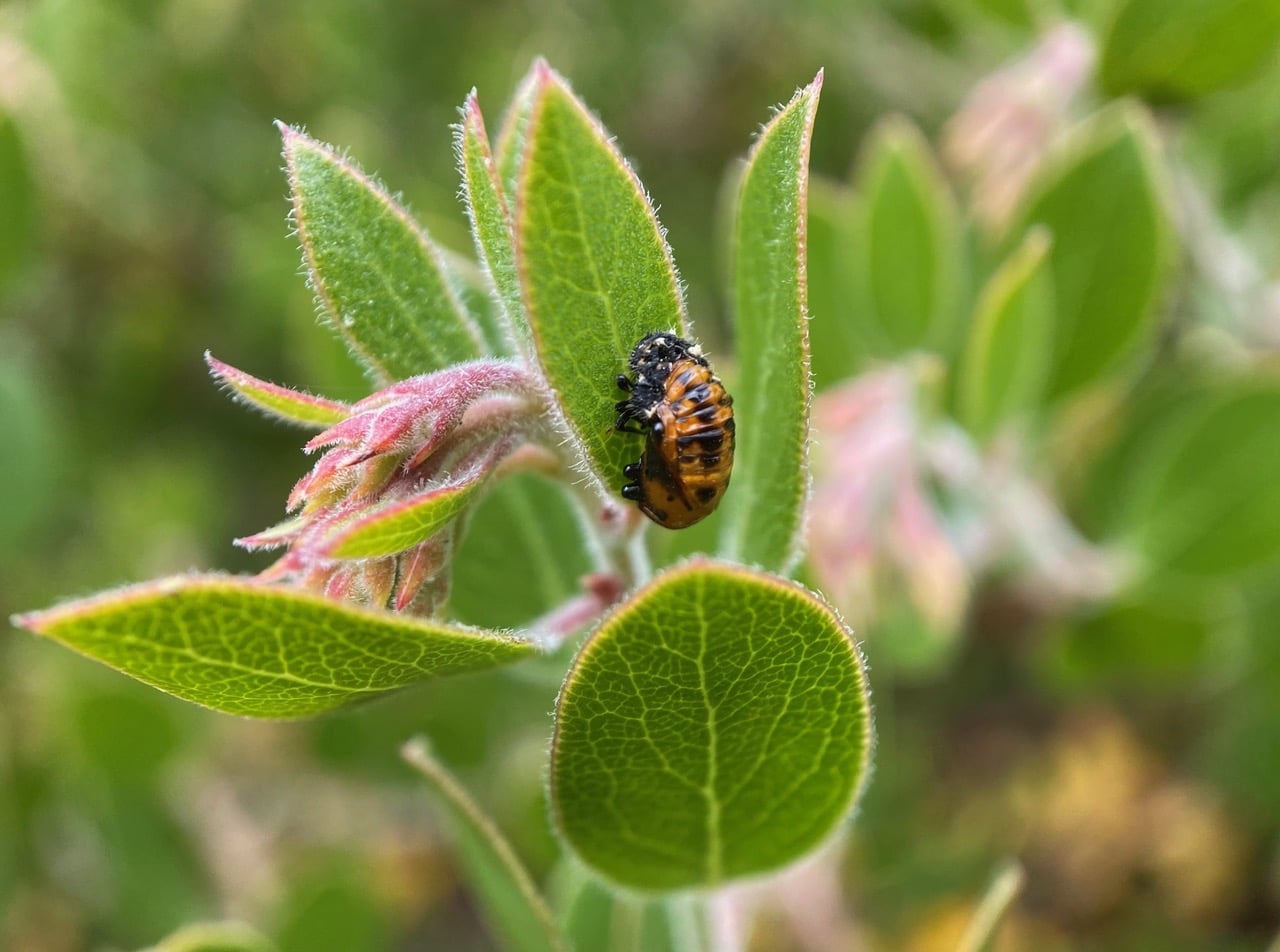
Scanning the plant, I see many more of the Lady Beetle pupae attached to the leaves.
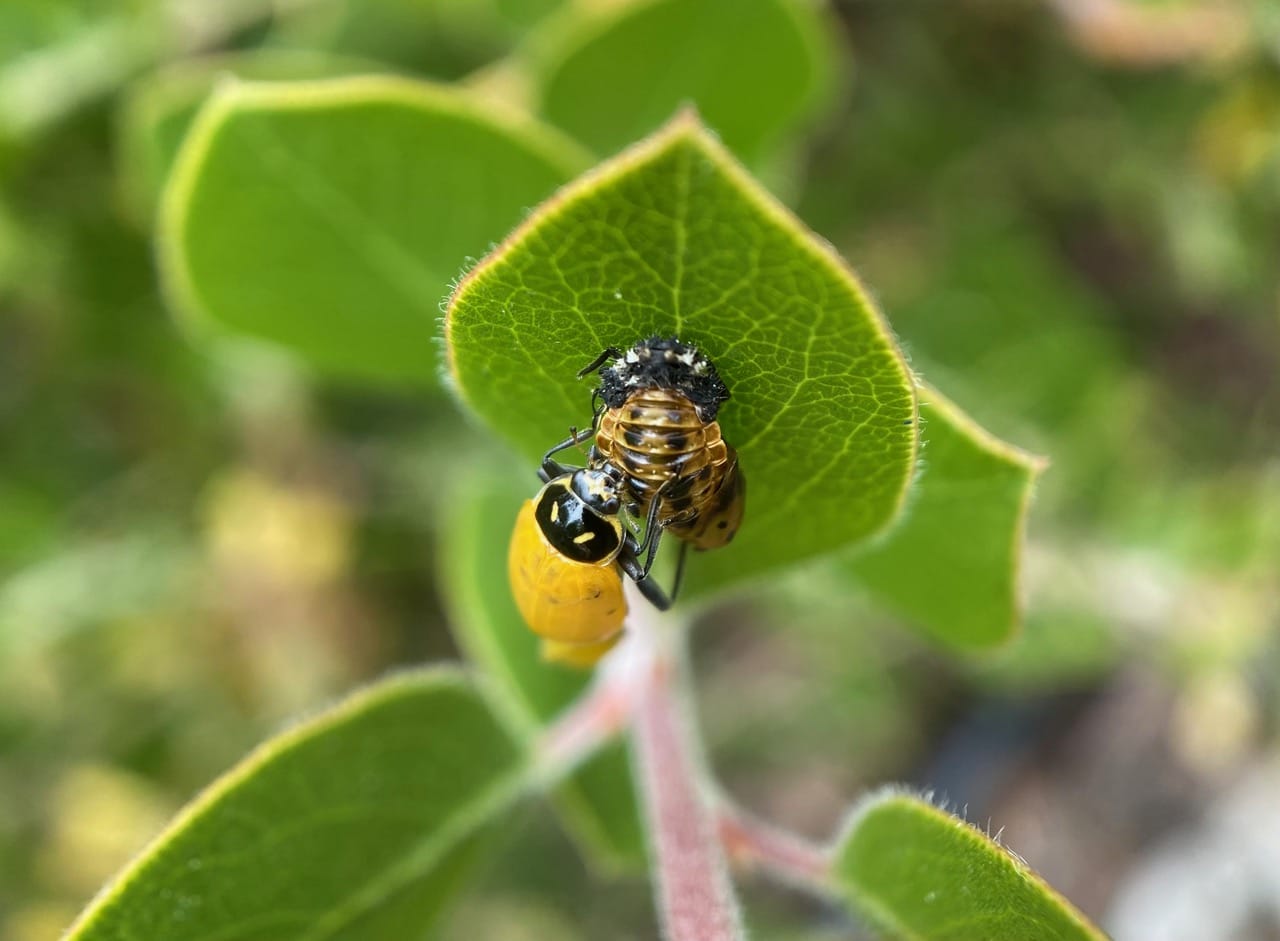
Ah, this is precious! A Lady Beetle has freshly eclosed, still clinging to its pupa case. From the two white converging lines on its black pronotum, I gather that it is a Convergent Lady Beetle, Hippodamia convergens (family Coccinellidae). It will take some hours for the red coloring and black spots to develop on its elytra.
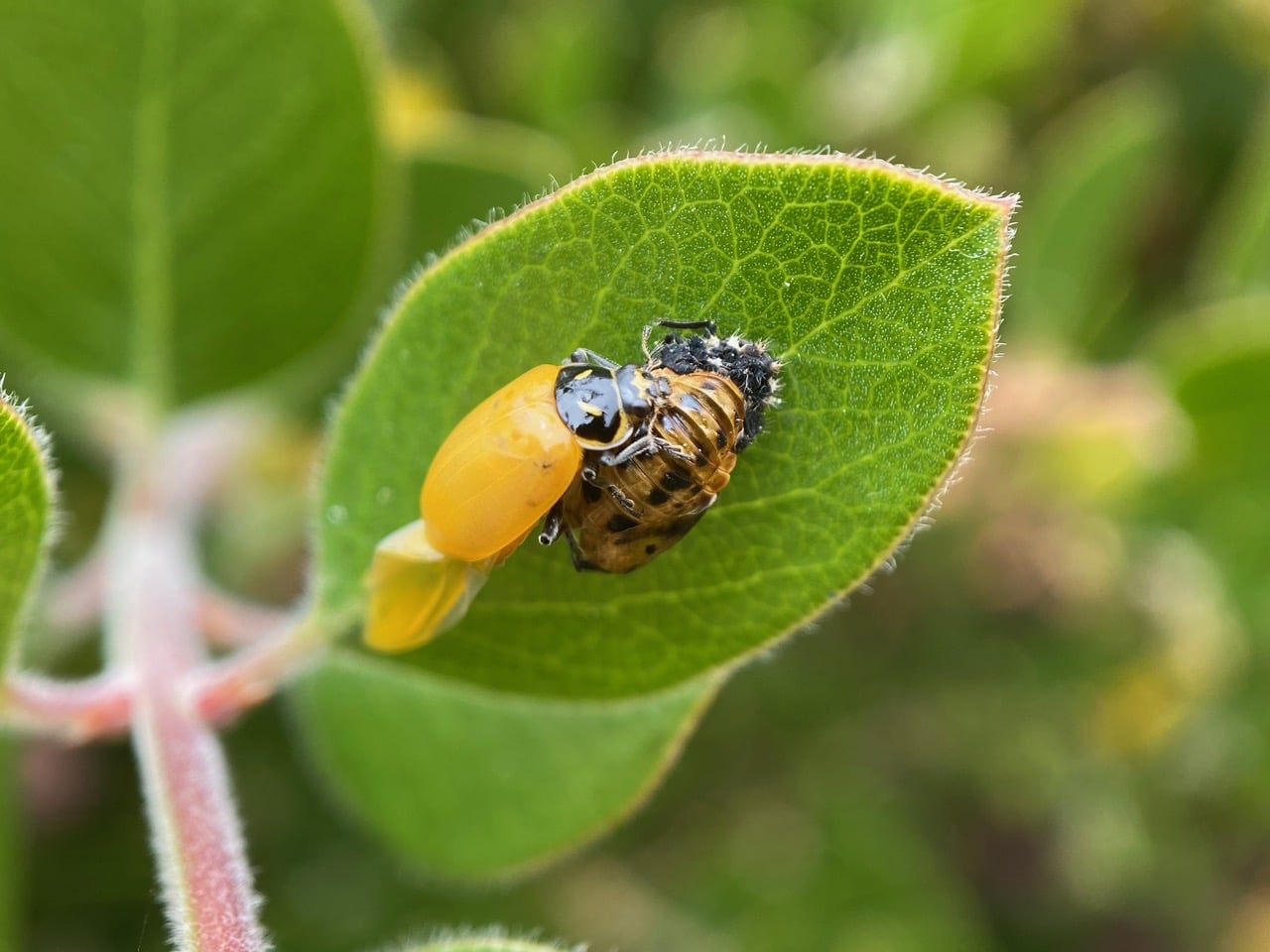
The newly eclosed Lady Beetle stretches out its flight wings from under its elytra – these need to harden and dry before the beetle can fly.
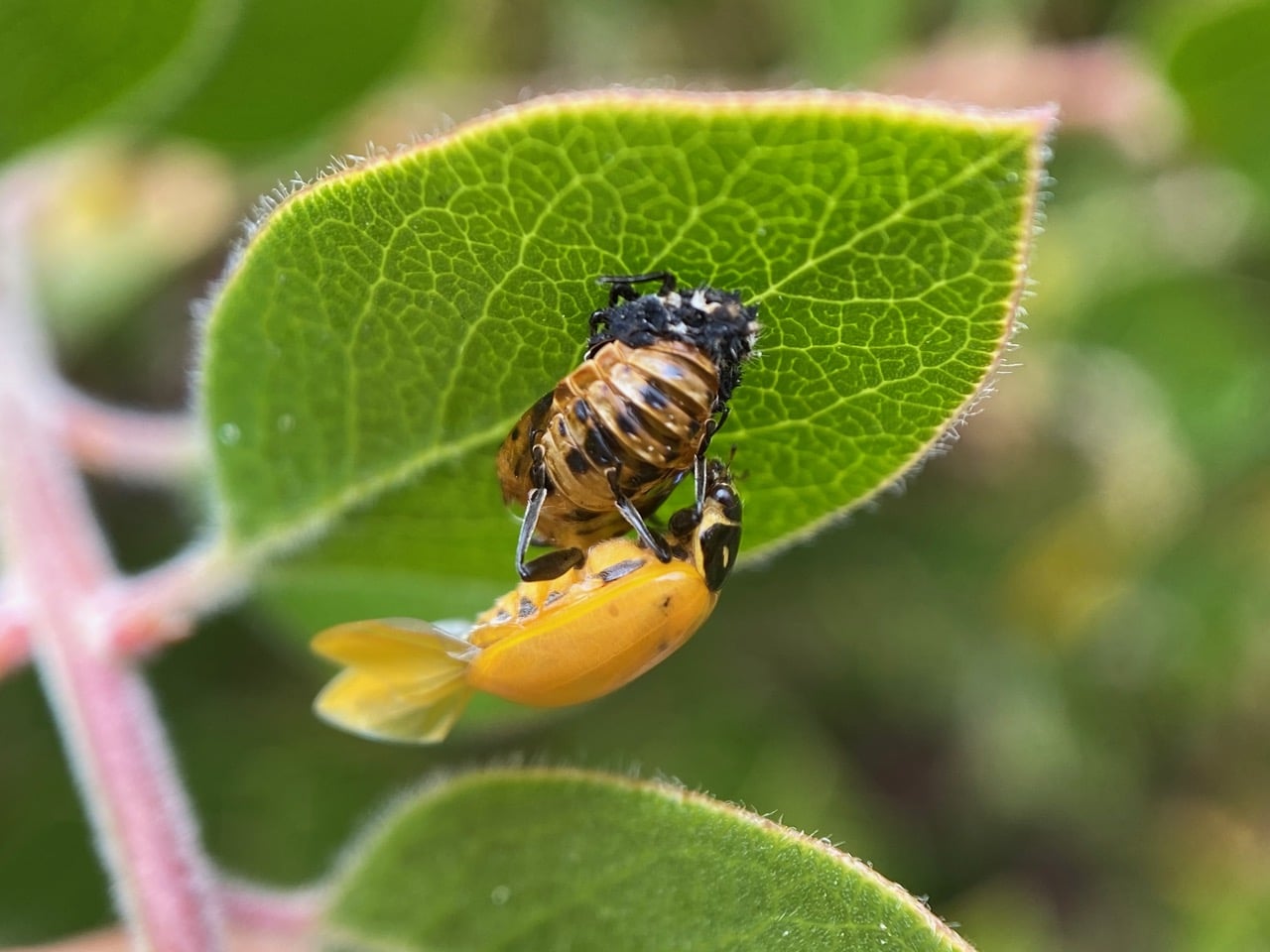
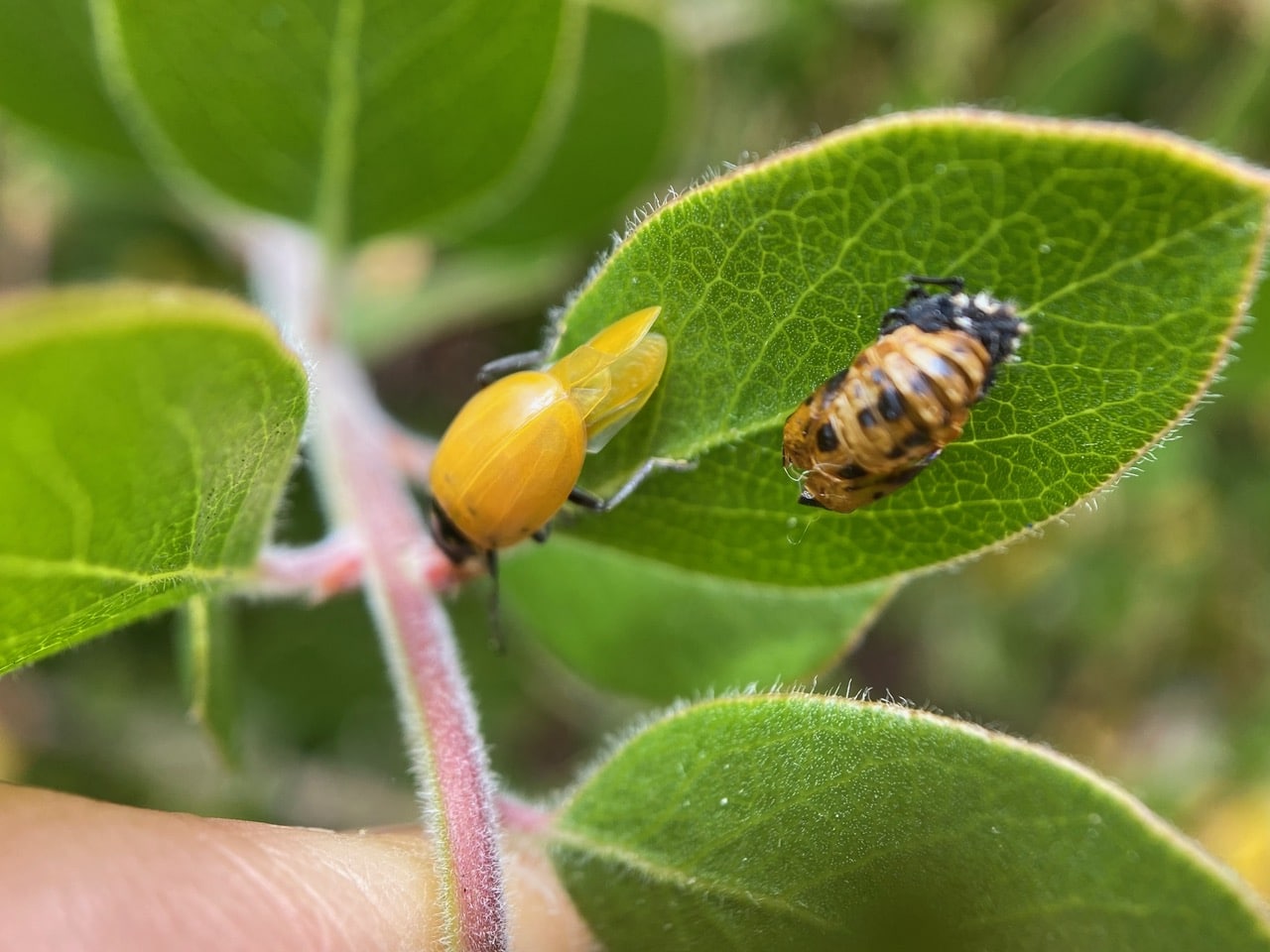
The beetle eventually moves away from its pupa case for more room to spread its flight wings.
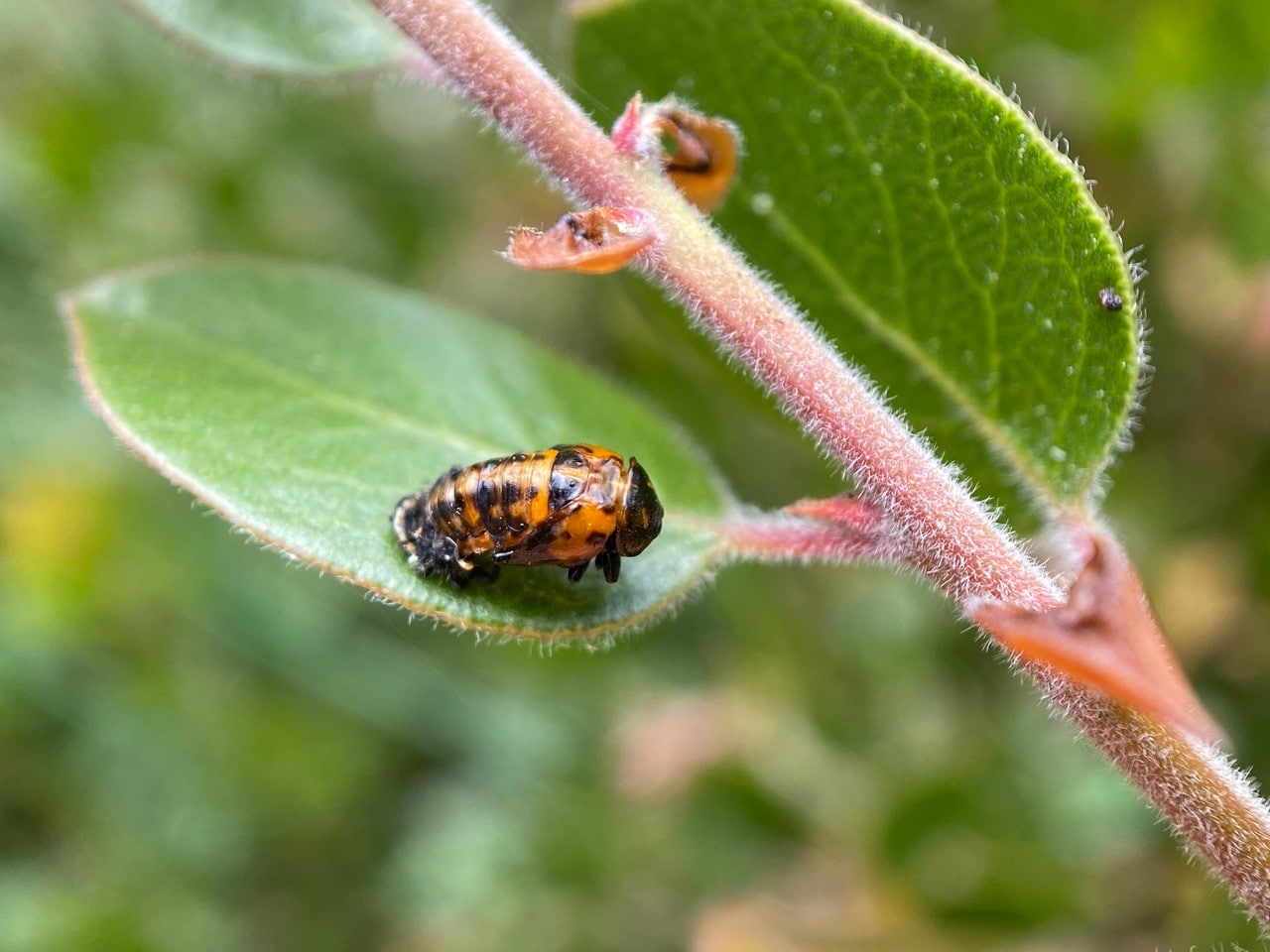
Not far away on the same Manzanita, a Convergent Lady Beetle pupa is stirring, occasionally lifting its front end off the leaf surface. It’s about to emerge! Since there is much to see in the garden, I didn’t wait around to watch the process.
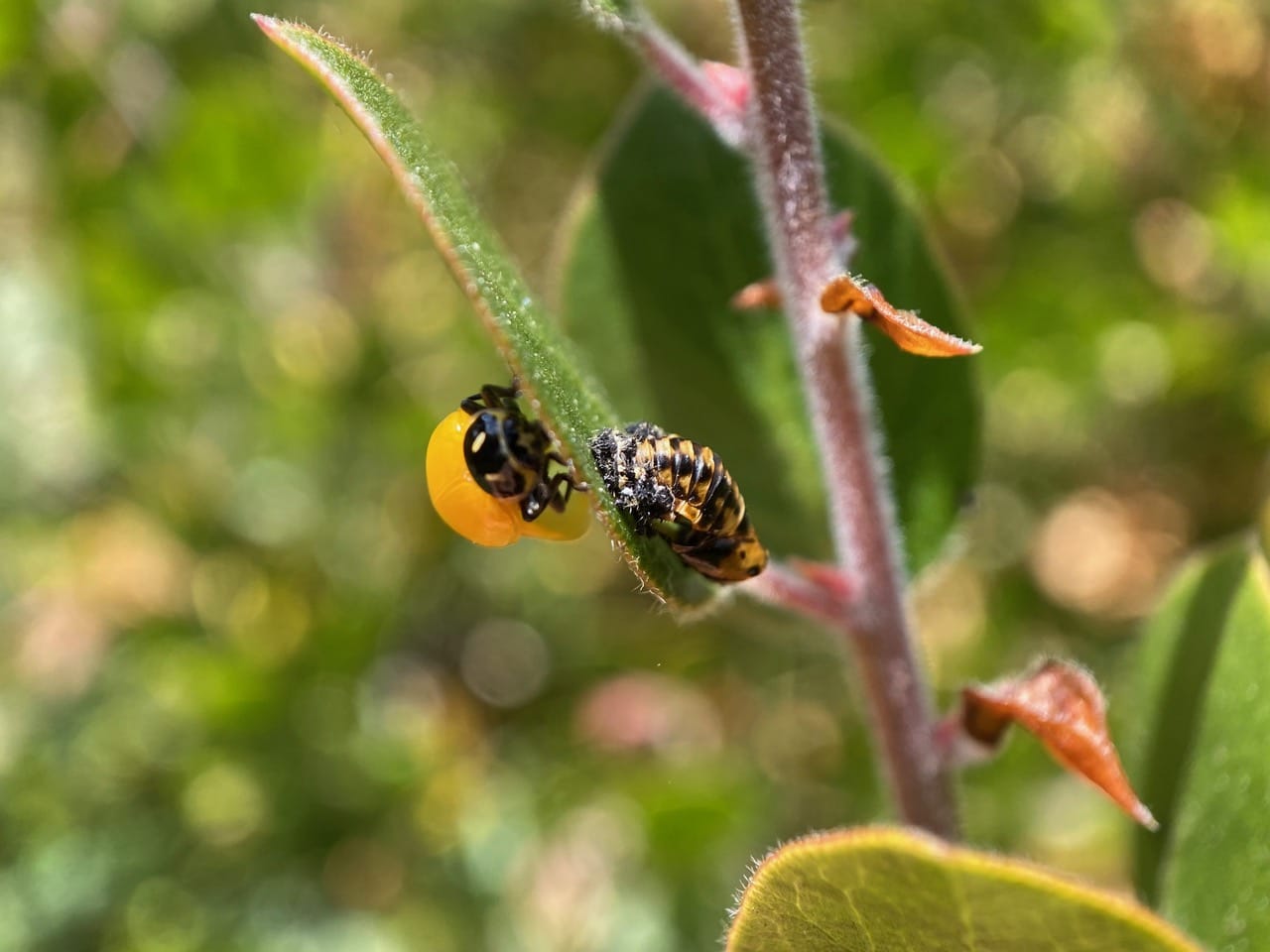
About 30 minutes later when I return to the pupa, the adult has already emerged and has moved to the other side of the leaf. It too is drying its flight wings.
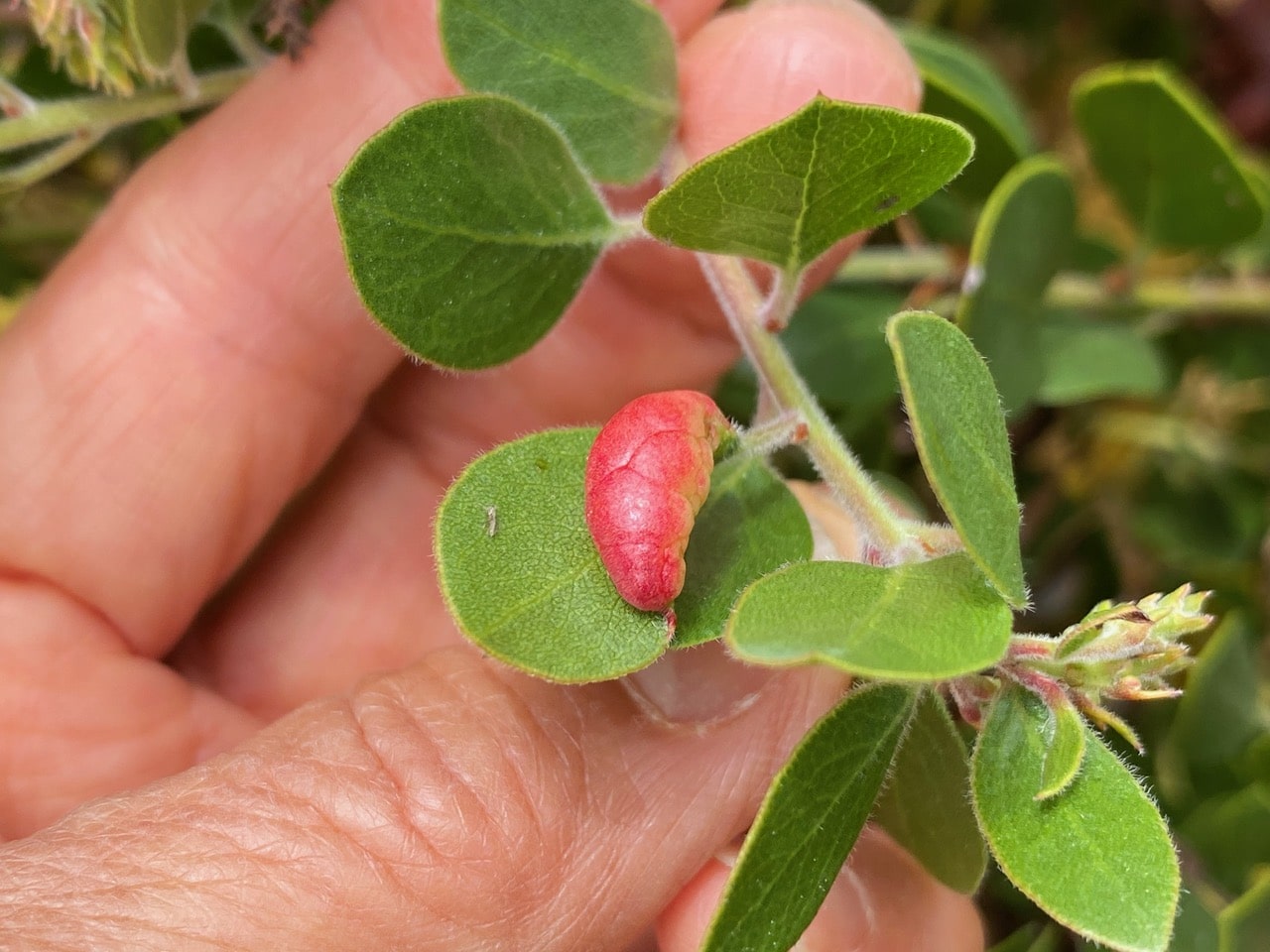
I spot a red swelling on the margin of a Manzanita leaf. It is a gall induced by the Manzanita Leafgall Aphid, Tamalia coweni (familt Aphididae). Since there are only two of these galls on the plant, I refrain from opening one up to see the critters inside. Instead, I will share an old picture of an opened gall from last year.
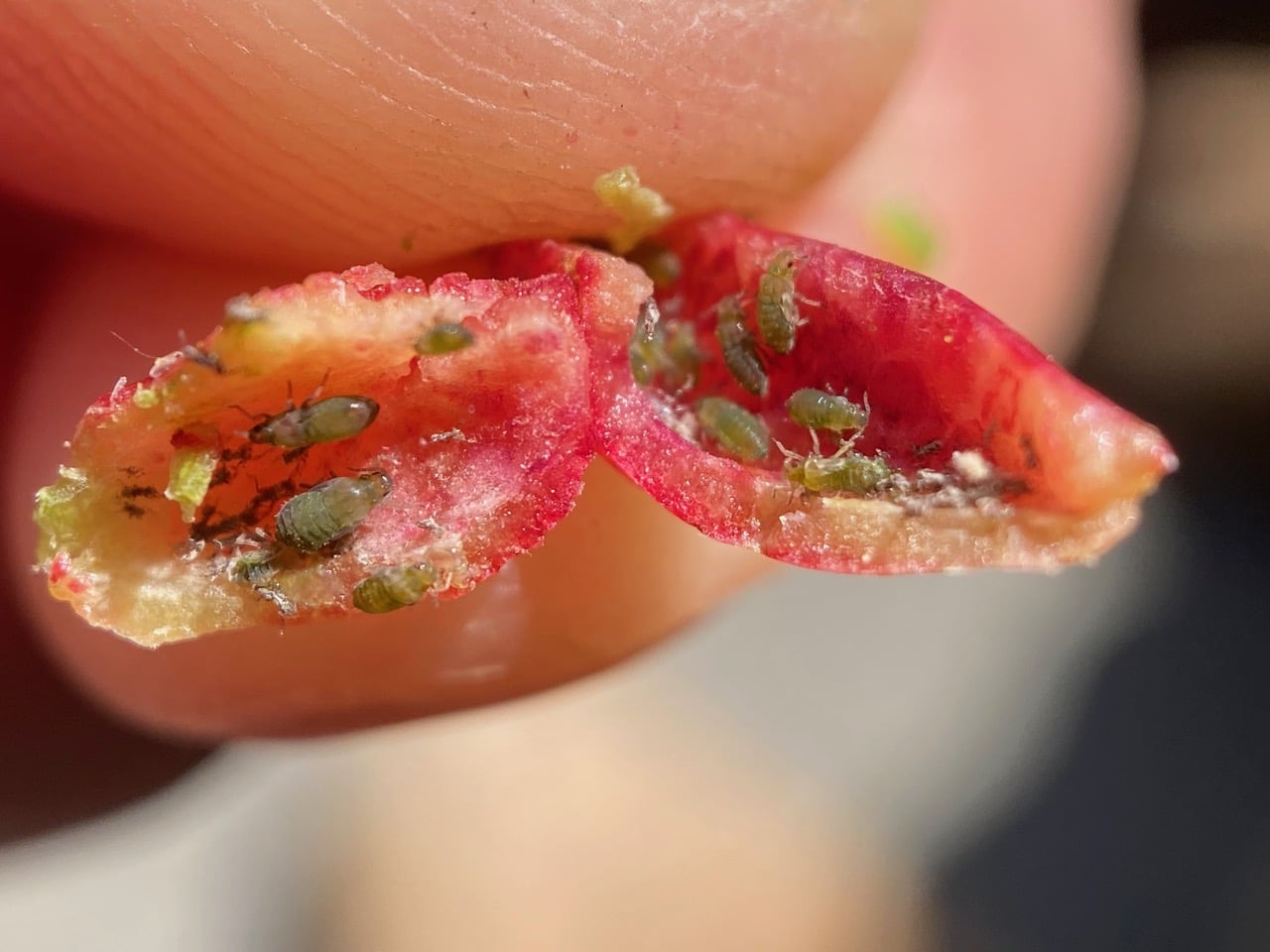
6/19/24
As Ben opens up the gall with his fingernails, tiny dull green aphids of various sizes spill out of the thick-walled structure. These aphids do not seem to have the typical cornicles (“tail-pipes”).
The Manzanita Leaf-gall Aphid, Tamalia coweni (family Aphididae) is a widespread species native to the west coast of North America. Feeding by the aphid on Arctostaphylos leaves induces red or reddish-green pod-shaped galls within which the aphids feed and develop. The tiny, gray or greenish aphids feed by sucking on tissue within the leaf galls. These aphids feed only on manzanita. Throughout most of the year adult females (which may be winged or wingless) give birth to live young without mating. In the fall, a sexual generation of winged males and females is produced. The winged aphids disperse, mate, and the females lay overwintering eggs on the bark at the base of the plant. Eggs hatch in late winter or spring and the emerging aphids walk up to the leaves, settle to feed, and initiate galls. They have several generations per year.
The galls do not significantly affect plant health, but some consider them aesthetically objectionable.
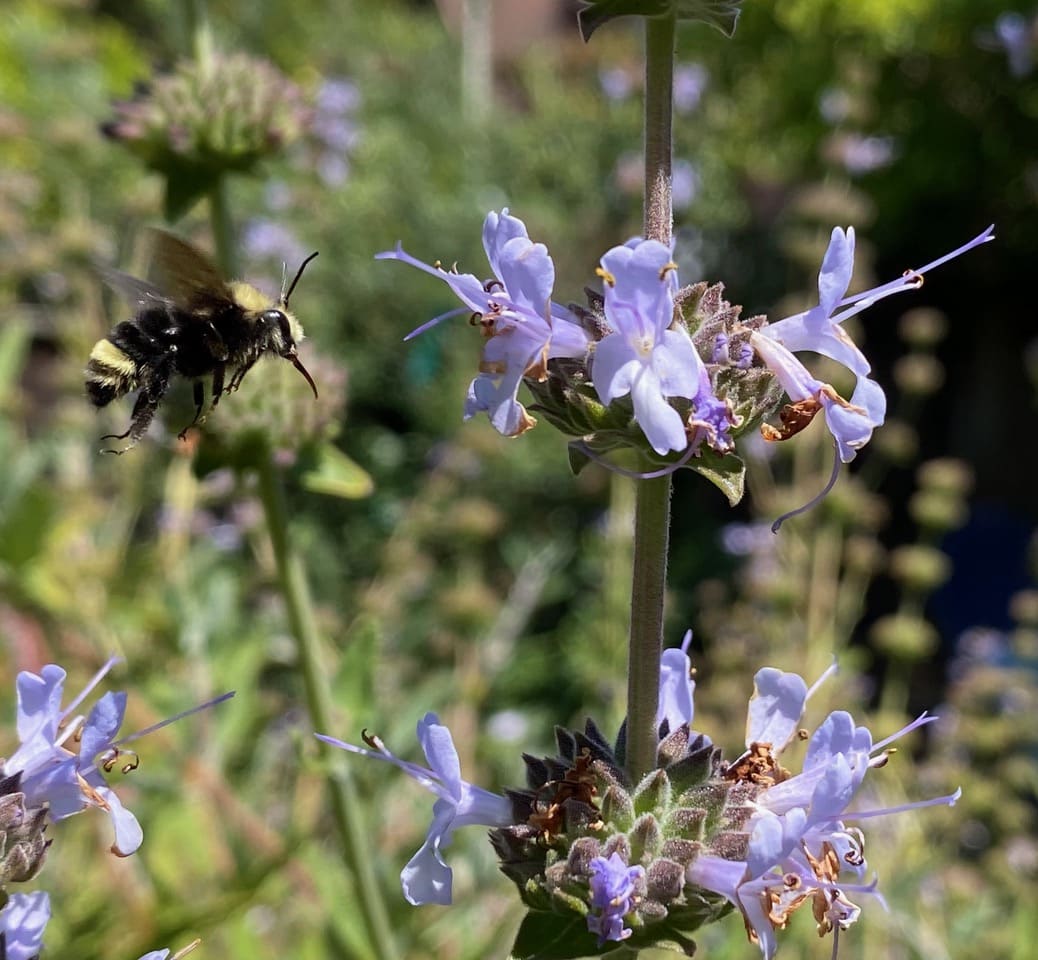
The Cleveland Sage, Salvia clevelandii is blooming gloriously, attracting all kinds of bees, big and small. Its tongue still extended, a Yellow-faced Bumble Bee, subgenus Pyrobombus (genus Bombus, family Apidae) lifts off a flower from which it has been taking nectar.
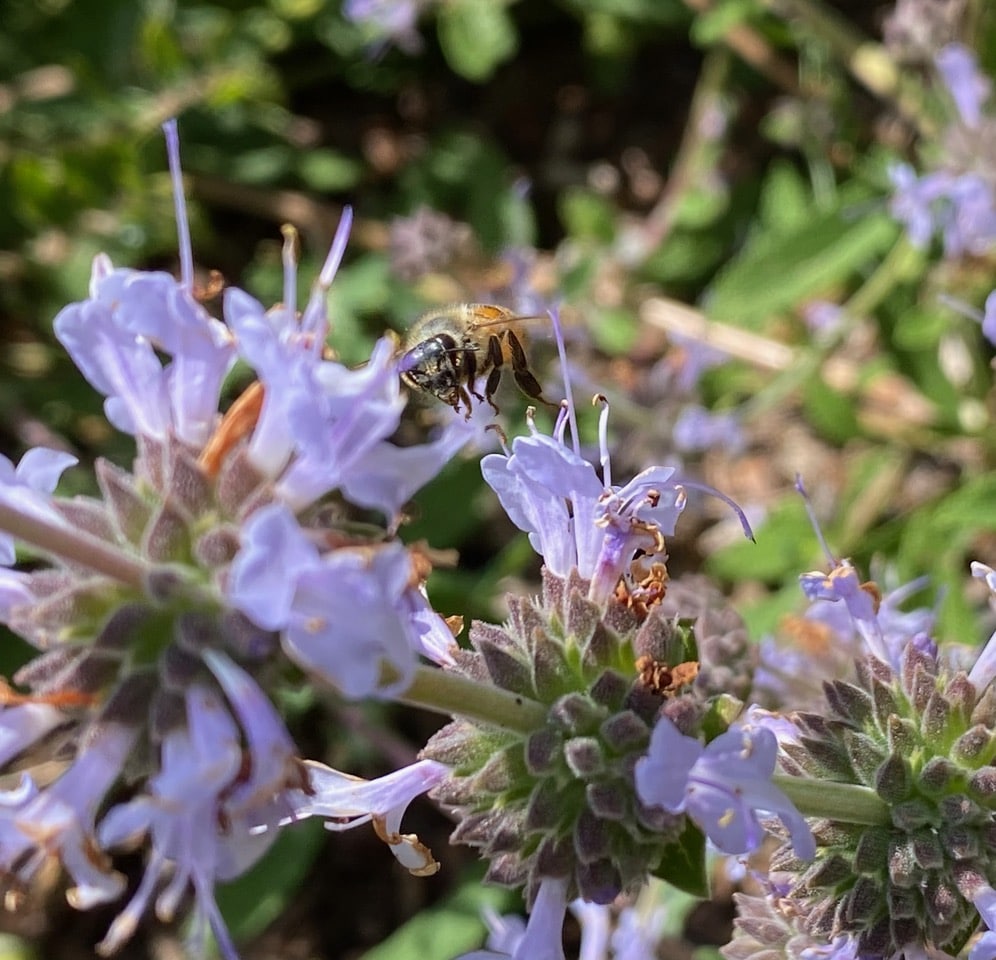
A Honey Bee, Apis mellifera (family Apidae) is enjoying the nectar feast too.

While the larger bees are more obvious, the most prevalent are actually the much smaller Sweat Bees, Halictus tripartitus (family Halictidae).
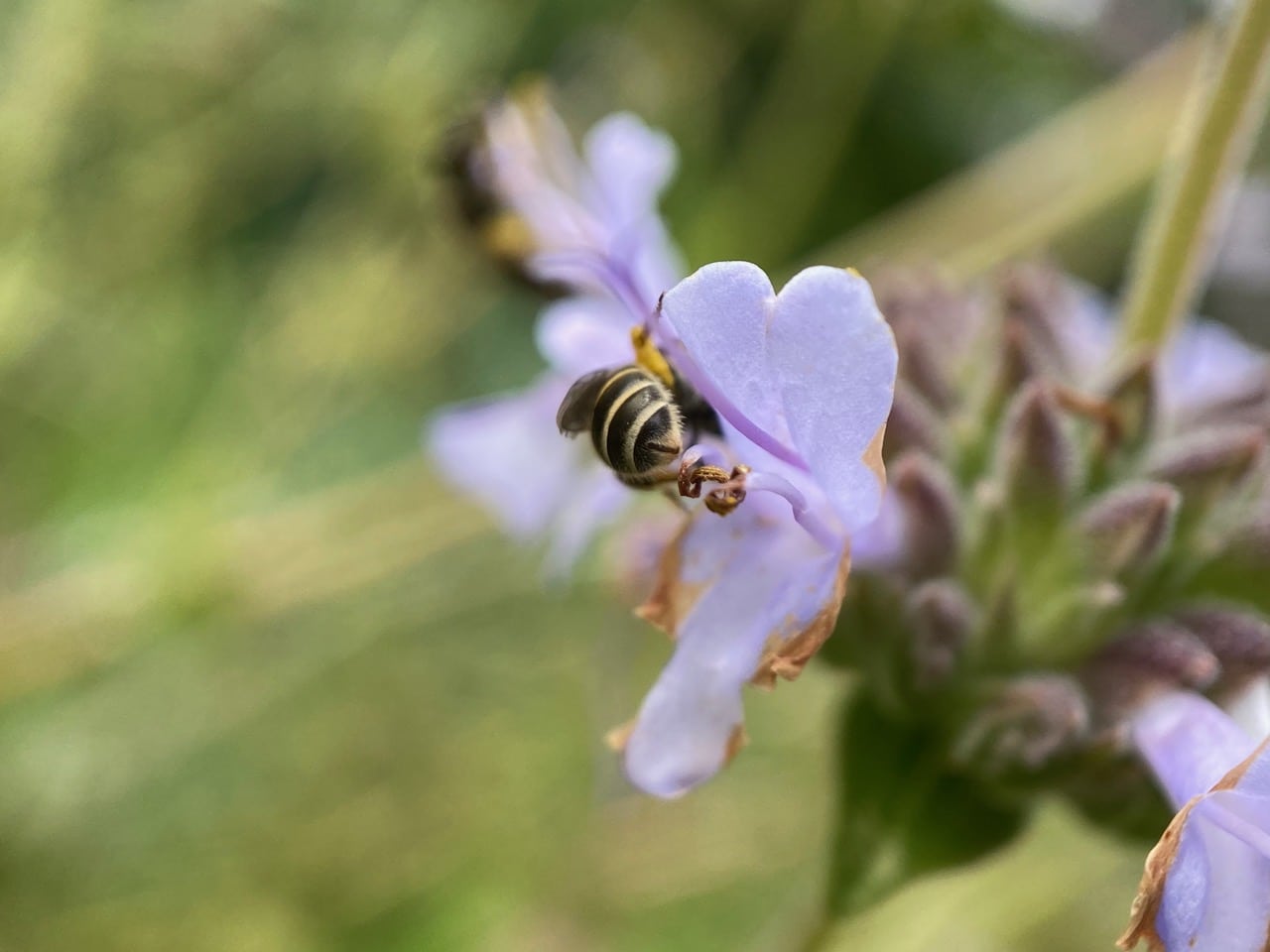
Here’s the rear view of a Tripartite Sweat Bee, Halictus tripartitus (family Halictidae) as she navigates a sage flower. Note the slit or furrow at the tip of her abdomen. This is why the sweat bees (in the genus Halictus and Lasioglossum) are often called Furrow Bees.
The Sweat Bee family Halictidae comprises two main genera, Halictus and Lasioglossum, which can be tricky to separate. Females of both genera have a groove, or furrow at the tip of the abdomen, called a rima. The function of the rima is unknown, but is believed to be involved in egg laying. The two genera differ in the position of the hair bands on the abdomen. In Halictus these are on the hind margin of the each tergite (body segment), but in Lasioglossum they are at the front of each tergite, often partly covered by the hind edge of the preceding tergite.
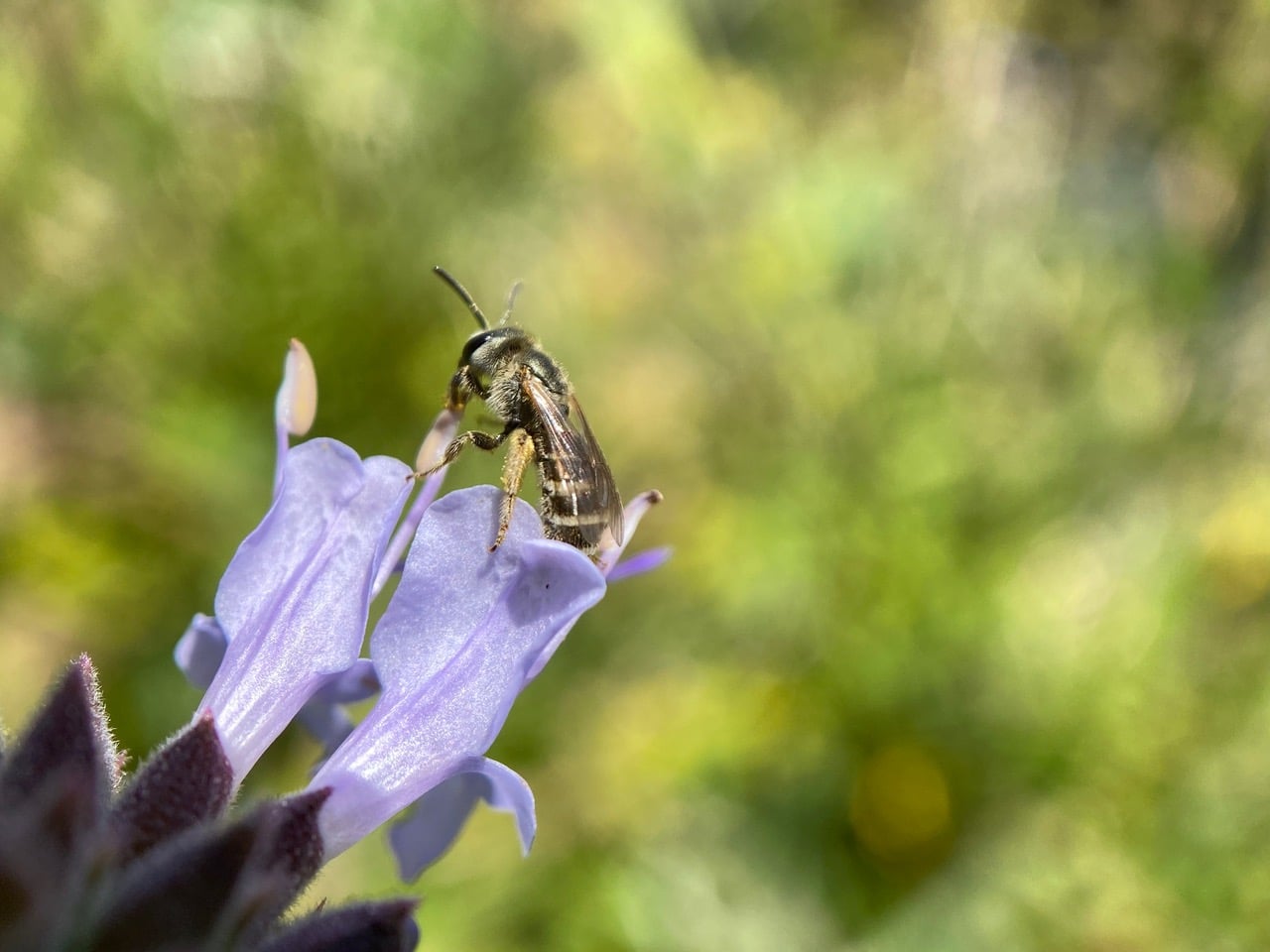
A Tripartite Sweat Bee is collecting pollen from an anther of a Cleveland Sage flower.
Halictus is found worldwide; they are most common in the Northern Hemisphere. All are generalists, foraging from a wide variety of flowering plants. Many species are social and produce several generations per year. This is not surprising as most blooming plants are season-specific; a bee that requires pollen and nectar across multiple seasons would not thrive as a specialist. All Halictus in North America nest in the ground, often in aggregations; and they may nest in the same area for decades.

Perched on another sage flower, a Tripartite Sweat Bee is collecting pollen from the anthers. She is using her jaws as well as her front legs to extract the pollen.
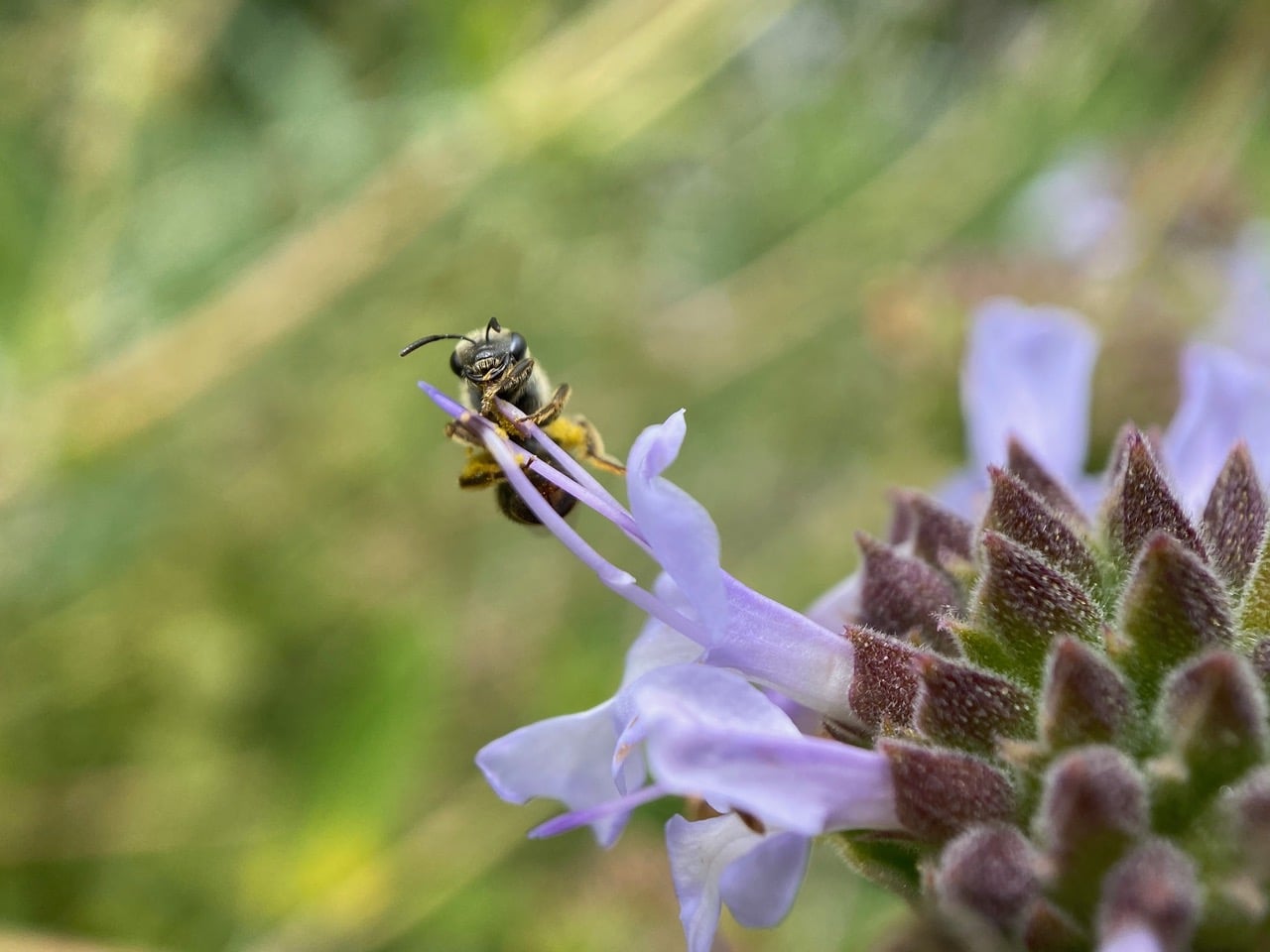
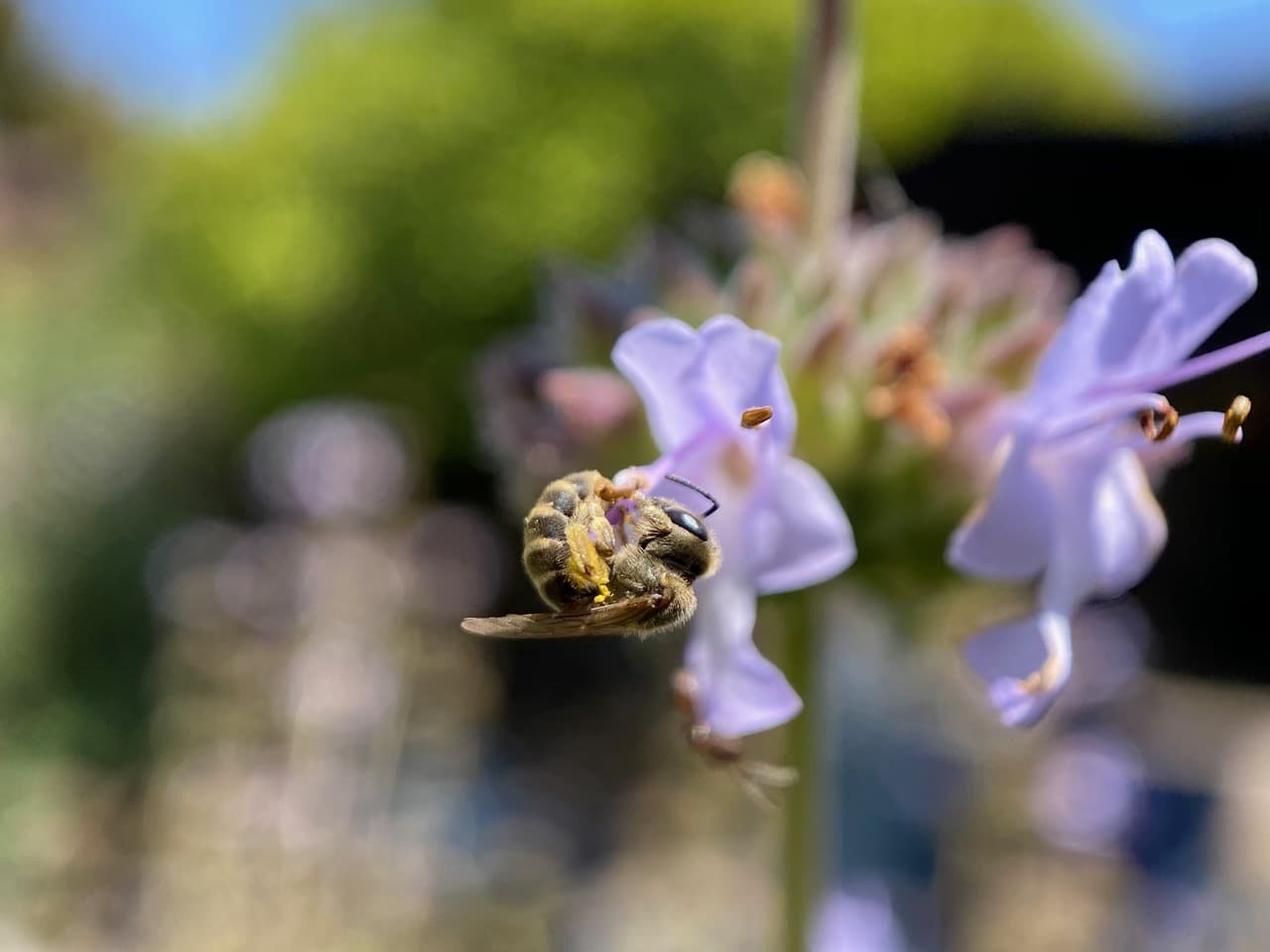
This Tripartite Sweat Bee is hanging off the stamens, collecting pollen from the anthers. It’s a full-body workout for the little bee, endlessly amusing to watch.
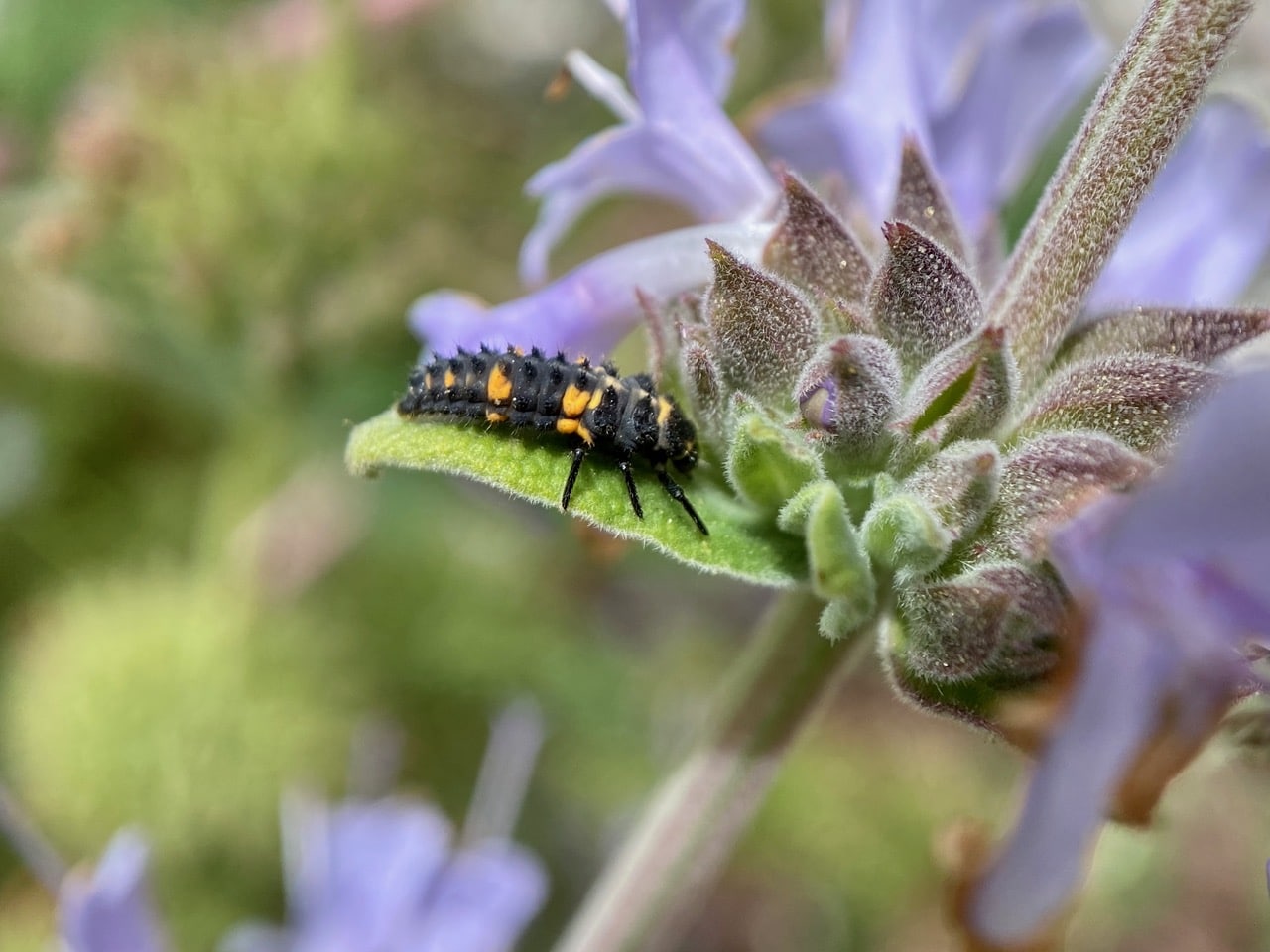
A Lady Beetle larva (family Coccinellidae) is resting on a leaf subtending a cluster of flower buds of Cleveland Sage.
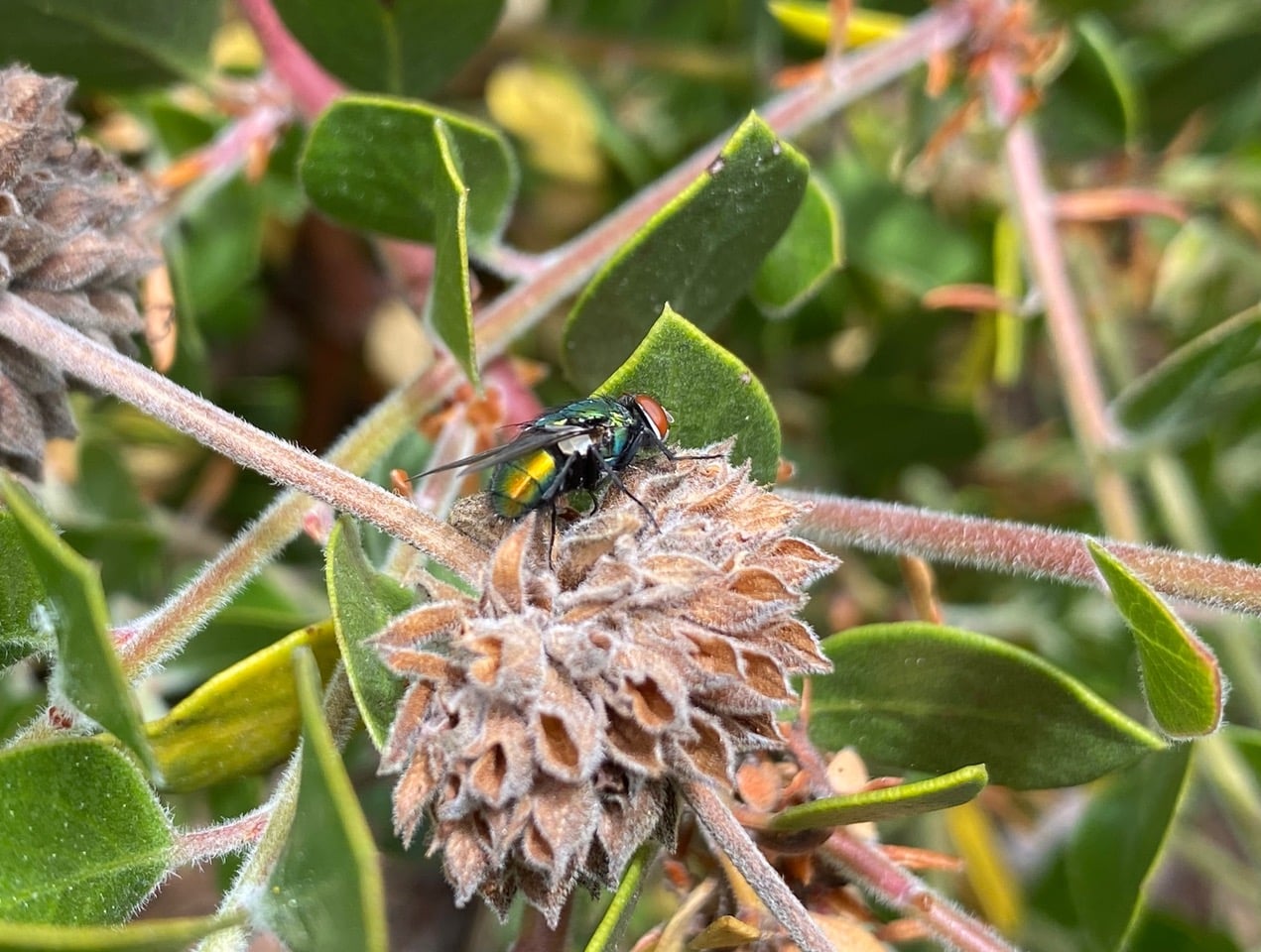
The iridescent body of a Common European Greenbottle Fly, Lucilia sericata (family Calliphoridae) glistens from a dried seed head of Cleveland Sage.
The Common European Greenbottle Fly is a Blowfly found in most areas of the world and is the most well-known of the numerous green bottle fly species. The lifecycle of Lucilia sericata is typical of blowflies. Females lay masses of eggs in fresh carrion. The flies are extremely prolific – a single female may produce 2,000 to 3,000 eggs in her lifetime. The larvae feed on dead or necrotic tissue, passing through 3 larval instars. Third-instar larvae drop off the host to pupate in the soil. The adults feed opportunistically on nectar, pollen, feces, or carrion; they are important pollinators as well as important agents of decomposition. Pollen is used as an alternative protein source, especially for gravid females who need large amounts of protein and cannot reliably find carrion.
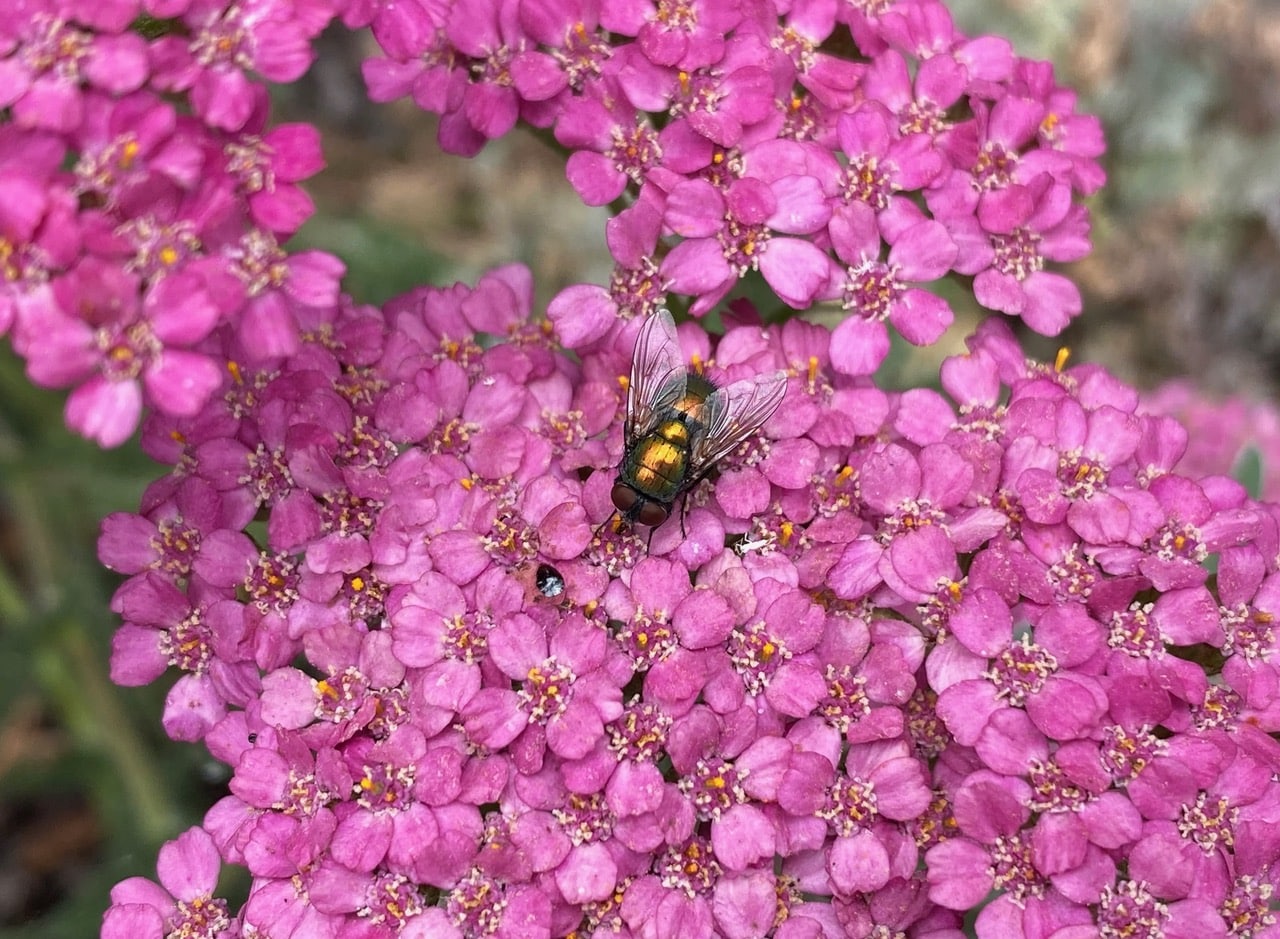
A Greenbottle Fly, Lucilia sericata (family Calliphoridae) is foraging on an inflorescence of pink Yarrow, Achillea millefolium. The metallic coloration of these flies can range from blue to green to coppery. The color isn’t just a pigment but is also a structural phenomenon. The color arises from the way light interacts with the thin, layered structure of the fly’s exoskeleton. These layers scatter and reflect light, creating a shimmering, metallic sheen. The shiny appearance may have evolved for several reasons. One possibility is that it serves as a visual signal for mating or as a warning signal to predators. Another suggestion is that it might help camouflage the fly by mimicking the appearance of raindrops on plants.
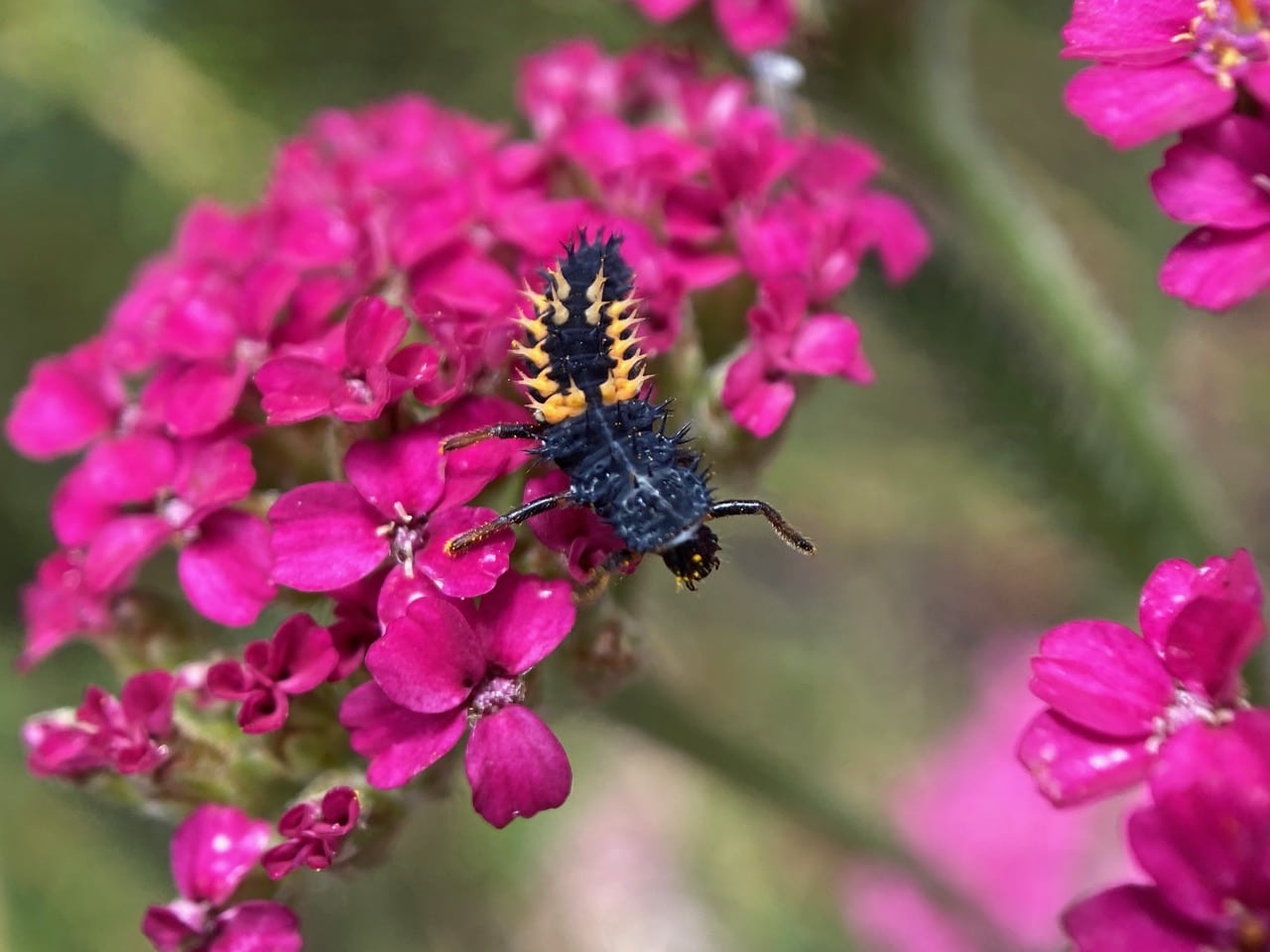
A Lady Beetle larva is actively moving on an inflorescence of pink Yarrow.
Ladybeetles go through complete metamorphosis, which comprises four stages: eggs, larva, pupa and adult. The larva goes through four molts during their development. Often described as miniature alligators with six legs, the larvae are voracious predators of aphids. Each larva can eat about 400 aphids in the three weeks before it pupates. Besides aphids, they also feed on soft scales, whitefly pupae, thrips, and spider mites.

A Carrot Plant Bug, Orthops scutellatus (family Miridae) is resting on an inflorescence of pink Yarrow.
Mirid bugs are also referred to as plant bugs or leaf bugs. Miridae is one of the largest family of true bugs in the order Hemiptera. Like other Hemipterans, Mirids have piercing, sucking mouthparts to extract plant sap. Some species are predatory. One useful feature in identifying members of the family is the presence of a cuneus; it is the triangular tip of the corium, the firm, horny part of the forewing, the hemielytron. The cuneus is visible in nearly all Miridae.
The Carrot Plant Bug, Orthops scutellatus is widespread in North America. The bug has a preference for plants in the carrot family Apiaceae or Umbellifers, and is considered a minor agricultural pest.

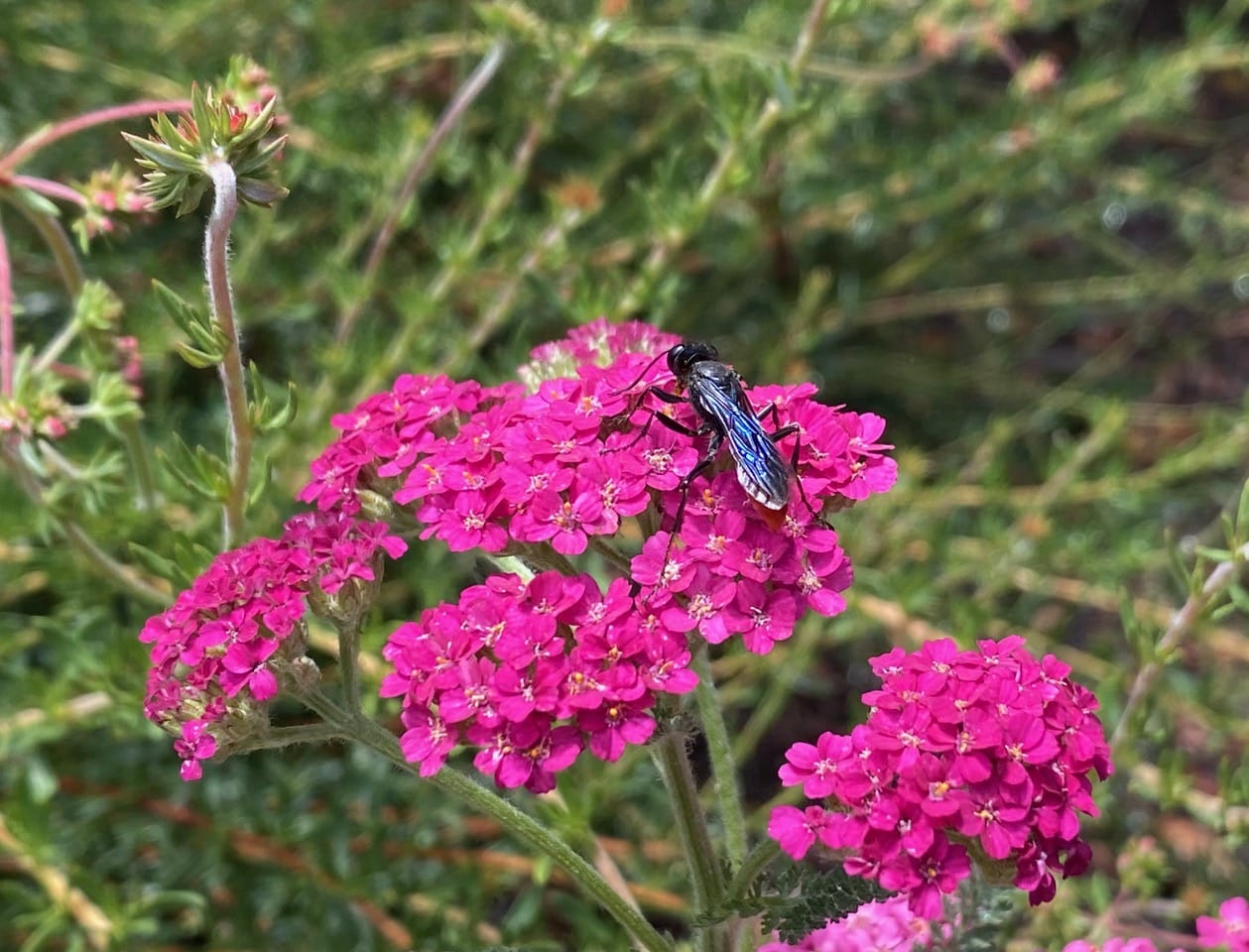
A female Thread-waisted Burrowing Wasp, Sphex lucae (family Sphecidae) has landed on an inflorescence of pink Yarrow, her smoky wings glinting in the sun.

As the wasp lowers her head to take nectar from the flowers, we get a glimpse of her orange-red abdomen.
The Sphecidae are solitary wasps with elongated and narrow first abdominal segment, giving rise to the common name Thread-waisted Wasps. Sphex lucae is a widespread western species, ranging from WA in the north, south to CA, and east to TX. The species exhibits sexual dimorphism – females are black with a red abdomen, while the males are all black. Adults visit many types of flowers for nectar. Females hunt katydids and grasshoppers as food for their young. The wasp excavates a single-celled burrow in the soil in advance of hunting activities. She drags her paralyzed prey back to the burrow, laying a single egg on the victim. The nest entrance is then sealed and the process is repeated. Males of this species spend nights in sleeping aggregations in sheltered places such as beneath a rock overhang.

Many of these wasps, both males and females, can be seen flitting around on the large Manzanita in the backyard. There are no flowers on the shrub at the moment – perhaps the wasps have emerged from the underground nests in the undisturbed soil under the manzanita? The shrub is also a good place to meet potential mates.