

Pollinator Post 6/18/25 (1)
Seeking shade and coolness on a day forecast to be hot, I take my morning walk at the Reinhardt Redwood Regional Park in the Oakland hills today.
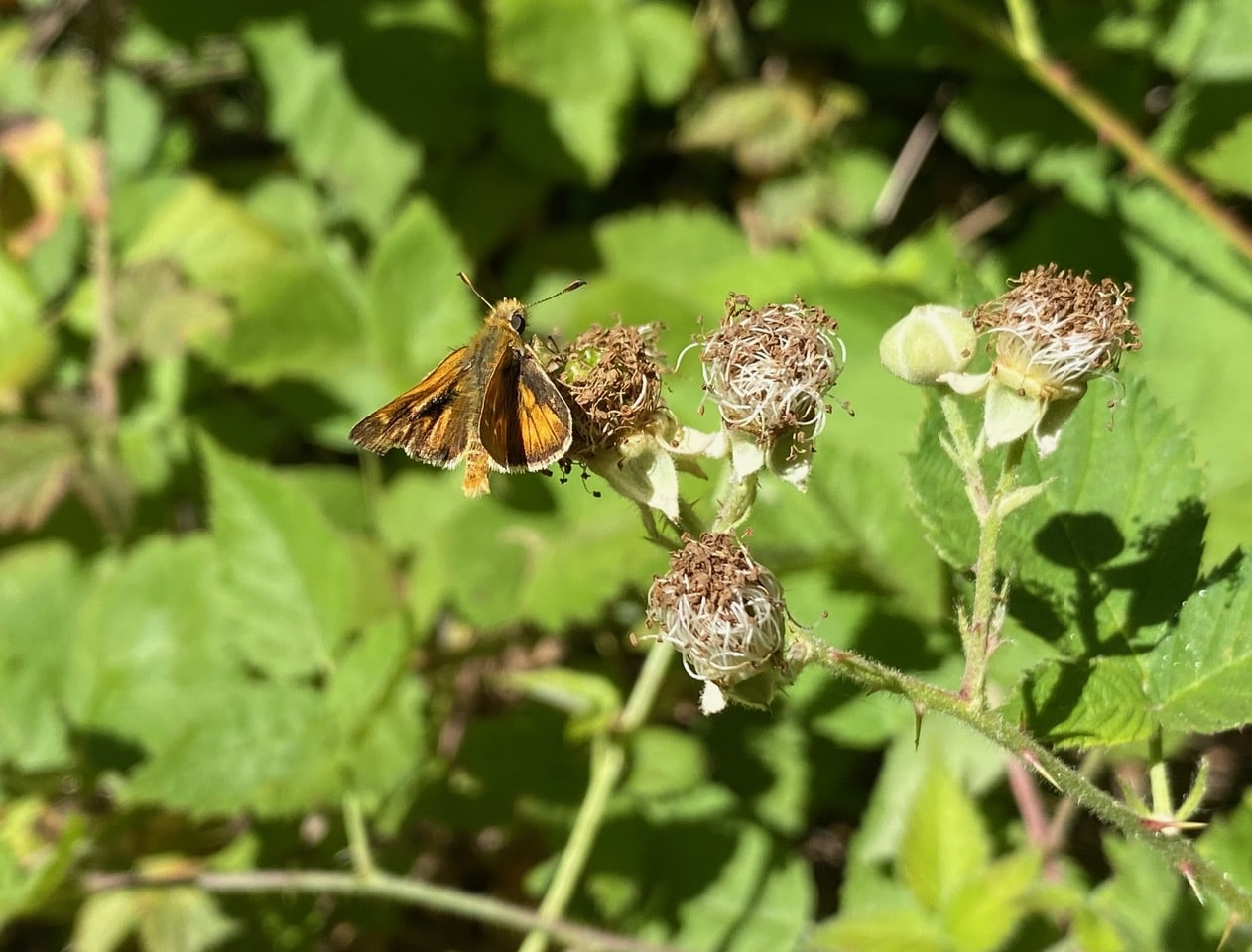
Most of the California Blackberry, Rubus ursinus have finished blooming, with berries developing beneath the faded flowers. A Skipper butterfly, Ochlodes sp. (family Hesperiidae) lands on the drying stamens of a former male flower. Blackberry is dioecious, with male and female flowers borne on separate plants. The male flowers will not yield any fruits.
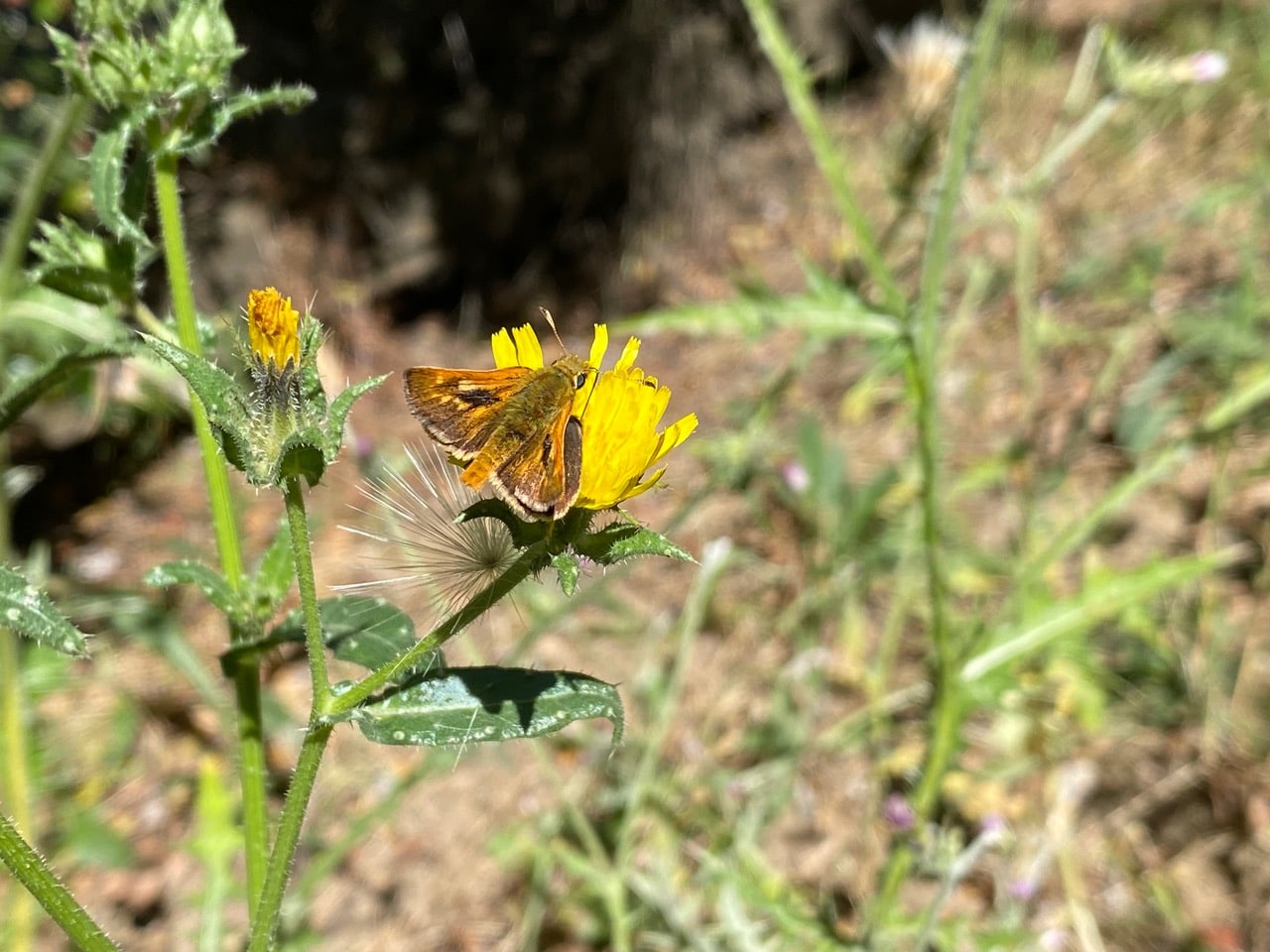






A similar Skipper, Ochlodes sp. (family Hesperiidae) is taking nectar from a flowerhead of Bristly Oxtongue, Helminthotheca echioides.
Skippers are a family, the Hesperiidae, of the order Lepidoptera (butterflies and moths). They are named for their quick, darting flight habits. Most have the antenna clubs hooked backwards like a crochet hook. They also have generally stockier bodies and larger compound eyes than the other butterflies. Their wings are usually small in proportion to their bodies. When at rest, skippers keep their wings usually angled upwards or spread out, and only rarely fold them up completely. Californian species are mostly brown or tan, with black, orange, or yellow markings.
Skipper caterpillars are usually green or brown, sometimes yellowish, never brightly colored. They have a distinctive “collar”, a narrow ring around the body right behind the head. Caterpillars are camouflaged and often hide during the day. Many species make nests of leaves and silk for additional protection. Most North American species feed on grasses, but some common species eat shrubs and trees, especially in the bean family. Most species are limited to a single group of food plants. Adult skippers are only active during the day, but Skipper caterpillars feed mainly when it is dark or partly light.
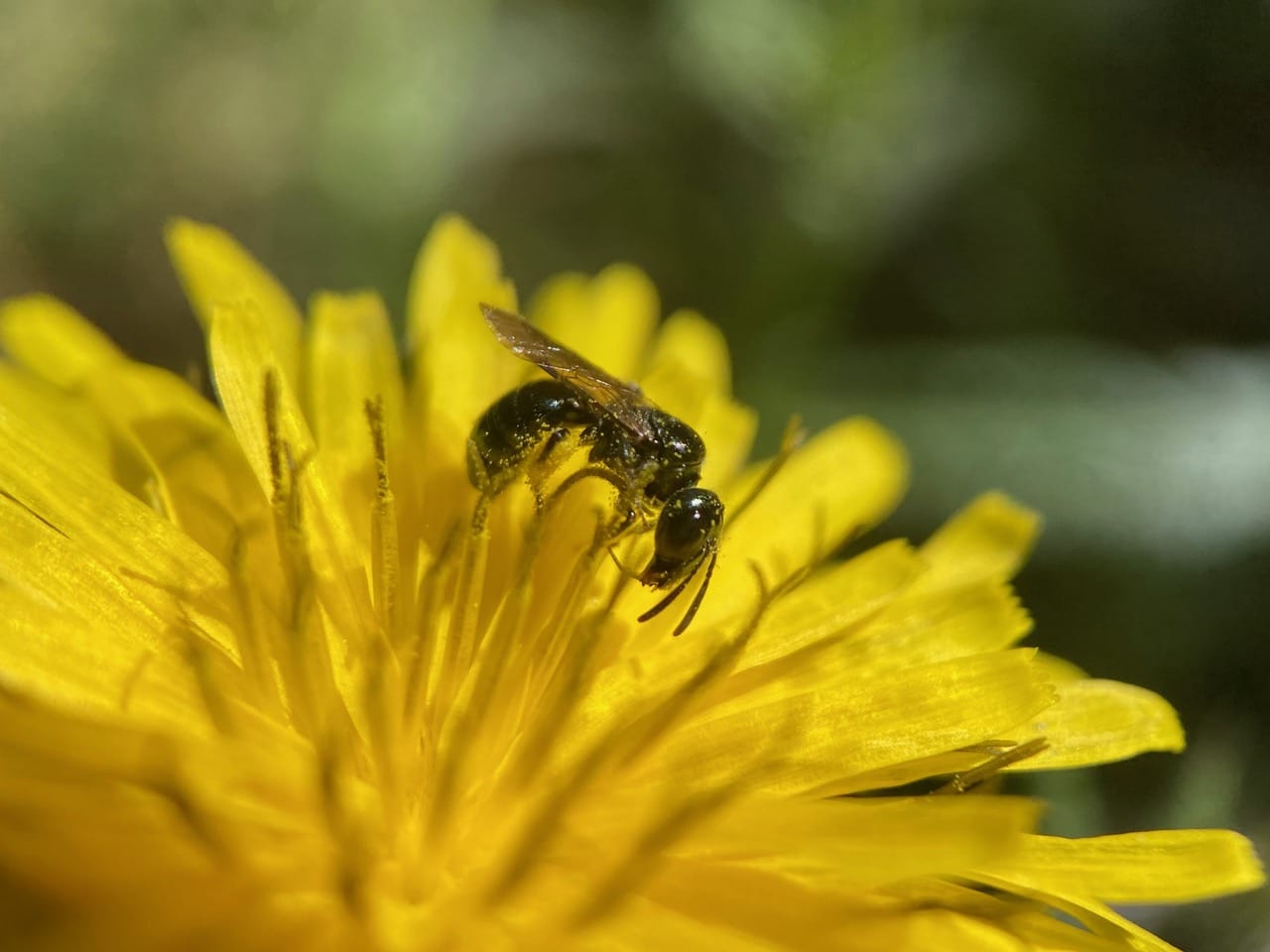
A small glossy black bee is foraging in a flowerhead of Bristly Oxtongue.
Here the bee is reaching down with its tongue extended to take nectar at the base of the florets. Note the pollen loosely held in the bee’s modest scopa on her hind leg. The bee is a Small Carpenter Bee, Ceratina sp. (family Apidae).
The Small Carpenter Bee genus Ceratina is closely related to the more familiar, and much larger Carpenter Bees (genus Xylocopa). Ceratina are typically dark, shiny, even metallic bees, with fairly sparse body hairs and a weak scopa on the hind leg. The shield-shaped abdomen comes to a point at the tip. Some species have yellow markings, often on the face.
Females excavate nests with their mandibles in the pith of broken or burned plant twigs and stems. While many species are solitary, a number are subsocial. Both male and female carpenter bees overwinter as adults within their old nest tunnels, emerging in the spring to mate. In the spring, this resting place (hibernaculum) is modified into a brood nest by further excavation. The female collects pollen and nectar, places this mixture (called bee bread) inside the cavity, lays an egg on the provision, and then caps off the cell with chewed plant material. Several cells are constructed end to end in each plant stem.

Note that Bristly Oxtongue has darkish forked stigmas at the tips of its central style, which is wrapped by a yellow anther. A bee can gather a large amount of pollen from these tightly clustered florets.
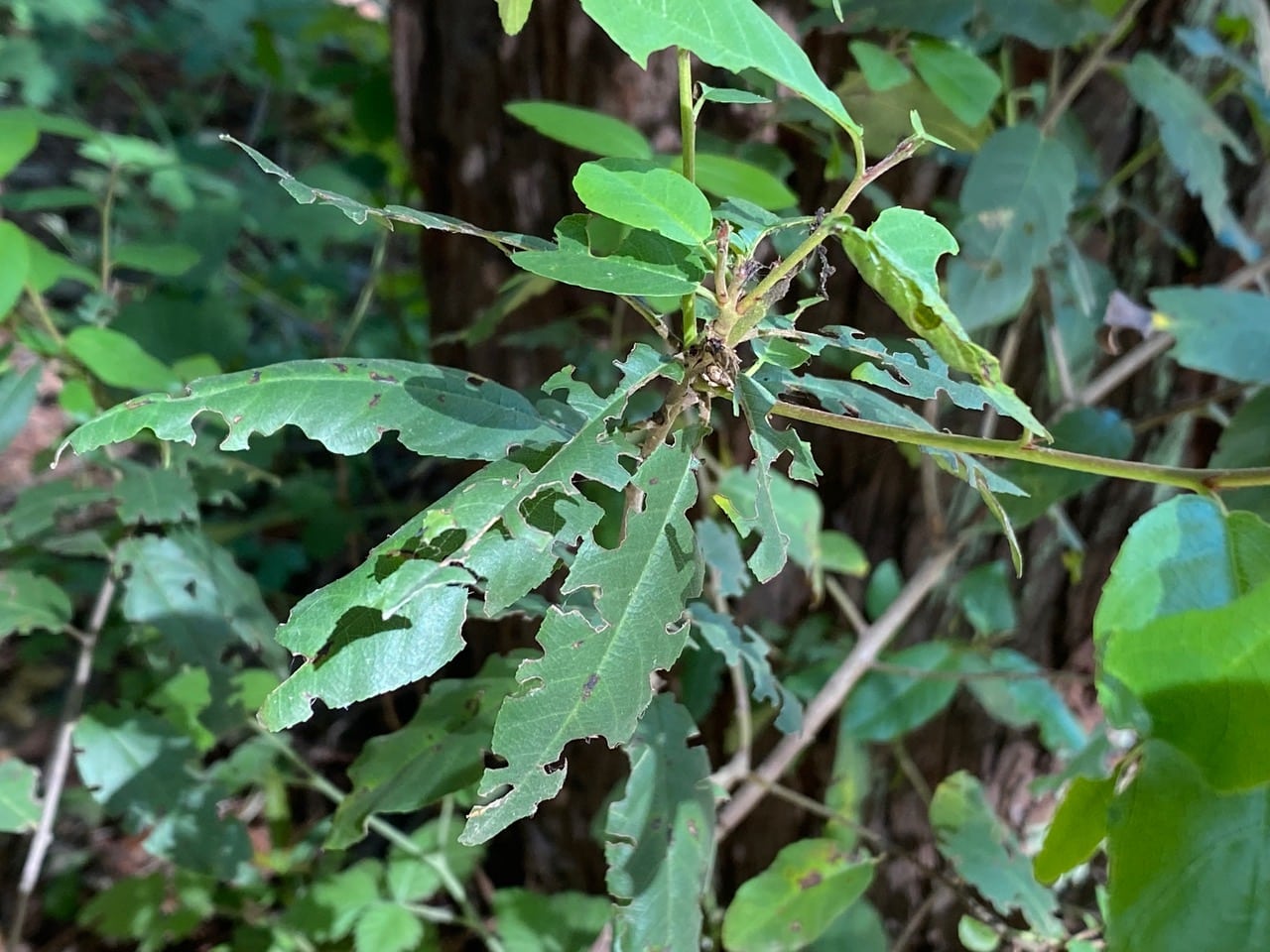
Who has been chewing on the edges of this Coffeeberry, Frangula californica is such a characteristic angular way? Beetles? Katydids? I never find any insect on these chewed plants. Maybe a nocturnal insect – like katydids?
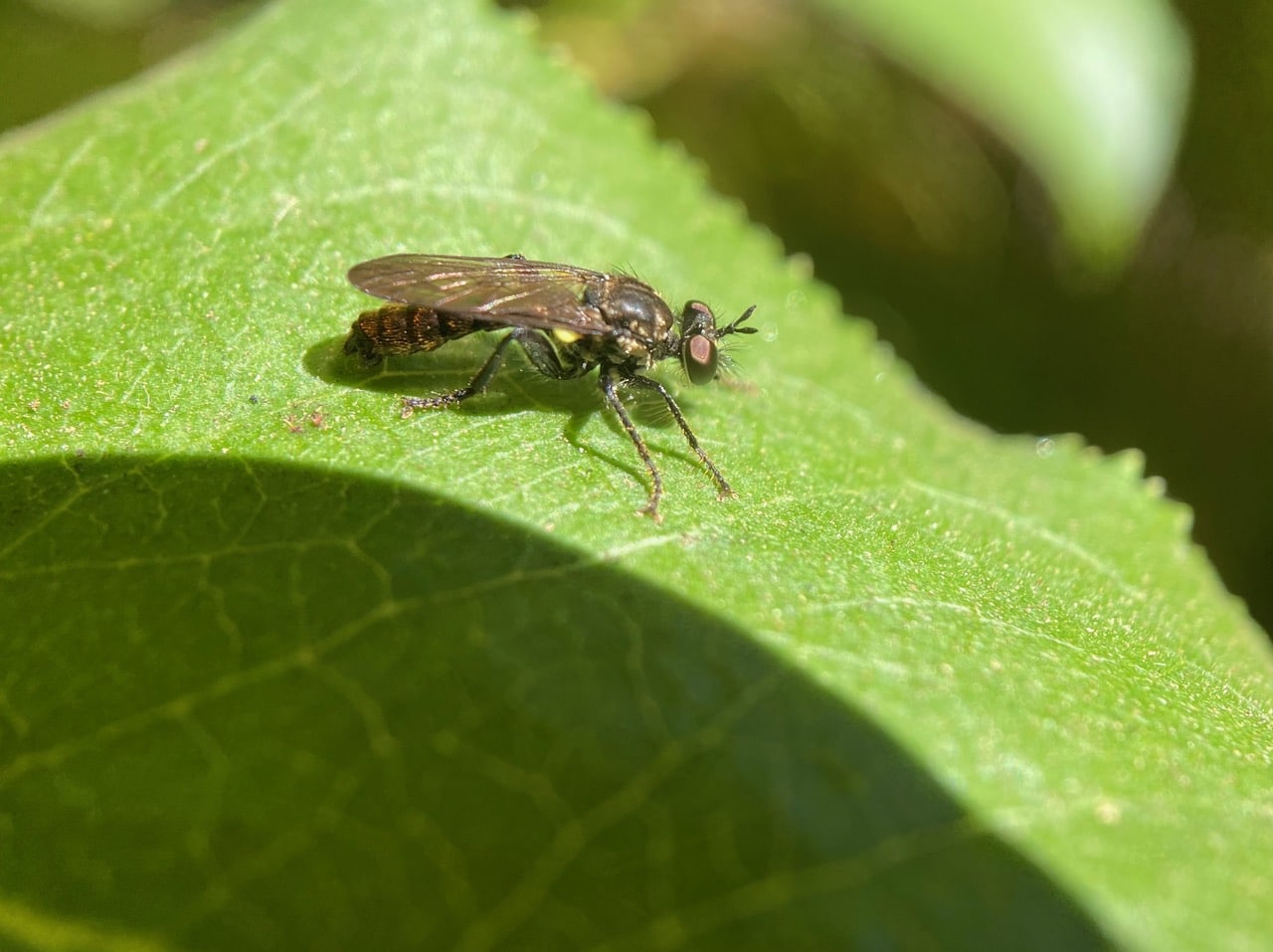
A small fly is perched on a Coffeeberry leaf. I only realize that it is a Robber Fly (family Asilidae) when I look through my macro lens. It is the smallest Robber Fly I have ever seen! iNaturalist has helped identify it as the species Eudioctria sackeni (family Asilidae).
Robber Flies (family Asilidae) have three simple eyes (ocelli) in a characteristic depression on the tops of their head between their two large compound eyes. This feature is clearly visible in the front view and is a morphological peculiarity of Asilidae. The face also has a characteristic dense bundle of mustache-like bristles, called a “mystax”. Apparently the mystax helps protect the head and face of the fly from its struggling prey bent on defense.
The name “robber flies” reflects their notoriously aggressive predatory habits; they feed mainly or exclusively on other insects and, as a rule, they wait in ambush and catch their prey in flight. Asilids have long, stout, spiny legs for capturing prey. The fly attacks its prey by stabbing it with its short, strong proboscis, injecting the victim with saliva containing neurotoxic and proteolytic enzymes which very rapidly paralyze the victim and digest the insides; the fly then sucks the liquefied material through the proboscis. In general, Asilids attack a very wide range of prey, including other flies, beetles, butterflies and moths, various bees, ants, wasps, dragonflies, damselflies, grasshoppers, and some spiders. Larvae of robberflies live in soil, rotting wood, leaf mold, and similar materials, some being predatory and others detritivorous.
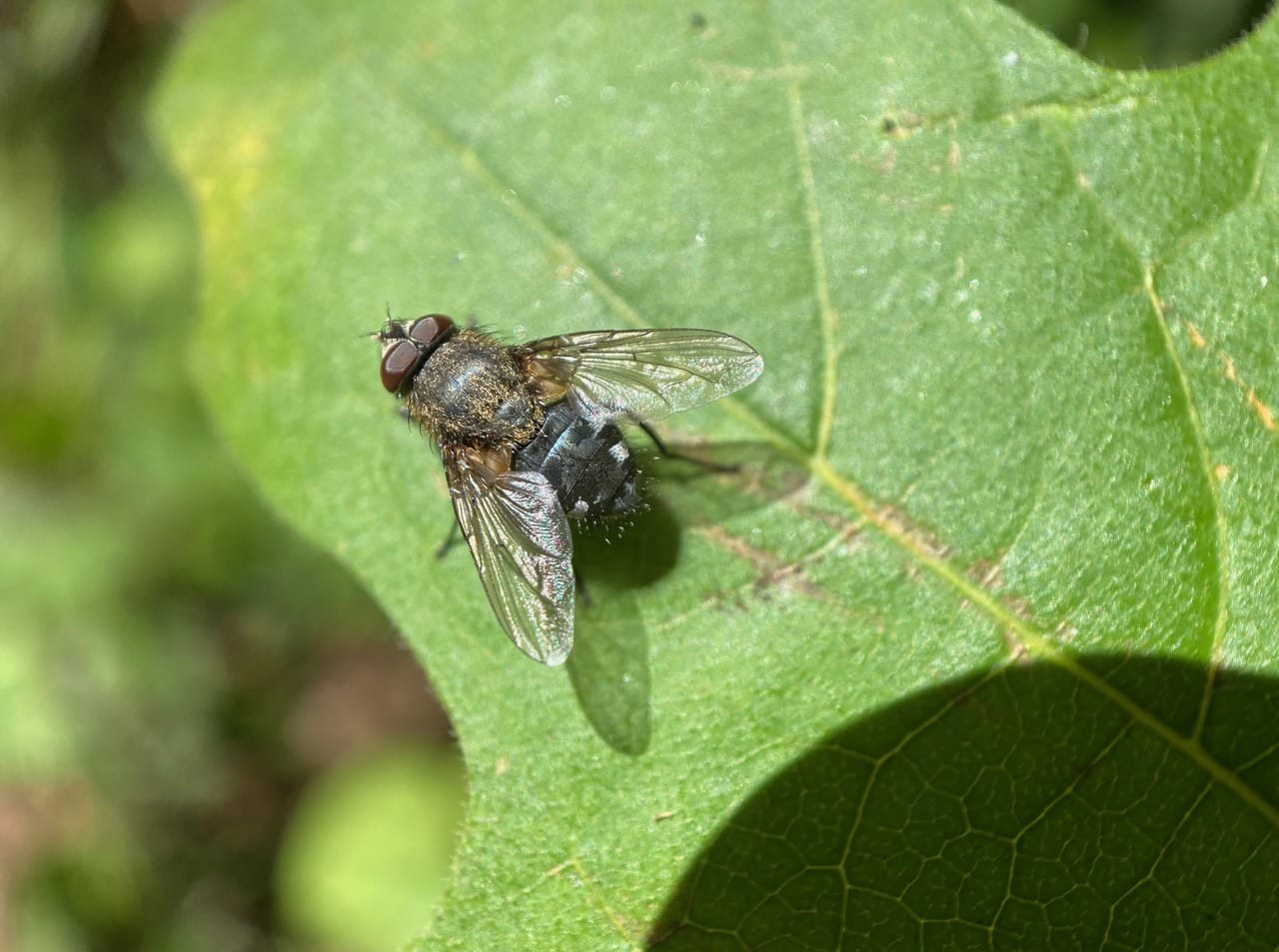
A large stocky fly is perched on a sunlit leaf by the trail. I recognize it as a Cluster Fly, Pollenia sp. (family Polleniidae).
Called the Common Cluster Fly, Pollenia rudis (family Polleniidae) is slightly larger than house flies. It is dull gray with checkered black and silvery-black abdomens. A newly emerged fly has many golden hairs on its thorax which may be lost throughout the life of the fly. The common name comes from the tendency of the flies to aggregate near windows when they are trapped in human dwellings. The immature stages – eggs and larvae – are seldom seen because they are deposited on the soil where they burrow into earthworms which they parasitize. The Cluster Fly is a European species. They may have found their way to America in the ballast of ships containing soil, probably along with introduced earthworms.
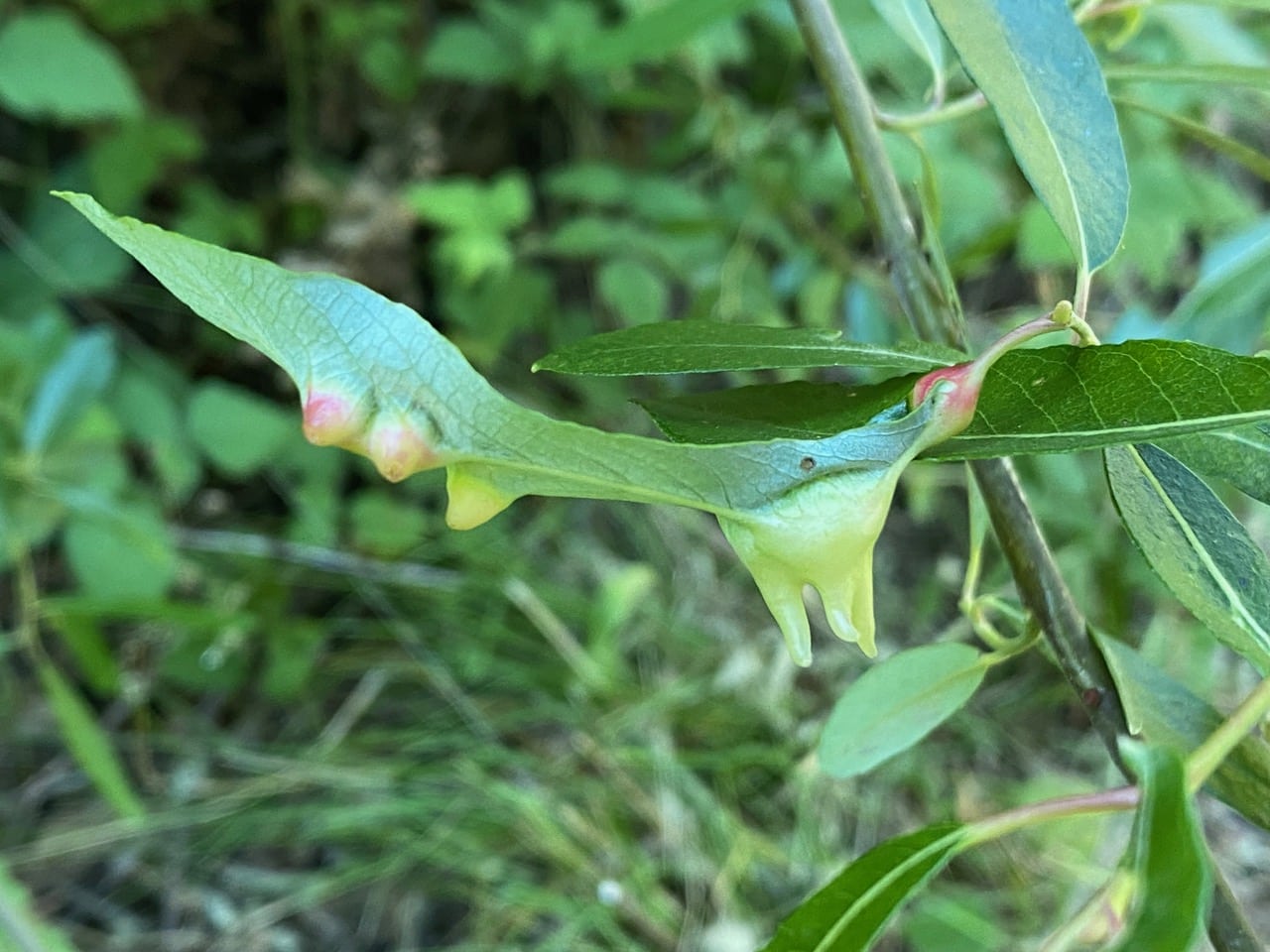
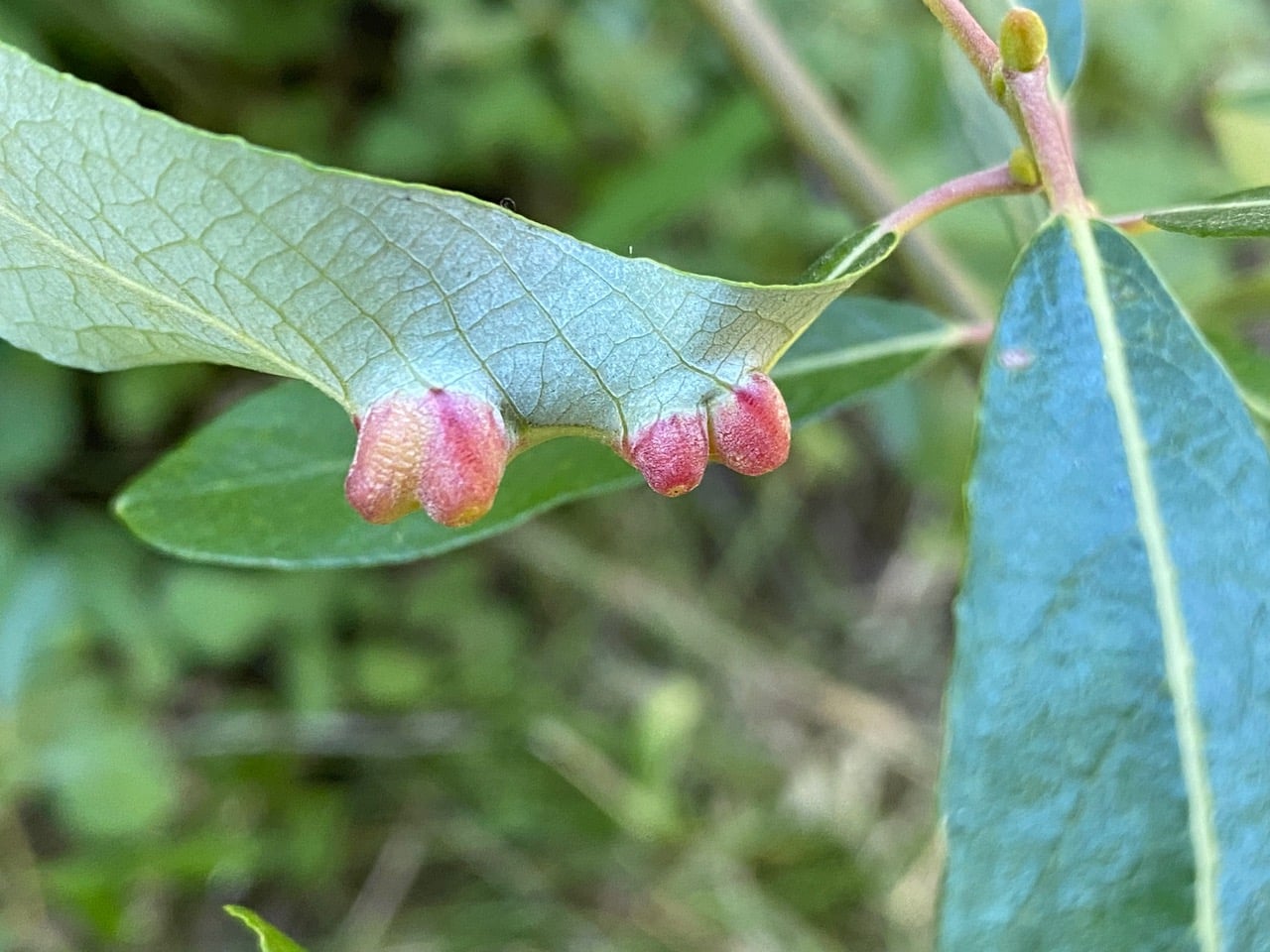
Some grotesque galls have deformed this leaf of Arroyo Willow, Salix lasiolepis.
Plant galls are abnormal growths, resembling tumors or warts, that form on plants due to the influence of other organisms such as insects, mites, bacteria, fungi, or nematodes, providing them with food, shelter, and protection. The gall-inducing organism lays eggs or penetrates the plant tissue, triggering a response in the plant. The plant cells begin to proliferate and reorganize, forming the gall tissue within which the gall organism feeds, protected from predators and harsh environmental conditions. Different gall-inducing organisms can create galls with unique appearances, shapes, and colors, allowing for identification of the gall-maker.
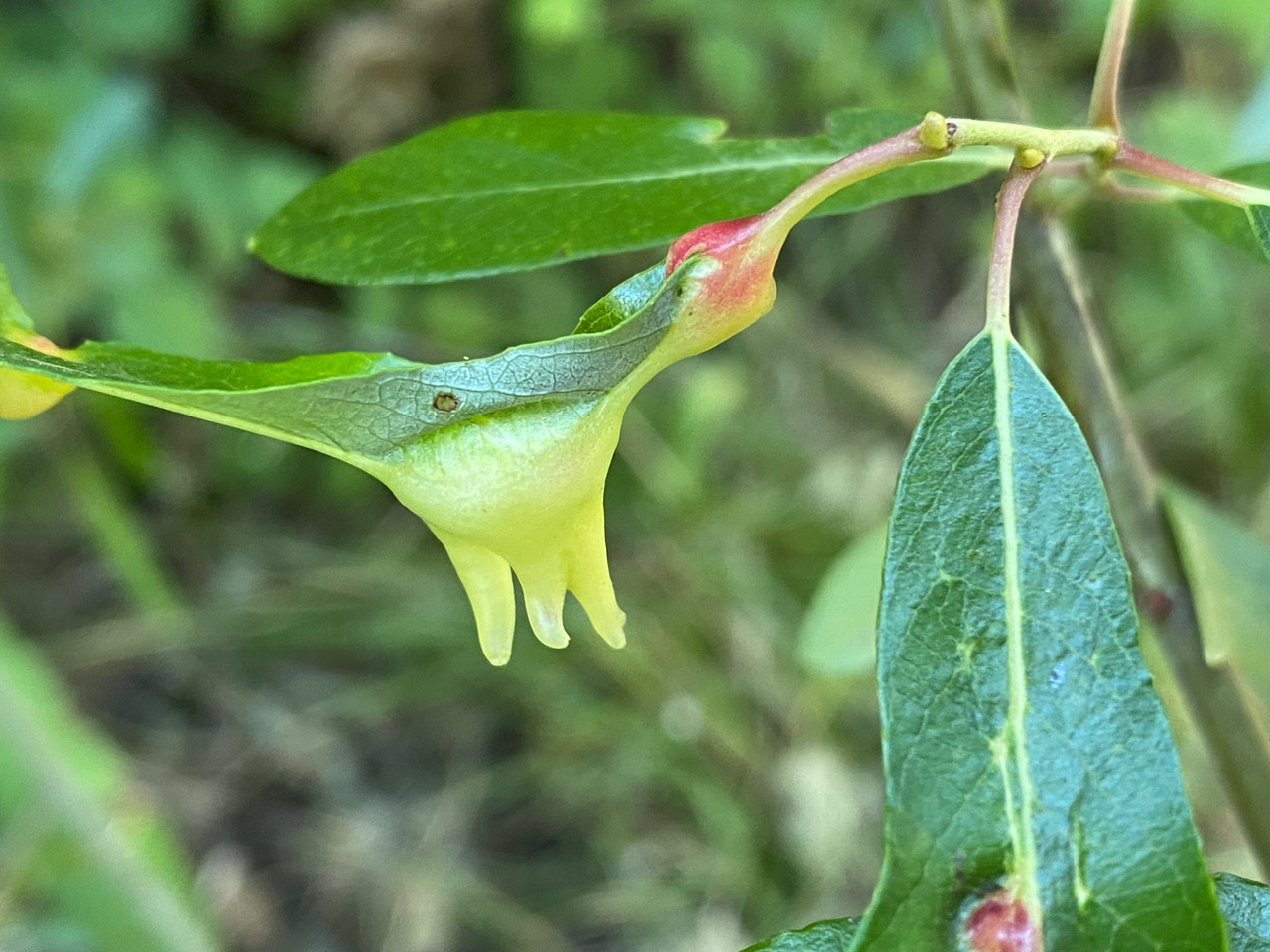
This gall is induced by the Willow Leaf Gall Midge, Iteomyia salicisverruca (family Cecidomyiidae). Ron Russo, author of Field Guide to Plant Galls of California and other Western States calls this gall the Willow Tooth Gall. Here’s an excerpt of his description of the species:
“This midge induces smooth, large, polythalamous galls mostly on the underside of the leaves of arroyo willow. Each gall is characterized by one or more slightly bent projections that look like the roots of a molar tooth. Each toothy projection is correlated with a larval chamber, allowing you to count the number of larvae per gall. Larval chambers are located near the base of the galls where the galls are attached to the host leaf. Galls actually bulge on the dorsal surface of the leaves, but the majority of gall growth occurs on the underside of the leaves. Galls can be yellow green or bright red, depending on exposure to the sun. The galls have no openings, as with the galls of other gall midges. Much of the biology of this gall remains a mystery.”
On the same willow, some leaves bear these tube-shaped galls induced by yet another species of Willow Leaf Gall Midge, Iteomyia sp. (family Cecidomyiidae). Ron Russo has called these Willow Tube Galls in his field guide.
The midge induces round-tubular monothalamous galls that hang from the underside of arroyo willow leaves. The distinguishing character of these midge galls is the apical hole or depression that develops at the end of each gall. While most of the gall hangs below the leaf, there is usually a slight depression on the dorsal surface. Galls are commonly pink to rose red with hints of yellow and green. Galls may develop singly or in coalescing groups of four to five individuals. Gall development begins in spring in central coastal area of California. While the biology of this species is relatively unknown, larvae appear to leave the gall by autumn.
A cluster of Snowberry flowers, Symphoricarpos albus are blooming profusely on the tip of a branch. The little bell-shaped flowers are covered with fine white hairs on the inside of the corolla.
The exact function of these hairs isn’t definitively known, but they are thought to be involved in temperature regulation or water repellency.
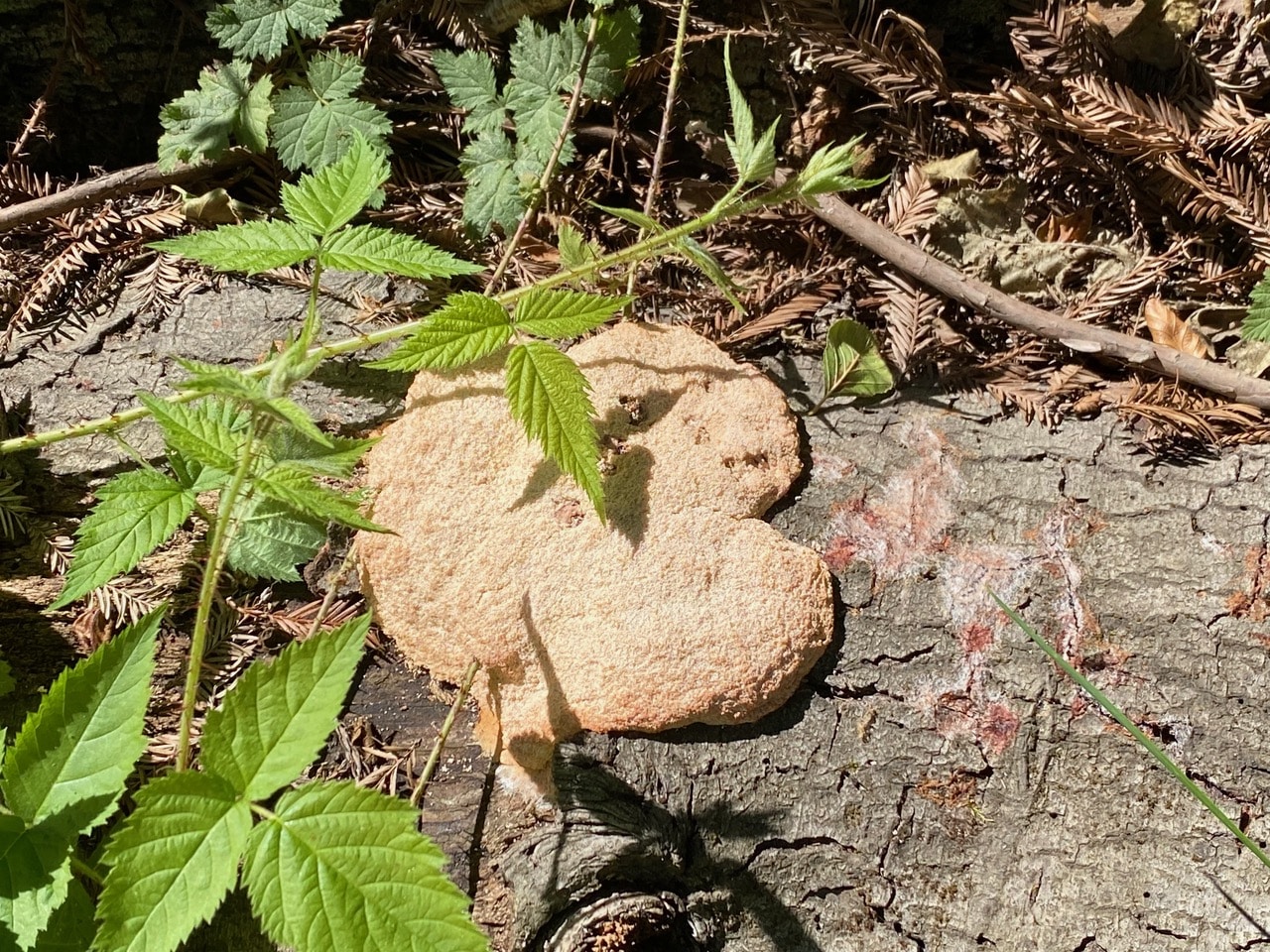
It looks like an animal has vomitted on this log. The mass is actually a drying sporangium of the Dog Vomit Slime Mold, Fuligo septica.
Slime Molds are fungus-like organisms that have previously been classified as fungi, but are now placed in Myxomycetes, in the kingdom Protista. The life cycle of slime molds consists of two distinct stages. During the amoeboflagellate stage, slime molds exist as typical single celled organisms. These amoeboid cells feed on bacteria, grow and multiply by fission. This stage eventually progresses to the plasmodium stage, usually by fusion of compatible amoeboflagellates. Morphologically the plasmodium is a veiny network with a viscous, slimy consistency. The plasmodium is multinucleate and can occupy an area larger than one square meter. However, it is technically still a single cell, as it undergoes many nuclear divisions without cellular divisions. The plasmodium feeds on bacteria, fungi, and other microorganisms, ingesting them through phagocytosis.
When conditions are right, the plasmodium will begin to produce fruiting bodies, or sporangia. Slime mold sporangia exhibit a wide variety of colors, shapes and sizes and are often quite beautiful. The primary function of sporangia is to produce and disperse the spores by which slime molds are propagated. The spores of Myxomycetes are microscopic and lightweight, and can be carried by wind for considerable distances. Under the right conditions, the spores germinate into the single-celled amoeboflagellates, and the cycle is repeated.
Mostly associated with cool and moist habitats, slime molds are commonly found in forests, often developing on the bark of living trees, on decaying logs, stumps, dead leaves and other organic litter.
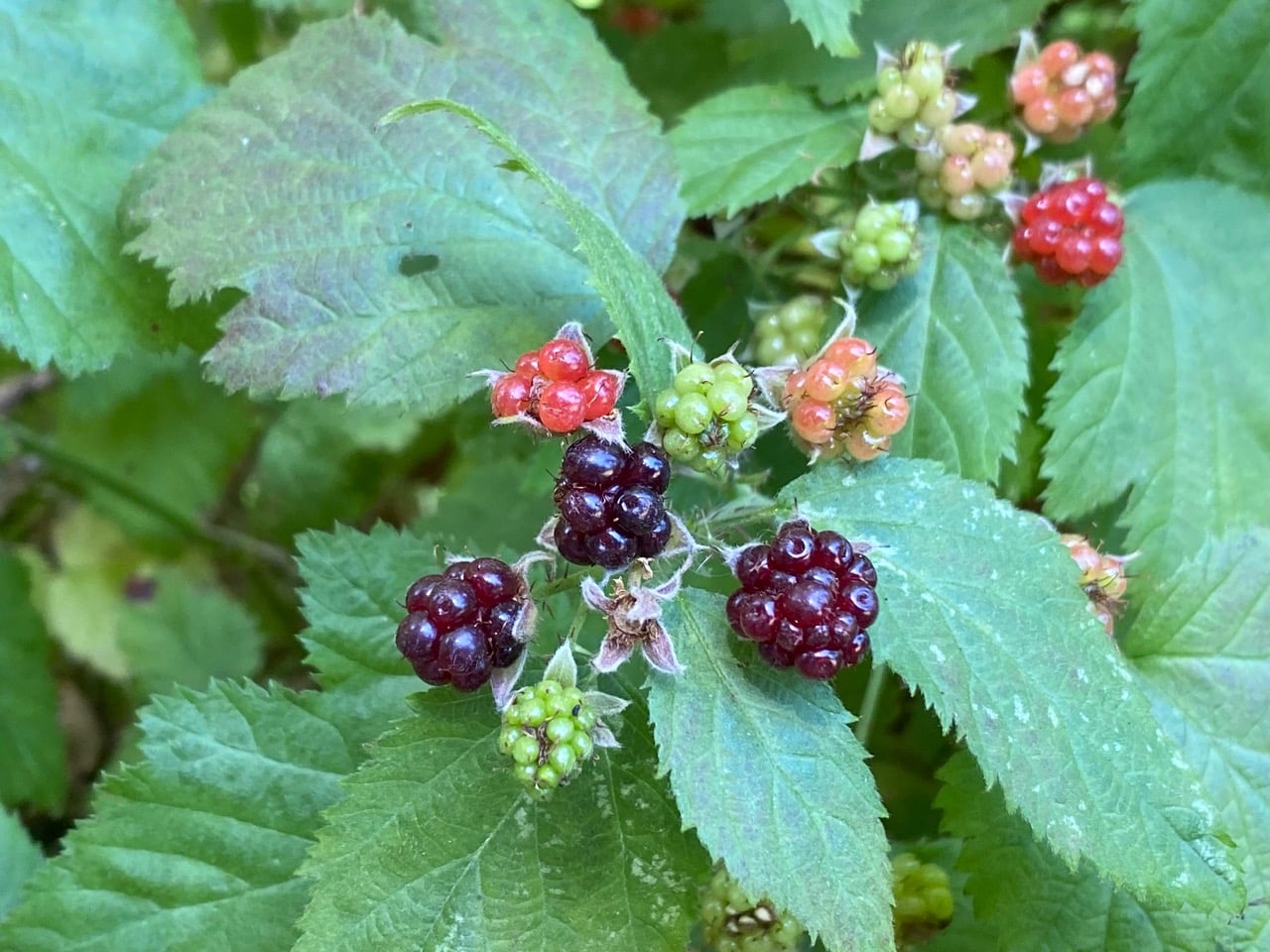
Luscious berries are ripening on the California Blackberry, Rubus ursinus.
Actually a blackberry is not a true berry in a botanical sense. It is an aggregate fruit, meaning it’s composed of numerous tiny individual fruits called drupelets, each with its own seed. True berries are formed from a single ovary in one flower. Blueberries, grapes, and tomatoes are considered true berries because they develop from a single ovary.
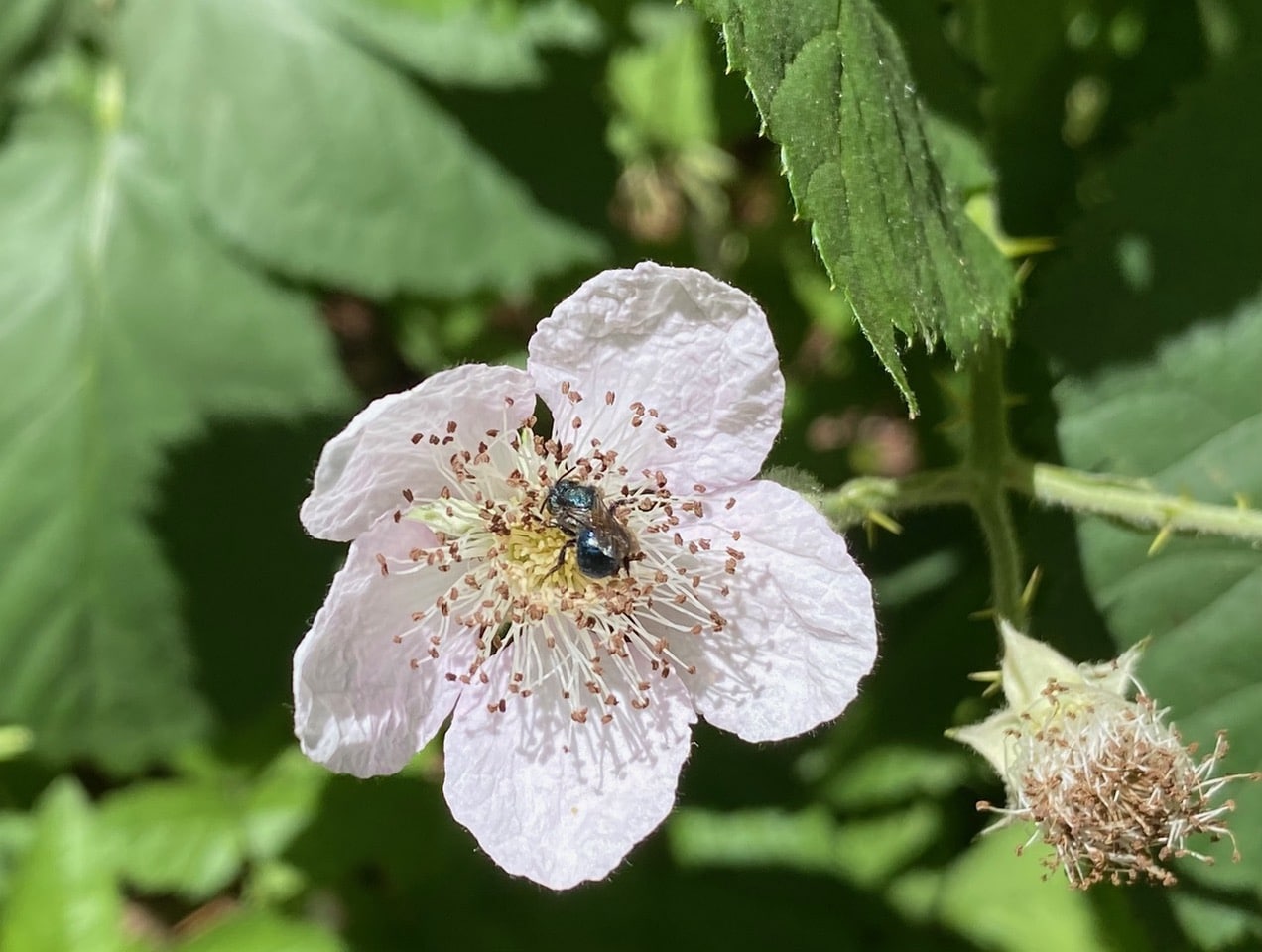
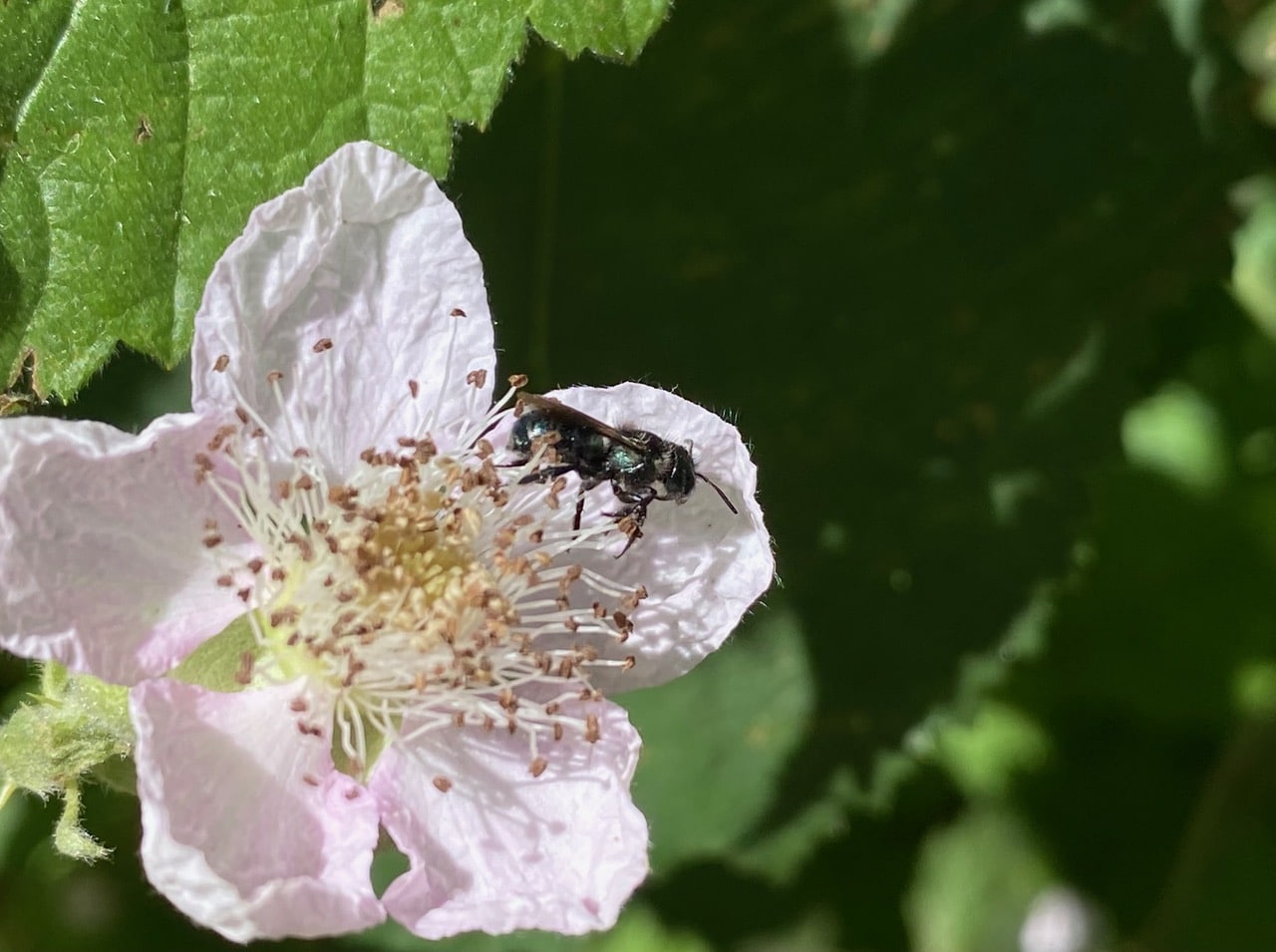
A small, metallic blue bee is foraging among the stamens of a strawberry flower.
There are no visible scopa on the legs of the bee.
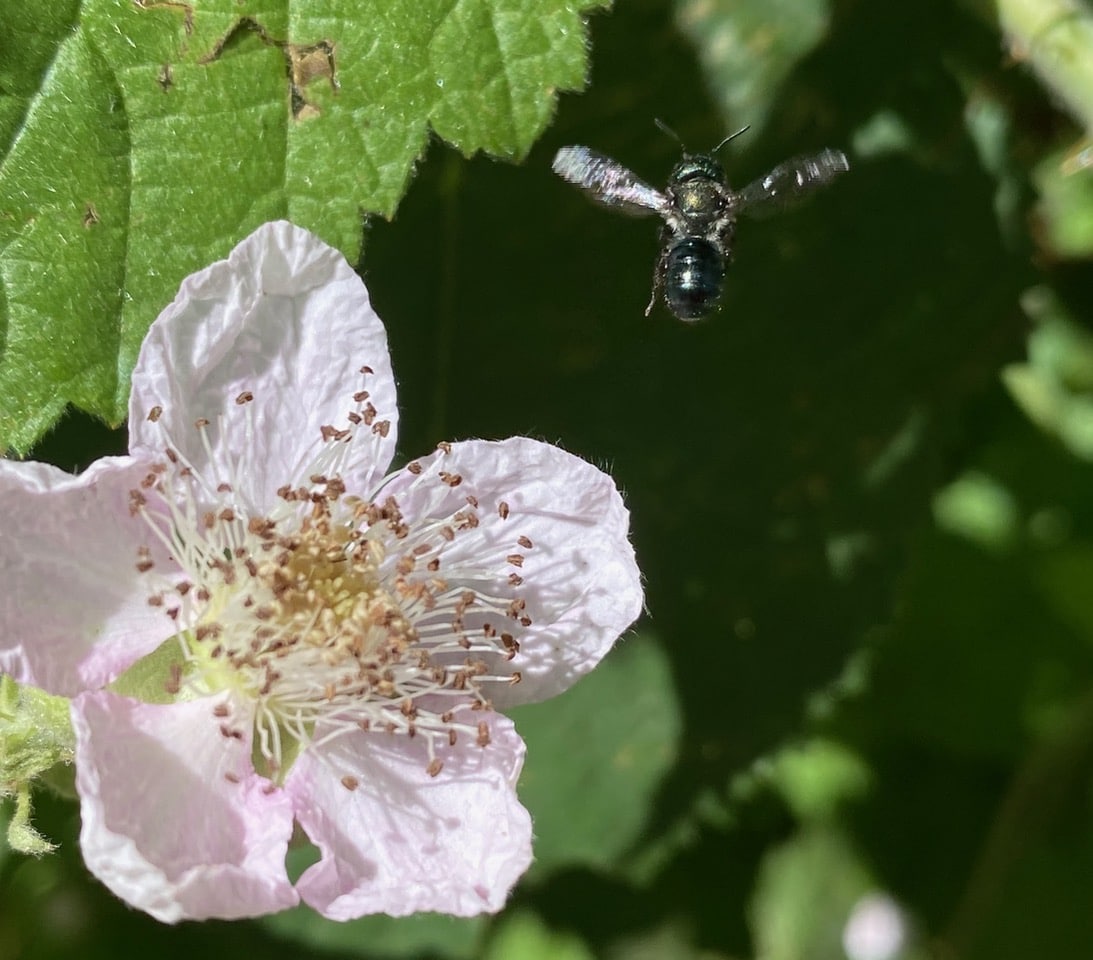
As the bee lifts off, we can see its rounded body parts. A friend once described the Mason Bee, Osmia sp. (family Megachilidae) as three BB pellets glued together. The imagery has stayed with me all these years, helping me identify these bees.
Mason Bee is a name commonly used for species of bees in the genus Osmia, of the family Megachilidae. Mason Bees are named for their habit of using mud or other “masonry” products in constructing their nests, which are made in naturally occurring gaps/cavities such as cracks in stones, hollow stems or holes in wood made by wood-boring insects. Osmia means ‘odor’, and refers to a faint lemony scent used by these bees to mark their nest entrances. Osmia species are frequently metallic green or blue. Females have black ventral scopae (special pollen collecting hairs) on the underside of their abdomen, which are difficult to see unless laden with pollen. Ventral abdominal scopae is a feature shared by all members of the Megachilidae family, which includes the wool-carder bees (genus Anthidium), and leaf-cutter bees (genus Megachile).
Mason Bees are a solitary species. Every female is fertile and makes her own nest. Each nest cell is provisioned with pollen and contains one egg which will develop into a larva. The female creates a partition of mud between the nest cells. The process continues until she has filled the cavity. She plugs the entrance to the cavity, and then may seek another nest location. The larvae that hatch out consume their provisions and begin spinning a cocoon around itself and enters pupal stage. Adults mature in fall or winter, hibernating inside its cocoon.
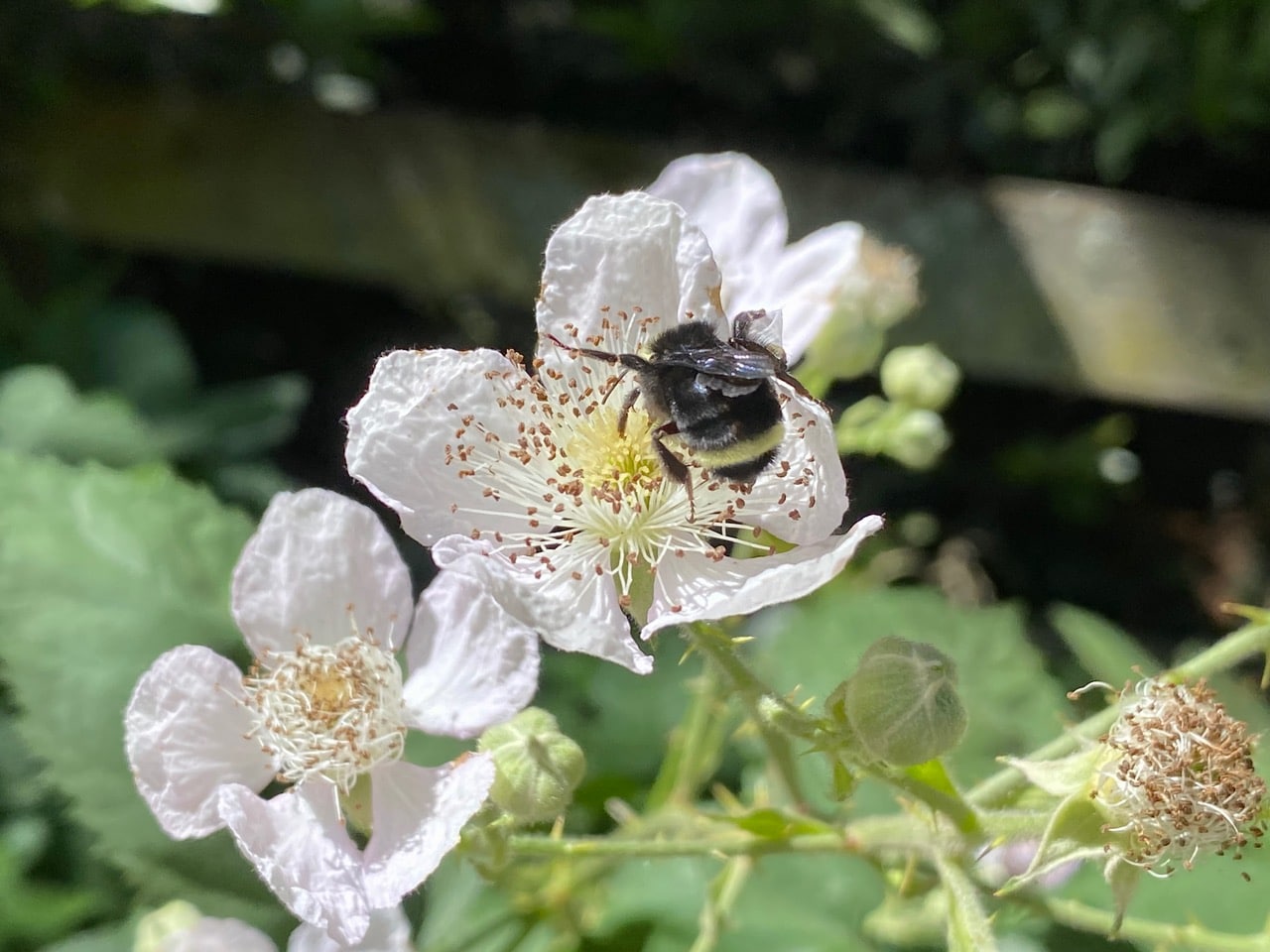
A yellow-faced Bumble Bee is foraging on a flower of California Blackberry, Rubus ursinus.
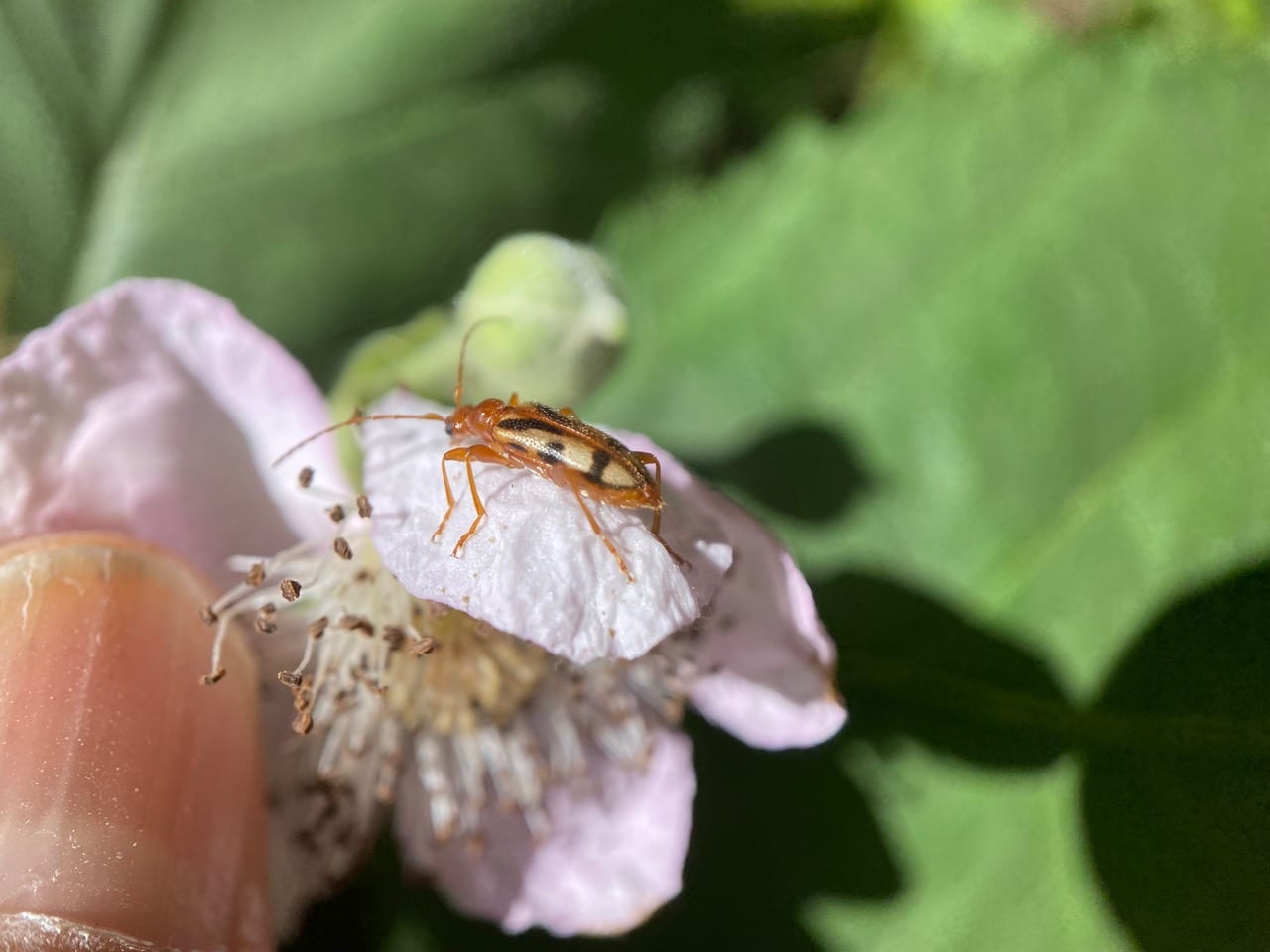
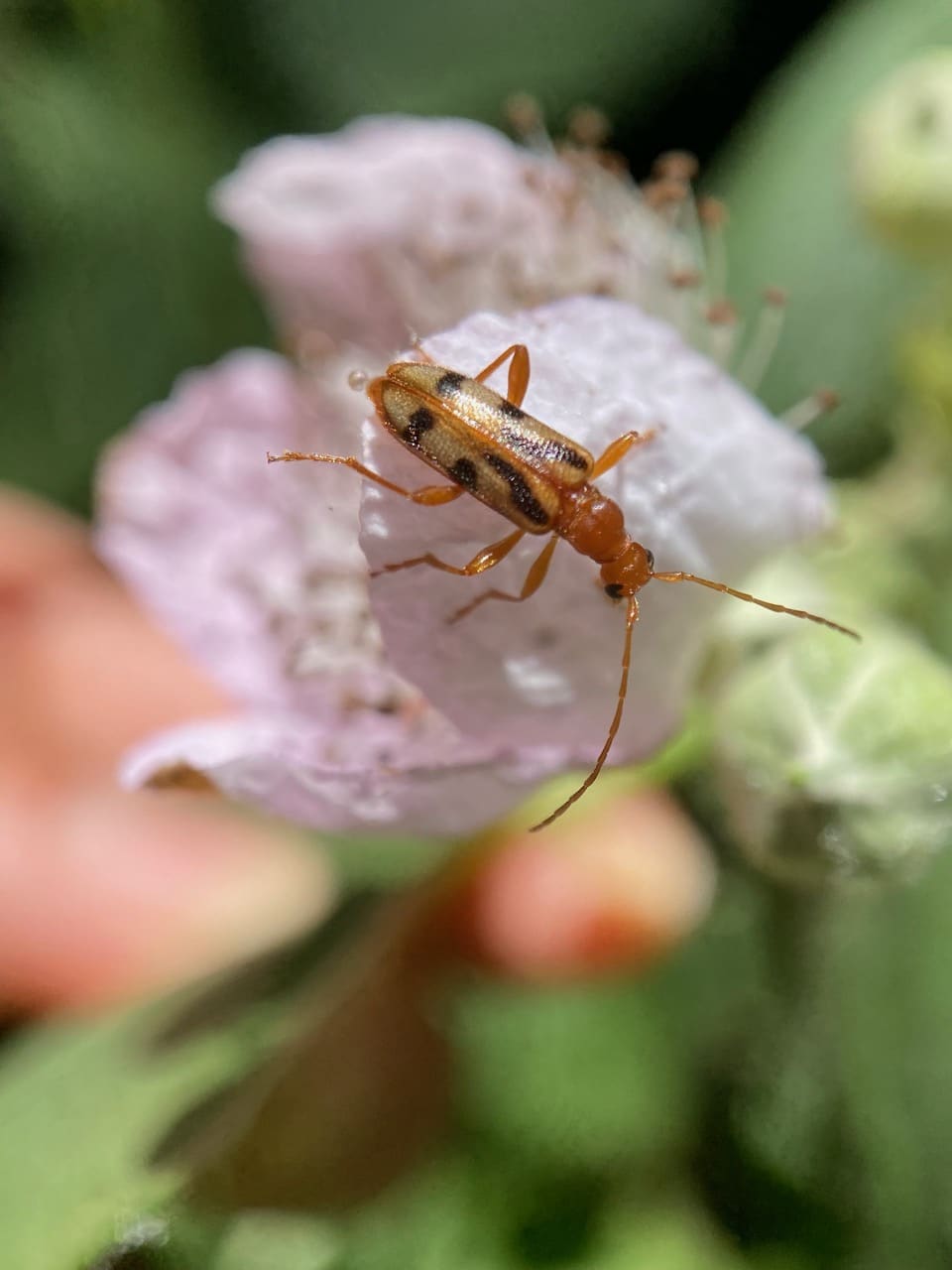
Hey, who’s this on the back of a Blackberry petal? It looks like a Flower Longhorn Beetle (subfamily Lepturinae, family Cerambycidae). iNaturalist has helped identify it to the species
Pidonia scripta (subfamily Lepturinae).
The flower Longhorn Beetles are usually found on flowers where they feed on pollen and nectar, and are considered pollinators. They have a particular affinity for the umbel flowers of the carrot family, Apiaceae. Most species of Flower Longhorn Beetles have a narrow body and very long legs. They also share the family trait with other Cerambycids of having very long antennae. The beetles spend their larval days as borers, just like other Cerambycids. However they are not considered pests, as they select trees that are stressed, dying, or dead.
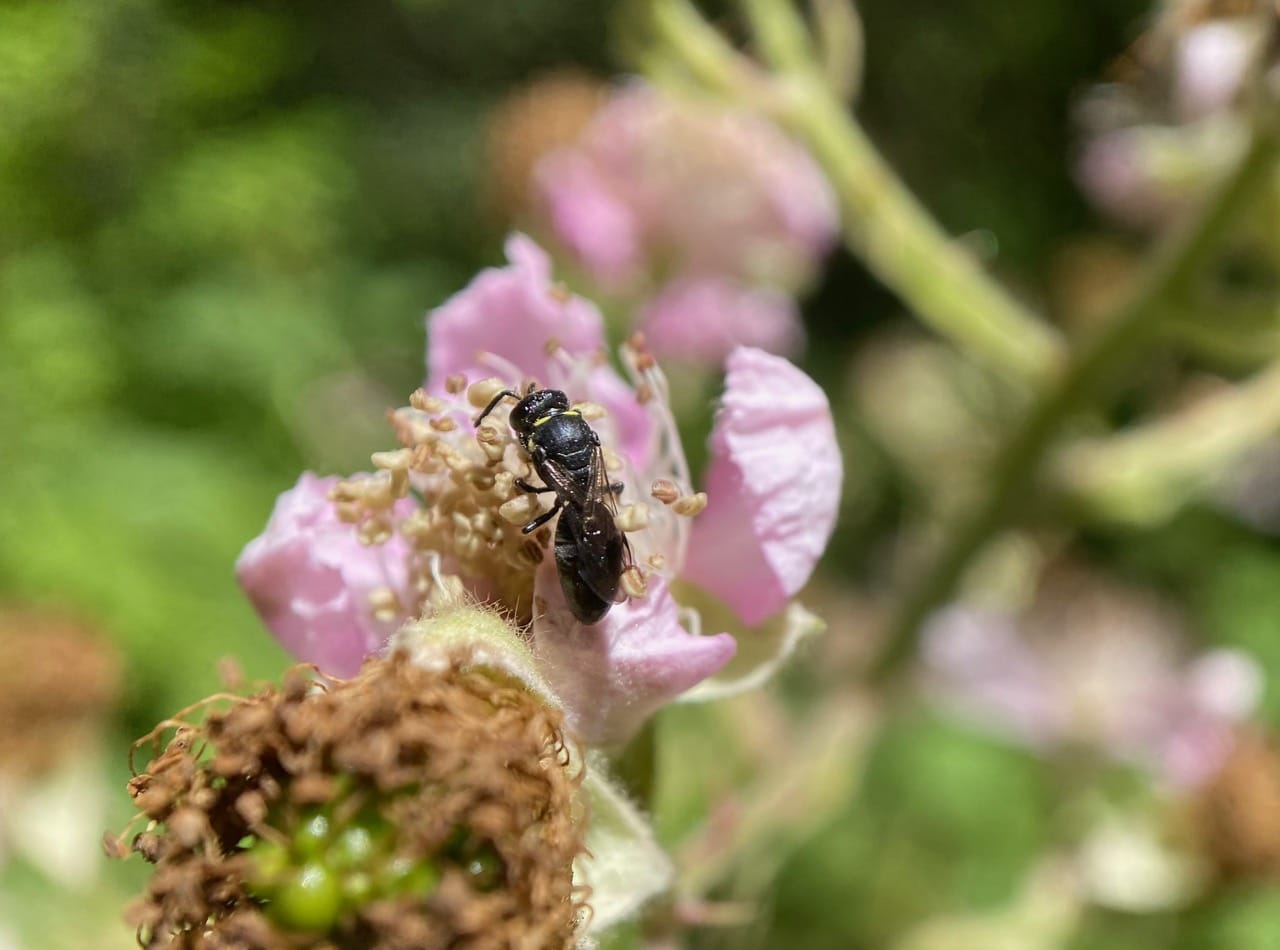
A Masked Bee, Hylaeus sp. (family Colletidae) has landed on a California Blackberry flower.
Hylaeus (family Colletidae) are shiny, slender, hairless, and superficially wasp-like bees. They are small, 5 to 7 mm long, usually black with bright yellow or white markings on their face and legs. These markings are more pronounced on the males. Hylaeus do not carry pollen and nectar externally, they instead store their food in the crop and regurgitate it upon returning to their nests. They are primarily generalist foragers. Hylaeus are short-tongued, but their small body size enables them to access deep flowers. Hylaeus nest in stems and twigs, lining their brood cells with self-secreted cellophane-like material. They lack strong mandibles and other adaptations for digging, using instead pre-existing cavities made by other insects.
Note that there is no pollen carrying scopae on this female Hylaeus. When a bee does not have any scopae or other external anatomical features for carrying pollen it is probably a male, a Cuckoo Bee, or one of these Masked Bees who carry their pollen internally in their crop.
Even in the shade the Western Calligrapher, Toxomerus occidentalis (family Syrphidae) is easily recognizable by its distinctive abdominal pattern.
Toxomerus is a very large genus of Hover Flies. They are found in North and South America. The majority of species are only 6-9 mm in length. They are notable for their mimicry of stinging Hymenoptera to avoid predators. Their unique abdominal patterns are diagnostic at the species level within the genus. There is marked sexual dimorphism – the females have a broader abdomen with lighter coloration and pattern. Most larvae feed on soft bodied insects, such as aphids; a few feed on pollen. Adults feed on the pollen of a wide range of flowers. A female can lay up to hundreds of eggs at a time and will place them where prey or pollen food sources are readily available. They can be found in a wide variety of habitats, often in dense ground cover.
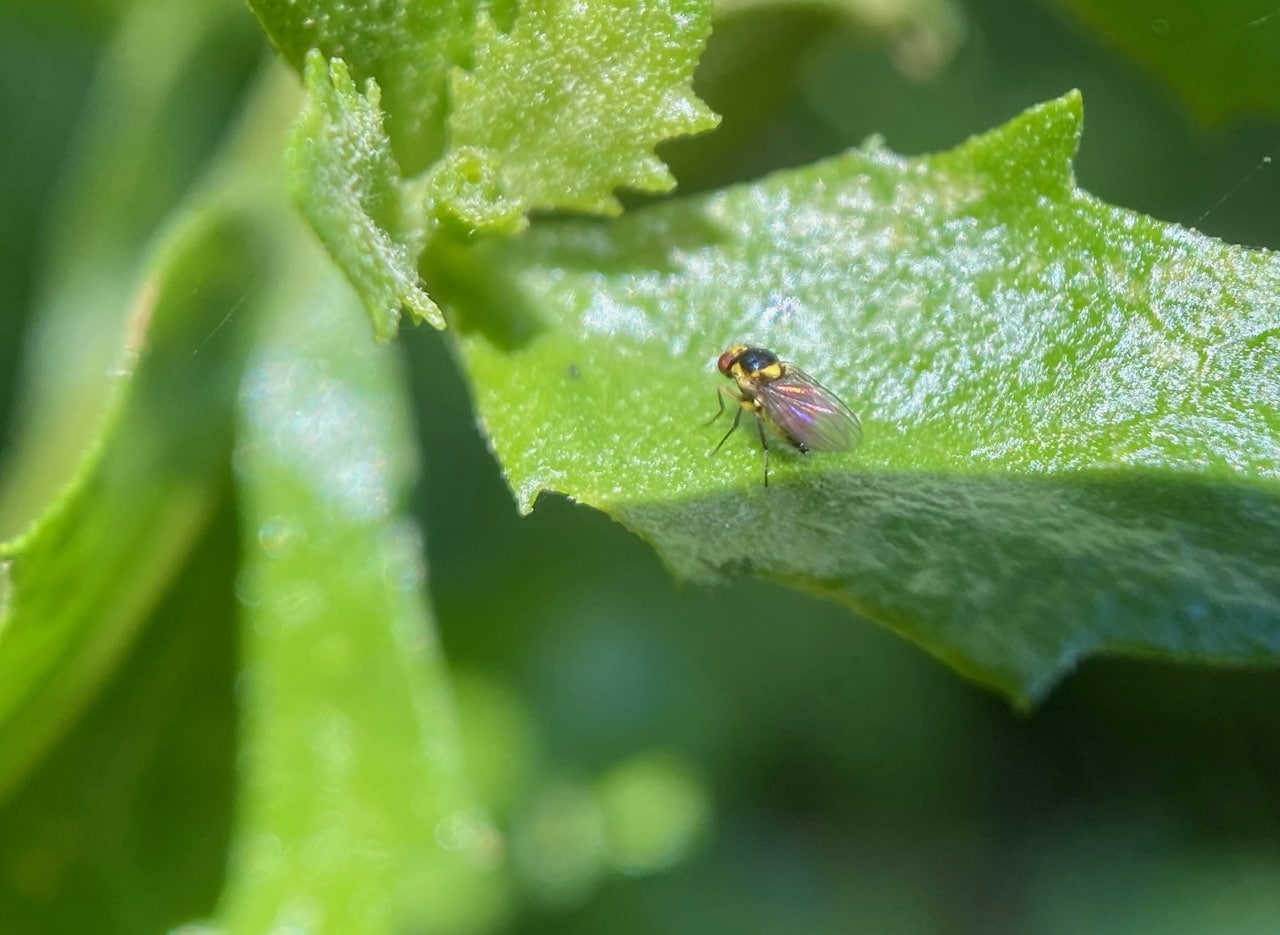
A tiny fly is perched on a leaf of Coyote Brush, Baccharis pilularis. From its minute size and coloration, I recognize it as a Leaf-miner Fly in the genus Liriomyza (family Agromyzidae).
The Agromyzidae are a family commonly referred to as the Leaf-miner Flies, for the feeding habits of their larvae, most of which are leaf miners on various plants. They are small flies, most species in the range of 2-3 mm. Agromyzidae larvae are phytophagous, feeding as leaf miners, less frequently as stem miners or stem borers. A few live on developing seeds, or produce galls. There is a high degree of host specificity. A number of species attack plants of agricultural or ornamental value, so are considered pests. The shape of the mine is often characteristic of the species and therefore useful for identification. Adults occur in a variety of habitats, depending on the larval host plants.