

Pollinator Post 6/23/25 (3)

Hey, something’s happening on that Coffeeberry leaf! A Western Lynx Spider, Oxyopes scalaris (family Oxyopidae) has captured a black winged insect. From this side view, you can see the bizarre profile of the spider and two of its six eyes arranged in a hexagon on the bump on its cephalothorax. This is the characteristic eye arrangement of Lynx Spiders.
Lynx Spiders (family Oxyopidae) can be distinguished from other families by their distinctive hexagonal eye arrangements and the prominent spines on their legs. Most species make little use of webs, instead spending their lives as hunting spiders on plants. Many species frequent flowers in particular, ambushing pollinators. They are active during the day hunting insects sometimes larger than themselves. Their long, spiny bristles form a “basket-like” cage that may assist in capturing prey and providing the spider with some protection. Lynx spiders are fast runners and leapers with good vision. Females fasten their egg sacs to twigs or leaf or suspended in a web in grass tufts. The females fiercely guard their egg sacs – they hold the sac between their legs, protecting it from predators, until the spiderlings hatch, often for up to several weeks. Some species even help the young emerge by tearing open the egg case.

Viewing from above, I can see the general shape of the spider better. Its prey is a Masked Bee, Hylaeus sp. (family Colletidae). The spider is manipulating the motionless bee with its pedipalps. It appears that the spider has only one leg on the left side. And yet it could catch a fast moving bee – amazing! This is, however, not the first time I have seen a handicapped spider hunt successfully. It looks like a full grown adult spider, so it is unlikely to be able to regenerate new legs to replace the lost ones.
The pedipalps are jointed appendages, much like small legs. They are used by the spider to sense objects, shape their webs, and to aid in prey capture and feeding. In male spiders, the pedipalps are also used to deliver sperm during mating.
A spider’s body is covered in a hard outer skin known as an exoskeleton. As the spider matures it has to shed its skin to allow for growth. A spider can go through 20 or more molts before it reaches its full, adult size. Not only does the shedding allow for growth, but it also allows for regeneration. If a spider loses a leg, it is able to grow a new leg provided it still has at least one more molt left in its life cycle. In most species the new leg is thinner and shorter than the original leg. It can take two or three molts until the regenerated limb matches the original in appearance.
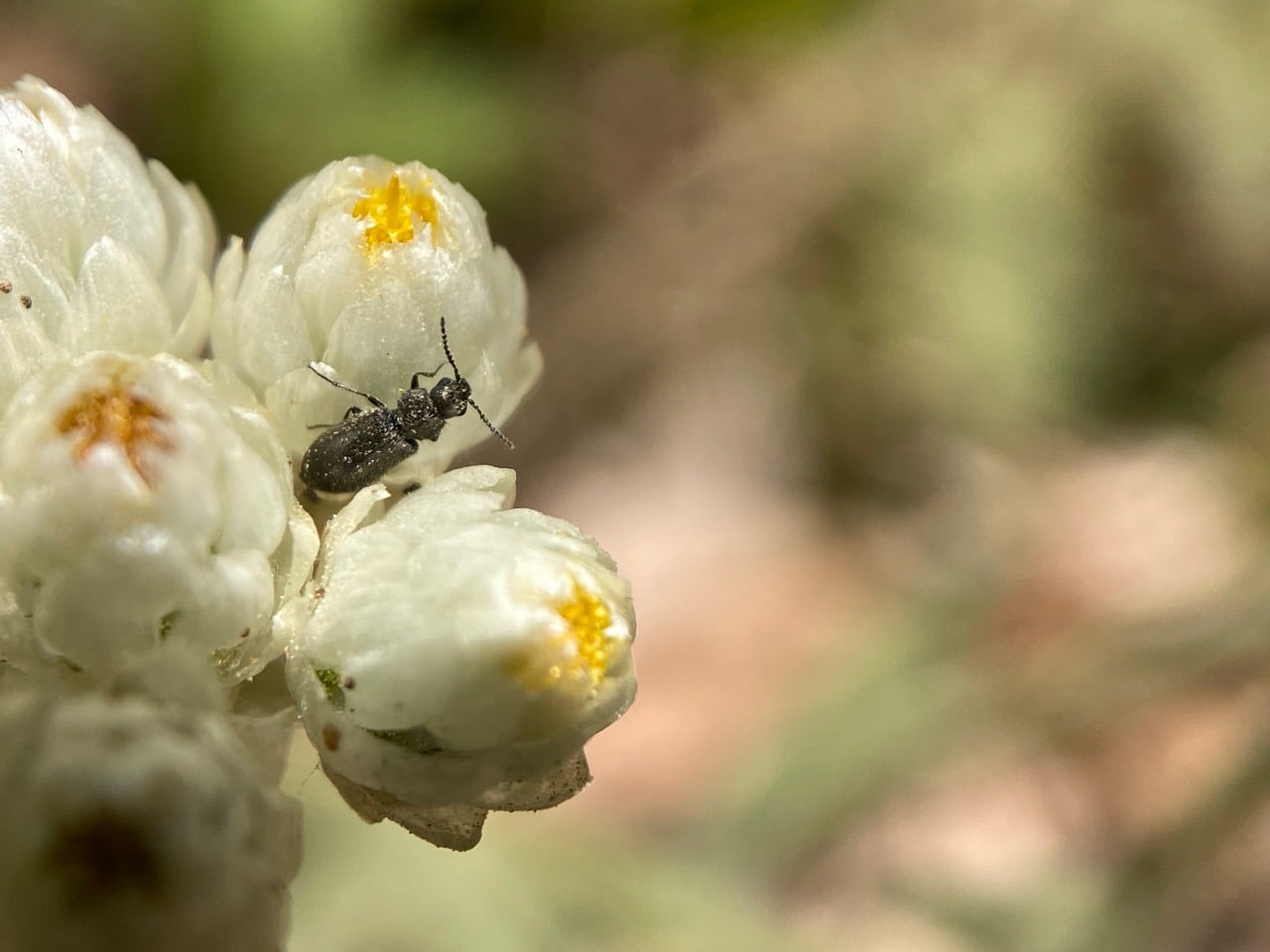
Peppered with pollen, a Soft-winged Flower Beetle, Listrus sp. (family Melyridae, subfamily Dasytinae) peers from the flowerheads of California Everlasting, Pseudognaphalium californicum.
Most species of Melyridae are various shades of brown or black and just 2 to 4 mm in length. They are sometimes very abundant in spring when there is an abundance of open flowers, particularly those with an abundance of pollen. In north America, dasytine beetles are hardly represented in the east, but are enormously diverse in the west, especially in California.
11 families of Coleoptera (beetles) are known to pollinate flowering plants. In western North America, the 300+ species of the beetle subfamily Dasytinae are commonly found on flowers, where adults feed on both nectar and pollen. Their dense setae (hairs) often trap pollen grains, which are transported to other flowers during the course of normal feeding. Many dasytine beetles form large feeding aggregations.