

Pollinator Post 6/26/25
I arrive at Crab Cove late this morning, almost noon.
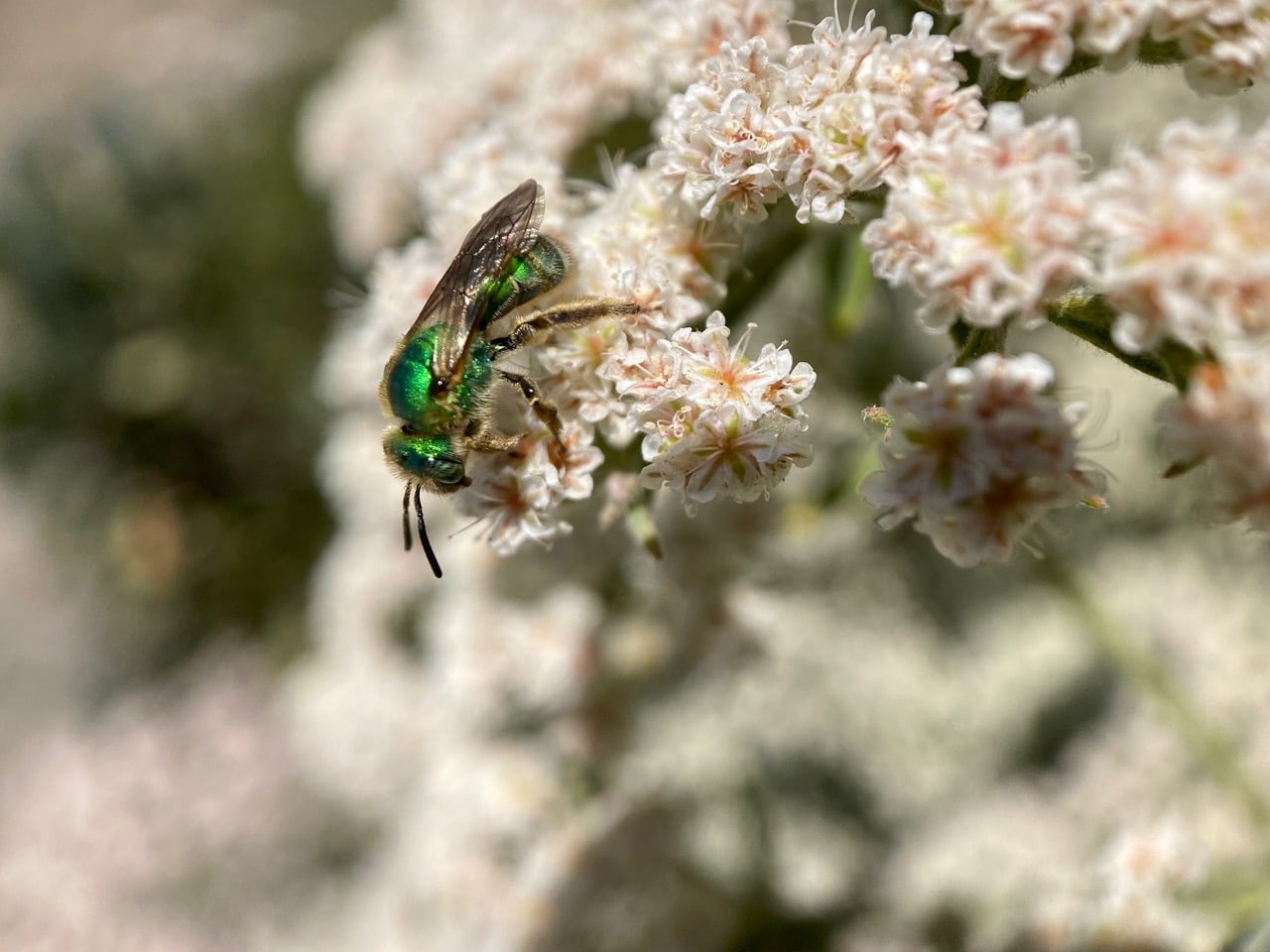
A female Fine Striped Sweat Bee, Agapostemon subtilior (family Halictidae) is taking nectar from an inflorescence of St. Catherine’s Lace, Eriogonum giganteum. Note that the scopae on her hind legs are empty of pollen.
The genus Agapostemon is widespread and abundant throughout North America. They are most diverse and abundant in temperate regions and southwestern U.S. deserts. Agapostemon are commonly called “sweat bees” because they are closely related to, and resemble bees in the Halictus and Lasioglossum genera. Unlike those bees however, Agapostemon are not attracted to human sweat.
Agapostemon are brightly colored metallic green or blue bees measuring 7 to 14.5 mm long. Most species have a metallic green head and thorax, and black-and-yellow striped abdomen; some females are entirely bright green or blue. Females carry pollen on scopal hairs located on their hind legs. Agapostemon are ground-nesters and generalist foragers. Like other members of the family Halictidae, they are short-tongued and thus have difficulty extracting nectar from deep flowers. Males are often seen flying slowly around flowers looking for females. The bees favor flowers with high densities.
Agapostemon females dig deep vertical burrows in flat or sloping soil, or sometimes in banks. Most species are solitary, but some species nest communally. Up to two dozen females may share a single nest entrance, but each individual builds and provisions its own cluster of brood cells. Where a communal nest gallery shares a single entrance, one bee usually guards the hole, with only her head visible from above ground. Unlike other social bees, in communal bees there is no reproductive division of labor. In cool temperate regions, there is one generation per year, with females active in the early summer and males and pre-diapausing females active in the late summer. Only mated females survive the winter. This is probably because unmated females cannot enter diapause (insect version of hibernation).
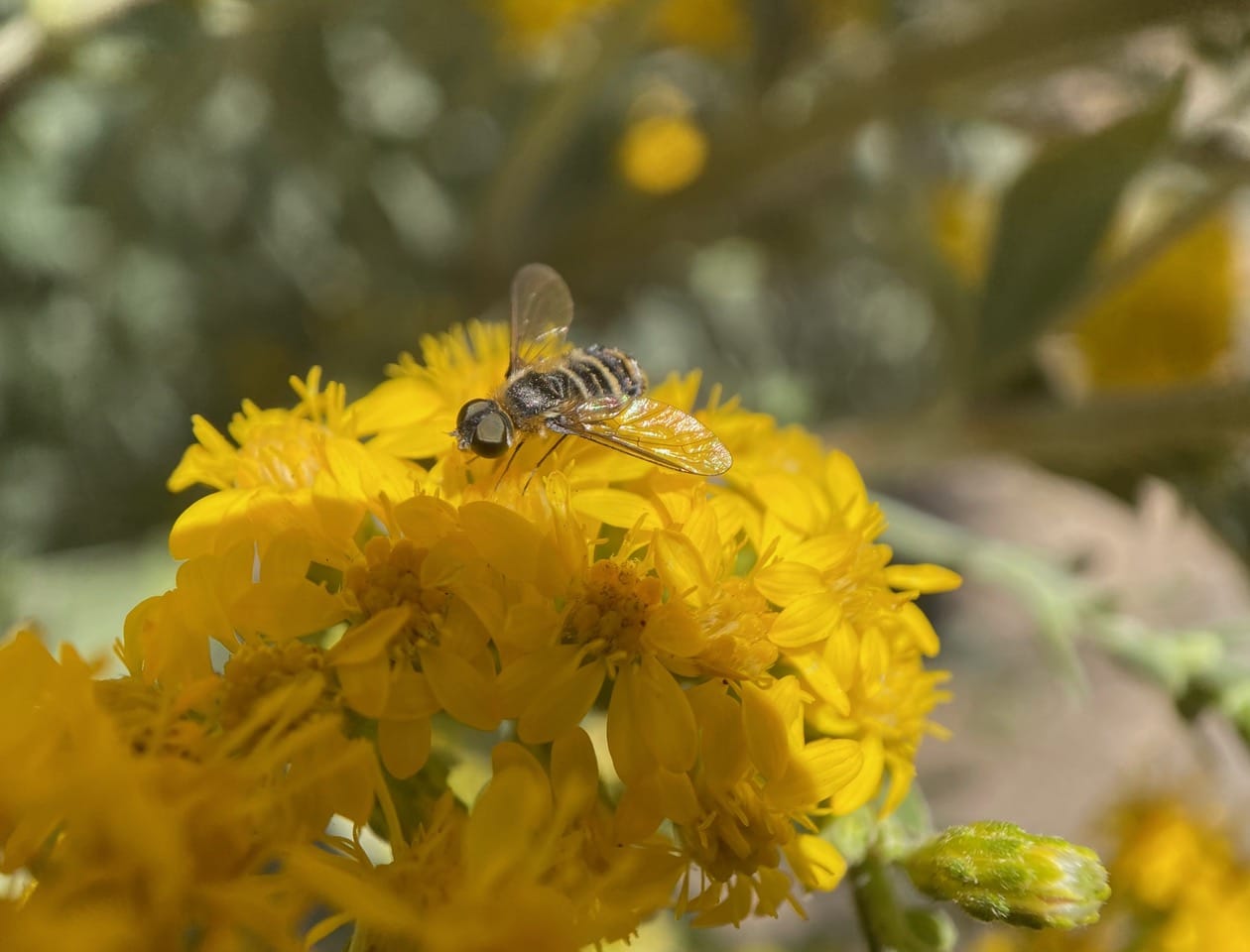
A small Bee Fly, Villa lateralis (family Bombyliidae) is foraging on an inflorescence of California Goldenrod, Solidago velutina ssp. californica.
The Bee Flies belong to the family Bombyliidae. Adults generally visit flowers for nectar and pollen, some being important pollinators. Larvae generally are parasitoids of other insects. When at rest, many species of bee flies hold their wings at a characteristic “swept back” angle. The adult females usually deposit eggs in the vicinity of possible hosts, quite often in the burrows of beetles or ground-nesting bees/wasps. Bombyliidae parasitism is not host-specific, but rather opportunistic, using a variety of hosts. Adult females of the genus Villa lay eggs in mid-air and flick them towards the nest entrances of their hosts. They typically have an eversible pouch near the tip of their abdomen known as a sand chamber, which is filled with sand grains gathered before egg laying. These sand grains are used to coat each egg just before their aerial release, presumably to improve the female’s aim by adding weight.
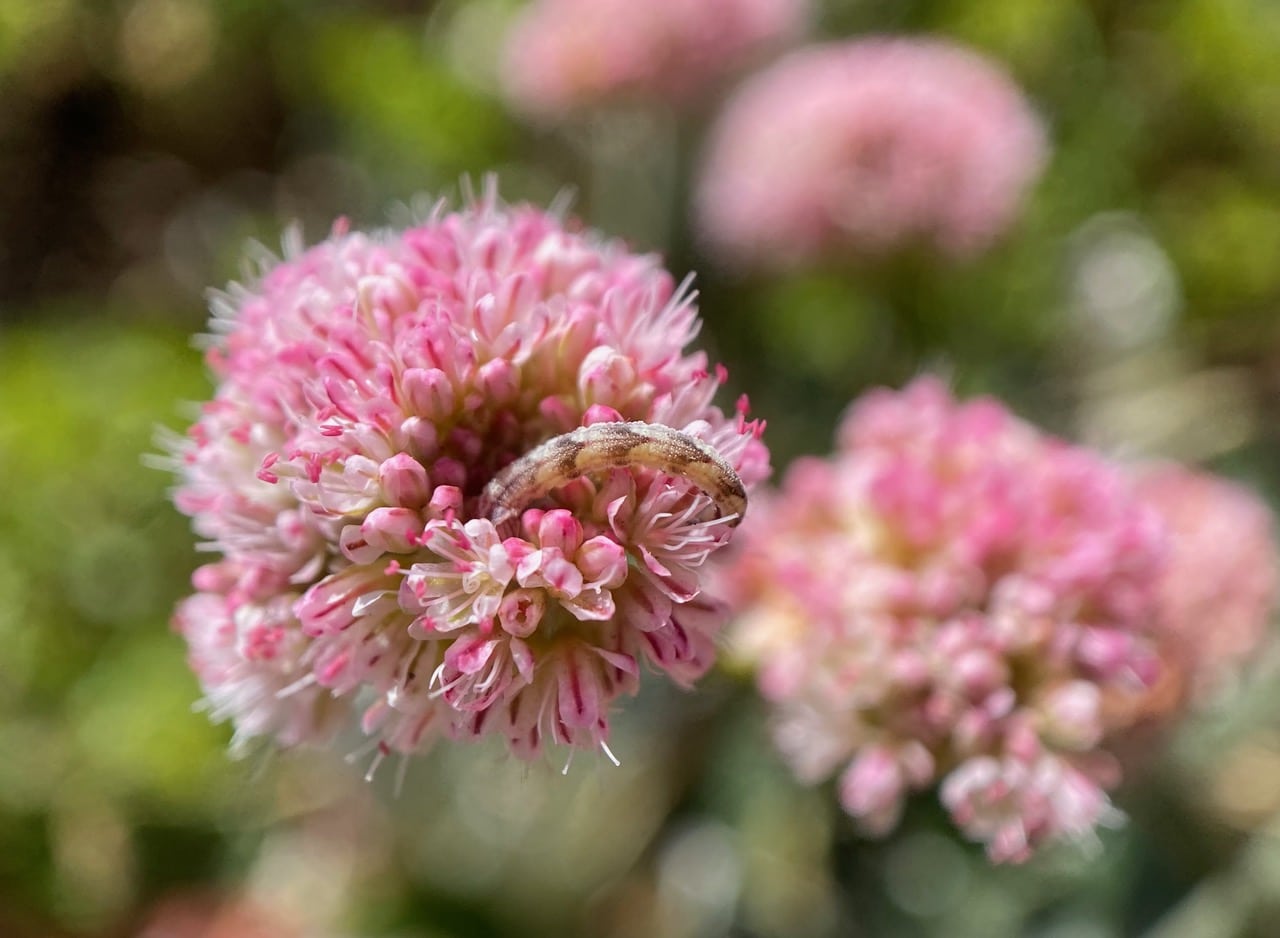
Hey, isn’t that a caterpillar on that inflorescence of pink-flowered Buckwheat, Eriogonum sp.? It is hard to tell which end is the head and which the tail of the caterpillar.
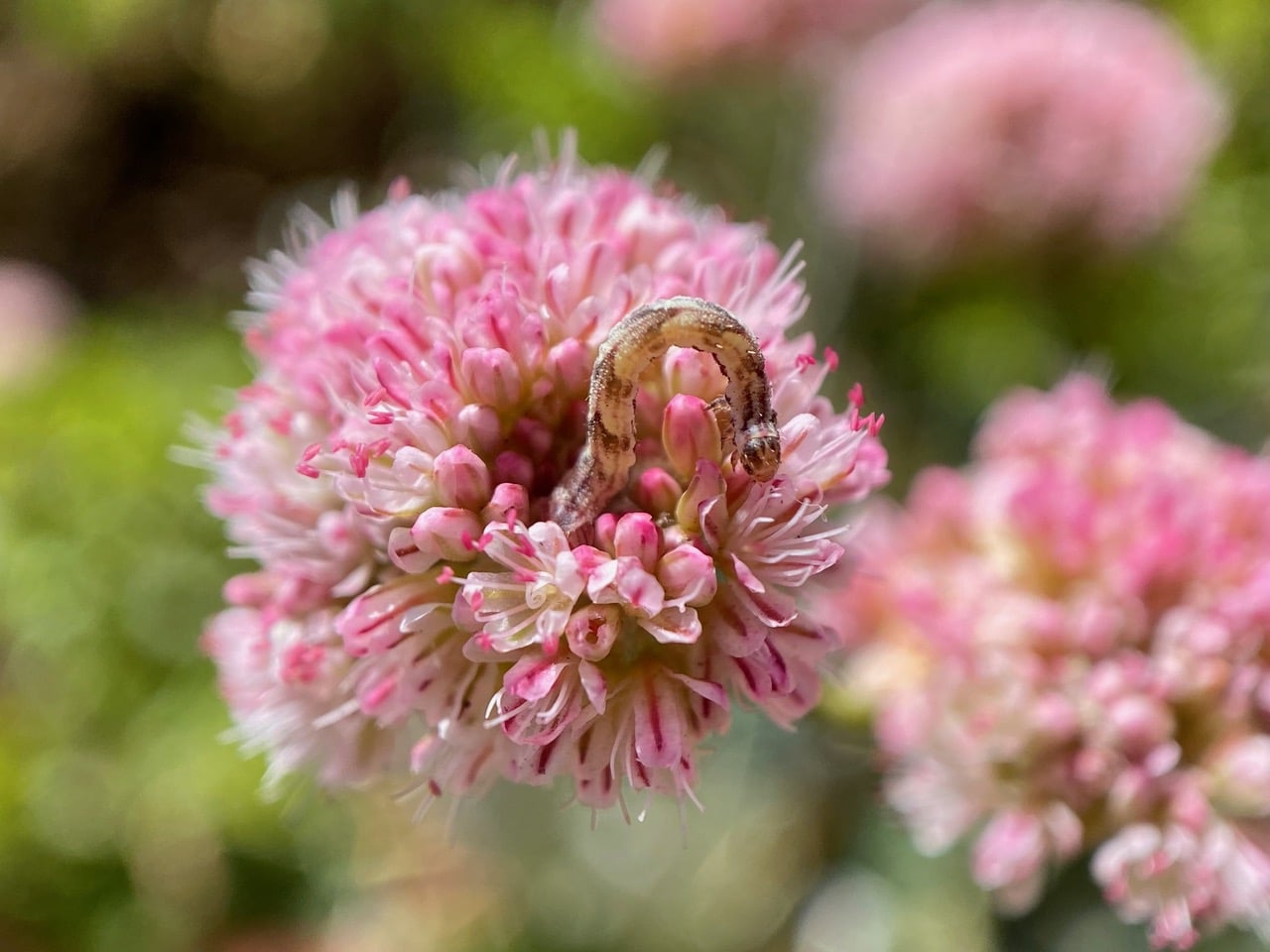
The caterpillar rears up in an inverted U shape, exposing its head and the three pairs of true legs behind it. It is an inchworm, the larva of a Geometrid Moth (family Geometridae). The chevron patterns on its body is suggestive of the Common Eupithecia Moth, Eupithecia miserulata (family Geometridae).
Inchworms are also called loopers and measuring worms. They majority of the inchworms are the larvae of moths in the family Geometridae. The name comes from the Greek “geo” for earth and “metro” from measure, because the caterpillars seem to be measuring the surface on which they are walking. Most caterpillars have five sets of prolegs, four in the middle of the body and one pair at the hind end. Inchworms have the normal six true legs but only two or three pairs of prolegs, all located at the tail end of the body, with none in the middle. When an inchworm walks, it moves its tail-end prolegs up behind its true legs, causing the center of its body to loop upward. Then it stretches its front end forward to take another step.
Eupithelia is the largest genus of moths of the family Geometridae. Occurring worldwide except for Australasia, species in the genus are commonly known as pugs. Adults are typically small, 12 – 35 mm, with muted colors. Most species rest with forewings held flat at right angles to the body, while the hindwing are largely covered by the forewings. They are generally nocturnal. Larvae mostly feed from the flowers and seeds of their food plants rather than the foliage. Many species have a very specific food plant.
Eupithecia miserulata, the Common Eupithecia Moth is found in North America. The adult wingspan is 12-20 mm. The larvae feed on a wide range of plants, including coneflower, asters, willow, cherry, juniper and clover.
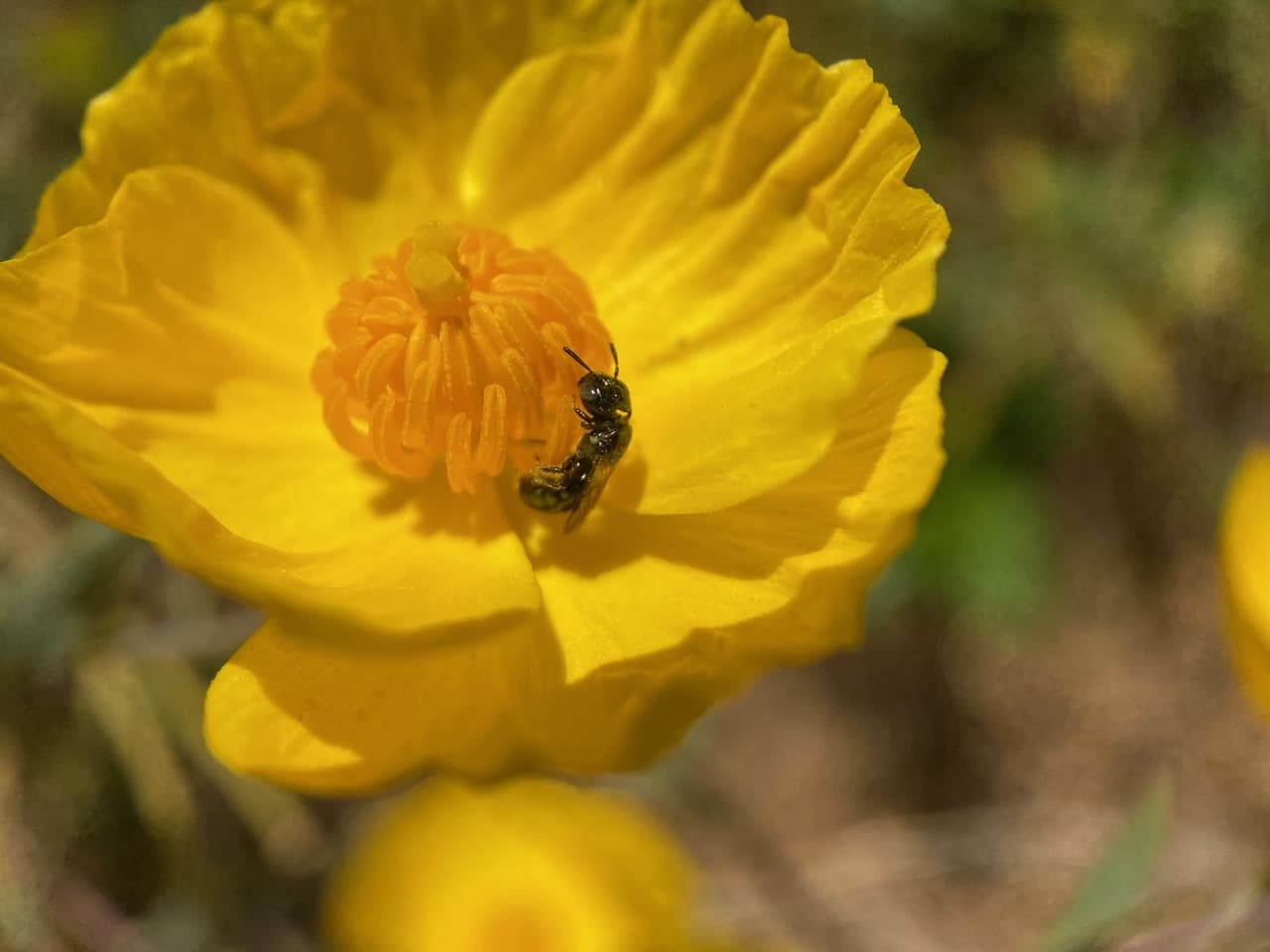
A Small Carpenter Bee, Ceratina sp. (family Apidae) is collecting pollen from the anthers of a flower of the Bush Poppy, Dendromecon rigida. Poppy flowers usually don’t produce nectar. The only reward for pollinators is the generous amounts of pollen.
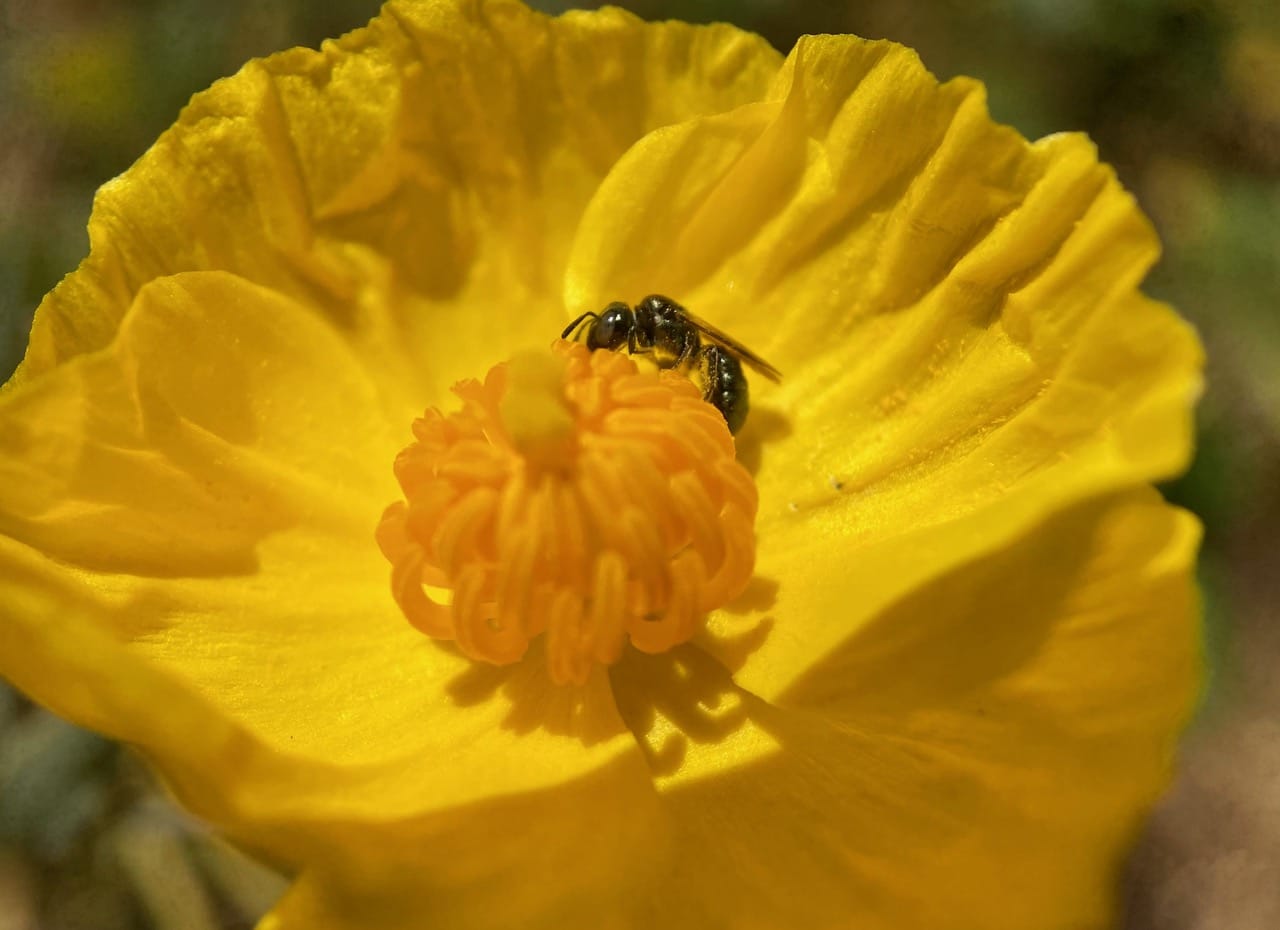
The Small Carpenter Bee genus Ceratina is closely related to the more familiar, and much larger Carpenter Bees (genus Xylocopa). Ceratina are typically dark, shiny, even metallic bees, with fairly sparse body hairs and a weak scopa on the hind leg. The shield-shaped abdomen comes to a point at the tip. Some species have yellow markings, often on the face.
Females excavate nests with their mandibles in the pith of broken or burned plant twigs and stems. While many species are solitary, a number are subsocial. Both male and female carpenter bees overwinter as adults within their old nest tunnels, emerging in the spring to mate. In the spring, this resting place (hibernaculum) is modified into a brood nest by further excavation. The female collects pollen and nectar, places this mixture (called bee bread) inside the cavity, lays an egg on the provision, and then caps off the cell with chewed plant material. Several cells are constructed end to end in each plant stem.

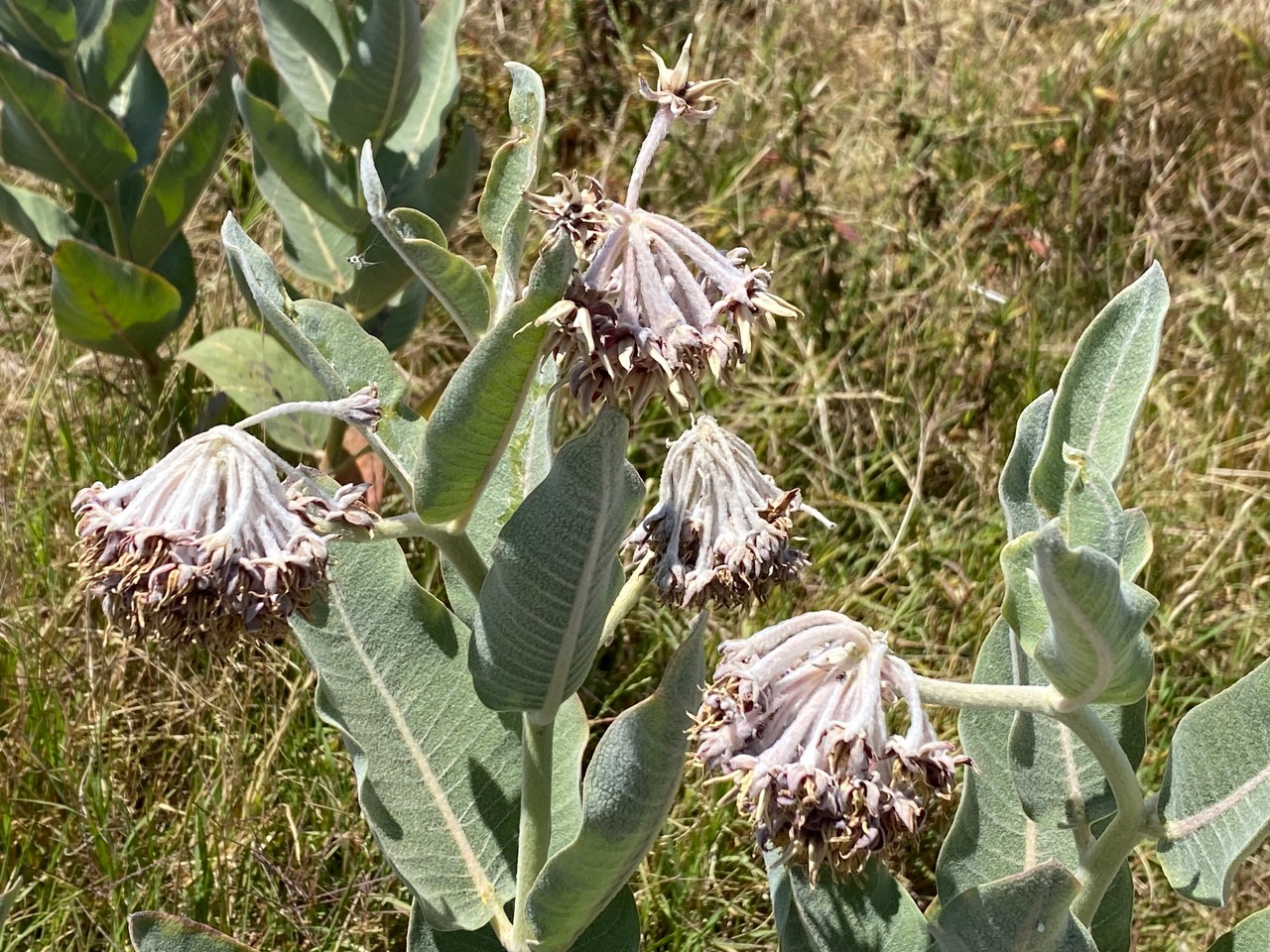
It’s shocking to see the Showy Milkweed, Asclepias speciosa in such a decrepit shape. They were just starting to bloom when we had the BioBlitz here less than a month ago. With the flowers gone, there is hardly any insect activity now. There is no sign of any developing fruits either. Failure in pollination?

Hey, life goes on! A pair of Meadow Spittlebugs, Philaenus spumarius (family Aphrophoridae) is mating on the back of a milkweed leaf.
Adult spittlebugs are commonly called Froghoppers. The Froghopper is a “true bug” in the order Hemiptera, family Aphrophoridae. Froghoppers are champion jumpers among insects, out-performing even the fleas. The bug can leap the human equivalent of a skyscraper without a running start! The muscles in its hind legs act like a “catapult” to release energy explosively. Its athletic prowess not withstanding, the Froghopper is better known for its young, the “spittle bugs”. The nymphs produce foamy white masses on plants within which they feed on plant sap. Froghoppers have piercing-sucking mouthparts, and feed on plant sap as both nymphs and adults. A recent report claims, “Froghoppers are the super-suckers of the animal world. The tiny insects produce negative pressures equivalent to people sucking a 100-meter-long straw.” So the little bug has two titles under its belt – champion jumper, and super-sucker!
Mating in the Meadow Spittlebugs has been studied in detail. The bugs use substrate-borne vibrational signals transmitted through the host plants to communicate and find mates. Both males and females can initiate pair formation by emitting signals. A pair signaling back and forth in harmonics results in a male-female vibrational duet. The female remains stationary during the process while the male searches for her. After mating, female spittlebugs lay eggs in the late summer and fall. Eggs are laid low on the plant, often in stubble or behind leaf sheaths. They hatch the following spring. Meadow Spittlebugs typically have only one generation per year. Female Spittlebugs are known to be polyandrous, meaning they mate with multiple males throughout the season. This results in eggs with different fathers, potentially increasing the bug’s adaptability to different environments.
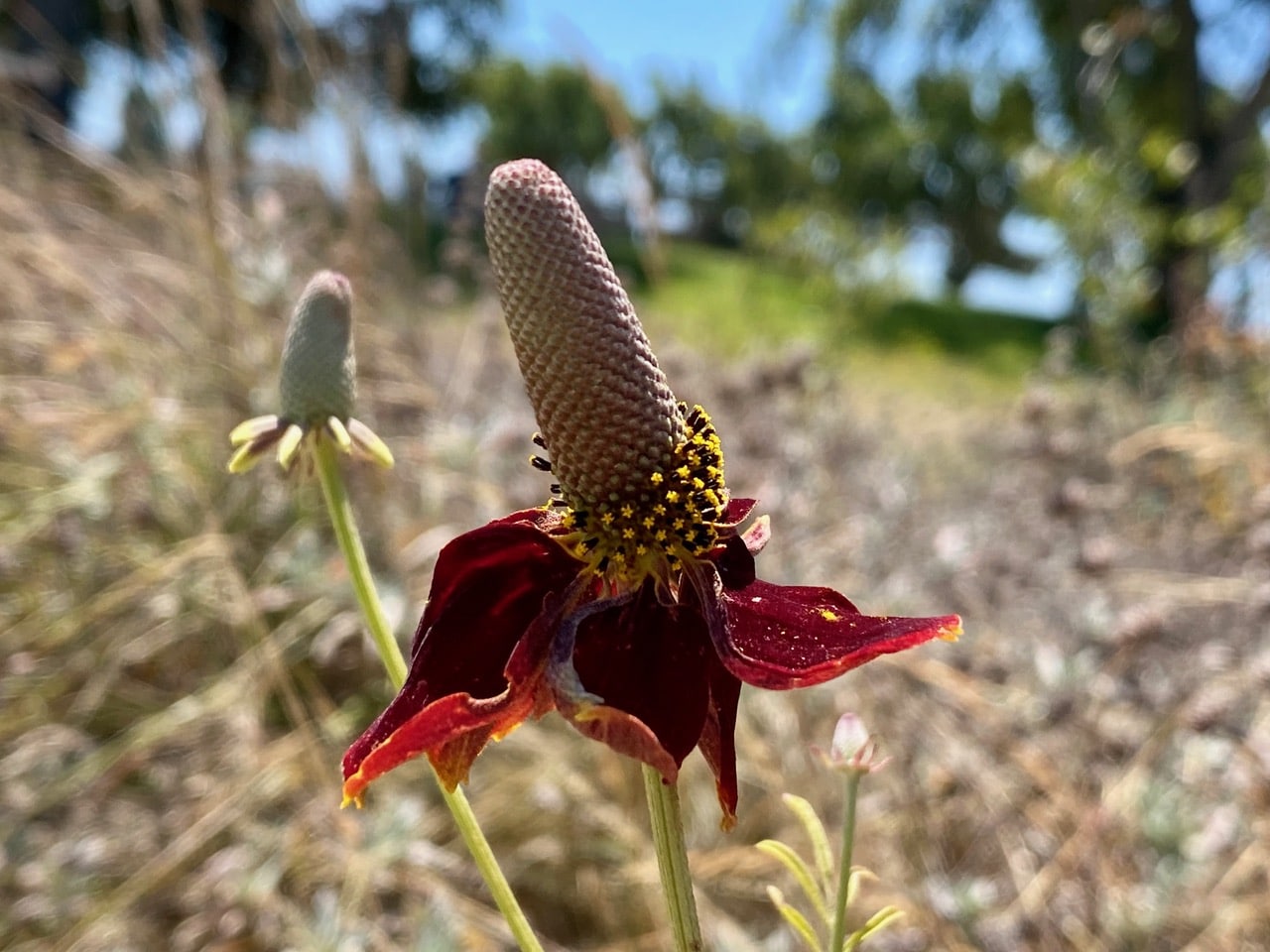
Hey, I have never seen that plant here before. The flowerhead is oddly charming, with florets arranged vertically on a large cone. iNaturalist has helped identify it as the Upright Prairie Coneflower, Ratibida columnifera.
The plant is native to much of North America and inhabits prairies, plains, roadsides, and disturbed areas. The inflorescence consists of 4-12 drooping, sterile ray florets that are yellow, brownish red, surrounding a central column which is up 2 in. long. The column is made up of numerous purplish disk florets, which open in bands starting at the base of the column and moving upwards. Flowers appear June to September. Prairie Coneflower is valued by gardeners for xeriscaping and native plant gardens for its color and rich fragrance.

A male Fine Striped Sweat Bee, Agapostemon subtilior (family Halictidae) is taking nectar from the open florets at the base of the cone. Note that the bee has a yellow-and-black striped abdomen.
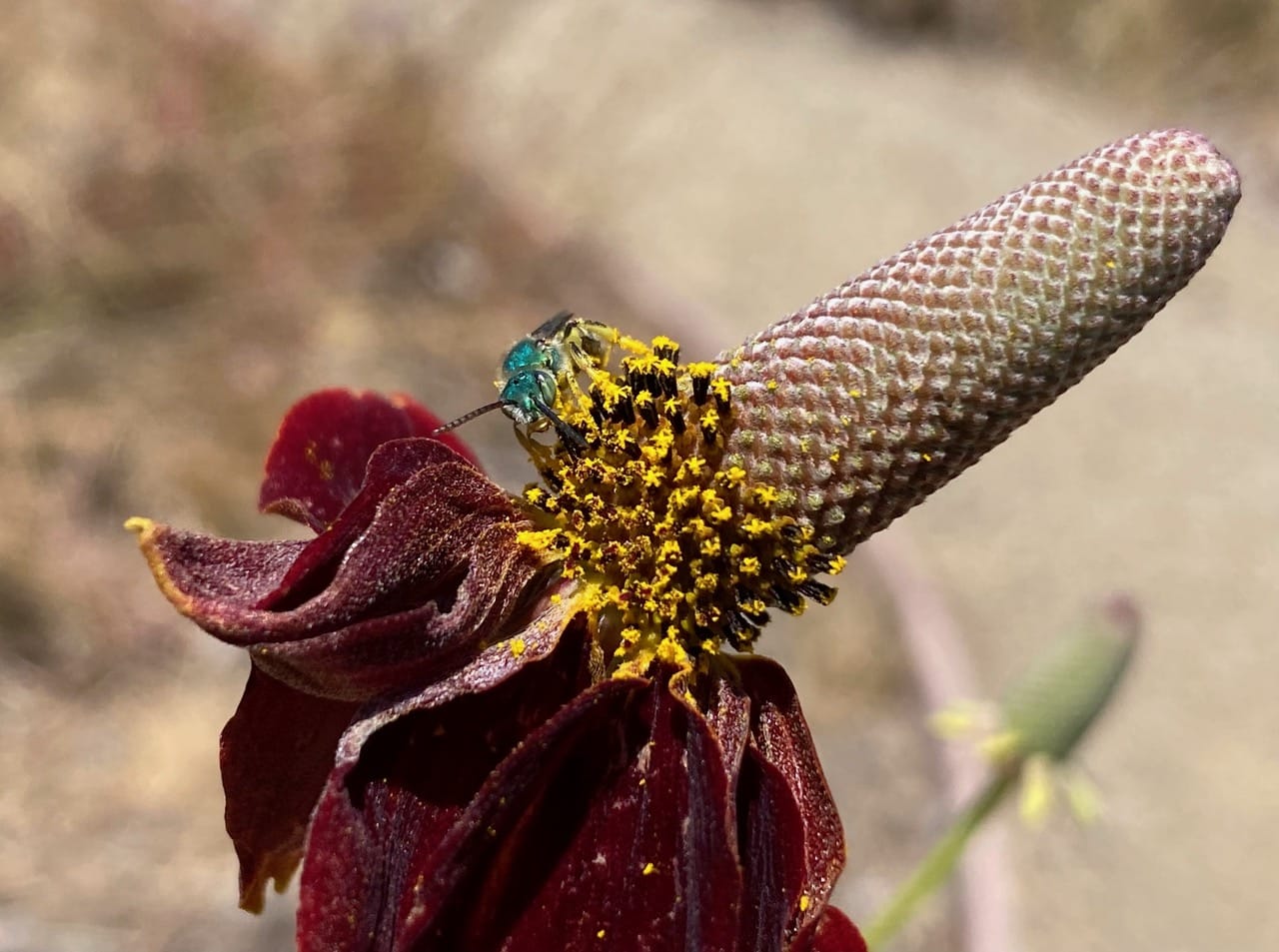
The bee has a brilliant iridescent green head and thorax. As we have seen earlier, the female of the species is green all over.
The genus Agapostemon is widespread and abundant throughout North America. They are most diverse and abundant in temperate regions and southwestern U.S. deserts. Agapostemon are commonly called “sweat bees” because they are closely related to, and resemble bees in the Halictus and Lasioglossum genera. Unlike those bees however, Agapostemon are not attracted to human sweat.
Agapostemon are brightly colored metallic green or blue bees measuring 7 to 14.5 mm long. Most species have a metallic green head and thorax, and black-and-yellow striped abdomen; some females are entirely bright green or blue. Females carry pollen on scopal hairs located on their hind legs. Agapostemon are ground-nesters and generalist foragers. Like other members of the family Halictidae, they are short-tongued and thus have difficulty extracting nectar from deep flowers. Males are often seen flying slowly around flowers looking for females. The bees favor flowers with high densities.
Agapostemon females dig deep vertical burrows in flat or sloping soil, or sometimes in banks. Most species are solitary, but some species nest communally. Up to two dozen females may share a single nest entrance, but each individual builds and provisions its own cluster of brood cells. Where a communal nest gallery shares a single entrance, one bee usually guards the hole, with only her head visible from above ground. Unlike other social bees, in communal bees there is no reproductive division of labor. In cool temperate regions, there is one generation per year, with females active in the early summer and males and pre-diapausing females active in the late summer. Only mated females survive the winter. This is probably because unmated females cannot enter diapause (insect version of hibernation).
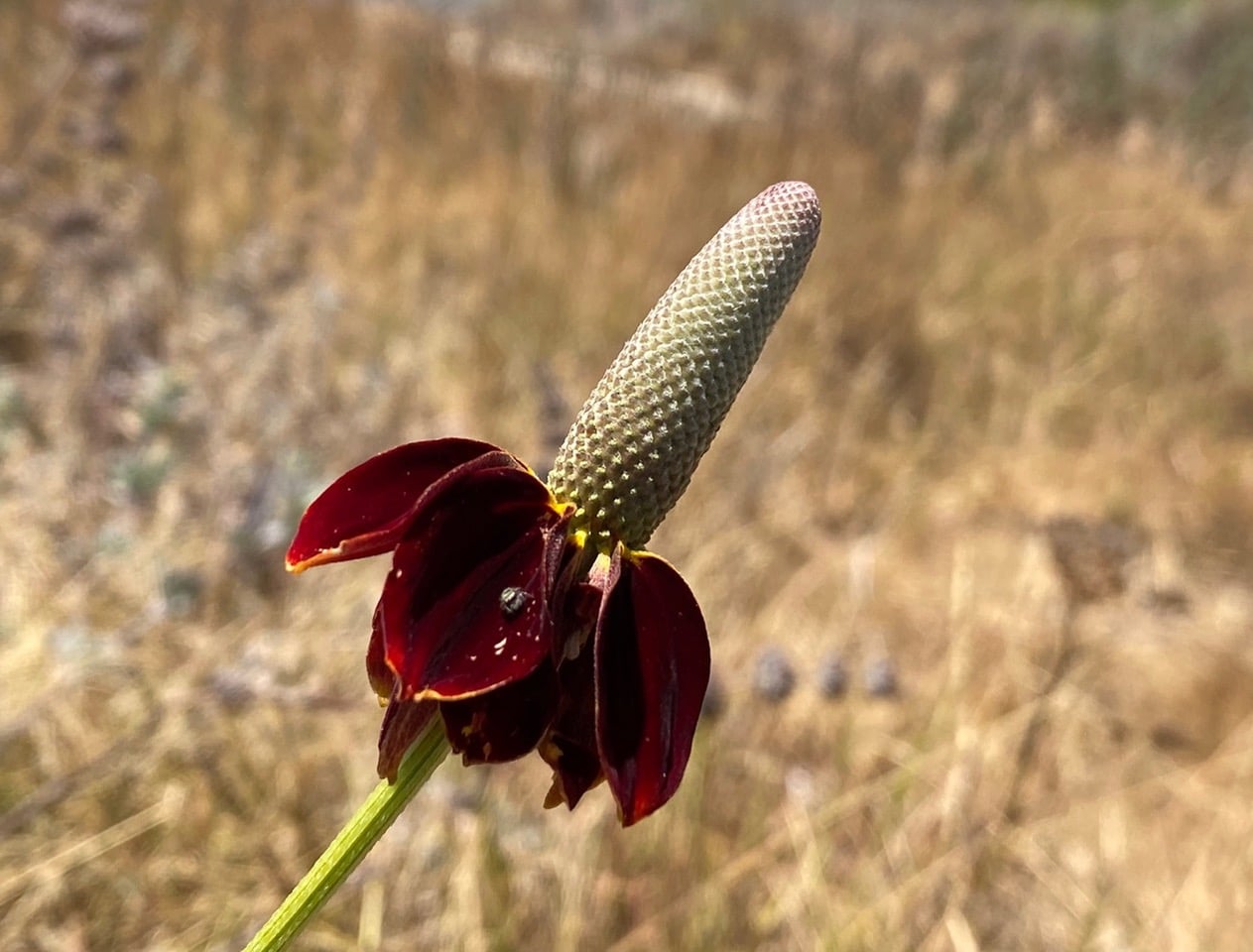
Wait, there’s something on the ray petal of that younger flowerhead.
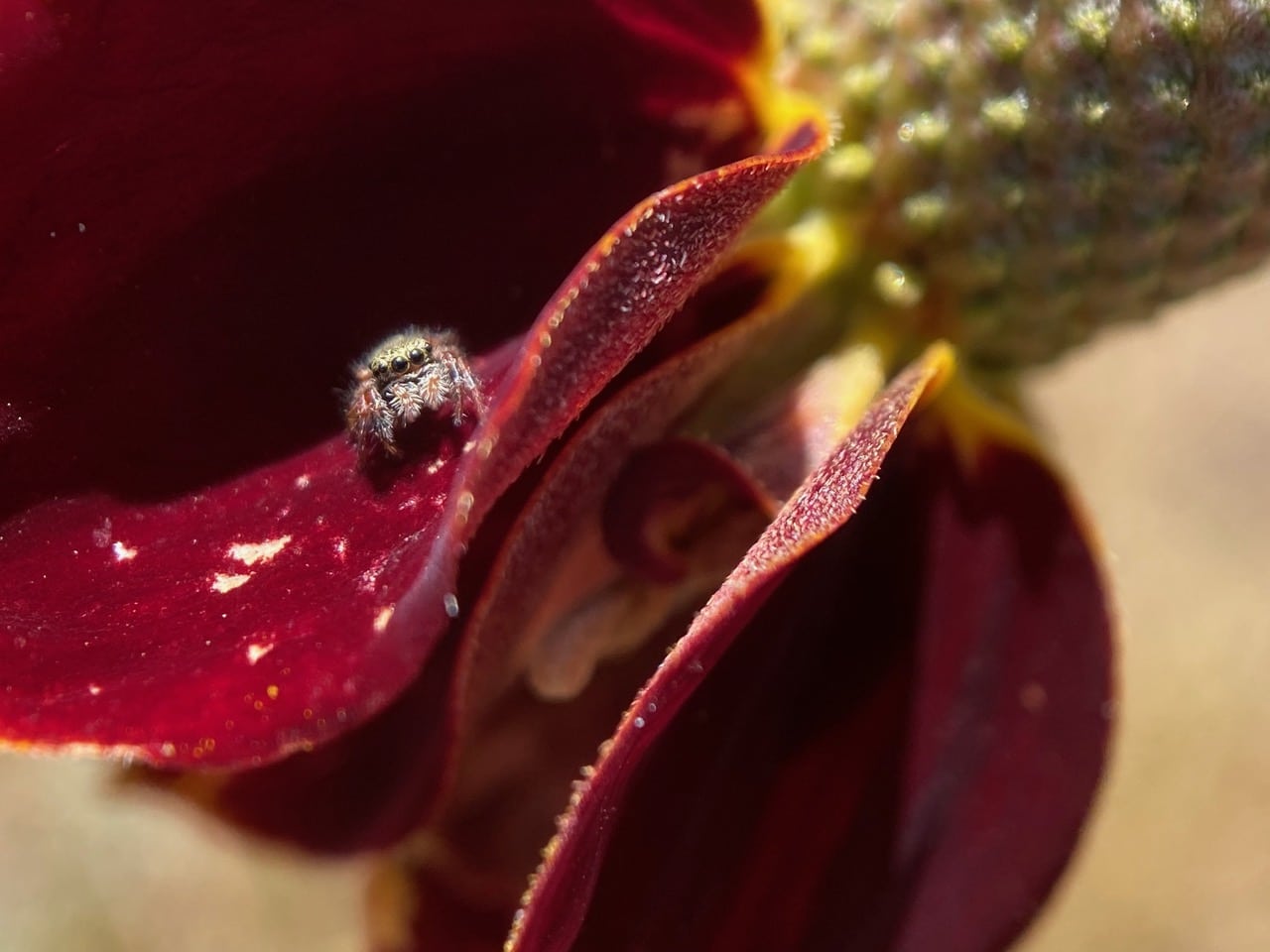
Aww, it’s a tiny Jumping Spider (family Salticidae), probably a juvenile.
Jumping spiders have a unique eye arrangement consisting of eight eyes in four pairs. The most prominent pair are the two large, forward-facing anterior median eyes (AMEs), which provide sharp, detailed vision and depth perception. The other three pairs are smaller secondary eyes: two anterior lateral eyes (ALEs), two posterior median eyes (PMEs), and two posterior lateral eyes (PLEs). These secondary eyes offer a wider field of view and help with detecting movement.

The little spider crawls up the cone. The shape and pattern of its abdomen are suggestive of the genus Phidippus.

A Mason Wasp, Euodynerus annulatus (family Vespidae, subfamily Eumeninae) is foraging on an inflorescence of a pink-flowered Buckwheat, Eriogonum sp. It seems that I always see this wasp on this particular plant whenever I visit the garden. I wonder if it isn’t the same individual who has a nest close by.

The Mason Wasp, Euodynerus annulus (family Vespidae, subfamily Eumininae) is a widespread species, found from coast to coast in the United States, south to Mexico, and north into Canada. The color and markings vary considerably among the various subspecies. These are sizable wasps, their fore wings measuring 8.5-10.5 mm. Males can be recognized by the hooked tips of the antennae, and their less robust appearance. Unlike the other Mason Wasps that use pre-existing cavities, or making mud nests, the females of this species excavate burrows. They also extend the tunnel above ground as a curved mud “chimney”. Several individual cells branch from the main burrow underground. The species seem to favor situations close to water, as the female regurgitate water to soften the soil during nest-building. The chimney might help protect against parasites, but it apparently serves as the source of mud pellets to make the final nest closure as well.
The female wasps provision their nests with moth caterpillars as food for their offspring. A single egg is suspended from a short thread attached to the wall of the cell before it is stocked with caterpillars. Usually several caterpillars are placed in each cell. When all cells are provisioned, the nest entrance is sealed. The turret or chimney is deconstructed entirely and the nest entrance made nearly invisible and flush with the surrounding soil. The wasp leaves to begin a new nest.
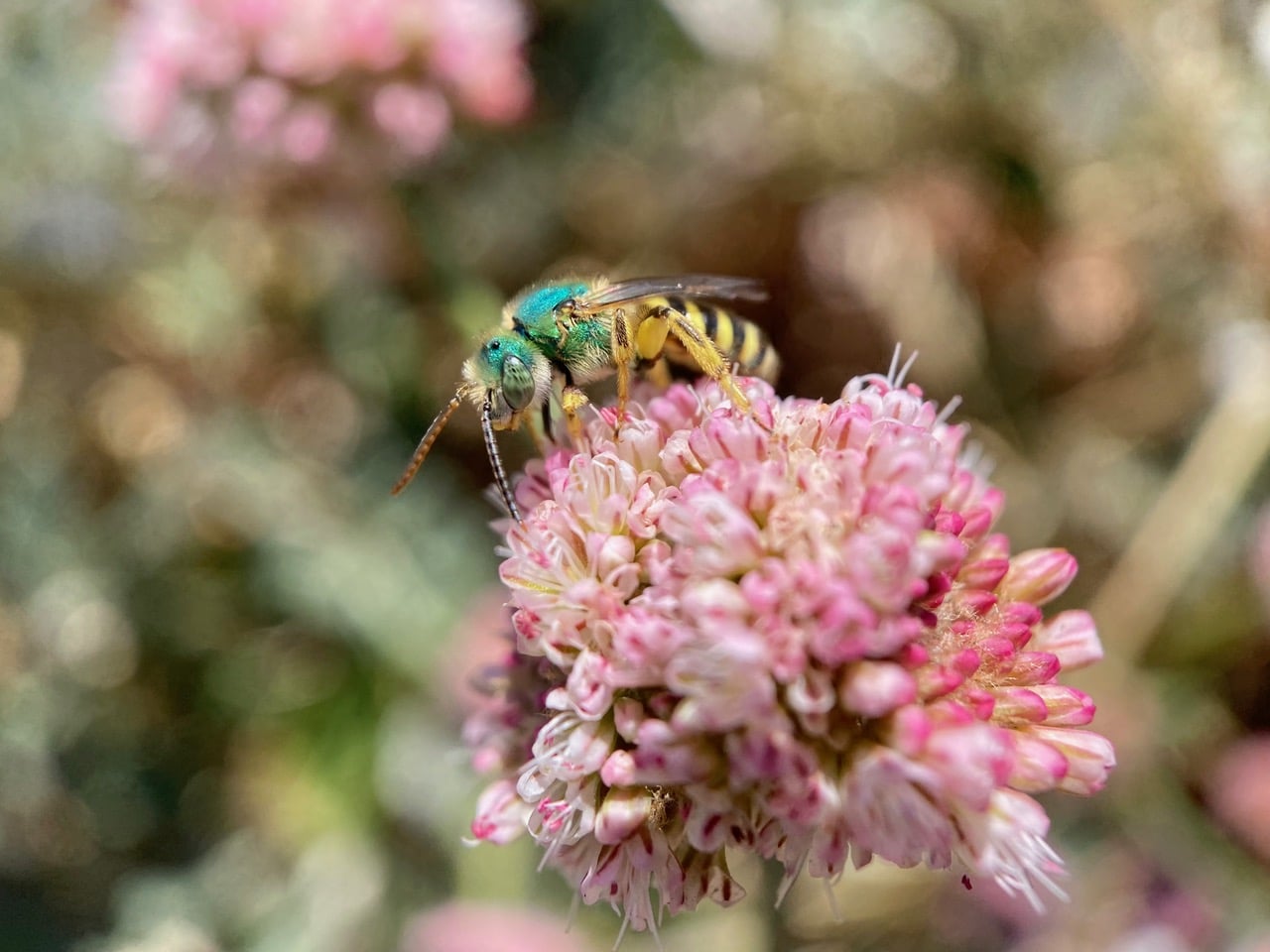
A male Fine Striped Sweat Bee, Agapostemon subtilior (family Halictidae) is seeking nectar on a inflorescence of the same pink-flowered buckwheat.
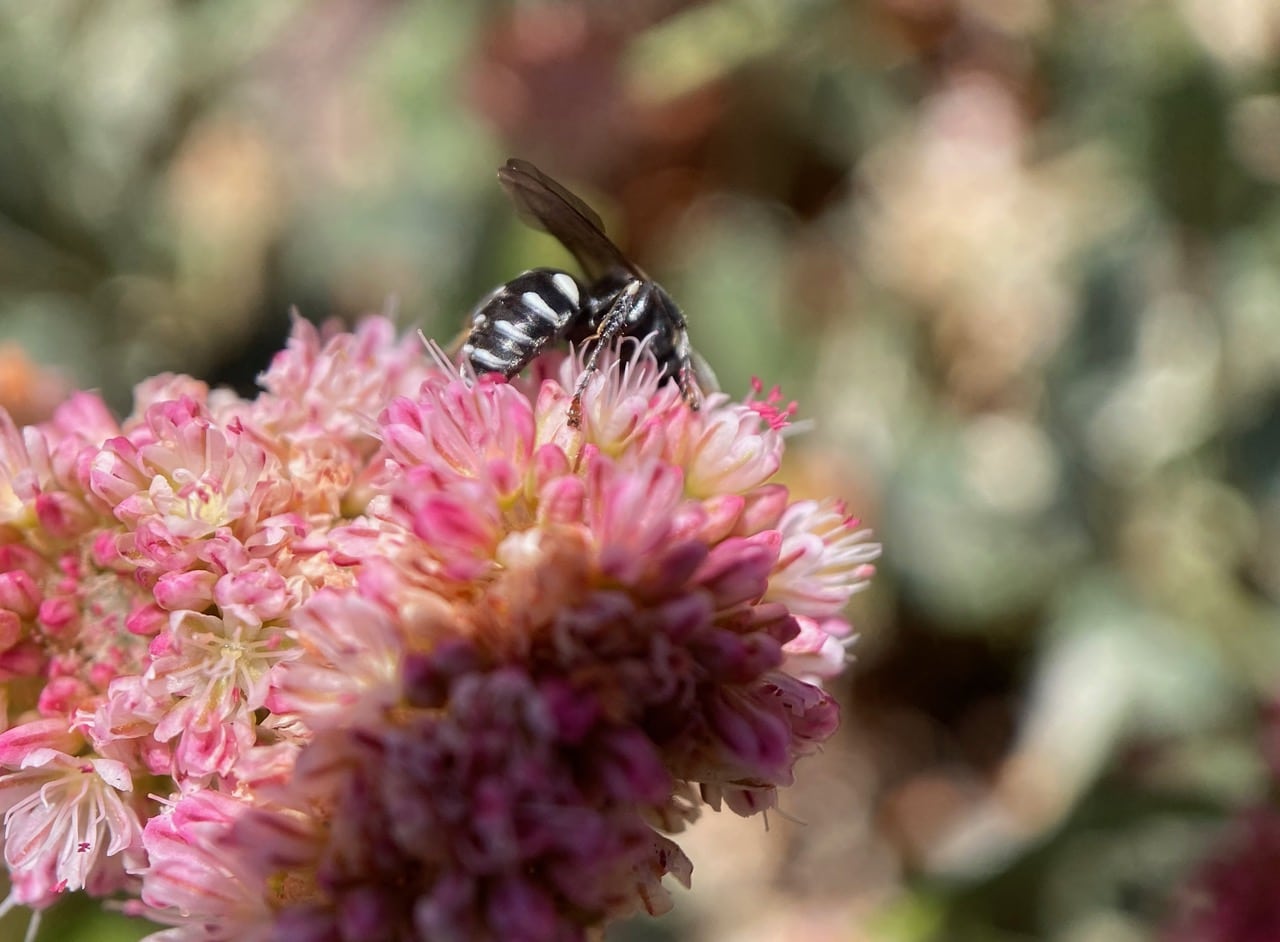
A small, dark insect with a distinctive black-and-white abdomen is foraging among the buckwheat flowers.
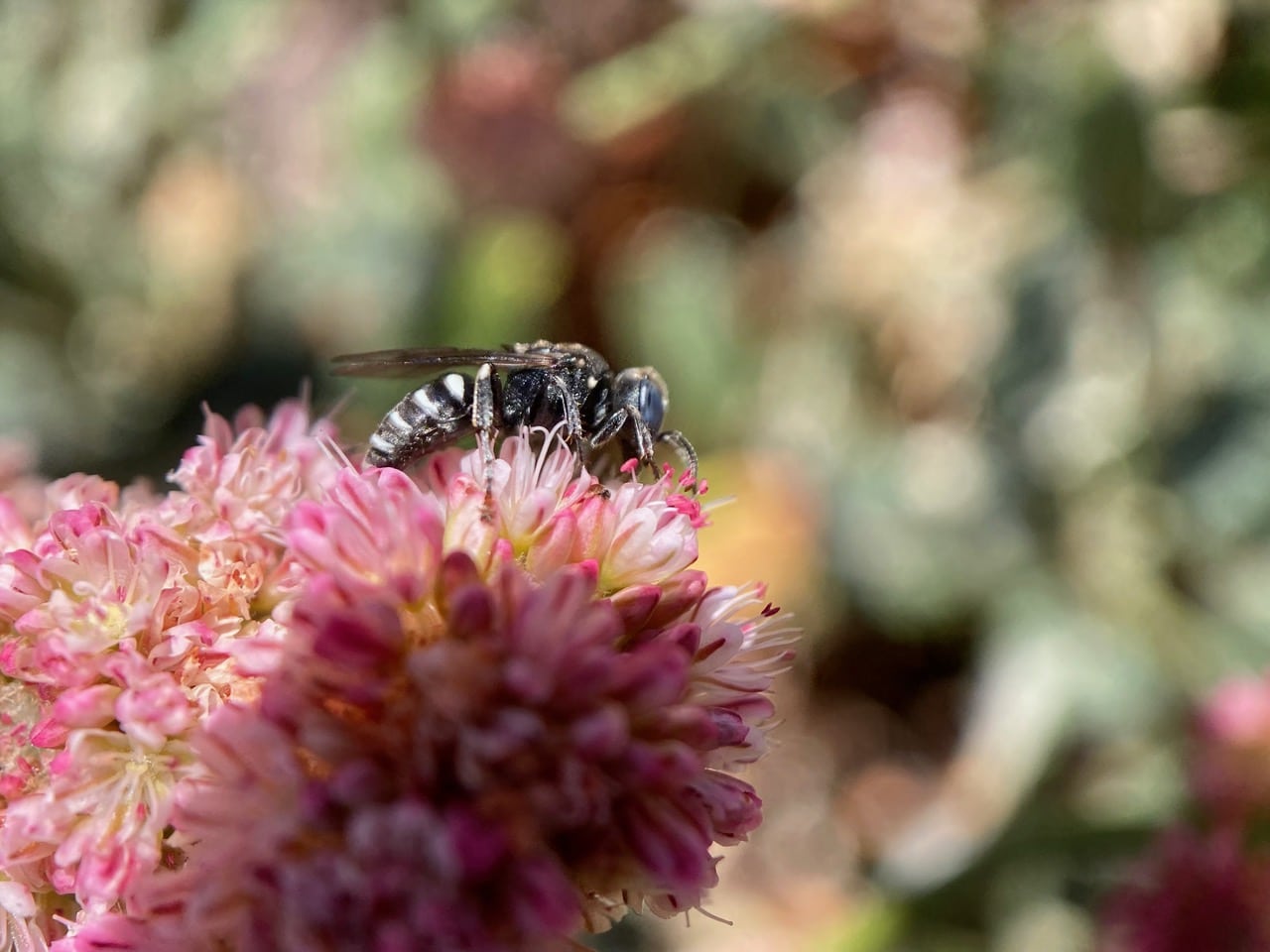
Ah, as I have suspected, it is a Prong-backed Fly Hunter Wasp, Oxybelus uniglumis (family Crabronidae). It is also known as the Common Spiny Digger Wasp.
The Prong-backed Fly Hunter Wasp, Oxybelus uniglumis (family Crabronidae) occurs in northeastern North America. Its range also includes California and other western states. It is a small wasp, measuring 5-9 mm. The wasp nests in well-drained, sandy soil in a variety of habitats. A fully provisioned nest has one cell or at most a few cells. The female hunts various kinds of flies on the wing, captures one, then stings it, injecting venom to paralyze it. Rather than transporting the prey clutched beneath her like other small predatory wasps, she instead leaves her sting impaled in the fly while transporting it back to the nest. She lays a single egg on the first fly placed in a nest cell, then adds additional two to nine more flies before backfilling the nest. There is one generation per year, flying between May to early October.
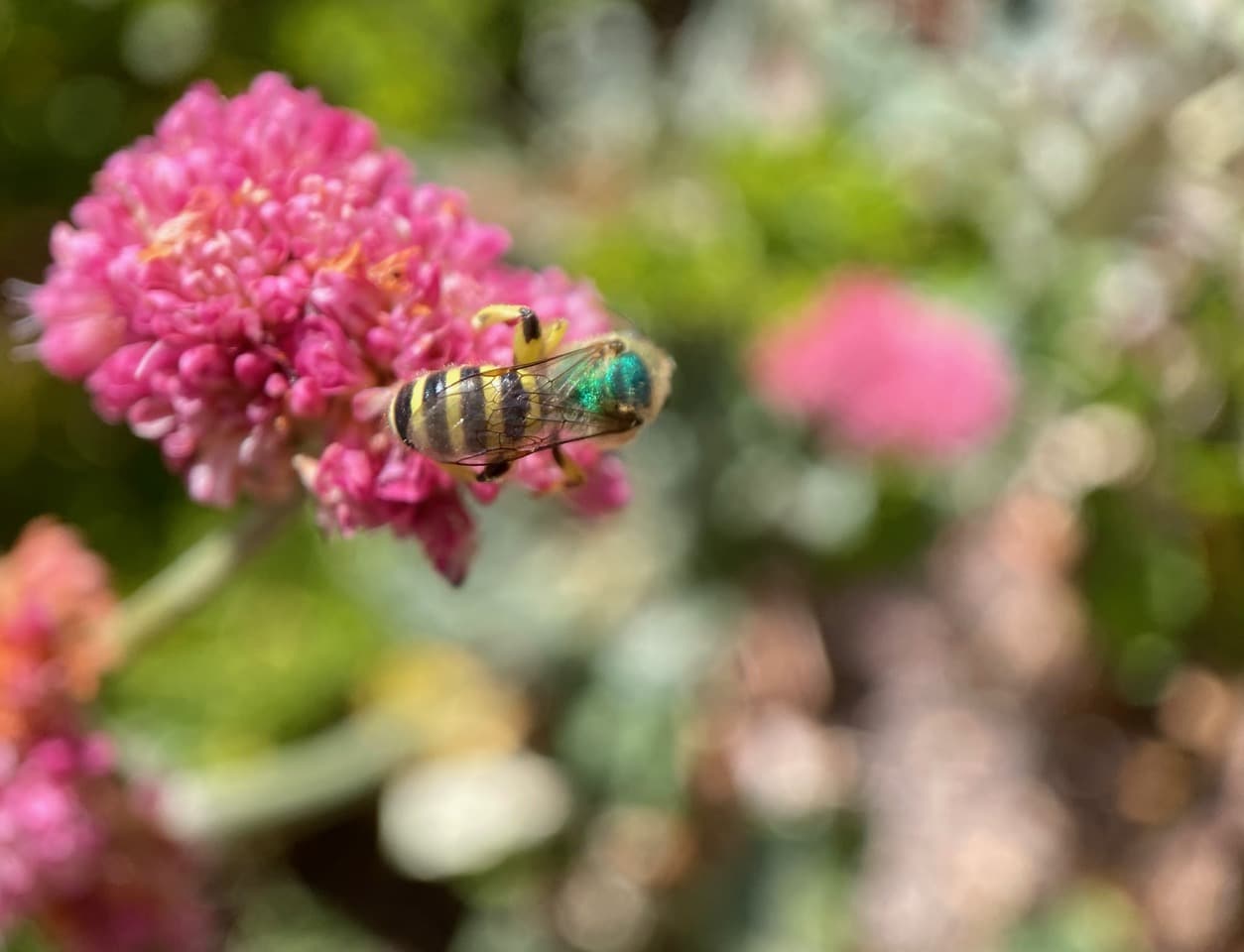
I am seeing more males than females of the Fine Striped Sweat Bees, Agapostemon subtilior (family Halictidae) lately.

Side view of the male Fine Striped Sweat Bee, showing his black-and-yellow striped abdomen. Note his long antennae, and the absence of scopae on his hind legs. Females of the species are entirely iridescent green, and carry pollen in the scopae of their hind legs.

The ubiquitous American Sand Wasp, Bembix americana (family Crabronidae) is seen on every flowering plant in this garden. The prevalence of the wasp here probably stems from the ideal nesting conditions along the sandy shoreline of Crab Cove.
Sand wasps in the genus Bembix are familiar and common throughout North America, digging their burrows in dunes, on beaches, and other habitats with loose, deep sand. The female rapidly kicks out large quantities of sand using a “tarsal rake” of spines on each front leg. The burrow is excavated before the wasp goes hunting. Bembix are generalist, opportunistic hunters. True flies in the order Diptera are the usual prey. A victim is paralyzed or killed by the wasp’s sting, and is then flown back to the nest. Most species will lay an egg on the first victim, while some species lay an egg in the empty cell before starting to hunt. Once the egg hatches, mama wasp brings flies to her larva as needed. This “progressive provisioning” is rare in the insect world. When the larva reaches maturity, mama wasp closes the cell. Inside, the larva spins an oblong cocoon, weaving sand grains into the structure and resulting in a hardened capsule. Overwintering takes place as a prepupa inside this cocoon, but there are usually two generations a year.
Male sand wasps often engage in an elaborate flight ritual called “sun dances”. Males emerge before females, and fly erratically at dizzying speed one or two inches above the ground attempting to detect virgin females about to emerge from their underground nests. Both sexes are often seen taking nectar at flowers, especially from Asteraceae family. Bembix wasps are often victims of other insects such as cuckoo wasps (Chrysididae), velvet ants (Mutillidae), satellite flies (Sarcophagidae), bee flies (Bombyliidae), and thick-headed flies (Conopidae).
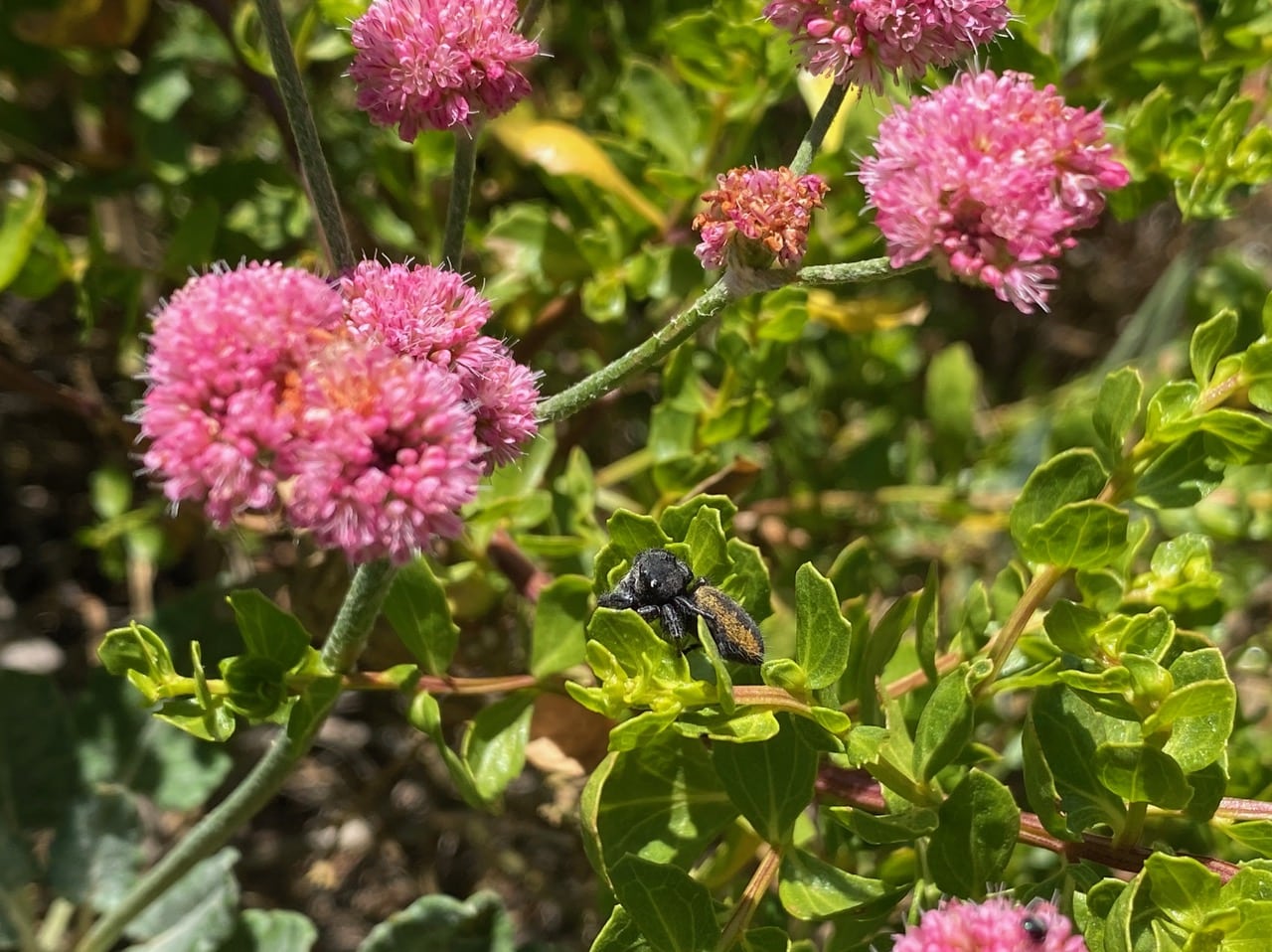
I spy an old, faded female Johnson’s Jumping Spider, Phidippus johnsoni (family Salticidae) crouched in the foliage of a Coyote Brush. She is totally focused on the insects buzzing around the buckwheat flowers above her.
Salticids are free-roaming hunting spiders. They do not weave a web to catch prey. They stalk, then pounce on their prey. Just before jumping, the spider fastens a safety line to the substrate. It can leap 10-20 times their body length to capture prey. Their movement is achieved by rapid changes in hydraulic pressure of the hemolymph (insect version of blood). Muscular contractions force fluids into the hind legs, which cause them to extend extremely quickly.
Johnson’s Jumping Spider, Phidippus johnsoni is one of the largest and most commonly encountered jumping spiders of western North America. Adults are about a centimeter in length. While both sexes have a bright red abdomen, the female has an additional black central stripe with white markings. The spiders construct conspicuous tubular silken nests under rocks and wood on the ground. They stay inside the nests at night and during bad weather. Molting, egg laying and sometimes courtship and mating occur inside these nests. They feed on a wide variety of insects, and also prey heavily on spiders. Cannibalism does occur sometimes, when females feed on males.
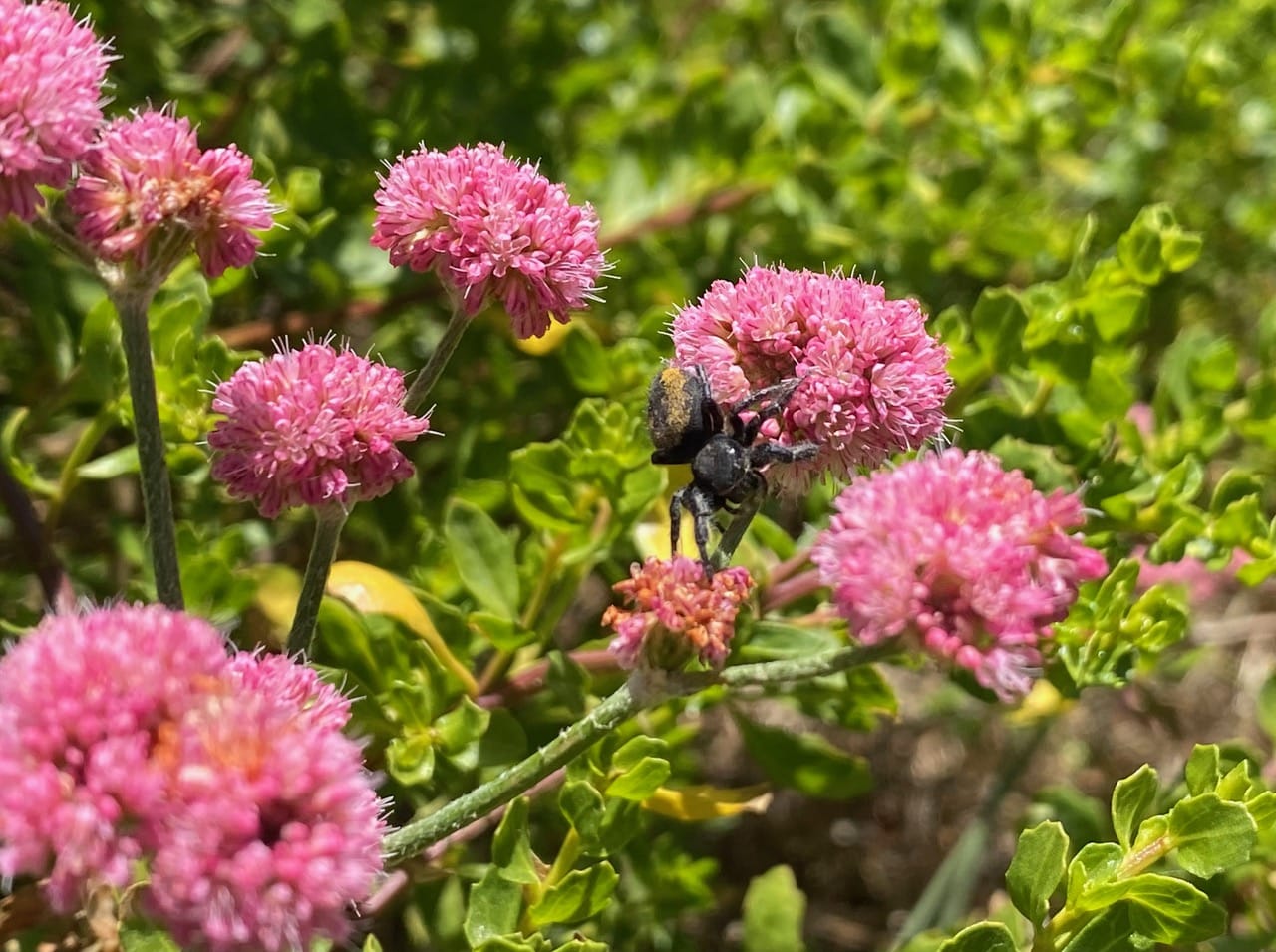
The spider finally makes a leap, but misses her target. She makes her way onto a lower cluster of flowers.
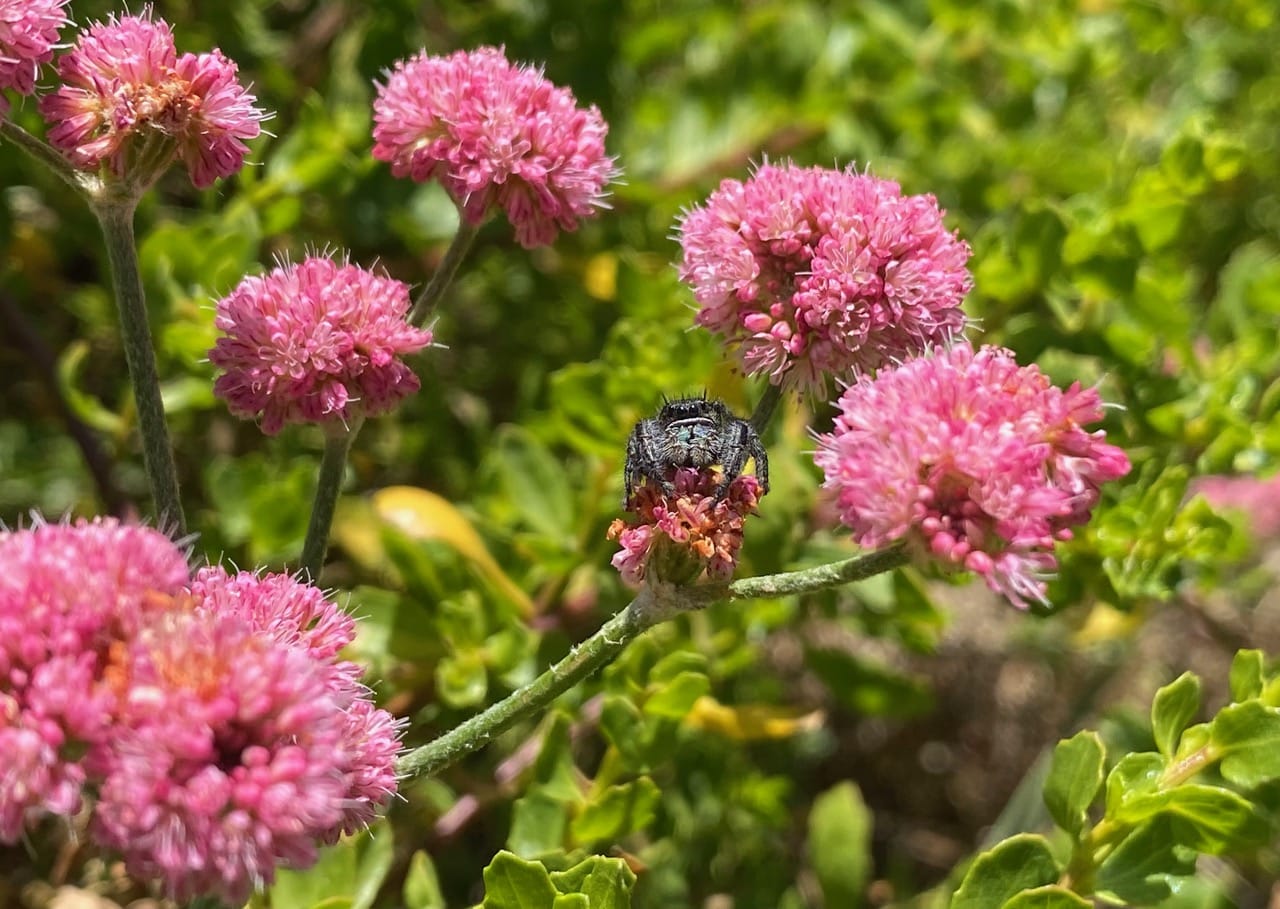
Settling down on a faded inflorescence, she gives me a thorough look over. She has covered her iridescent teal-colored chelicerae under her face with her pair of hairy pedipalps, moving them somewhat nervously.
The chelicerae are articulated fangs that are hollow and contain venom glands, used to inject venom into prey. The pedipalps are jointed appendages, much like small legs. They are used by the spider to sense objects, shape their webs, and to aid in prey capture and feeding. In male spiders, the pedipalps are also used to deliver sperm during mating.
Jumping spiders have excellent vision, with among the highest acuities in invertebrates. The 8 eyes are grouped four on the face (the two big Anterior Median Eyes in the middle, and two smaller Anterior Lateral eyes to the side), and four on top of the carapace. The anterior median eyes provide high acuity but small field of view, while the other six eyes act like our peripheral vision, with lower resolution but broad field of view. Since all eight eyes are fixed in place and can’t pivot independently from the body like human eyes can, jumping spiders must turn to face whatever they want to see well. This includes moving their cephalothorax up and down, an endearing behavior.
