

Pollinator Post 6/28/25 (1)
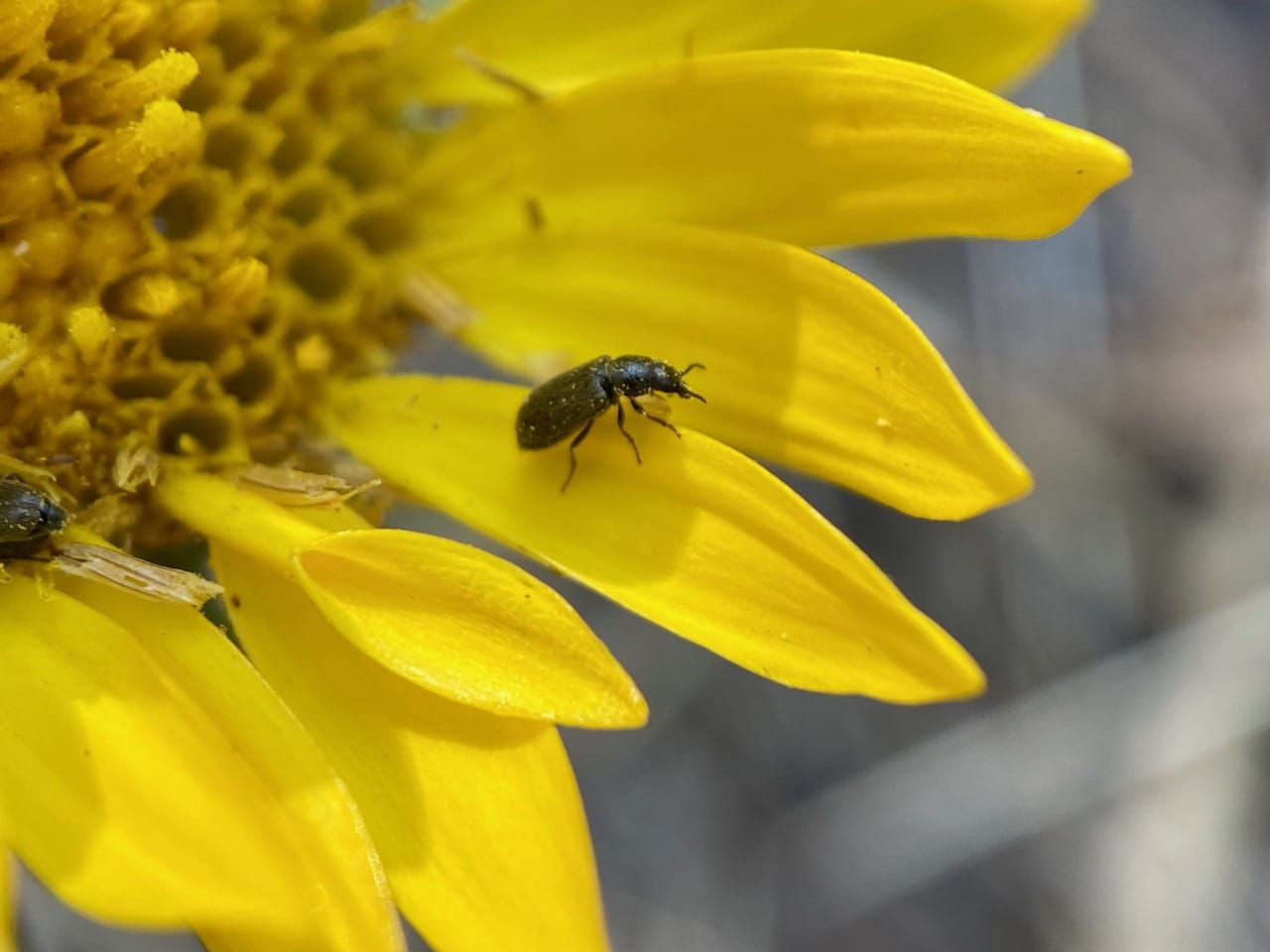
It is time to revisit Joaquin Miller Park in the Oakland hills.
It is still early and cool in the morning, and not many insects are flying. The Soft-winged Flower Beetles, Listrus sp. (family Melyridae, subfamily Dasytinae) have been on the Grindelia flowerheads all along, feasting on nectar and pollen. This one stumbles out on a ray petal, its body covered with pollen. Although these beetles may lay waste to flowers, they may also serve as important pollinators as they transport pollen from flower to flower.
Most species of Melyridae are various shades of brown or black and just 2 to 4 mm in length. They are sometimes very abundant in spring when there is an abundance of open flowers, particularly those with an abundance of pollen. In north America, dasytine beetles are hardly represented in the east, but are enormously diverse in the west, especially in California.
11 families of Coleoptera (beetles) are known to pollinate flowering plants. In western North America, the 300+ species of the beetle subfamily Dasytinae are commonly found on flowers, where adults feed on both nectar and pollen. Their dense setae (hairs) often trap pollen grains, which are transported to other flowers during the course of normal feeding. Many dasytine beetles form large feeding aggregations.

A Soft-winged Flower Beetle, Listrus sp. (family Melyridae, subfamily Dasytinae) is extracting pollen from an anther tube of a floret on a Catsear flowerhead.
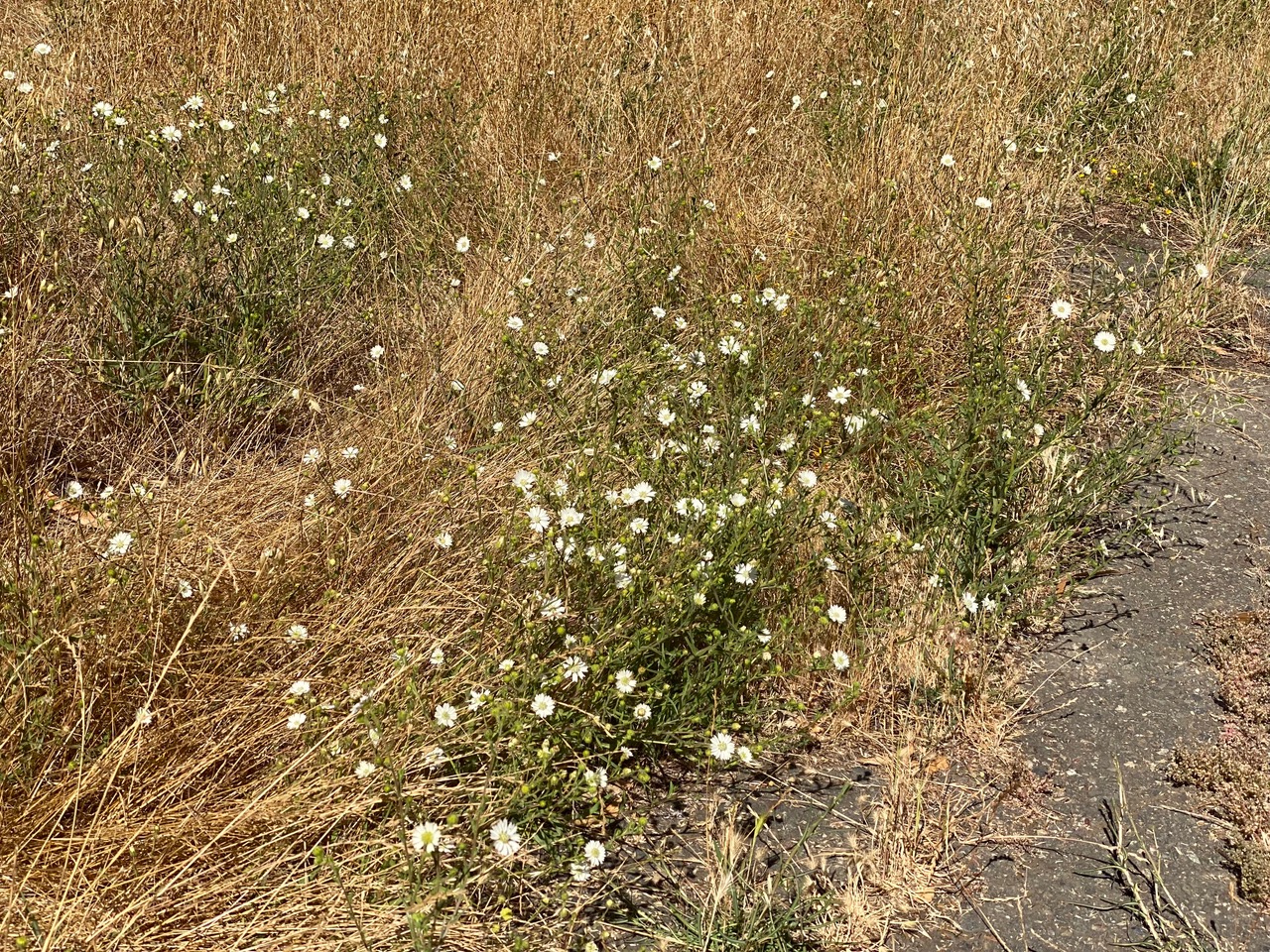
The Hayfield Tarweed, Hemizonia congesta (family Asteraceae) is blooming gloriously among the dried grasses along Sanborn Drive. I have never seen a more vibrant and prolific showing of these wildflowers over the years I have walked this road. This must be a good year for this humble, hardly, drought tolerant annual herb. Some subspecies in other areas have yellow flowers. All have a special place in my heart.

It’s a pity that few native plant enthusiasts include the Hayfield Tarweed in their gardens. The low-growing herb makes good border plantings, and reseed itself readily year after year. The cheery white blooms brighten up the dreariest spot in the summer through fall when everything else has turned brown and crispy. And they support a diversity of insects during a time of hardship and scarcity.
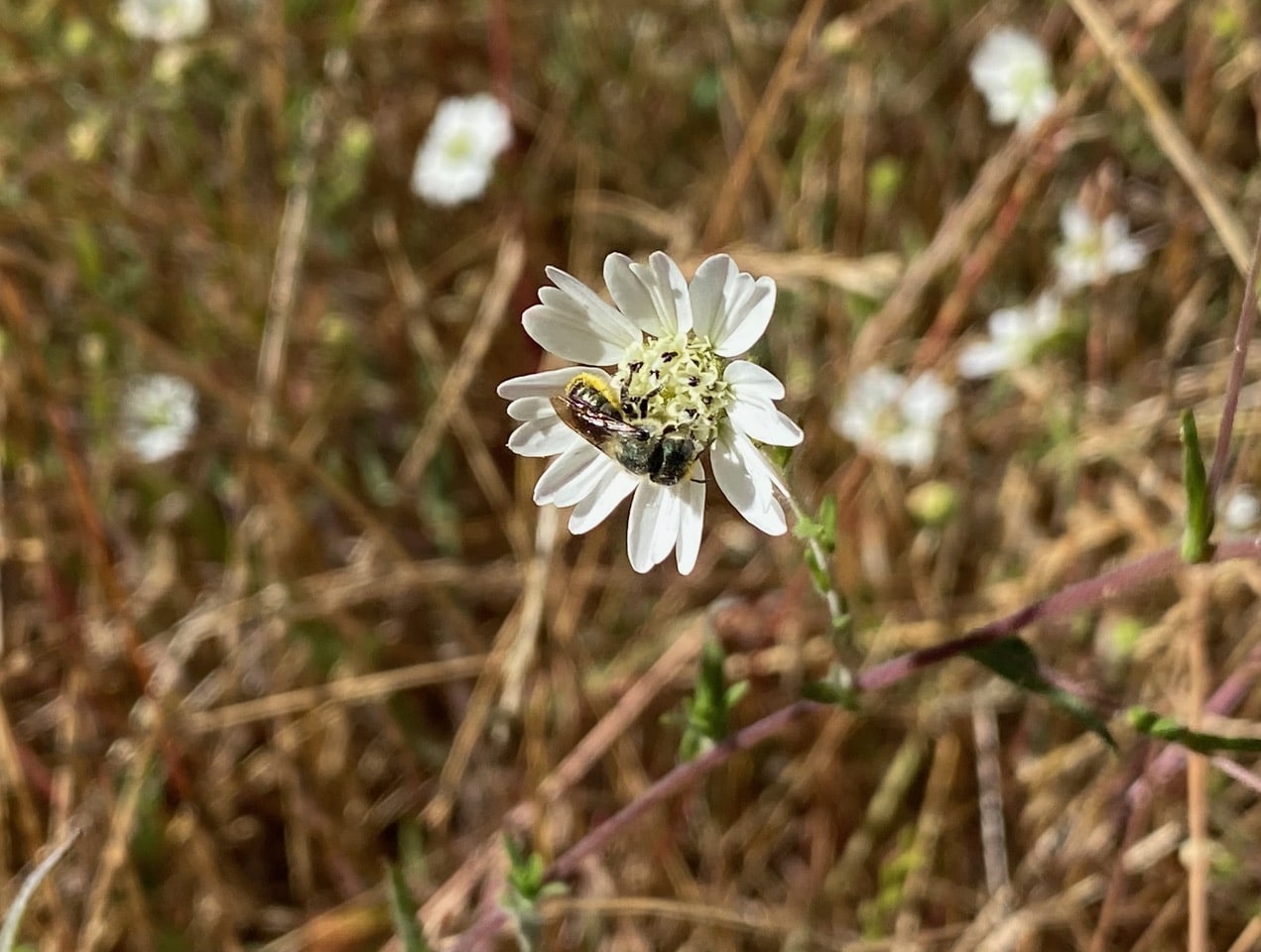
Numerous Colorado Mason Bees, Osmia coloradensis (family Megachilidae) are foraging on the Hayfield Tarweed flowerheads. See the light yellow pollen on the underside of the bee’s abdomen?
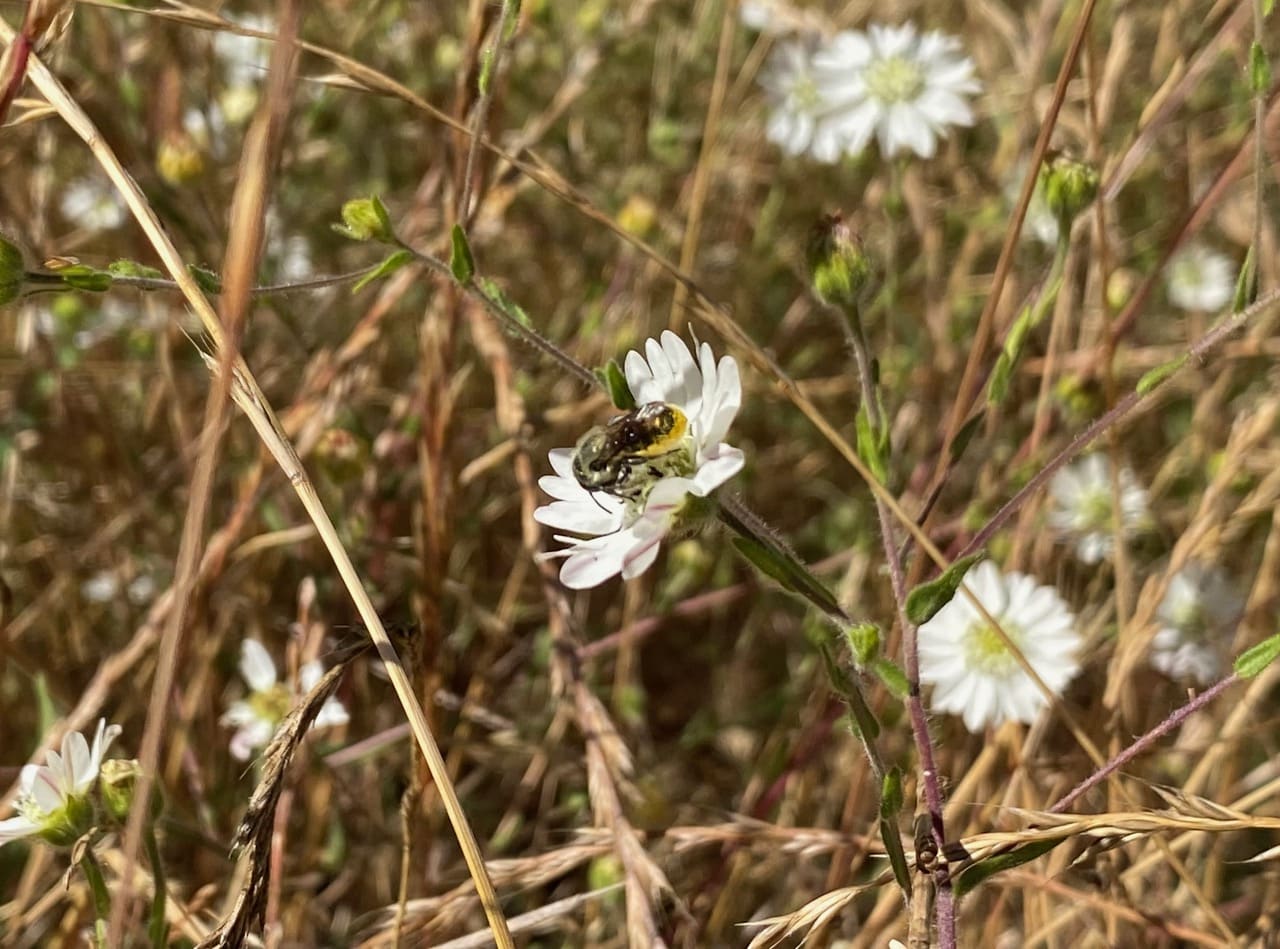
Mason Bee is a name commonly used for species of bees in the genus Osmia, of the family Megachilidae. Mason Bees are named for their habit of using mud or other “masonry” products in constructing their nests, which are made in naturally occurring gaps/cavities such as cracks in stones, hollow stems or holes in wood made by wood-boring insects. Osmia means ‘odor’, and refers to a faint lemony scent used by these bees to mark their nest entrances. Osmia species are frequently metallic green or blue. Females have black ventral scopae (special pollen collecting hairs) on the underside of their abdomen, which are difficult to see unless laden with pollen. Ventral abdominal scopae is a feature shared by all members of the Megachilidae family, which include the wool-carder bees (genus Anthidium), and leaf-cutter bees (genus Megachile).
Mason Bees are a solitary species and are non-aggressive. Every female is fertile and makes her own nest. Each nest cell is provisioned with pollen and contains one egg which will develop into a larva. The female creates a partition of mud between the nest cells. The process continues until she has filled the cavity. She plugs the entrance to the cavity, and then may seek another nest location. The larvae that hatch out consume their provisions and begin spinning a cocoon around itself and enters pupal stage. Adults mature in fall or winter, hibernating inside its cocoon.
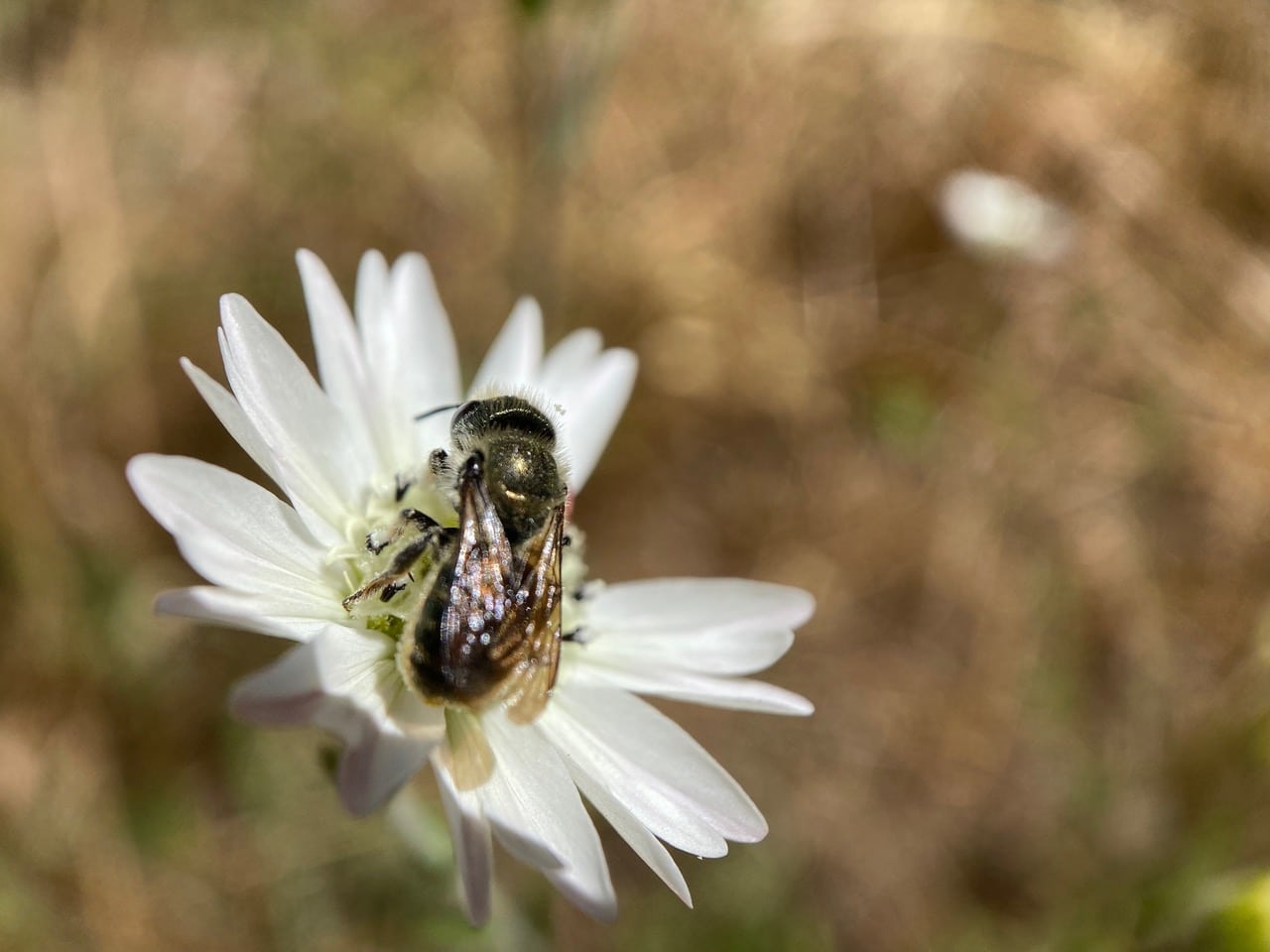
The Colorado Mason Bee, Osmia coloradensis (family Megachilidae) is found in Central America and North America. This species is a common and widespread Mason Bee found in gardens across California from March into July. The bee is a specialist on plants belonging to the sunflower family, Asteraceae. This means that the females primarily collect pollen from these plants for their nest provisions. I find that the easiest way to identify these bees in the field is their pollen gathering behavior – the female walks over the flower’s reproductive parts, tap-tapping their abdomen ever so rapidly and gently over them. Only their relatives, the female Leaf-cutter Bees, Megachile sp. share this foraging behavior. O. coloradensis is further characterized by its nesting requirements, needing preexisting cavities in wood, stems, or even Jeffery pine cones.
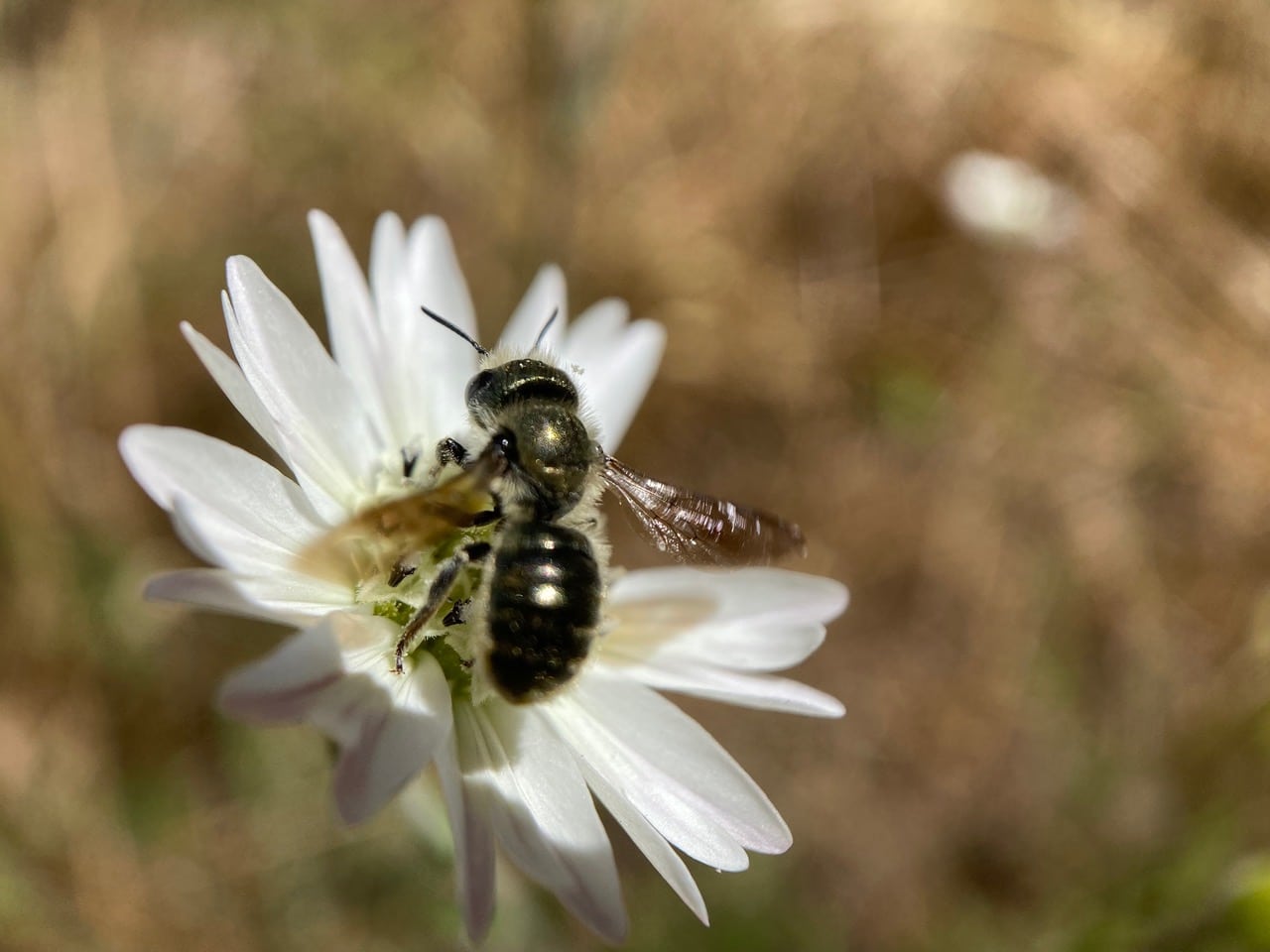
Osmia bees generally have a metallic sheen, with round body parts, including a big round head. A naturalist friend once described the bee as resembling three BB pellets glued together. The imagery has stayed with me all these years, helping me identify these bees in the field.
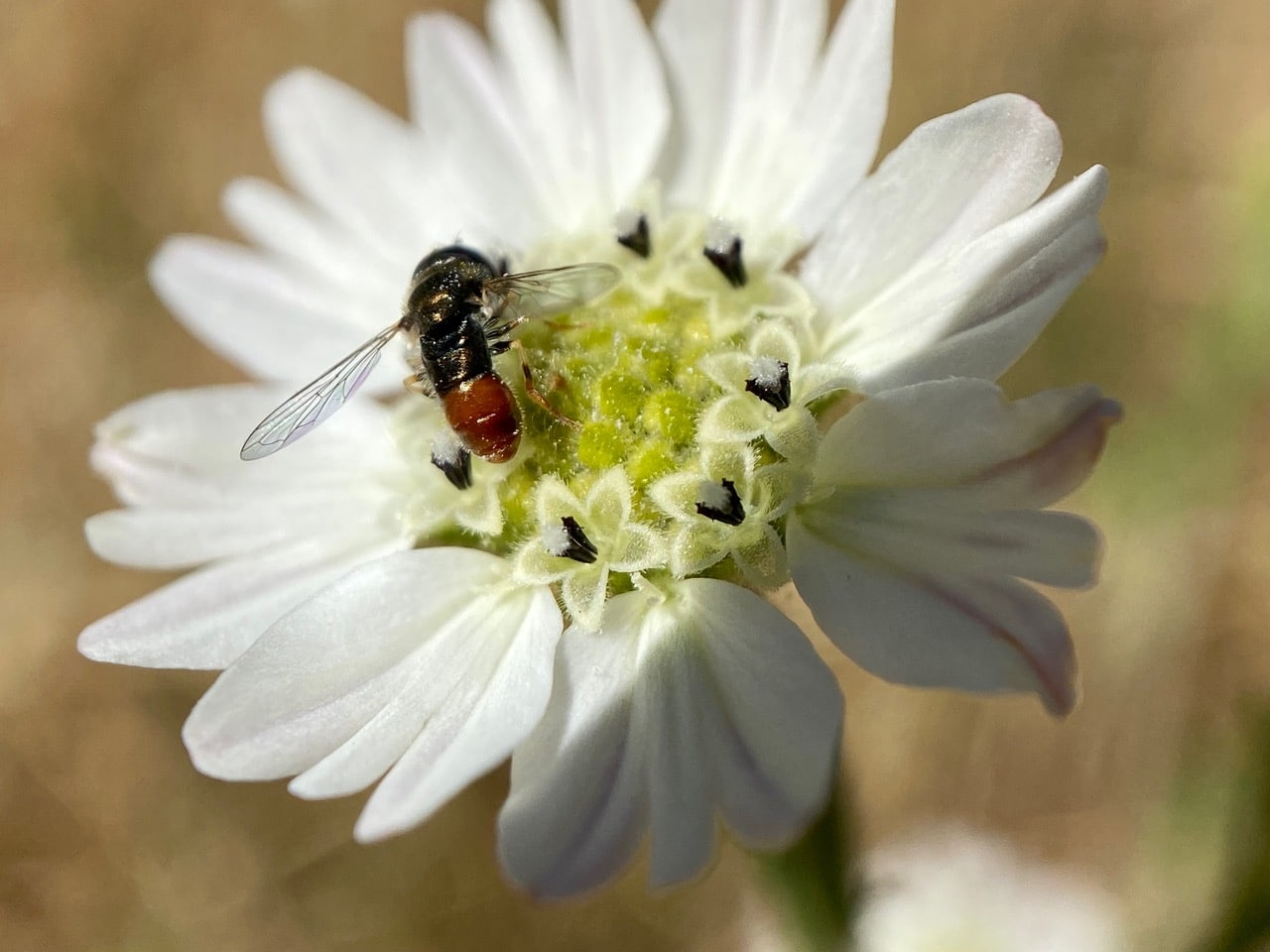
A tiny hover fly, the Common Grass Skimmer is foraging on a Hayfield Tarweed flowerhead.
The Common Grass Skimmer, Paragus haemorrhous (family Syrphidae) is easily the smallest hover fly I know, measuring only about 4 mm in length. The species has a world-wide distribution, found in unimproved grassland, dune grass, open areas and pathsides in forest, and meadows. Adults visit flowers for nectar and pollen. Larvae feed on aphids on low herbaceous plants.
Photos of Common Grass Skimmer (Paragus haemorrhous) · iNaturalist
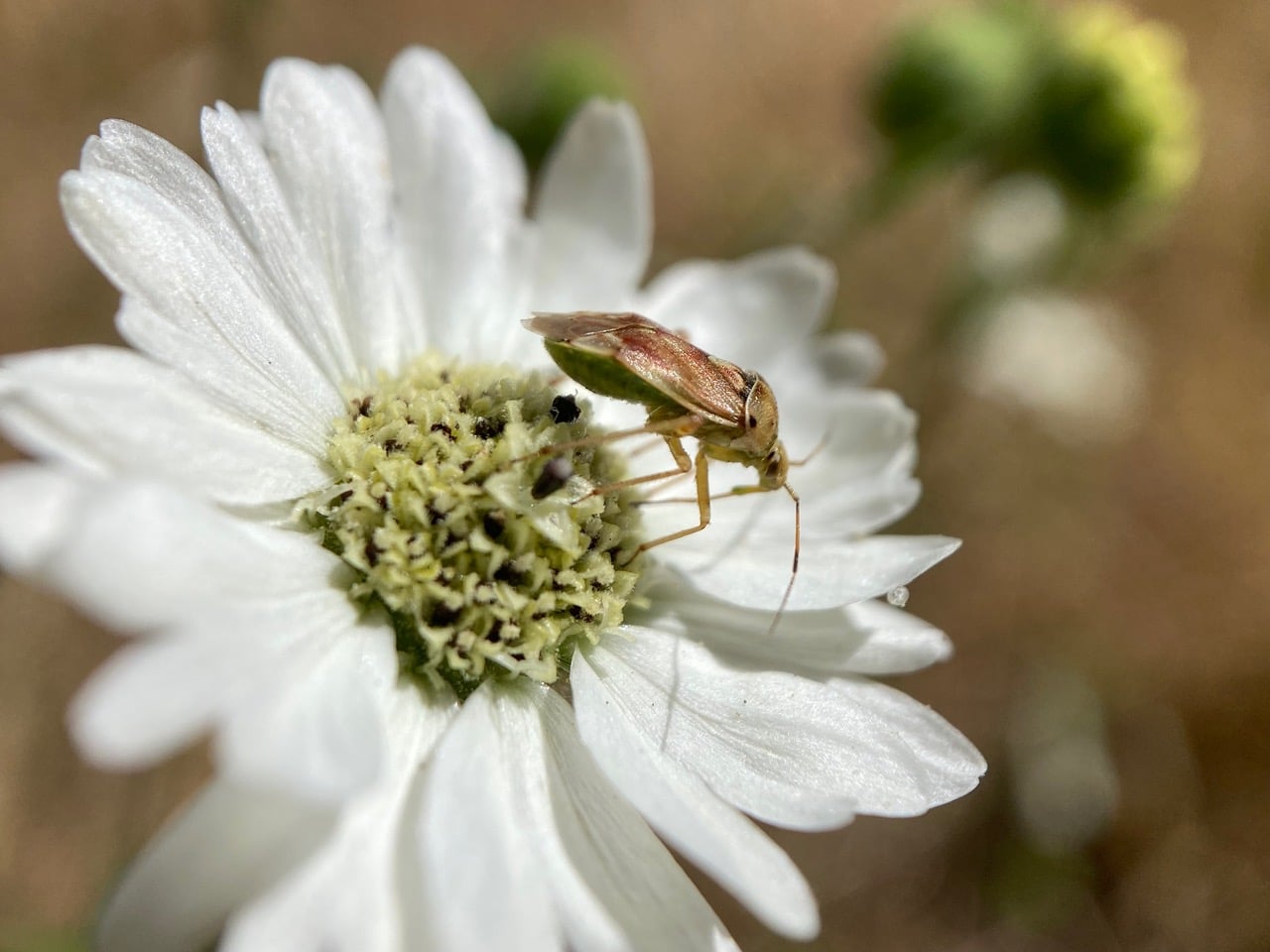
A Western Tarnished Plant Bug, Lygus hesperus (family Miridae) is feeding on a Hayfield Tarweed flowerhead.
Commonly referred to as Lygus Bugs, the species is a serious pest on strawberry in the Central Coast of California. Adults are about 6 mm long, oval and rather flattened. They are greenish or brownish and have reddish-brown markings on their wings. In the center of their back is a distinct, bur small, yellow or pale green triangle that helps distinguish them from other insects. The cunei (singular cuneus), triangular-shaped areas near the end of the forewings are translucent, blending with the coloration of surrounding body parts. The immature forms are pale green and resemble aphids. They can be distinguished from aphids by their more rapid movements.
In general the Lygus Bug’s abundance is highest after winters of higher rainfall. This causes more lush grows of vegetation such as mustards and other weeds that support a higher abundance and survival of the bugs during the winter and spring. Damage to crops and garden plants are caused by the bugs’ piercing-sucking mouthparts that extract fluids from the plant tissues.
One useful feature in identifying members of the family Miridae or plant bugs is the presence of a cuneus; it is the triangular tip of the corium, the firm, horny part of the forewing, the hemielytron. The cuneus is visible in nearly all Miridae.

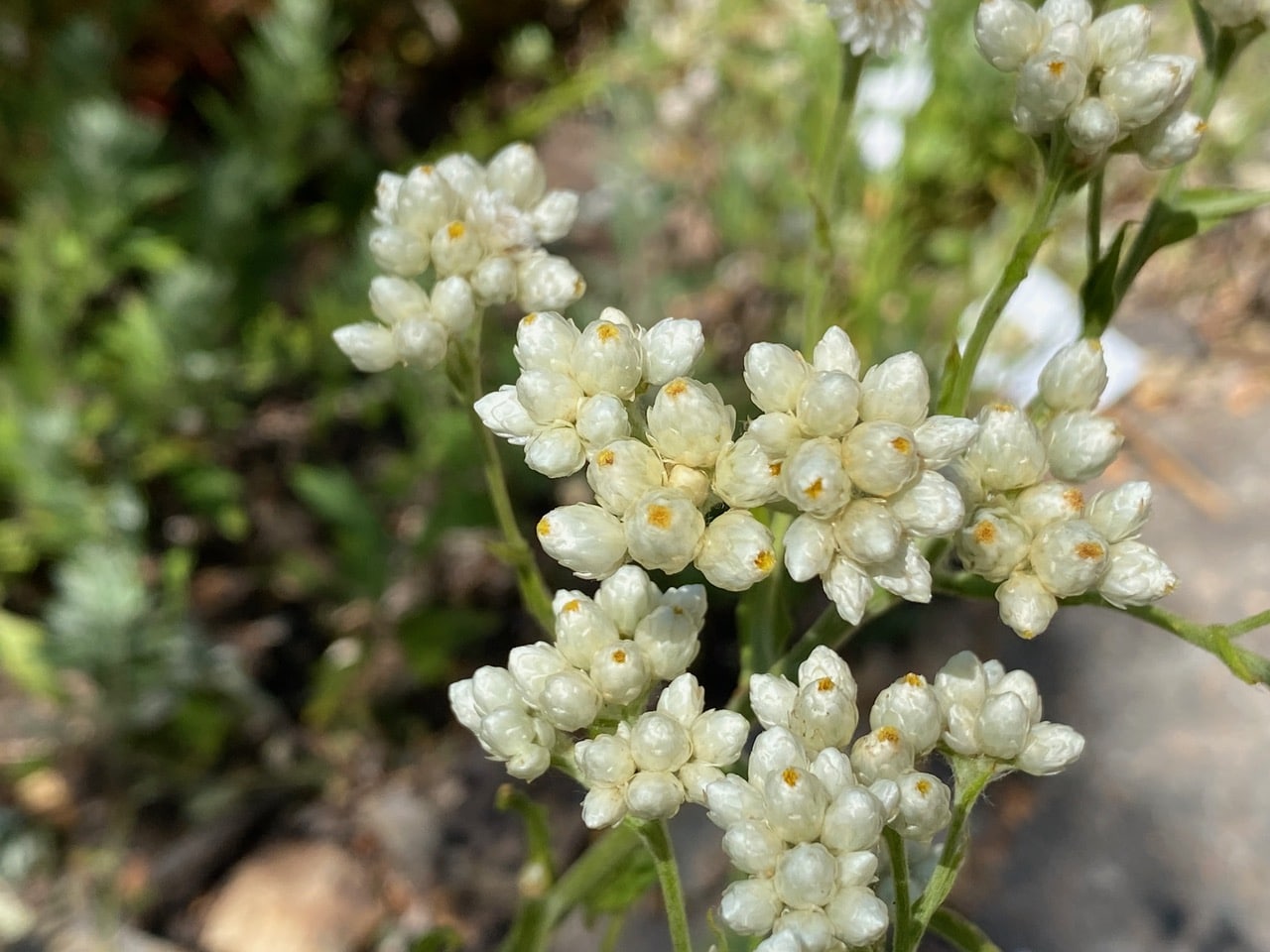
Along the fence of the FOSC native plant nursery, a few California Everlasting, Pseudognaphalium californicum is in bloom.

Close examination reveals some tiny insects on the flowerheads. Ooh, I recognize these – they are invariably found on Everlastings. And often in copula. This mating pair is moving slowly, with the larger female in the lead.
The Hyaline Grass Bug, Liorhyssus hyalinus is a species of Scentless Plant Bugs belonging to the family Rhopalidae. It is characterized by its hyaline (clear or translucent) wing membrane extending beyond the dark upper side of the abdomen. The bug is commonly found in hemp fields, where they feed on flowers, developing seeds, and foliage. These bugs are known to migrate from various weed hosts into hemp fields, especially when seeds are developing. They use piercing-sucking mouthparts to extract plant tissues. They are able to feed on seeds by injecting digestive juices into the seeds and sucking up the digested contents as a liquid. The mouthparts, collectively called a rostrum, is folded under the body when not in use.

Here’s another pair,
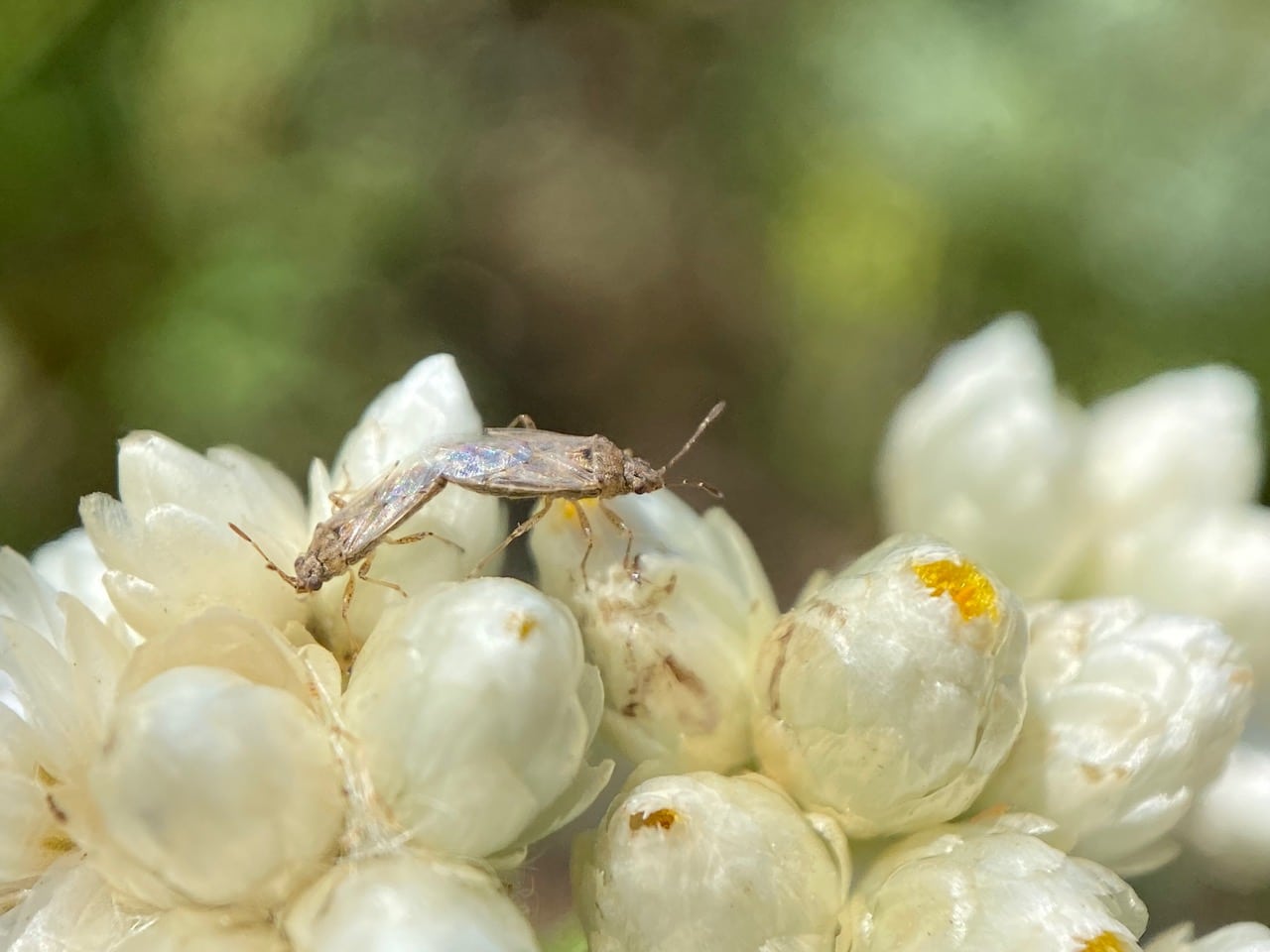
And yet another mating pair.

A Leaf Beetle, Stator limbatus (family Chrysomelidae) is perched on a flowerhead of California Everlasting.
Stator limbatus is native to the southwestern United States, Mexico, and northern South America, where it lives in dry tropical environments. The beetle is 2-3 mm long. The elytra do not completely cover the blunt-tipped abdomen. It is a seed-feeding beetle, specifically belonging to the subfamily Bruchinae (seed beetles) within the family Chrysomelidae (leaf beetles). While it can be a generalist it is known to primarily feed on the seeds of legumes (Fabaceae).
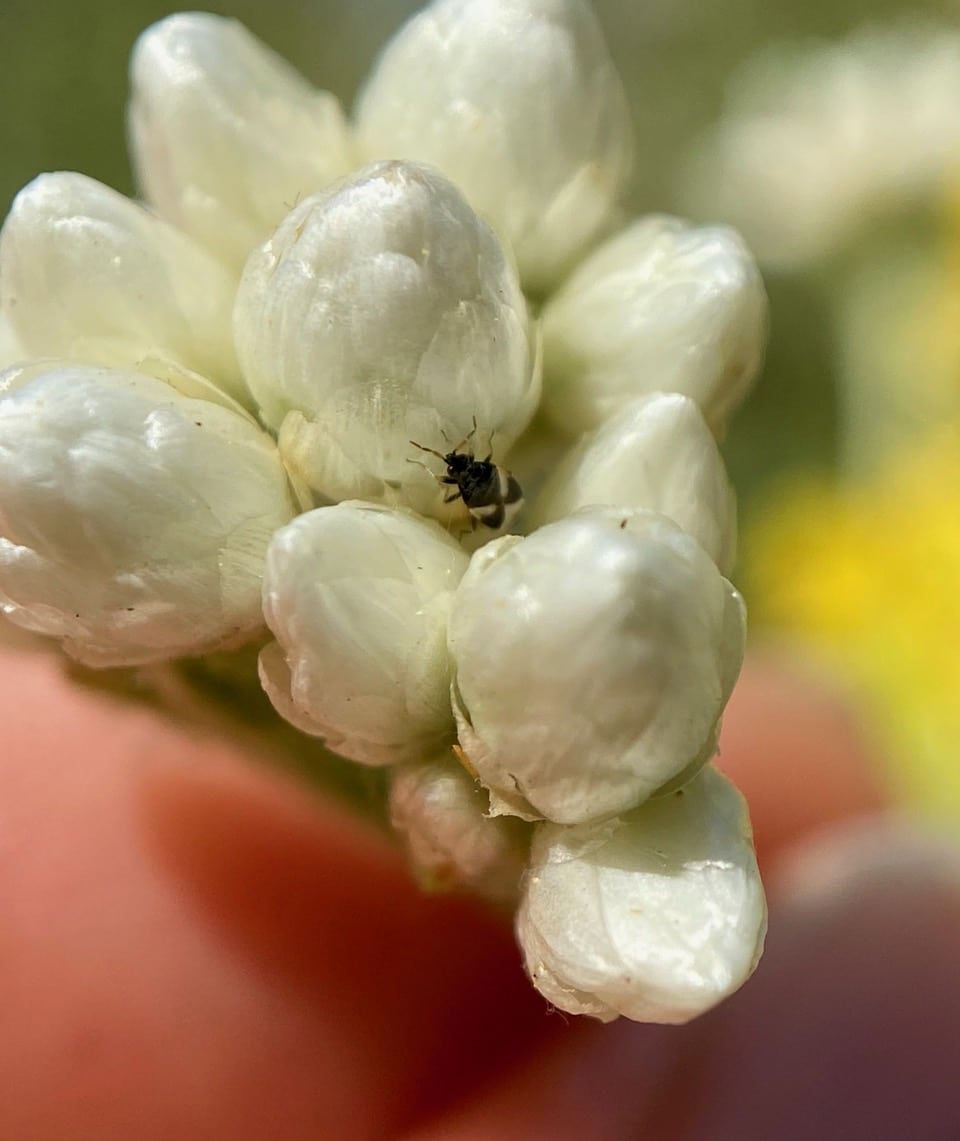
Hello, who’s this tiny insect crawling out from between the California Everlasting flowerheads? It is new to me – I have never seen this insect before.

It appears to be a black-and-white “true” bug or Hemiptera. The term “hemiptera” means “half-wing”, and refers to the unique wing structure of insects in this order of true bugs. Their front wings
(forewings) are divided into two distinct sections: partially hardened and leathery near the base, while the tips are membranous. This gives the bugs the appearance of having “half wings”.

iNaturalist has helped identify the bug as a Minute Pirate Bug, Orius tristicolor (family Anthocoridae).
Orius tristicolor are “true”bugs in the order Hemiptera. Adults are very small (3mm long), have bulging eyes, somewhat oval-shaped, and black with white wing patches. The bug is predatory. Both adults and nymphs feed by sucking juices from their prey through a sharp, needle-like beak (the rostrum), which is characteristic of all true bugs. Prey includes thrips, spider mites, insect eggs, aphids, and small caterpillars. Orius holds its prey with its front legs and inserts its beak into the prey, generally several times, until the soft body is empty and only the exoskeleton remains. Females lay eggs within plant tissues. Several generations may occur during a growing season. Orius is common on many agricultural crops, on pasture land, in orchards, and is successfully used as a biological control agent in greenhouses.

I watch as the Minute Pirate Bug goes into all the nooks and crannies between the flowerheads.
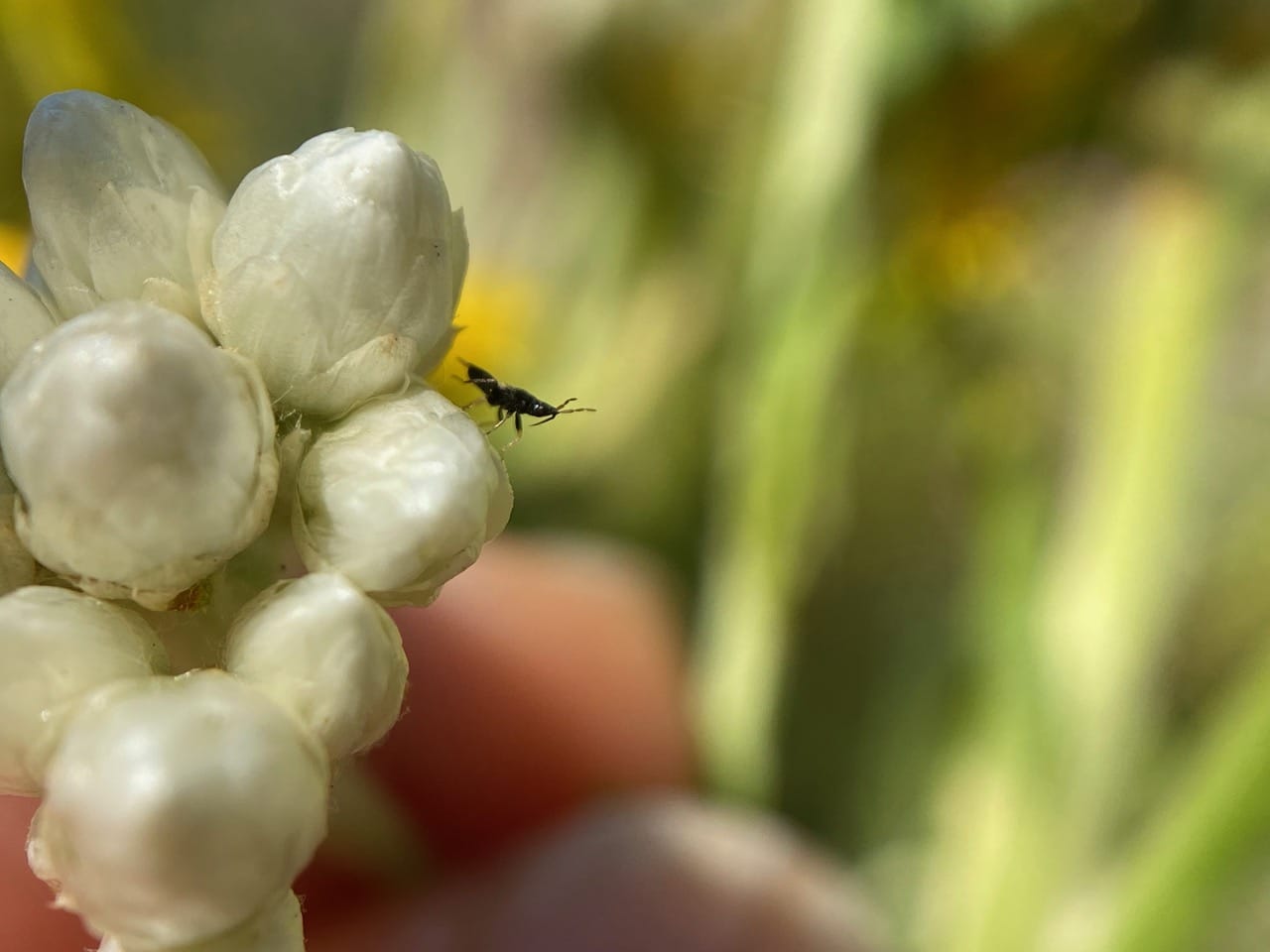
A side view of the Minute Pirate Bug shows a short, curved rostrum characteristic of predatory bugs.
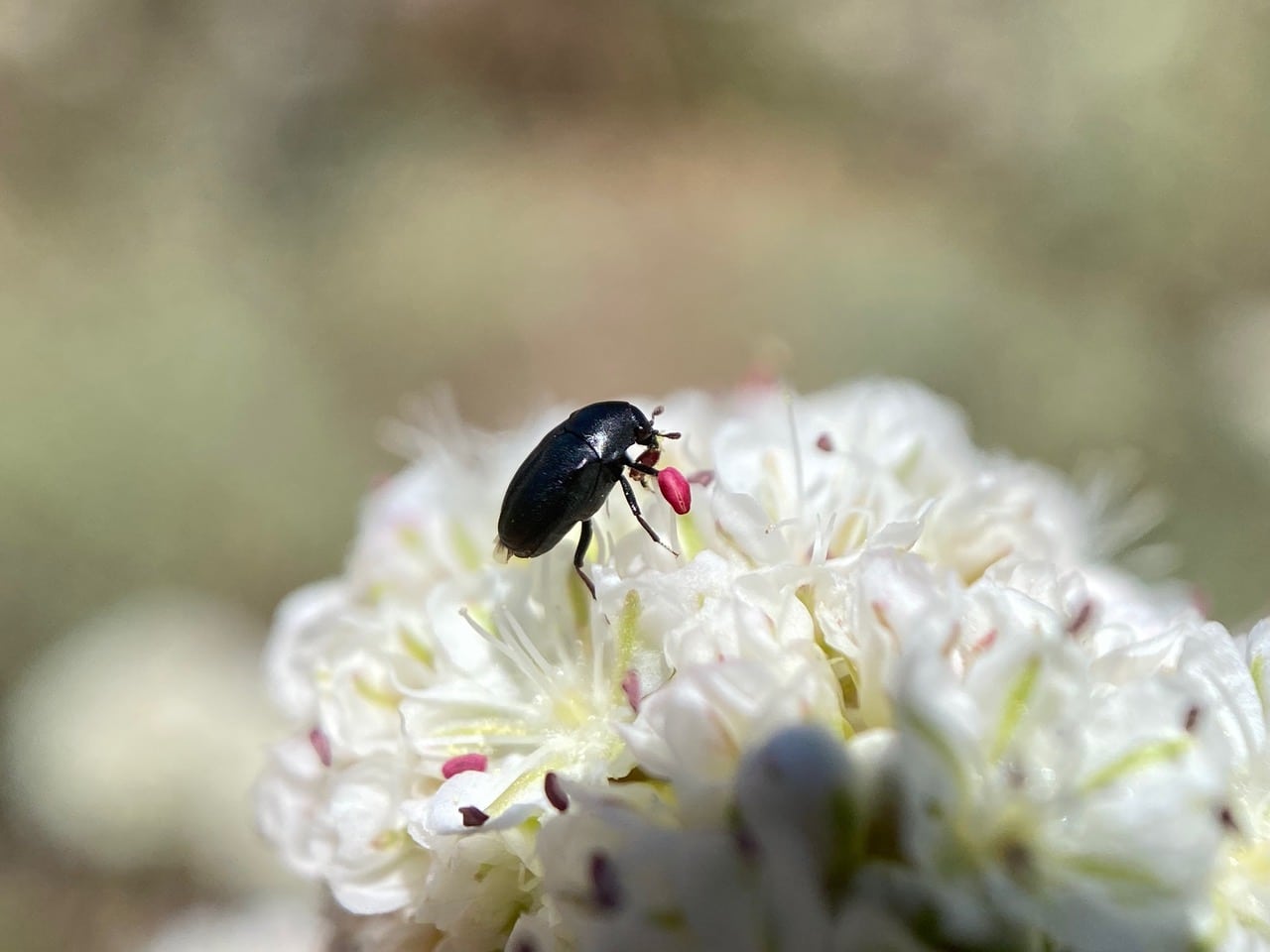
Right outside the gate of the FOSC native plant nursery, the Nude Buckwheat, Eriogonum nudum is blooming gloriously. A Dark Carpet Beetle, Orphilus subnitidus (family Dermestidae) is feeding on pollen from an anther.
Dermestidae are a family of Coleoptera (beetles) that are commonly referred to as skin of carpet beetles. Ranging in size from 1 to 2 mm, the beetles typically have clubbed antennae that fit into deep grooves. Most Dermestids are scavengers that feed on dry animal or plant materials, such as skin or pollen, animal hair, feathers, dead insects and natural fibers. The larvae are used in taxidermy and by natural history museums to clean animal skeletons. Orphilus subnitidus is found in western North America. The beetle measures 3-4 mm.
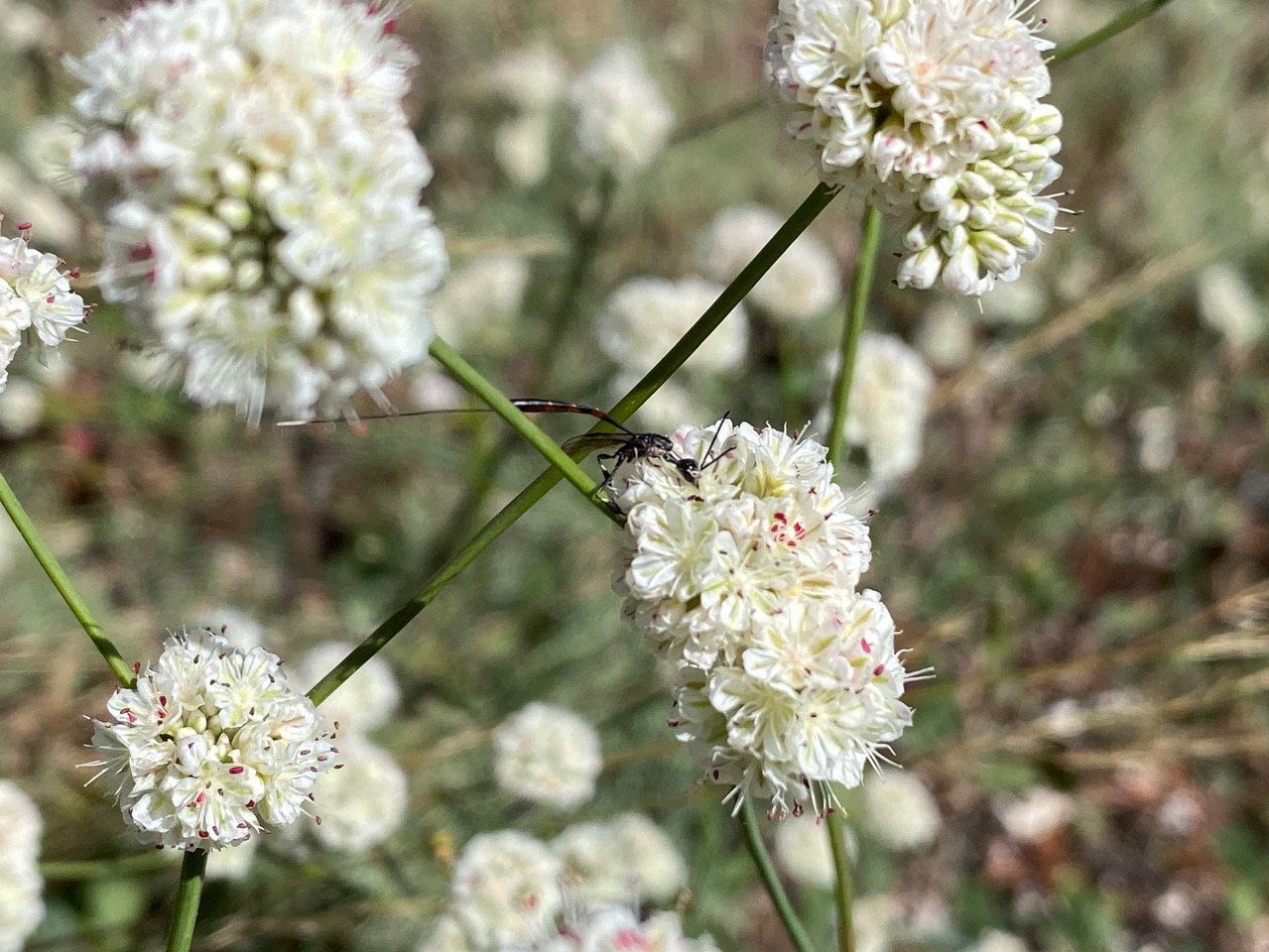
Ooh, do you see that skinny wasp with the long, white-tipped ovipositor? It’s my first female Javelin Wasp, Gasteruption jaculator (family Gasteruptiidae) – Yay!.
The Javelin Wasp is a small wasp with a body length of 10-18 mm. A striking feature of the Gasteruption jaculator is the upright position of the abdomen in flight. In resting position, the abdomen is pulled in a slight downward or upward curve. The wings are then folded along its length. The femurs are thick at the end like clubs. The wasp is a parasitoid of solitary bees and wasps that nest in twigs or borings in wood. The wasps are found in gardens and meadows where they visit various flowers, or hover around the nests of potential hosts. When a host nest is located, the female wasp pushes her ovipositor into the nest, depositing her own eggs on or near the eggs of the host. Upon hatching the wasp larva will feed on the host larva as well as on the stored food.

This top view of Gasteruption jaculator shows why the wasp is sometimes referred to as “needle wasp”. The description stems from their very slender and elongated bodies, particularly the female’s long ovipositor which resembles a needle.
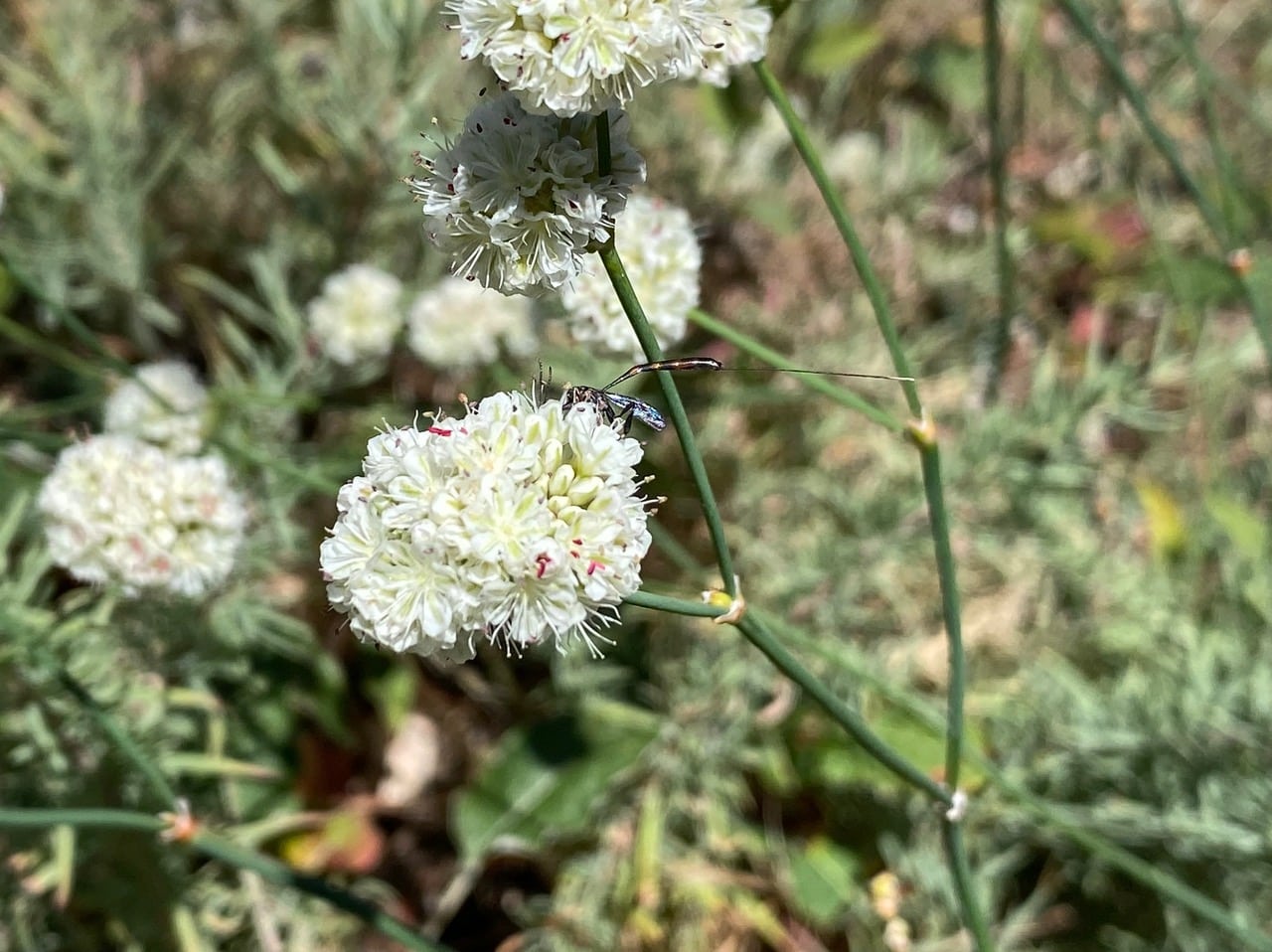
A more common and recognized name for the genus Gasteruption is Carrot Wasps, due to their frequent presence at flowers in the carrot family Apiaceae, where they feed on nectar.
The species G. jaculator has the common name of Javelin Wasp, referring to the needle-like ovipositor.
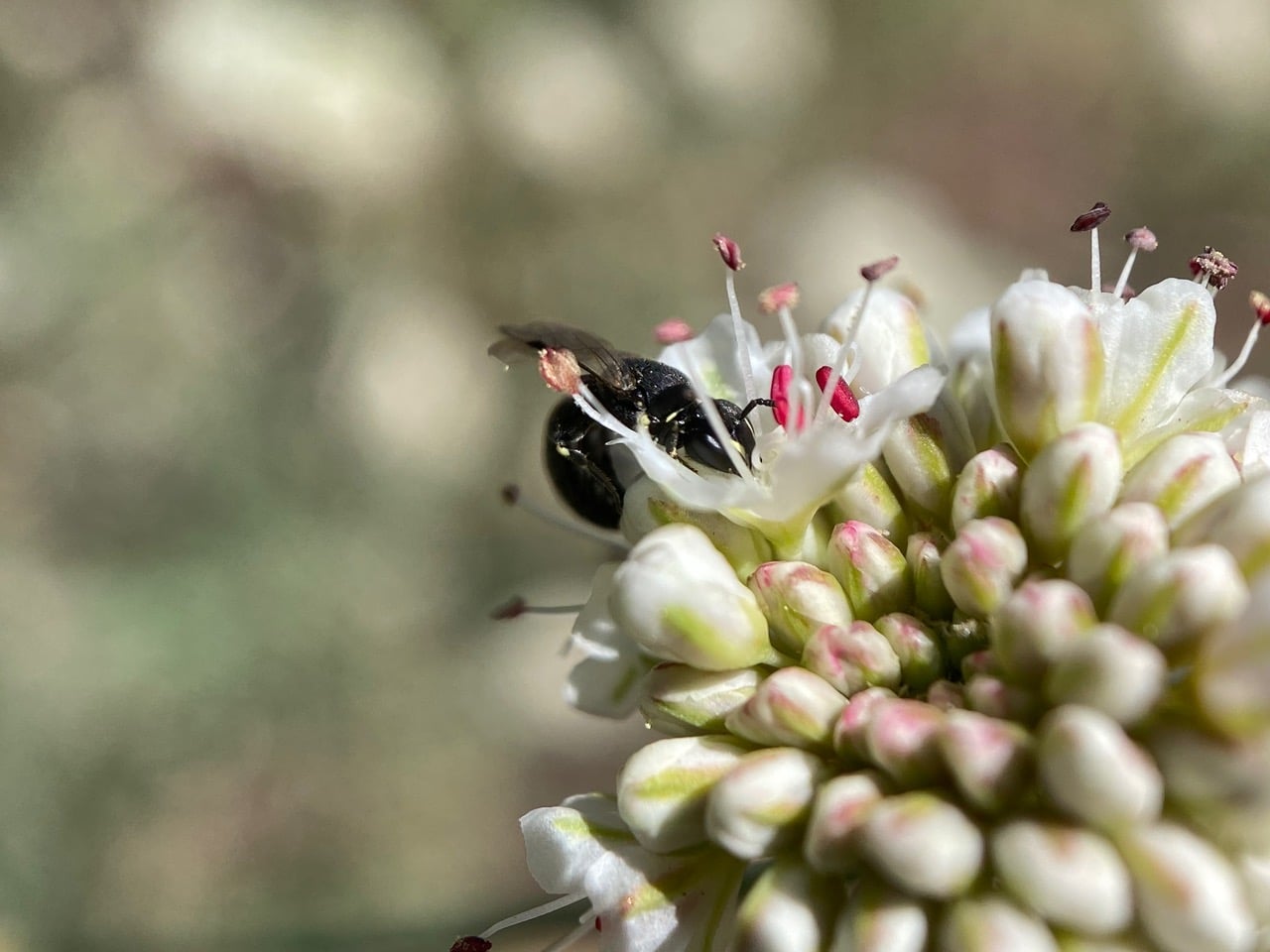
A tiny bee about the size of a grain of rice is taking nectar from a flower of Nude Buckwheat, Eriogonum nudum. The yellow markings on its face identify it as a female Masked Bee, Hylaeus sp. (family Colletidae).
Hylaeus (family Colletidae) are shiny, slender, hairless, and superficially wasp-like bees. They are small, 5 to 7 mm long, usually black with bright yellow or white markings on their face and legs. These markings are more pronounced on the males. Hylaeus do not carry pollen and nectar externally, they instead store their food in the crop and regurgitate it upon returning to their nests. They are primarily generalist foragers. Hylaeus are short-tongued, but their small body size enables them to access deep flowers. Hylaeus nest in stems and twigs, lining their brood cells with self-secreted cellophane-like material. They lack strong mandibles and other adaptations for digging, using instead pre-existing cavities made by other insects.