

Pollinator Post 6/28/25 (2)
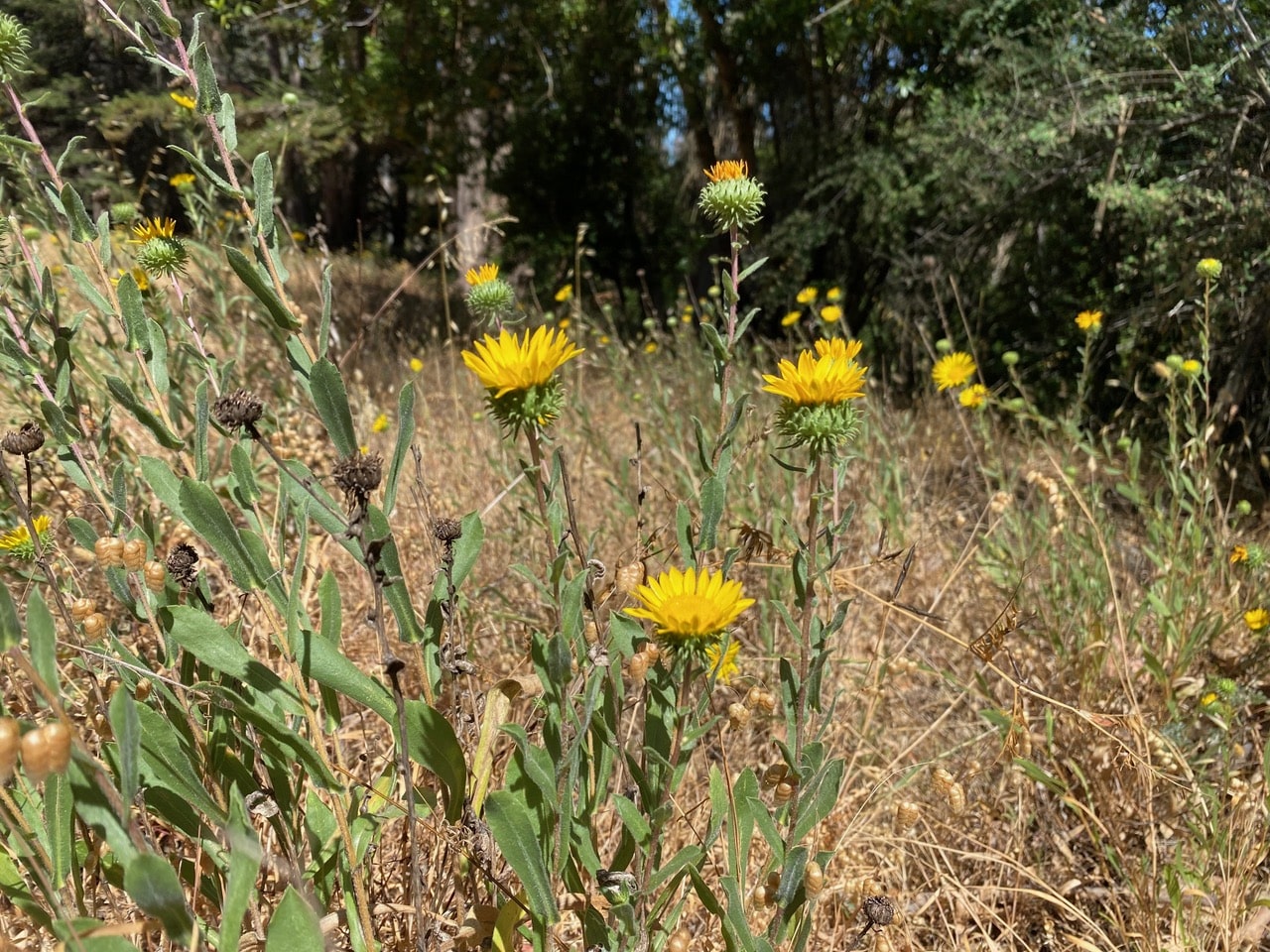
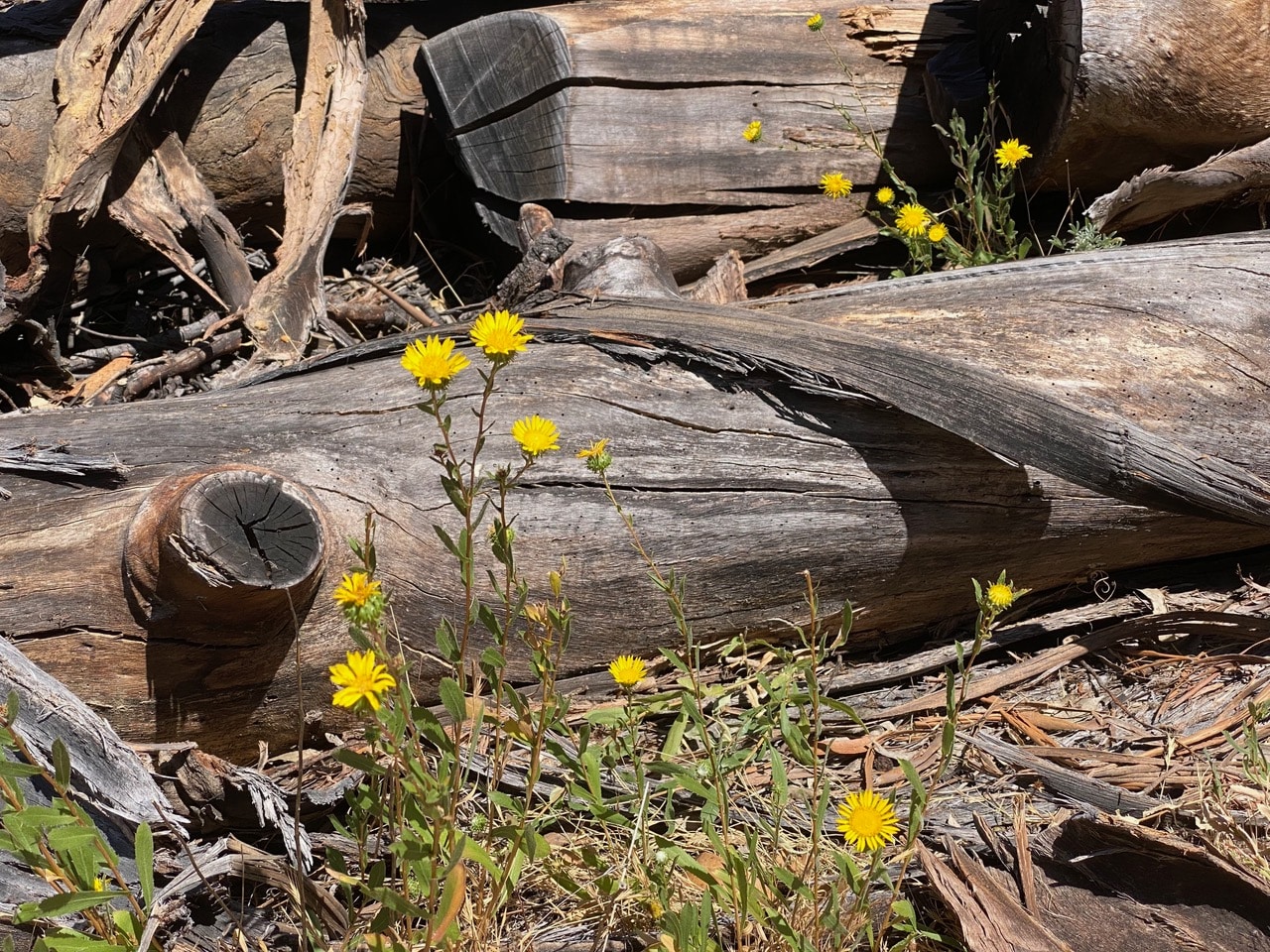
This must be a good year for the Hairy Gumweed, Grindelia hirsutula (family Asteraceae). The plants are blooming in profusion along Sanborn Ave., especially where the road loops around near the scenic lookout point.
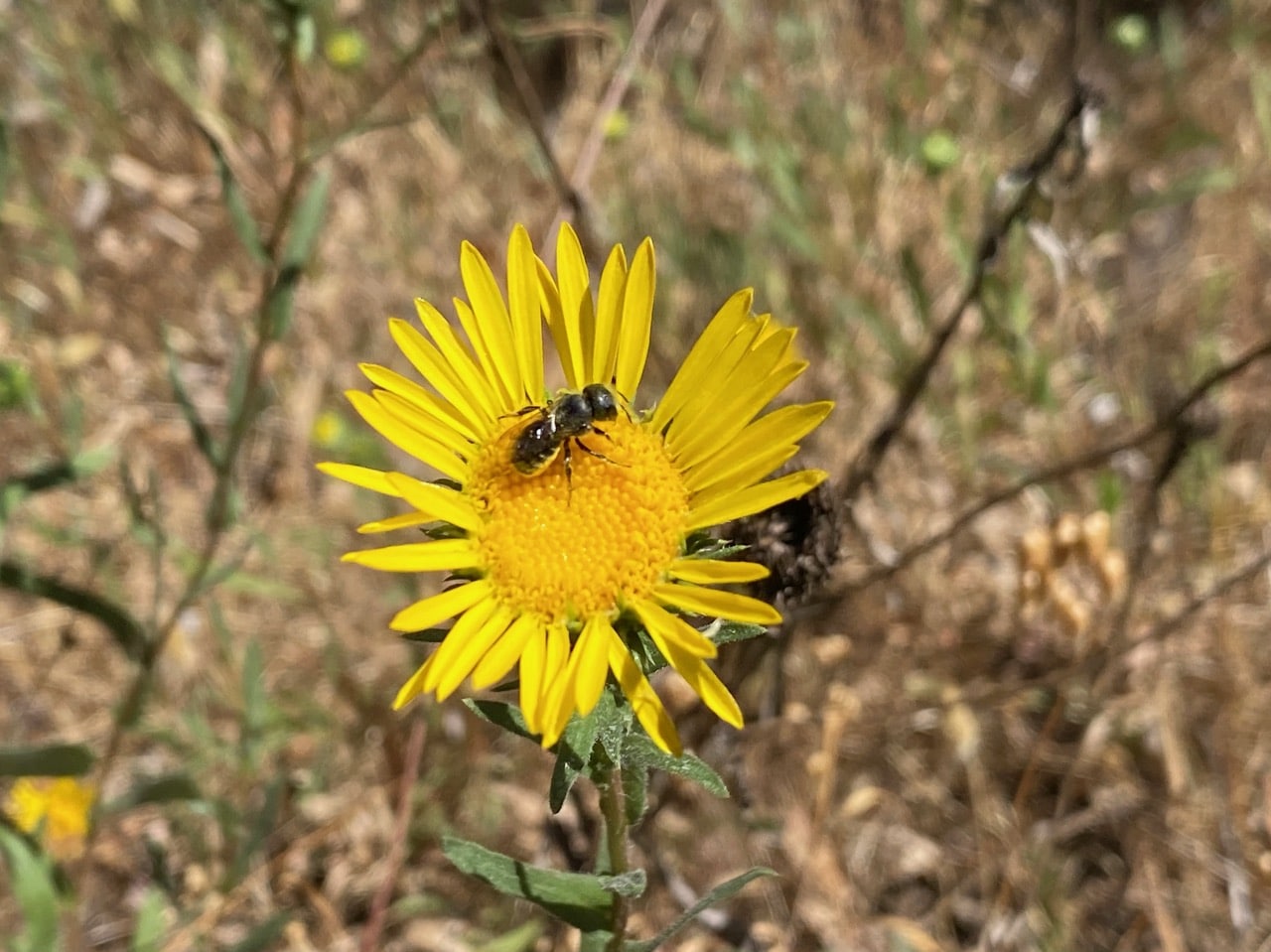
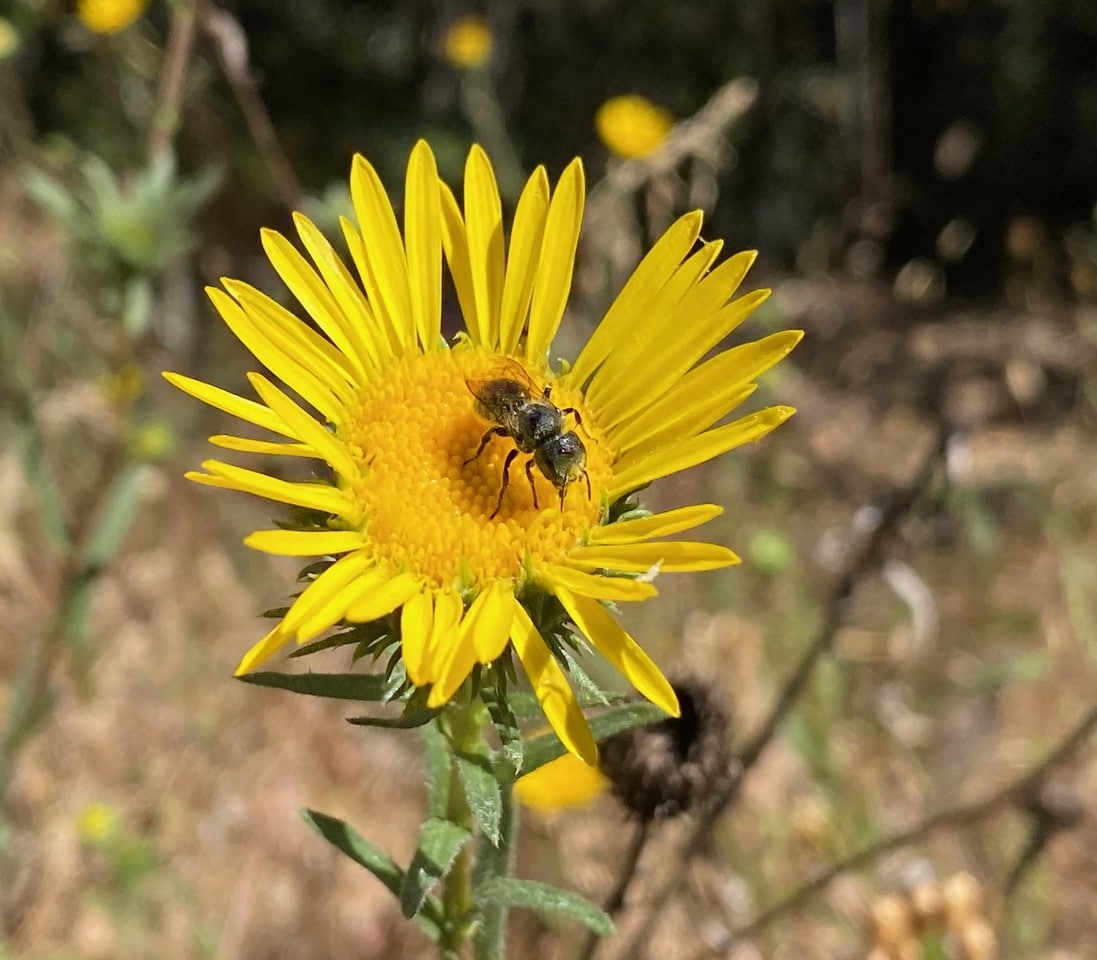
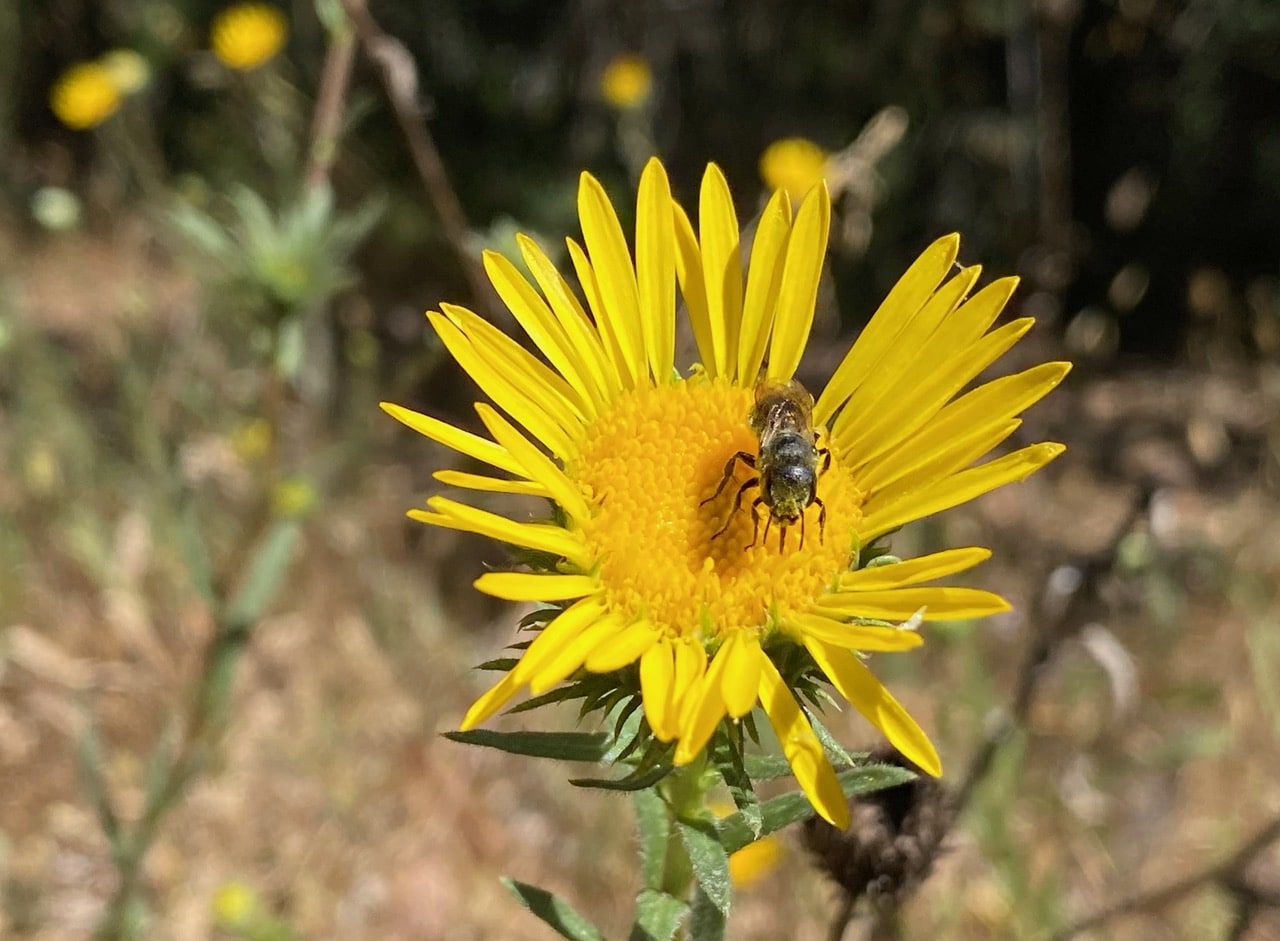

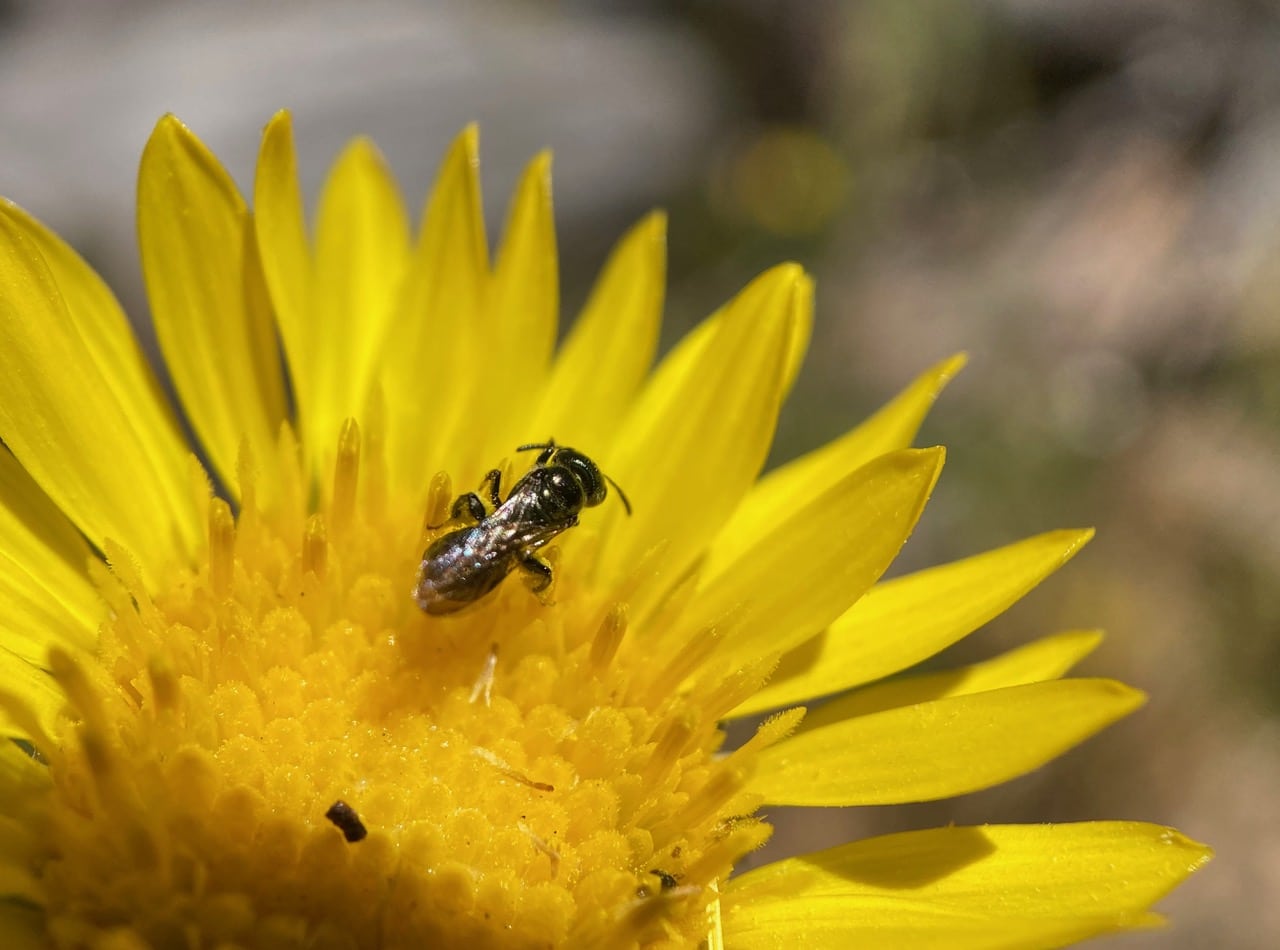

As with the Hayfield Tarweed I saw earlier, most of the insect visitors to the Grindelia are the Colorado Mason Bees, Osmia coloradensis (family Megachilidae). Note the yellow pollen on the scopa on the underside of the bee’s abdomen.
Mason Bee is a name commonly used for species of bees in the genus Osmia, of the family Megachilidae. Mason Bees are named for their habit of using mud or other “masonry” products in constructing their nests, which are made in naturally occurring gaps/cavities such as cracks in stones, hollow stems or holes in wood made by wood-boring insects. Osmia means ‘odor’, and refers to a faint lemony scent used by these bees to mark their nest entrances. Osmia species are frequently metallic green or blue. Females have black ventral scopae (special pollen collecting hairs) on the underside of their abdomen, which are difficult to see unless laden with pollen. Ventral abdominal scopae is a feature shared by all members of the Megachilidae family, which include the wool-carder bees (genus Anthidium), and leaf-cutter bees (genus Megachile).
Mason Bees are a solitary species and are non-aggressive. Every female is fertile and makes her own nest. Each nest cell is provisioned with pollen and contains one egg which will develop into a larva. The female creates a partition of mud between the nest cells. The process continues until she has filled the cavity. She plugs the entrance to the cavity, and then may seek another nest location. The larvae that hatch out consume their provisions and begin spinning a cocoon around itself and enters pupal stage. Adults mature in fall or winter, hibernating inside its cocoon.
The Colorado Mason Bee, Osmia coloradensis (family Megachilidae) is found in Central America and North America. This species is a common and widespread Mason Bee found in gardens and wildlands across California from March into July. The bee is a specialist on plants belonging to the sunflower family, Asteraceae. This means that the females primarily collect pollen from these plants for their nest provisions. O. coloradensis is also characterized by its nesting requirements, needing preexisting cavities in wood, stems, or even Jeffery pine cones.
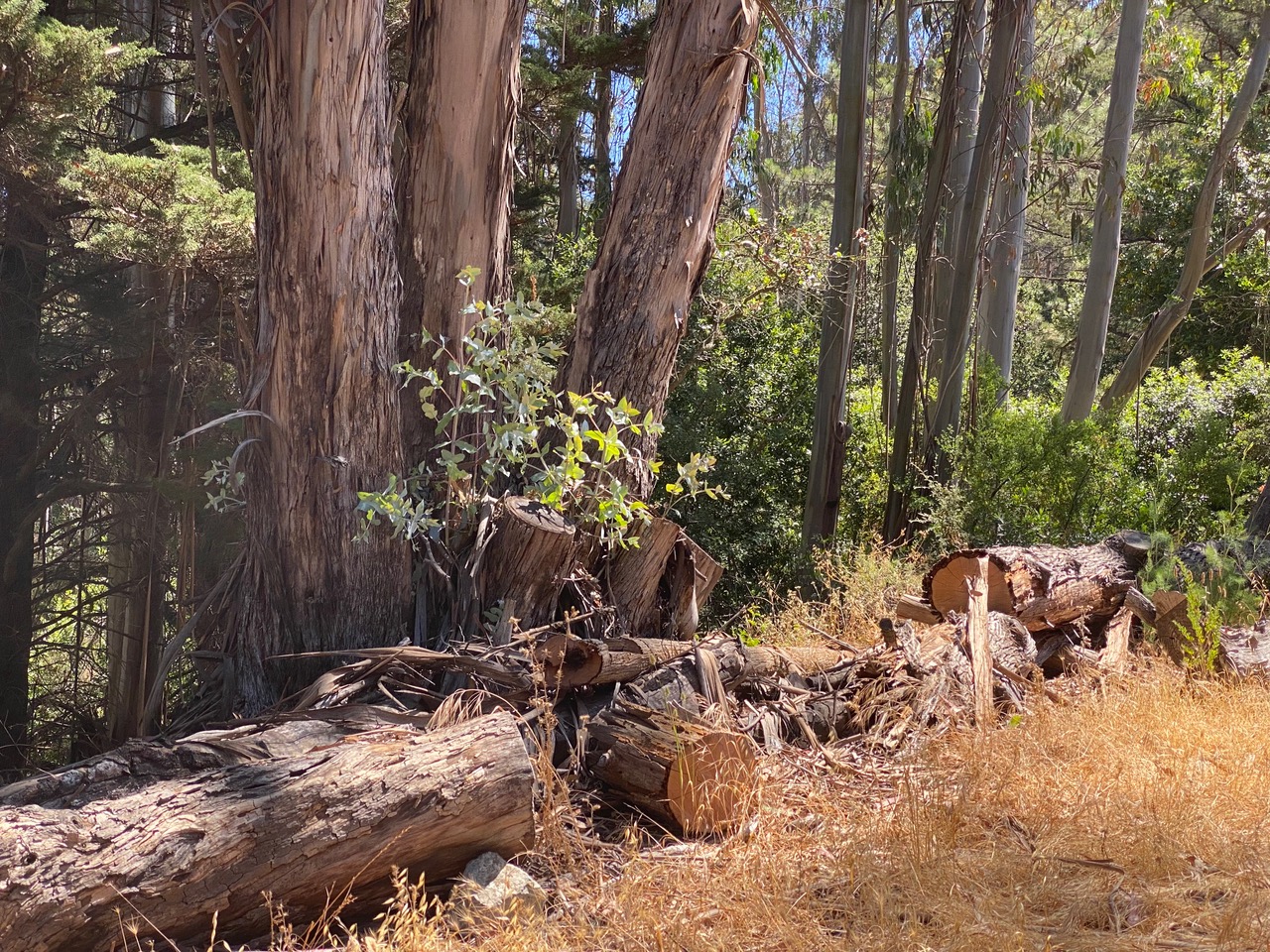
Along the same stretch of the road, large logs lay in piles from Eucalyptus removal. Some are remains of aged Monterey Pines downed by winter storms.
Exhausted from the heat, I stop to rest on a log. Looking around I notice numerous Grindelia growing happily among the decaying logs.
Looking down at the logs, I find these perfect round holes made by wood boring beetles. It suddenly dawns on me why this park is such a paradise for the Colorado Mason Bees. There is an abundance of dead trees that provides ample nesting opportunities for the bees who are dependent on preexisting holes in wood. The abundance of the Hayfield Tarweed, Hemizonia congesta, and the Hairy Gumweed, Grindelia hirsutula, both members of the family Asteraceae, provide the floral resources that these specialist bees need to provision their nest. The Masked Bees, Hylaeus sp. (family Colletidae) also benefit from the smaller holes in the logs, as they are cavity nesters not capable of drilling their own nest holes either. The abundance of these bees in turn have brought in their parasitoids, the Javelin Wasps, Gasteruption jaculator (family Gasteruptiidae), who has evolved long ovipositors that can be inserted deep into these nest holes. Everything I have seen in the last couple of hours come together like jigsaw pieces that complete a bigger picture – a working ecosystem with interacting elements! I sit stunned with these revelations.
I am so glad that Joaquin Miller Park has not removed, chipped or pulverized the dead trees as so many other parks have done in recent years.
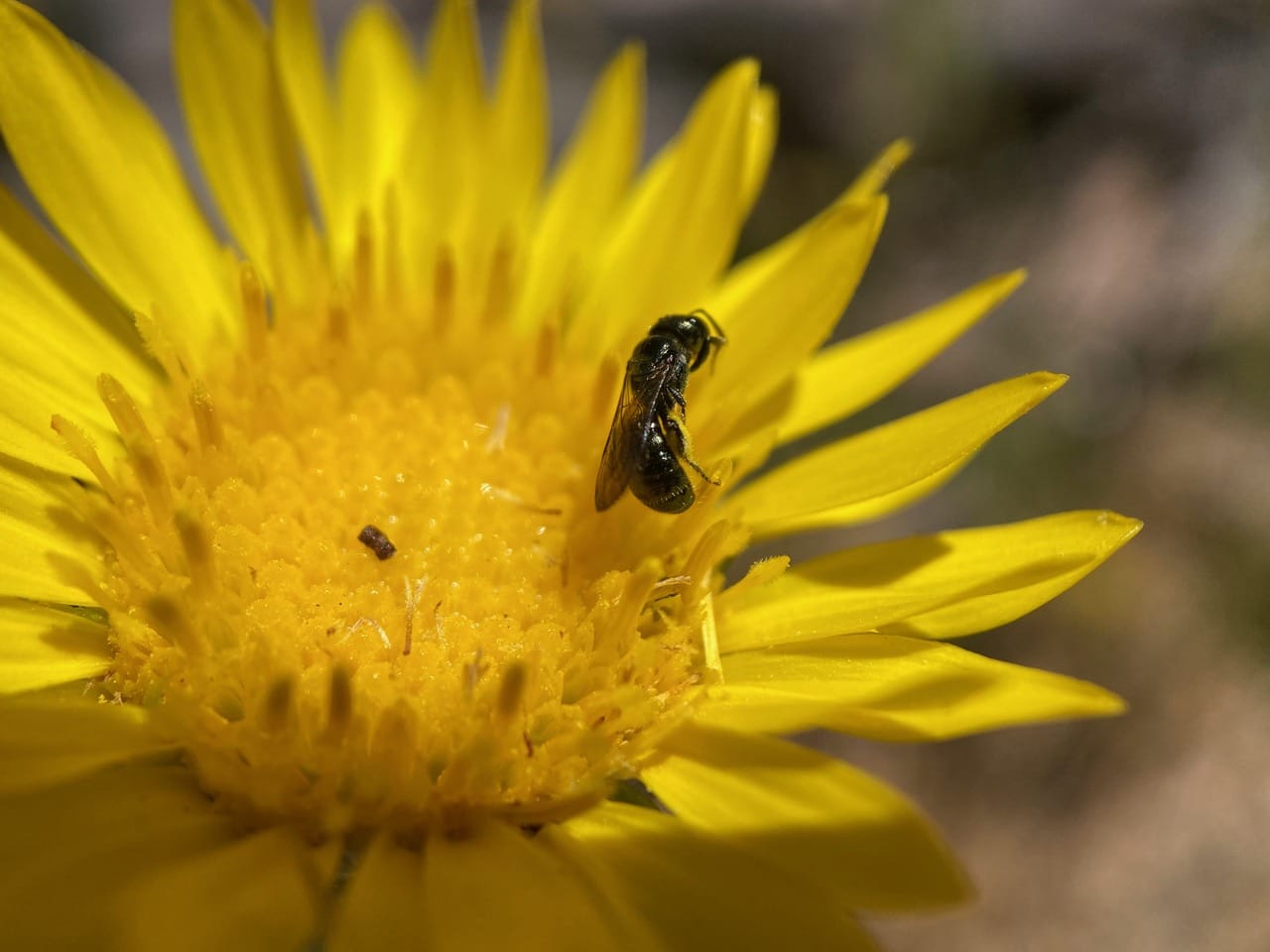
A little glossy black bee is busy collecting pollen from the stamen tubes on a flowerhead of Hairy Gumweed, Grindelia hirsutula. It is a Small Carpenter Bee, Ceratina sp. (family Apidae).
Note the pollen in the modest scopa of the female Small Carpenter Bee.
The Small Carpenter Bee genus Ceratina is closely related to the more familiar, and much larger Carpenter Bees (genus Xylocopa). Ceratina are typically dark, shiny, even metallic bees, with fairly sparse body hairs and a weak scopa on the hind leg. The shield-shaped abdomen comes to a point at the tip. Some species have yellow markings, often on the face.
Females excavate nests with their mandibles in the pith of broken or burned plant twigs and stems. While many species are solitary, a number are subsocial. Both male and female carpenter bees overwinter as adults within their old nest tunnels, emerging in the spring to mate. In the spring, this resting place (hibernaculum) is modified into a brood nest by further excavation. The female collects pollen and nectar, places this mixture (called bee bread) inside the cavity, lays an egg on the provision, and then caps off the cell with chewed plant material. Several cells are constructed end to end in each plant stem.

A few Yellow Mariposa Lily, Calochortus luteus are blooming on the grassy slope where Sanborn Ave. loops around. As beautiful as these large flowers are, they don’t seem to be getting any attention from the pollinators today.
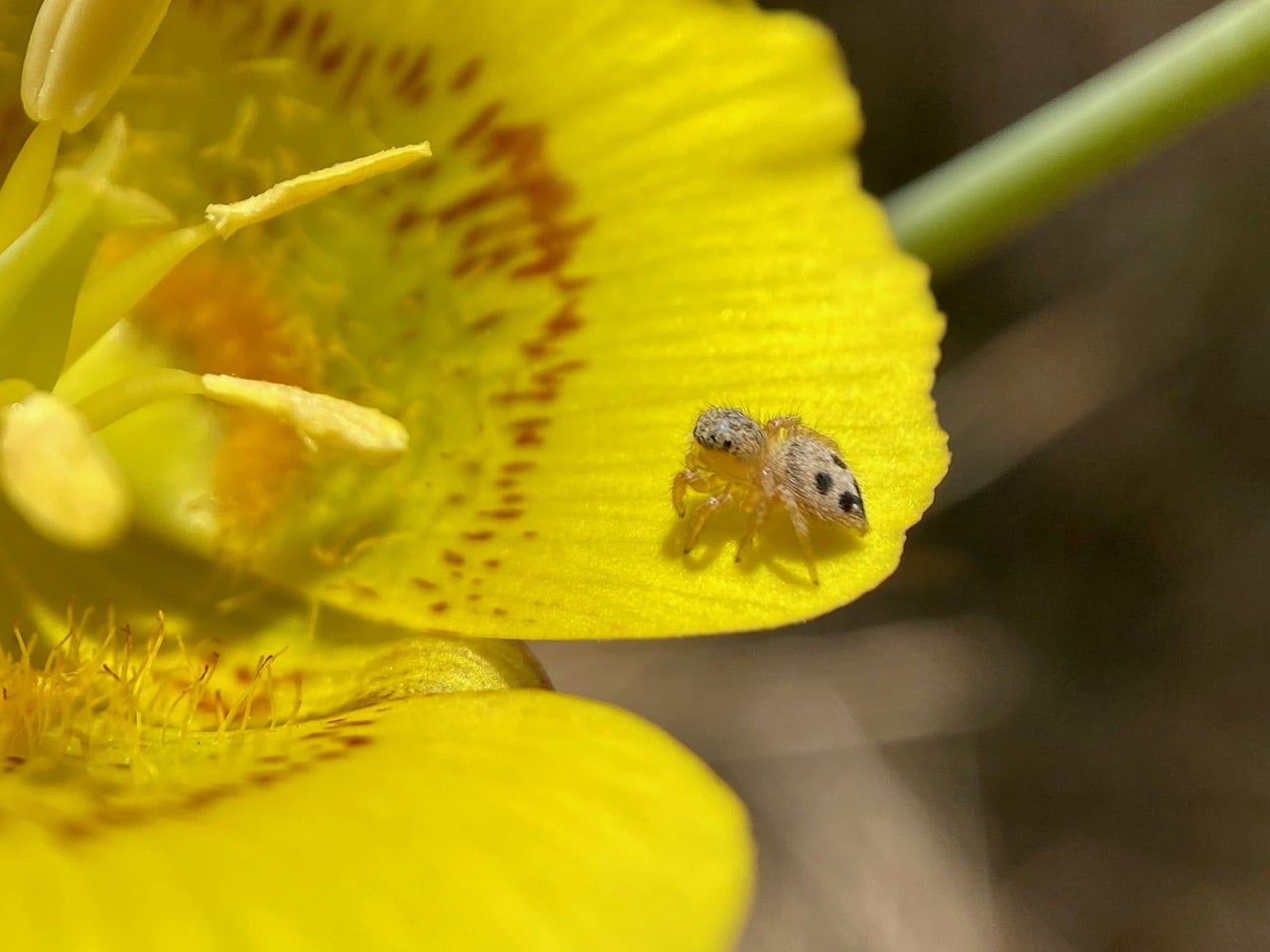
A tiny Jumping Spider stands forlorn on a petal of Mariposa Lily. It is probably a juvenile. I hope the spider gets enough to eat. Apparently young spiders do feed on pollen. Eating pollen has been shown to increase the survival rate of spiderlings compared to those that don’t have access to it. Pollen provides a range of essential nutrients that spiders need, especially when insects are scarce.
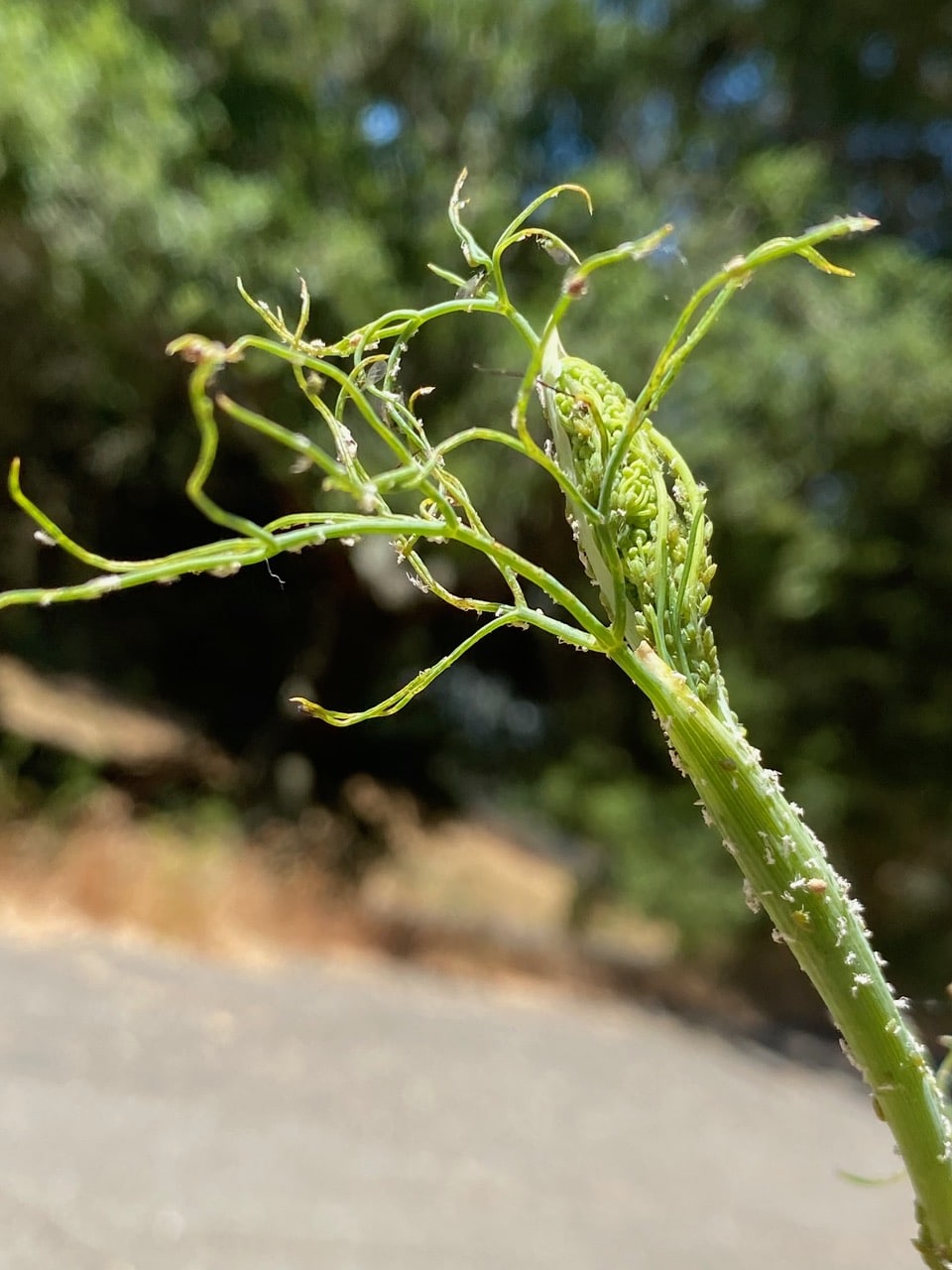
The terminal leaves and flower buds of this Fennel, Foeniculum vulgare are infested with aphids. While the green aphids are hardly visible, their white exuvia give their presence away. Exuvia are the
discarded exoskeleton of an arthropod (such as an insect, crustacean or spider) after it molts.
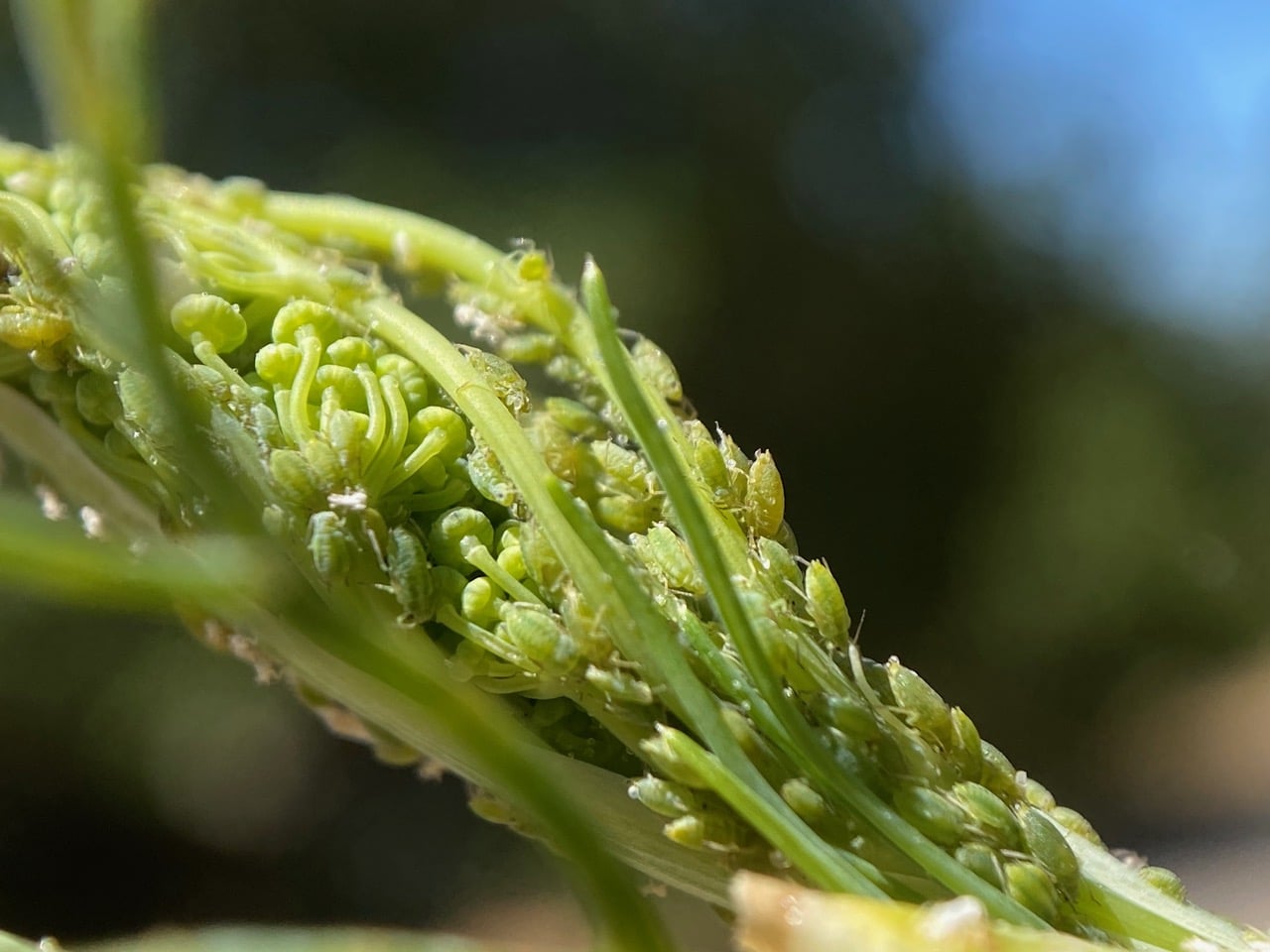
The green aphids are stacked imperceptibly among the green flower buds. Two female hover flies, the Common Grass Skimmers, Paragus haemorrhous (family Syrphidae) compete fiercely with each other to lay eggs near the aphid colony, bumping each other off her perch. Unfortunately I fail to get a photo of the action. Female hover flies search diligently for aphids on plants. They lay their eggs close to the aphids to ensure that their aphidophagous larvae will have plenty to eat when they hatch.
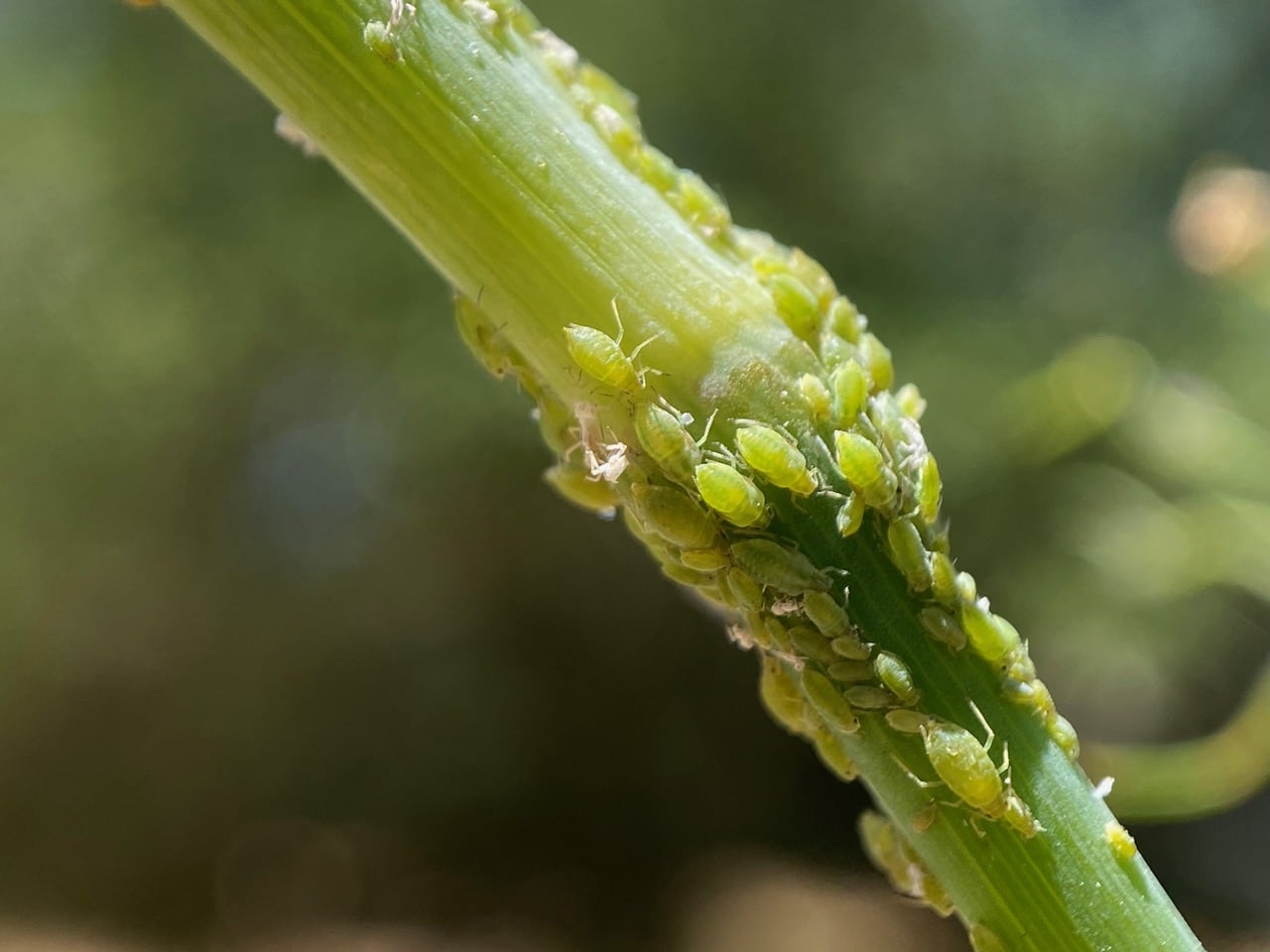
More aphids on the lower stem of the same Fennel. iNaturalist has helped identify them as the Potato Aphids, Macrosiphum euphorbiae.
Aphids (family Aphididae) are small sap-sucking insects in the order Hemiptera. Aphids usually feed passively on phloem of plants. Once the phloem vessel is punctured, the sap, which is under pressure, is forced into the aphid’s food canal. Aphids produce large amounts of a sugary liquid waste called “honeydew”. A fungus called sooty mold can grow on honeydew deposits that accumulate on leaves and branches, turning them black.
A typical life cycle involves flightless females giving live birth to female nymphs, – who may also be already pregnant, an adaptation called telescoping generations – without the involvement of males. Maturing rapidly, females breed profusely so that the population multiplies quickly. Winged females may develop later in the season, allowing the insects to colonize new plants. In temperate regions, a phase of sexual reproduction occurs in the autumn, with the insects often overwintering as eggs. The life cycle of some species involves an alternation between two species of host plants. Some species feed on only one type of plant, while others are generalists, colonizing many plant groups. Some ants have a mutualistic relationship with aphids, tending them for their honeydew and protecting them from predators.
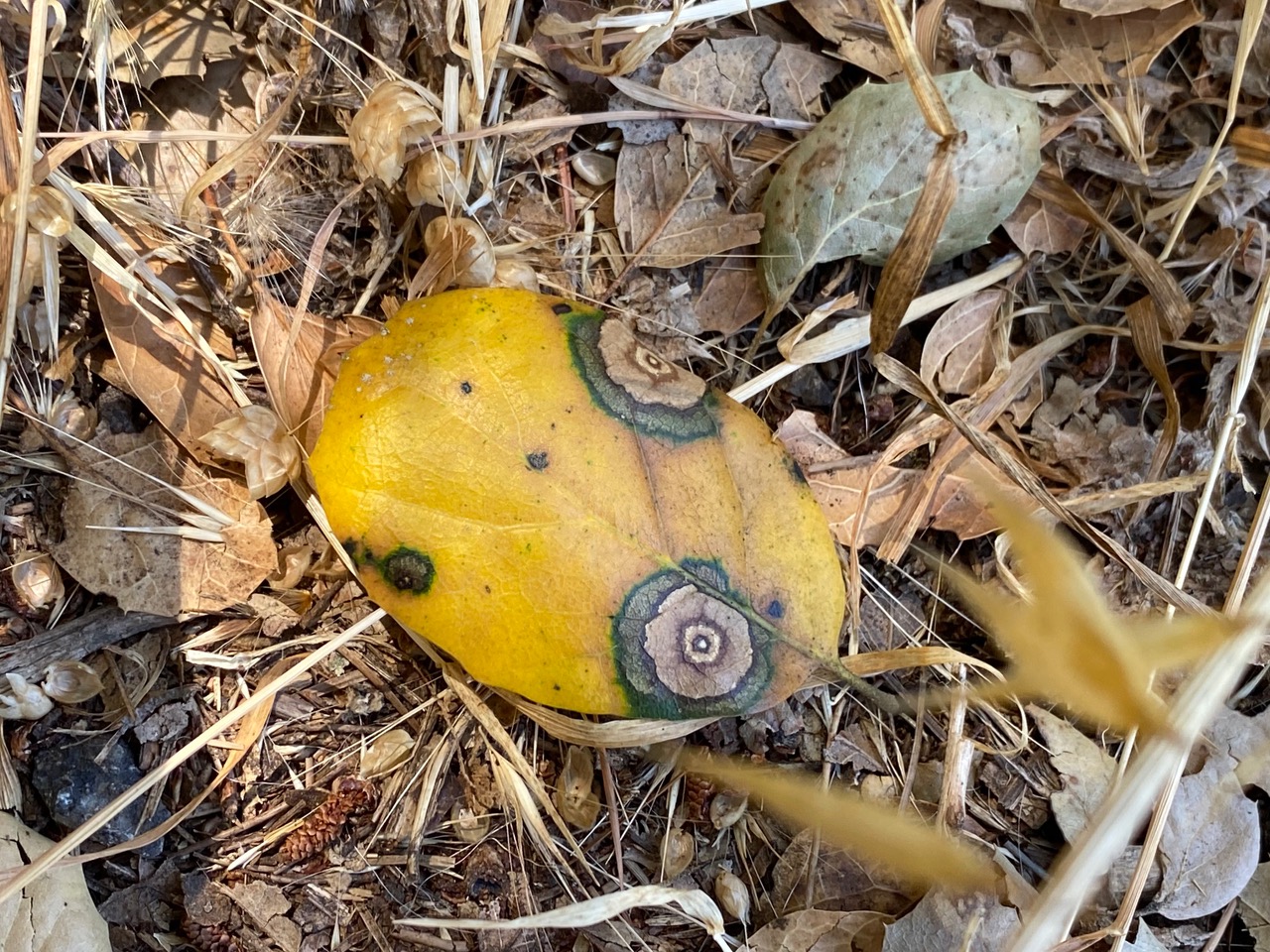
Under a Coast Live Oak, Quercus agrifolia, a fallen yellow leaf lies conspicuously amidst the brown leaf litter. It has two prominent bulls-eyes with concentric circles of brown and green tissues. I have seen many leaves with the brown concentric circles and have learned that they are caused by fungal infection. But what about the green areas? Is this a “green island phenomenon”?
The term “green island phenomenon” typically refers to the observation of photosynthetically active green patches on otherwise senescing plant leaves, particularly in the presence of certain insects or pathogens. These green areas, which appear as “islands” amidst yellowing or browning tissue, are characterized by higher levels of cytokinins and increased nutrient availability.
Some leaf-mining insects, such as certain moth larvae, can induce this green island effect by creating a symbiotic relationship with a bacteria Wolbachia on their body. These bacteria increase the production of cytokinins, which are plant hormones that inhibit leaf senescence. Essentially, the insect’s presence and the bacteria’s activity keep the leaf tissue around them from aging, creating the green island, and extending the period when the insect can continue to feed. Plant pathogens, including certain fungi and viruses, can also cause green islands to form. The area around the active infection site may remain green while the rest of the leaf yellows and degrades. This is often due to localized changes in leaf chemistry and nutrient distribution, potentially favoring the pathogen’s growth and reproduction.
Here’s my attempt at making sense of our beautiful leaf: The center of the bull’s-eye pattern on the leaf is the starting point of the fungal infection, which spreads out radially as it grows. The consumed areas turn brown. The green leading edges of the infection is usually masked by chlorophyll while the leaf is green, but becomes evident when the leaf senesces and turns yellow.
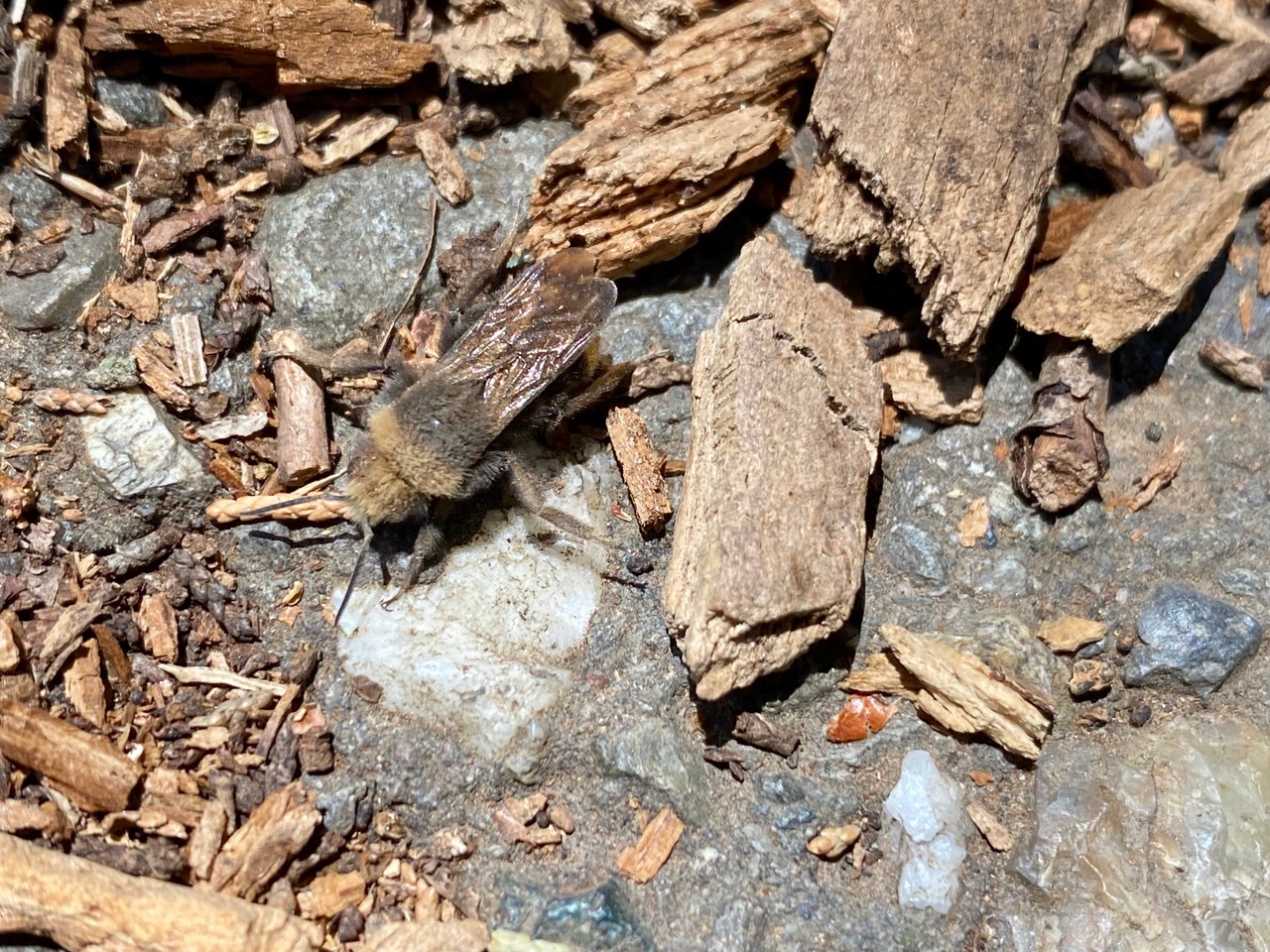
Approaching the parking lot, I pass some large decomposing logs. Movements on the ground draw my attention to a large insect running erratically among the wood debris. It looks like a Yellow-faced Bumble Bee that has been thoroughly dusted with fine soil or sawdust. Wow, what happened to the bee, and what is it doing? Has it been parasitized to behave so strangely? In the summer over the past few years I have occasionally come across a bumble bee behaving like this – running around on the ground, apparently disoriented or in distress. I am tempted to collect the bee to see if I could rear out the parasite, if the bee is indeed parasitized. A chilling thought. There is a parasitoid of bumble bees, the Thick-headed Fly (family Conopidae) that lays its eggs on bumble bees….
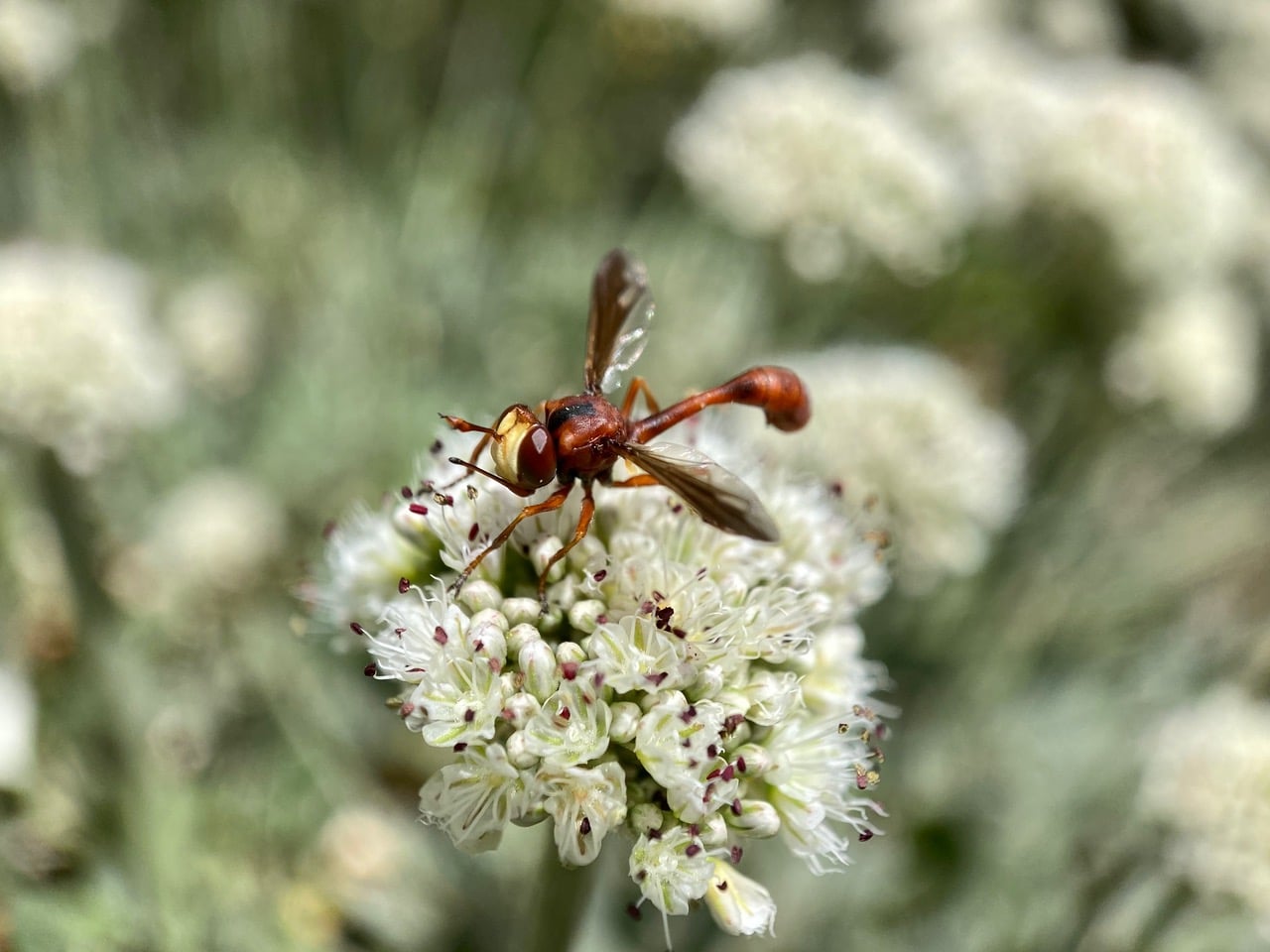
Photo taken on 6/1/25 in Stefanie’s garden in San Leandro. A Thick-headed Fly, Physocephala burgessi (family Conopidae) is perched on a cluster of flowers of Nude Buckwheat.
The small and little-known family of Conopidae, commonly called the Thick-headed Flies, are distributed worldwide. Remarkable mimics of wasps and bees, the flies are frequently found at flowers, feeding on nectar with their long probosces. The larvae of all Conopids are internal parasitoids, mostly of aculeate (stinging) Hymenoptera (wasps, bees). Adult females aggressively intercept their hosts in flight to deposit eggs. Vulnerable foraging bees are likely the most susceptible to parasitism by Conopids. The female’s abdomen is modified to form what amounts to a “can opener” to pry open the segments of the host abdomen as the egg is inserted. The fly larva feeds on the host from the inside out. The bee host continues to live, and is able to fly throughout the duration of the larval developmental period. The vast majority of parasitized bumble bees bury themselves by burrowing into the ground right before they die. This behavior does not matter to the bees – they are doomed. But it is critical for the flies – if the host dies underground, the fly is sheltered from the elements, predators and parasites. Pupation occurs in the abdomen of the now deceased bee host. The adult fly typically emerges after overwintering in the abdominal puparium of the bee.