

Pollinator Post 7/18/25 (2)
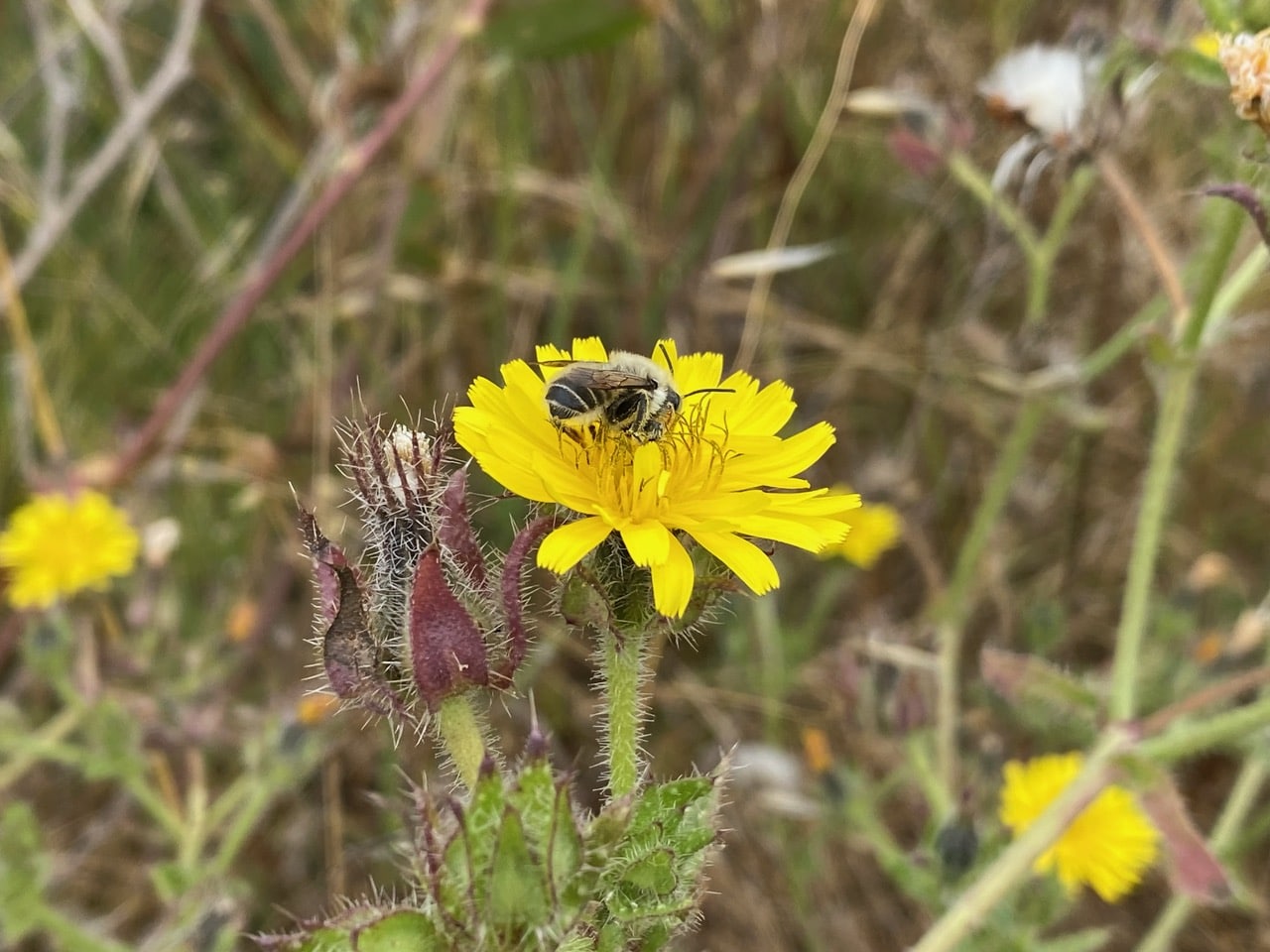
I next move on to Bay Farm Island and walk a short stretch of the trail along Shoreline Park.
I am glad that the park has left some of the Bristly Oxtongue, Helminthotheca echioides in place along the shore. Although considered a weed, their flowers provide pollen and nectar during times of scarcity when few native plants are in bloom, filling in the gaps. Here a male Western Leafcutter Bee, Megachile perihirta (family Megachilidae) is foraging on a Bristly Oxtongue flowerhead, Helminthotheca echioides.
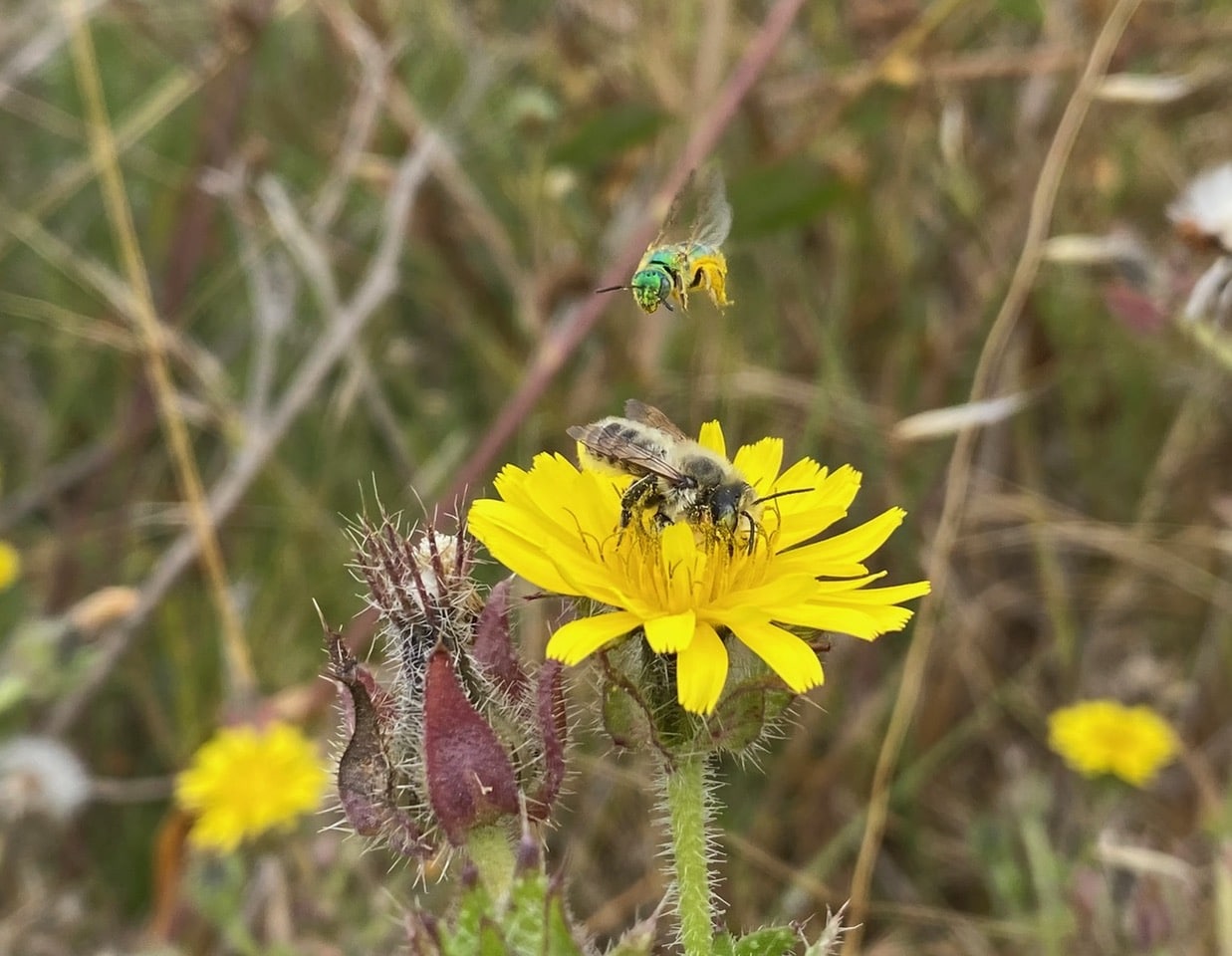
Lucky shot of a passing female Fine Striped Sweat Bee, Agapostemon subtilior (family Halictidae). I am only focusing on the Leafcutter of course.
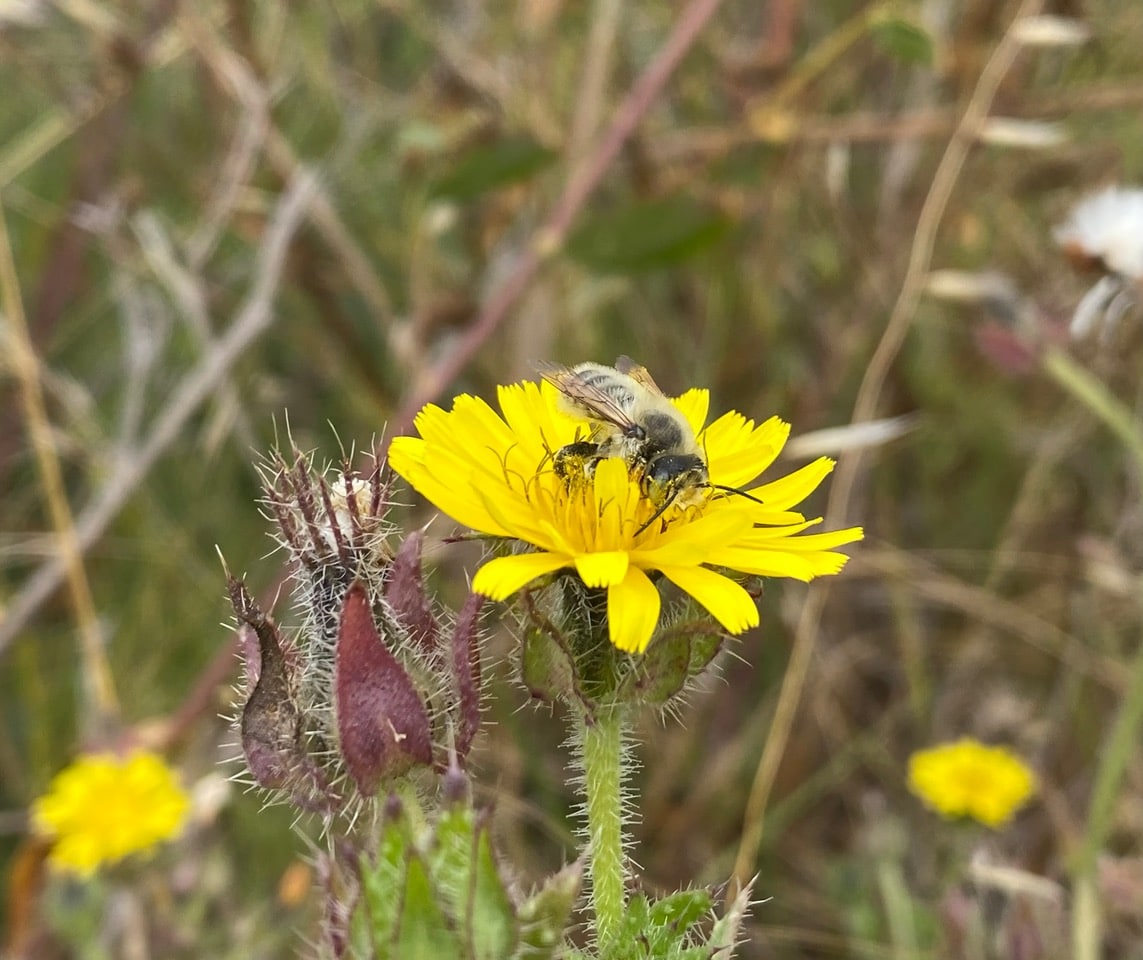
The family Megachilidae includes some of our charismatic bees such as the Leafcutter Bees (Megachile), the Mason Bees (Osmia), and the Woolcarder Bees (Anthidium). Their common names reflect the materials with which the bees build their nest cells (leaves, soil, plant fibers respectively). The scientific name Megachilidae translates as “large lipped” in Greek, referring to their large lips and strong jaws that are well-suited for collecting of nest-building materials. The family represents 15-20% of named species of bees. Most build their nests in above-ground cavities; they all are solitary bees. Characteristic traits of this family are their typically elongated labrum, and the way the females carry pollen – in a scopa (special pollen-collecting hairs) on the underside of the abdomen. (The labrum, often called the “upper lip”, is a flap-like structure that helps hold food in place during feeding. It is located at the front of the insect’s head, above the mouth opening.) The motion of Megachilidae in pollen gathering is energetic and swimming-like; this agitation releases large amounts of pollen from the flower’s reproductive structures.
Because they are mostly above-ground nesters and more easily attracted to artificial nests, megachilid bees (especially Osmia) are extensively studied for their commercial possibilities.
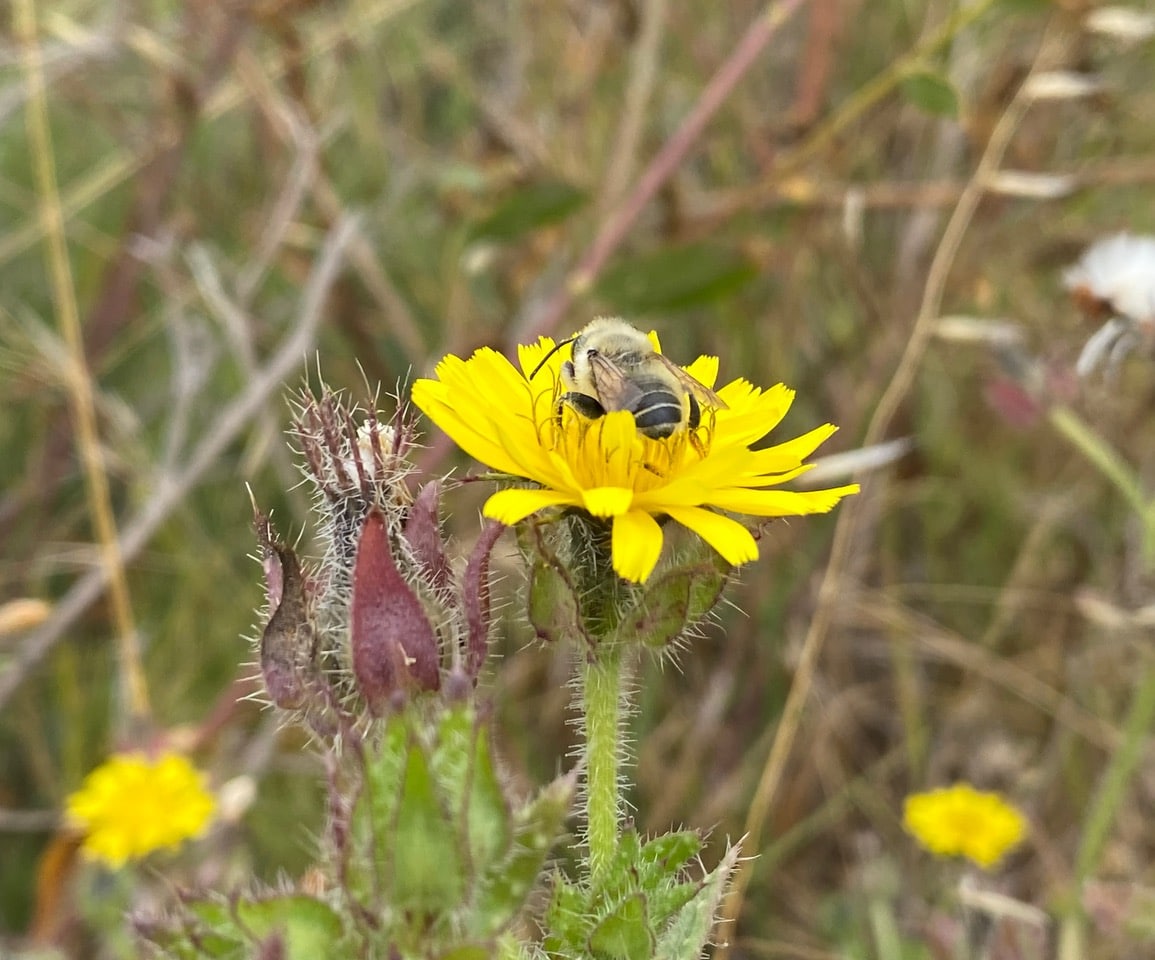
Leaf-cutter Bees, Megachile sp. (family Megachilidae) are stout-bodied, usually with pale hair on the thorax and stripes of white hairs on the abdomen. Females usually have a triangular abdomen with a pointed tip, and males’ faces are covered with dense, pale hair. Flight season is from May into September, with peak activity from June to August.
Solitary females construct nests in tubular cavities, including hollow stems, tree holes, and abandoned beetle burrows in wood. Many use holes drilled into wood, straws, or other manufactured tunnels. Females cut pieces from leaves or flower petals for use in the construction of brood cells. Most Megachile females are generalists when foraging for pollen. Pollen is transported in dense scopae on the underside of the abdomen.
Photos of Western Leafcutter Bee (Megachile perihirta) · iNaturalist
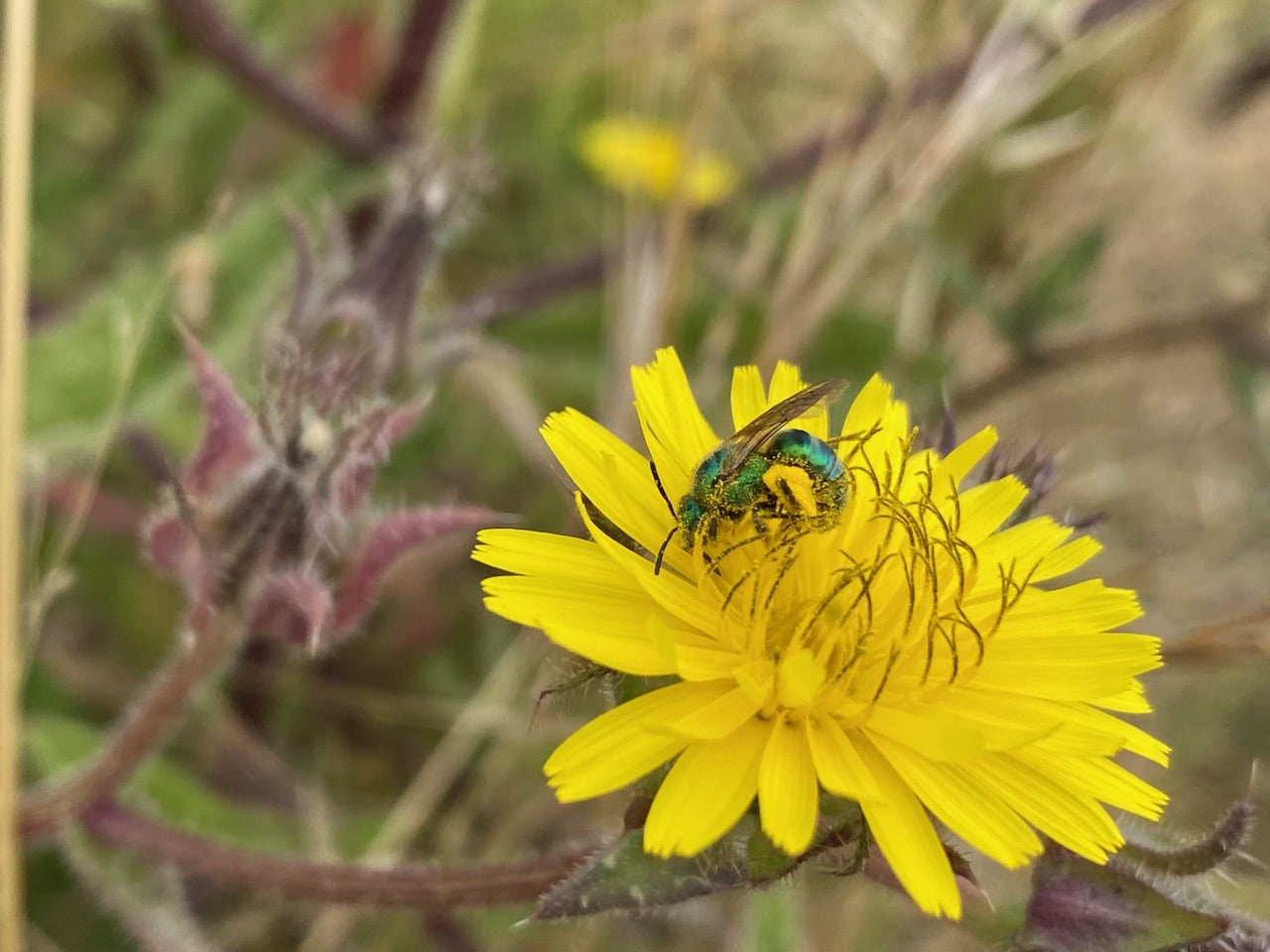
A female Fine Striped Sweat Bee, Agapostemon subtilior (family Halictidae) is foraging on a flowerhead of Bristly Oxtongue. She already has an impressive pollen load on the scopae of her hind legs.
Agapostemon are brightly colored metallic green or blue bees measuring 7 to 14.5 mm long. Most species have a metallic green head and thorax, and black-and-yellow striped abdomen; some females are entirely bright green or blue. Females carry pollen on scopal hairs located on their hind legs. Agapostemon are generalists. Like other members of the family Halictidae, they are short-tongued and thus have difficulty extracting nectar from deep flowers. Males are often seen flying slowly around flowers looking for females. The bees favor flowers with high densities. Females excavate nests in the ground. These are summer to fall bees.
Agapostemon females dig deep vertical burrows in flat or sloping soil, or sometimes in banks. Most species are solitary, but some species nest communally. Up to two dozen females may share a single nest entrance, but each individual builds and provisions its own cluster of brood cells. Where a communal nest gallery shares a single entrance, one bee usually guards the hole, with only her head visible from above ground. Unlike other social bees, in communal bees there is no reproductive division of labor. In cool temperate regions, there is one generation per year, with females active in the early summer and males and pre-diapausing females active in the late summer. Only mated females survive the winter. This is probably because unmated females cannot enter diapause (insect version of hibernation).
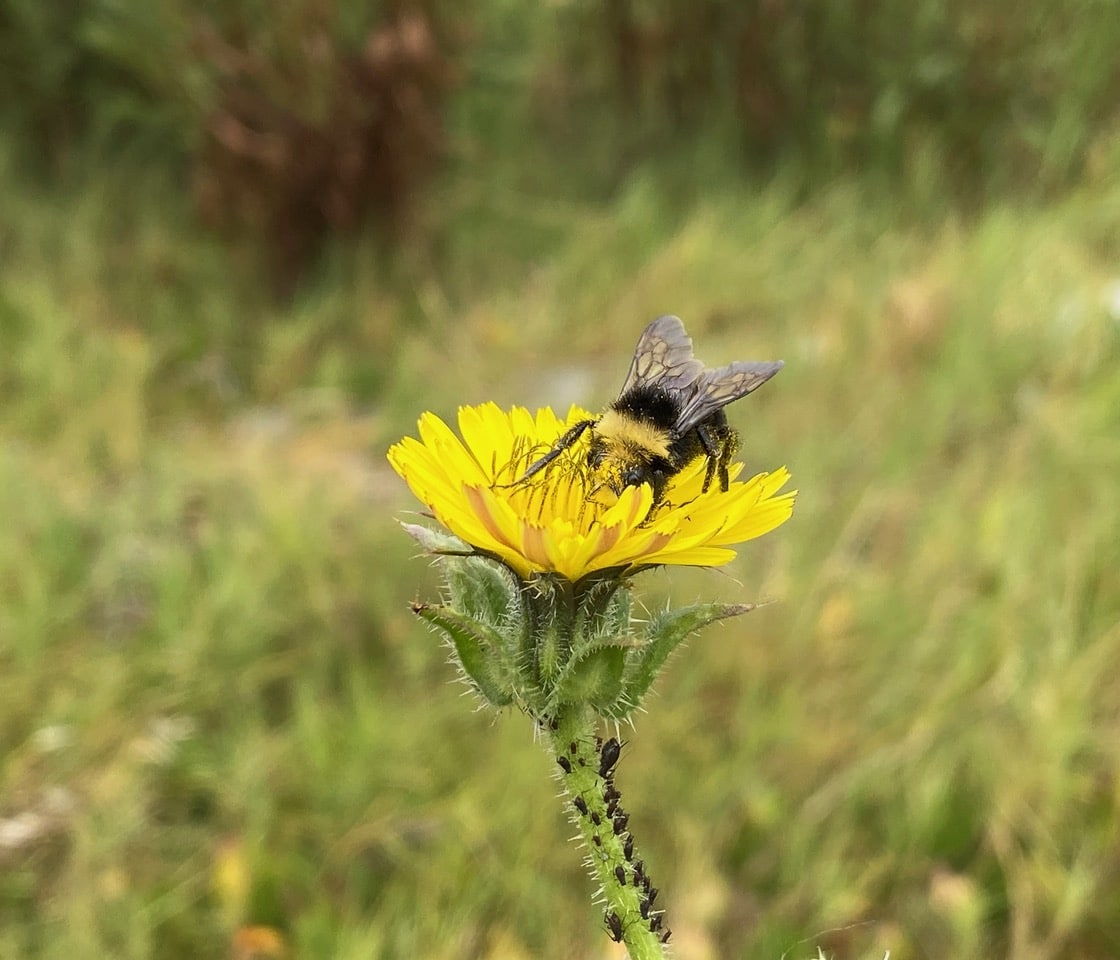
Her face dusted with pollen, a Yellow-faced Bumble Bee, subgenus Pyrobombus (genus Bombus, family Apidae) is foraging on a Bristly Oxtongue flowerhead. Note that the florets of Bristly Oxtongue flowerhead have dark pistils (female parts comprising stigmas and styles). Ooh, look at those large, dark Aphids on the peduncle.
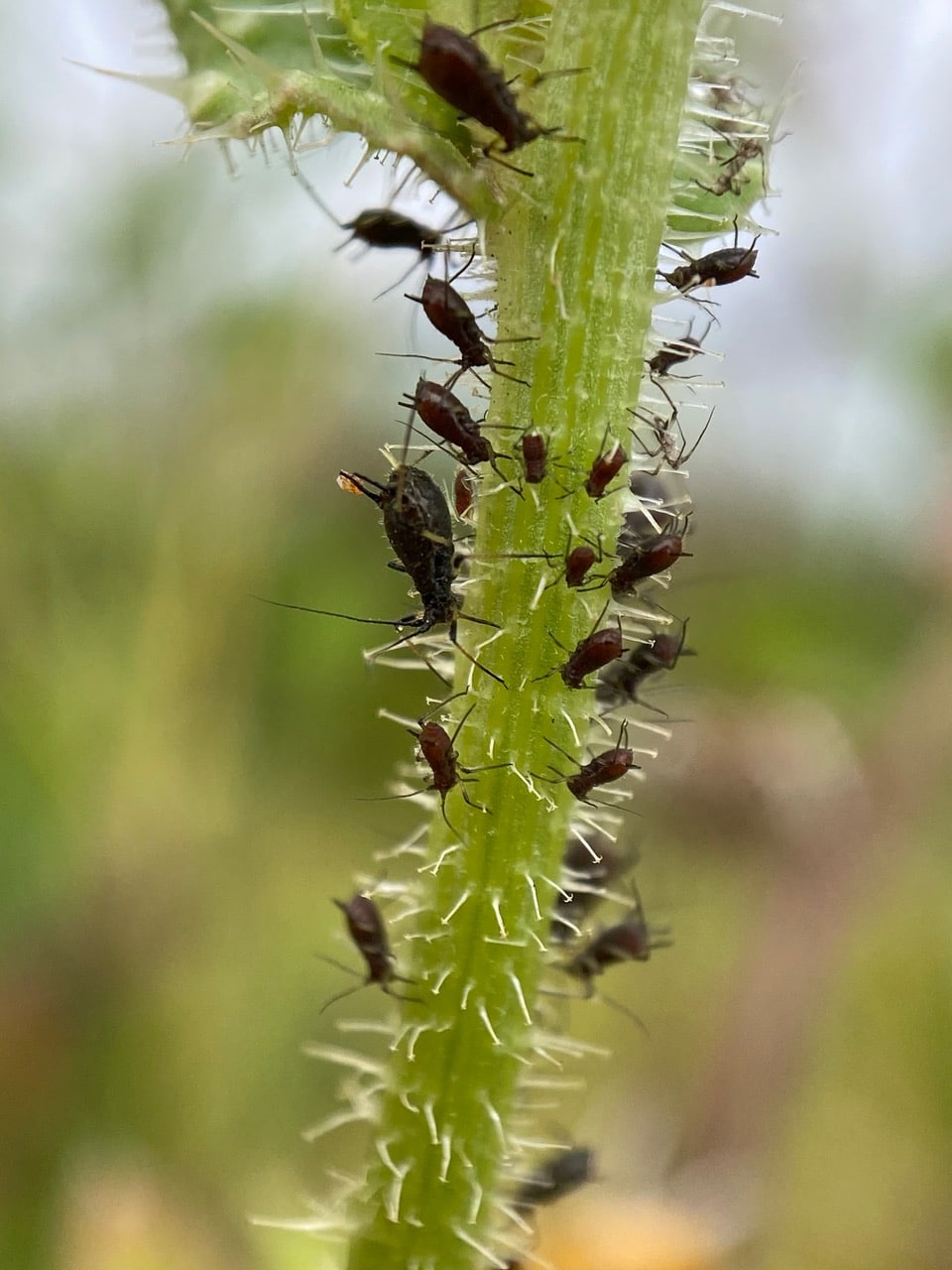
iNaturalist has helped identify the aphids as the Large Daisy Aphids, Uroleucon sp. (family Aphididae, tribe Macrosiphini).
Aphids (family Aphididae) are small sap-sucking insects in the order Hemiptera. Aphids usually feed passively on phloem of plants. Once the phloem vessel is punctured, the sap, which is under pressure, is forced into the aphid’s food canal. Aphids produce large amounts of a sugary liquid waste called “honeydew”. A fungus called sooty mold can grow on honeydew deposits that accumulate on leaves and branches, turning them black.
A typical life cycle involves flightless females giving live birth to female nymphs, – who may also be already pregnant, an adaptation called telescoping generations – without the involvement of males. Maturing rapidly, females breed profusely so that the population multiplies quickly. Winged females may develop later in the season, allowing the insects to colonize new plants. In temperate regions, a phase of sexual reproduction occurs in the autumn, with the insects often overwintering as eggs. The life cycle of some species involves an alternation between two species of host plants. Some species feed on only one type of plant, while others are generalists, colonizing many plant groups. Some ants have a mutualistic relationship with aphids, tending them for their honeydew and protecting them from predators.
Uroleucon is a large genus, with worldwide distribution associated entirely with the sunflower family (Asteraceae) and bellflower family (Campanulaceae). Uroleucon are medium-sized to rather large aphids which may be shiny red, reddish brown or blackish brown. The antennae are about as long as the body. The siphunculi (“tail pipes”) are black and long. These aphids do not host alternate. They usually have a sexual stage in their life cycle and overwinter as eggs. Uroleucon are not usually attended by ants.
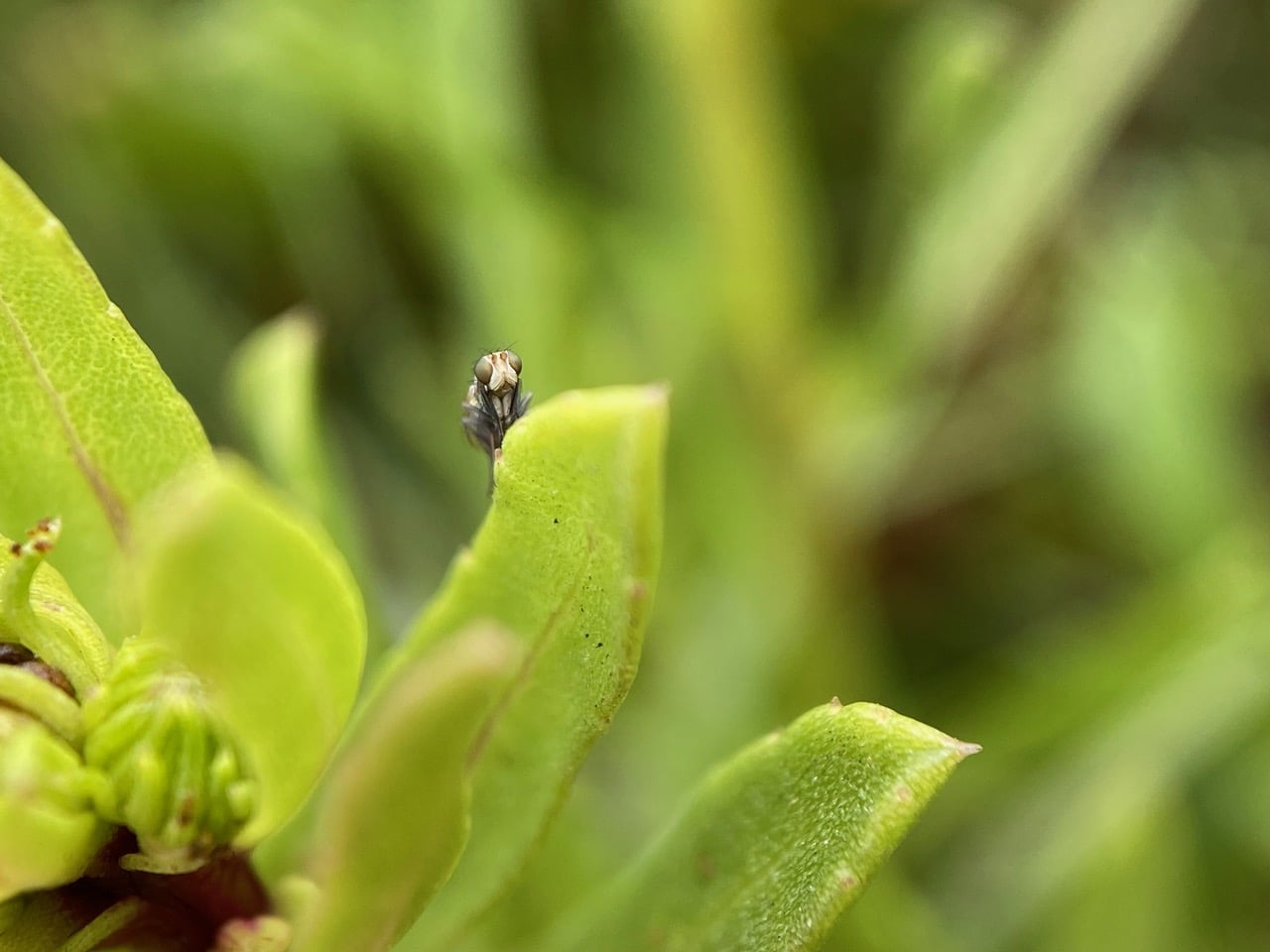
A tiny fly, barely 2 mm long, is perched on the tip of a leaf of Oregon Gumweed, Grindelia stricta. What an interesting mouth!
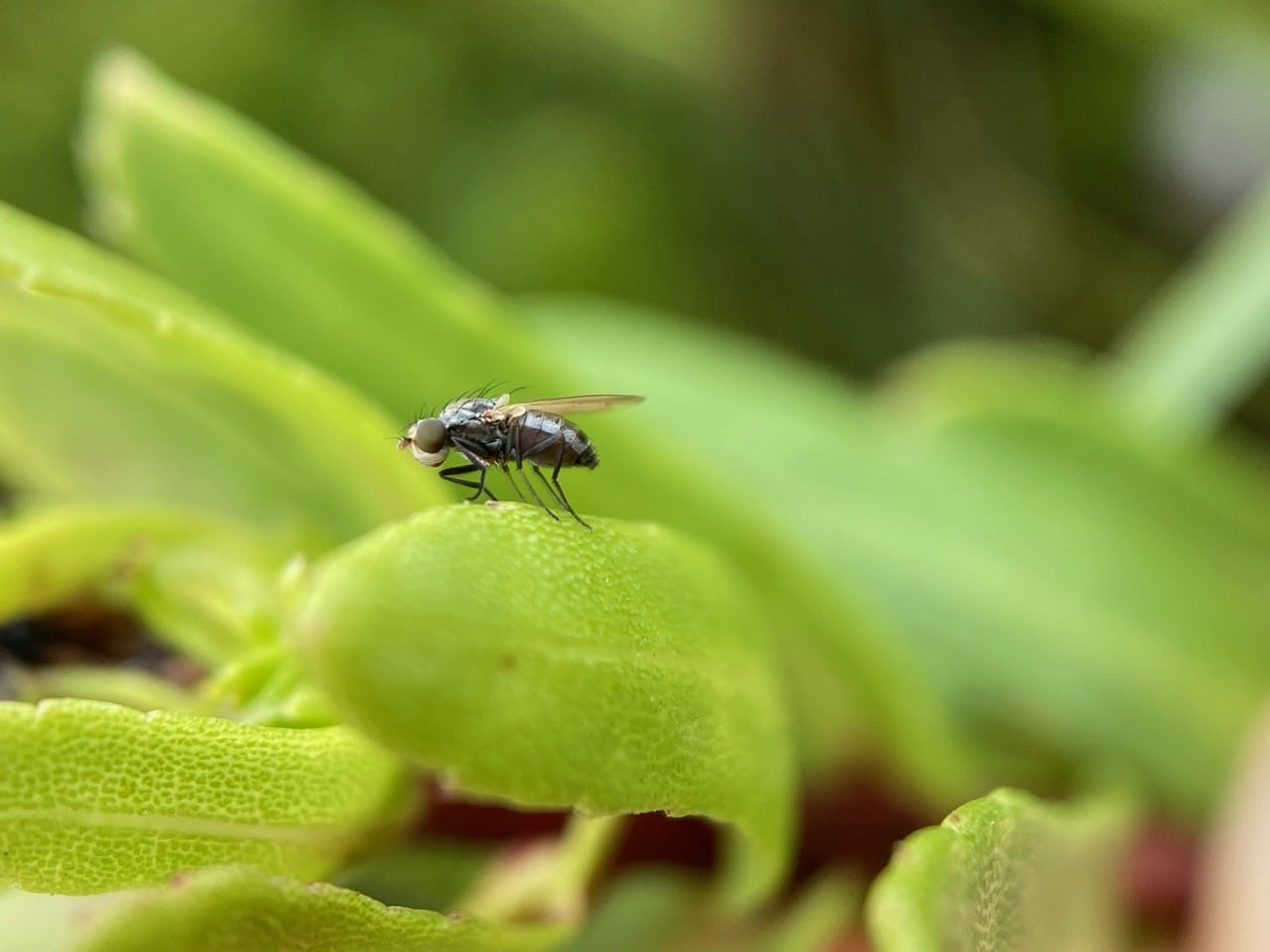
iNaturalist has helped identify the fly as a Beach Fly (family Canacidae).
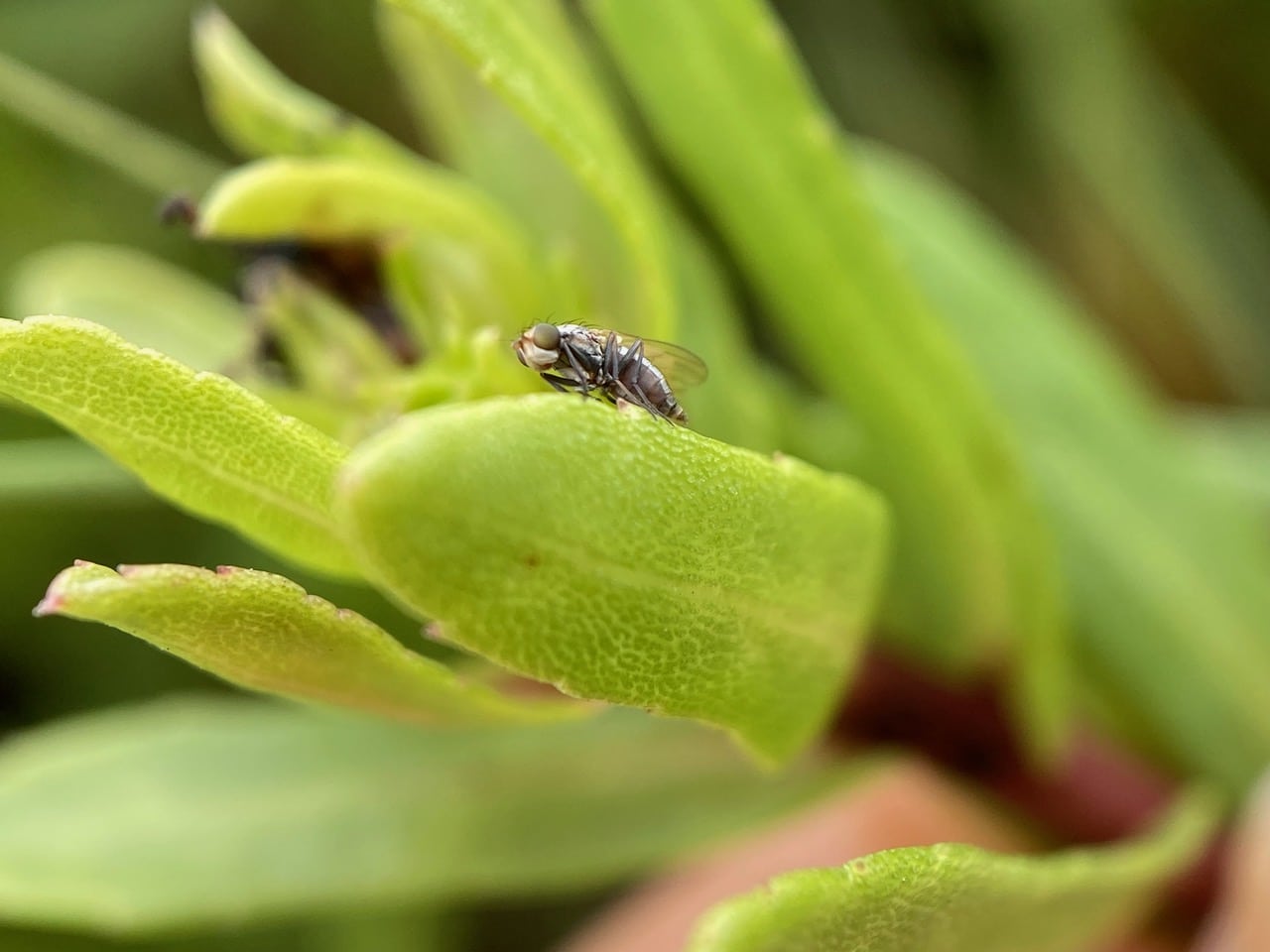
The Beach Flies (family Canacidae) are minute (1.6-5 mm) yellow, gray or gray-brown pruinose flies with whitish to grayish markings. The head is large with small antenna bearing bare to pubescent arista. The “mouth” is a large oval opening. The Canacidae are found along the sea coasts, on the surface of small bodies of water, saline and fresh, in places protected from the wind. They feed on infusoria and other tiny organisms. Infusoria is a word used to describe various freshwater microorganisms, including ciliates, copepods, euglenoids, planktonic crustaceans, protozoa, unicellular algae and small invertebrates.
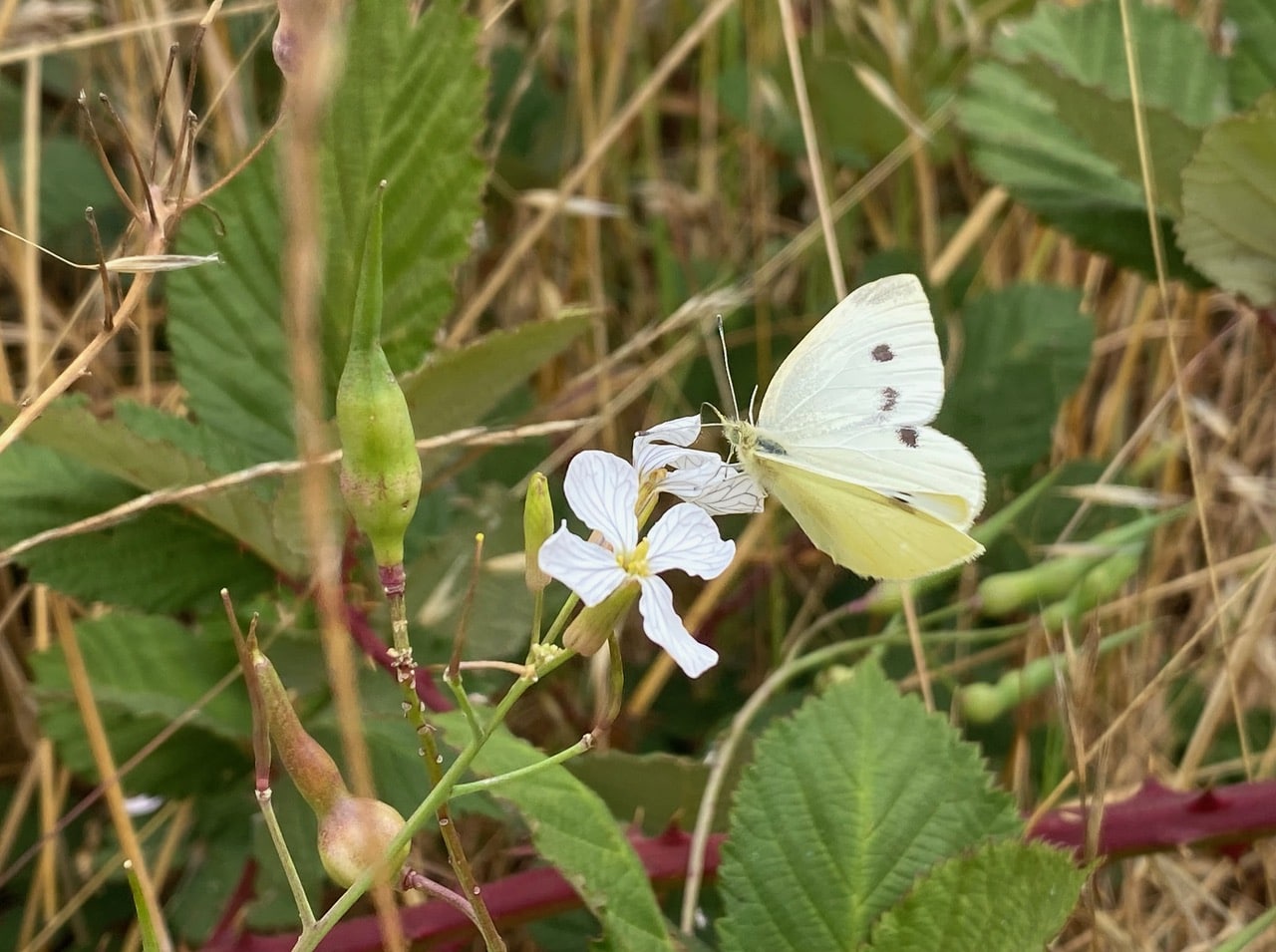
A female Cabbage White butterfly lands on a flower of Wild Radish to take nectar.
The Cabbage White, Pieris rapae (family Pieridae) was introduced to the US along with European cabbage imports in the 1860’5. The caterpillars feed on plants in the mustard or Brassicaceae family, and occasionally some in the caper family. The butterflies have a darkened, yellowish underside of the hind wings, which enables them to heat up quickly in the sun. The butterfly’s white wings reflect ultraviolet light, which we can’t see but the butterflies can. To our eyes the butterflies seem plain and drab, but to each other, females are a gentle lavender and males shine with a deep royal purple. Brighter males are more attractive to females and the color’s strength reflects the amount of protein the males consumed as caterpillars. During mating, male butterflies transfer nutrients to the females in the form of infertile sperm, a nuptial gift which will enhance the female’s life expectancy and fertility. A male with a higher quality diet can afford to be brighter and to produce bigger and more nutritious nuptial gifts.

Although we can’t see the UV reflectance of the butterflies, we can still tell the gender of the Cabbage White visually in the field. Both sexes have dark wingtips on the forewings. Females have two black spots in the center of the forewings; males have one. The underside is yellow-white. There is a black spot on the edge of the upper surface of the hindwing that is not easily visible, as it is usually covered by the forewings.
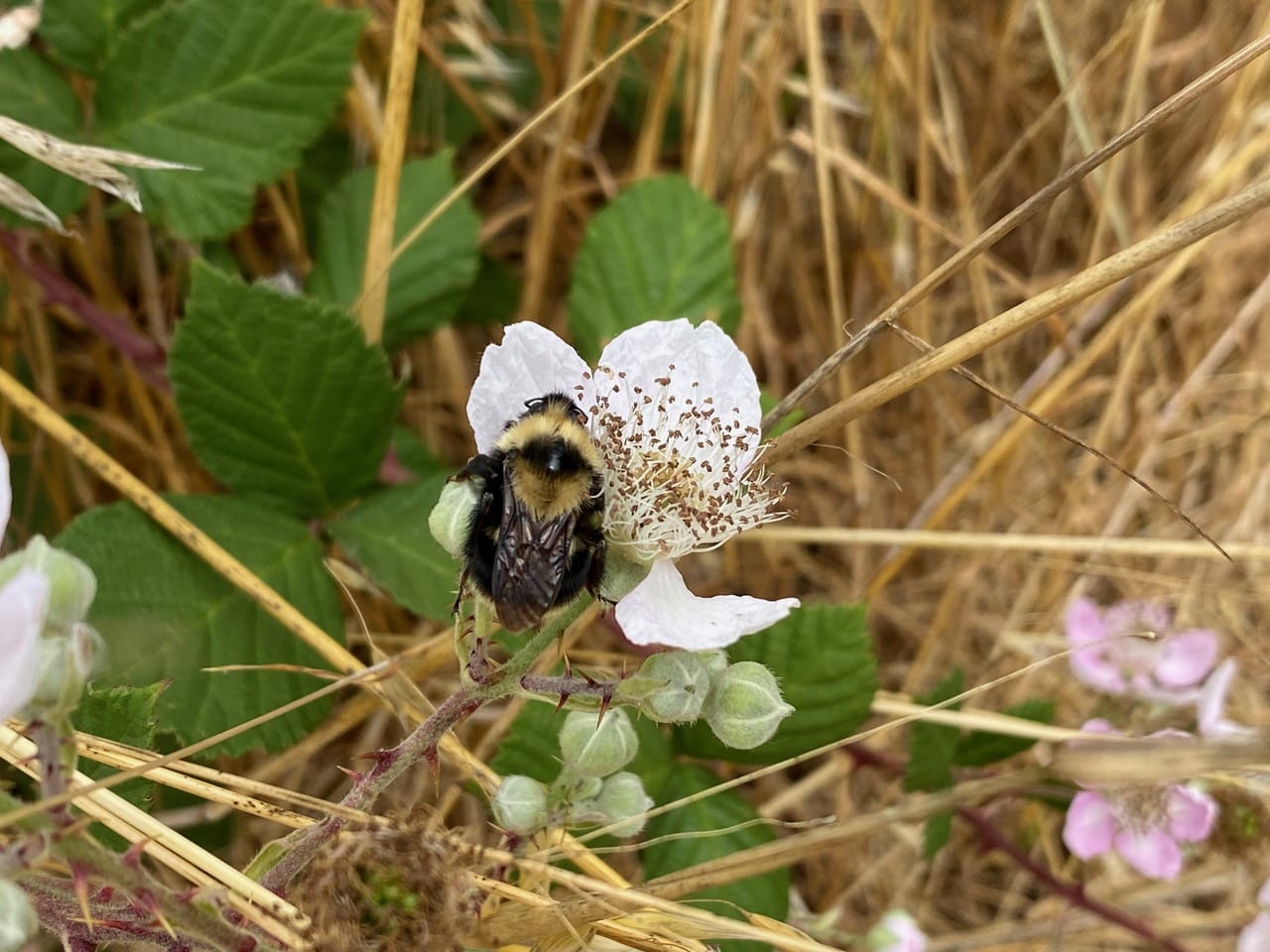
A huge Bumble Bee is draped over a flower of Armenian Blackberry, Rubus armeniacus. Obviously a queen, possibly the largest I have ever seen.
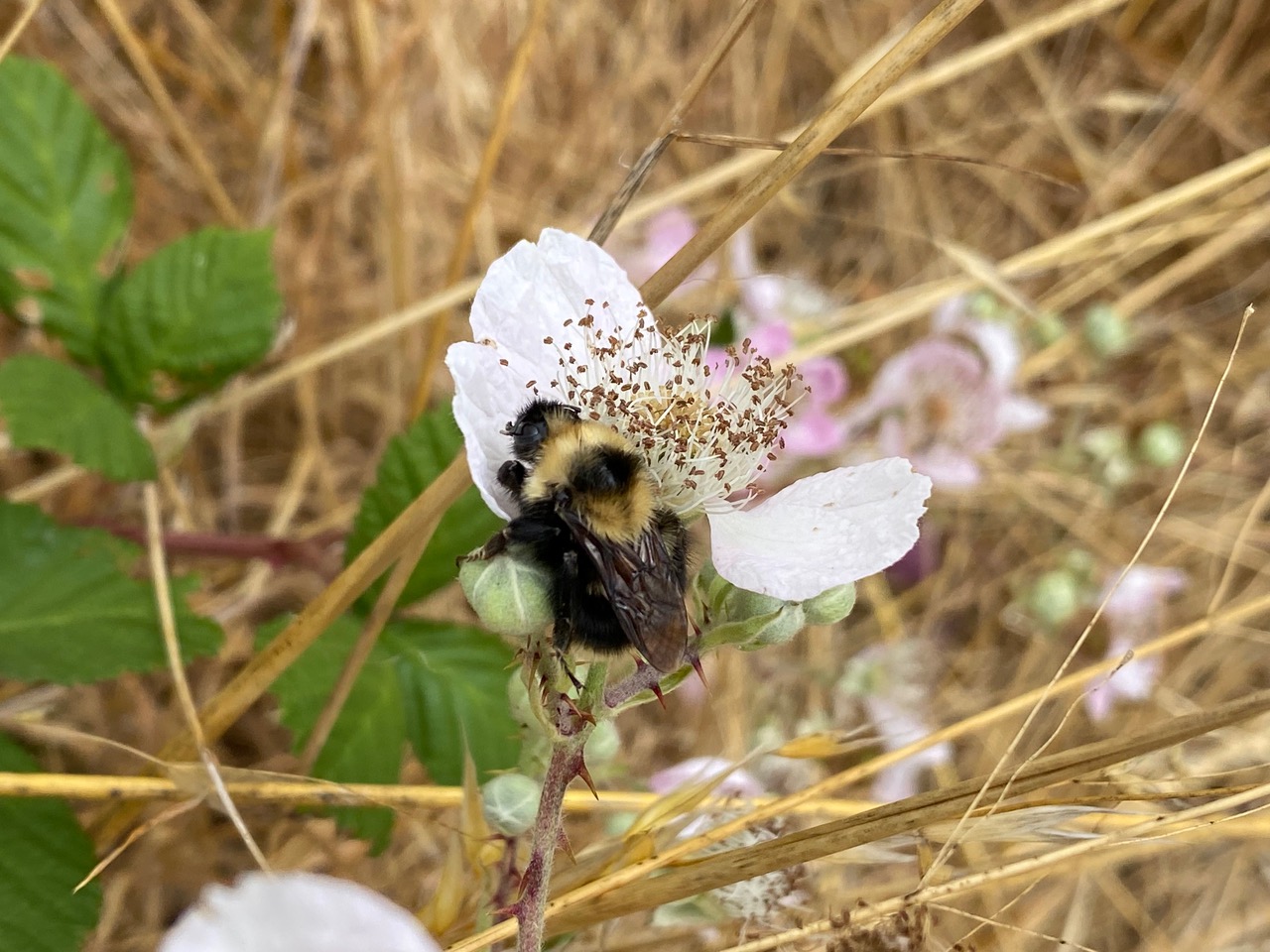
The color pattern on the bee is similar to that of the Yellow-faced Bumble Bee, except for the black head. It is a California Bumble Bee, Bombus californicus (family Apidae).
Bombus californicus, the California Bumble Bee, is found in Central and the western half of North America. The species is now classified as Vulnerable by the IUCN. It was the most common bumble bee in California until about the 1990s when its numbers and distribution began to decline. Many factors may have contributed to its decline, including invasive species, pesticide use, commercial bumble bee rearing, habitat destruction, and climate change.
Although morphologically the species is quite variable, the “typical” color pattern of female B. californicus is black with only a single strong yellow band anteriorly on the thorax, and another single yellow band near the apex of the abdomen. Males exhibit considerably more variation.
The California Bumble Bee is an important pollinator in alpine environments in its native range. They are social bees having a queen and workers. Their colonies last for one year. New queens overwinter, usually underground, and found new colonies from scratch the following year. Queens emerge from April through mid July. Workers are present from April to September. The species is known to pollinate sage, blueberry bushes, red clover, California poppies, and many other species of flowers.

The bee is staying very still, moving her mouthparts in and out continuously, like a cow chewing cud. Is she cleaning her tongue? I recall seeing the same behavior in another California Bumble Bee on 7/11.

Hey, that is the familiar abdominal markings of the Prong-backed Fly Hunter Wasp, Oxybelus uniglumis (family Crabronidae). Is it trying to access nectar from a blackberry flower that has shed all its petals? It’s interesting how the spent stamens of the blackberry flower converge in the middle to protect the developing fruit.

The wasp is diving deep into the spent stamens. Why doesn’t it find a fresh flower instead?
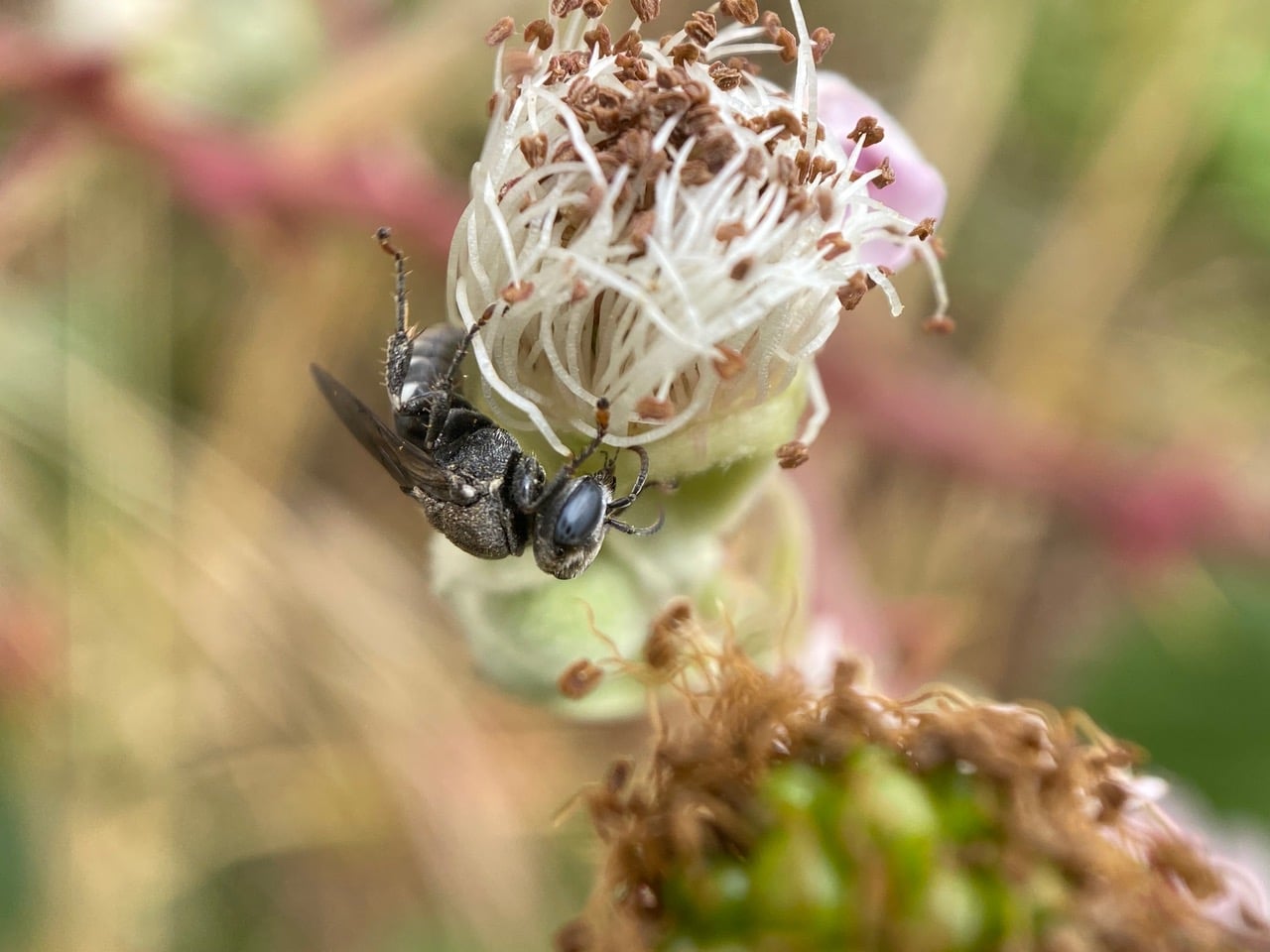
The Prong-backed Fly Hunter Wasp, Oxybelus uniglumis (family Crabronidae) occurs in northeastern North America. Its range also includes California and other western states. It is a small wasp, measuring 5-9 mm. The wasp nests in well-drained, sandy soil in a variety of habitats. A fully provisioned nest has one cell or at most a few cells. The female hunts various kinds of flies on the wing, captures one, then stings it, injecting venom to paralyze it. Rather than transporting the prey clutched beneath her like other small predatory wasps, she instead leaves her sting impaled in the fly while transporting it back to the nest. She lays a single egg on the first fly placed in a nest cell, then adds additional two to nine more flies before backfilling the nest. There is one generation per year, flying between May to early October.

I have never had such a good look at Oxybelus’ face! These small wasps are much more difficult to photograph on the ground near their nests.

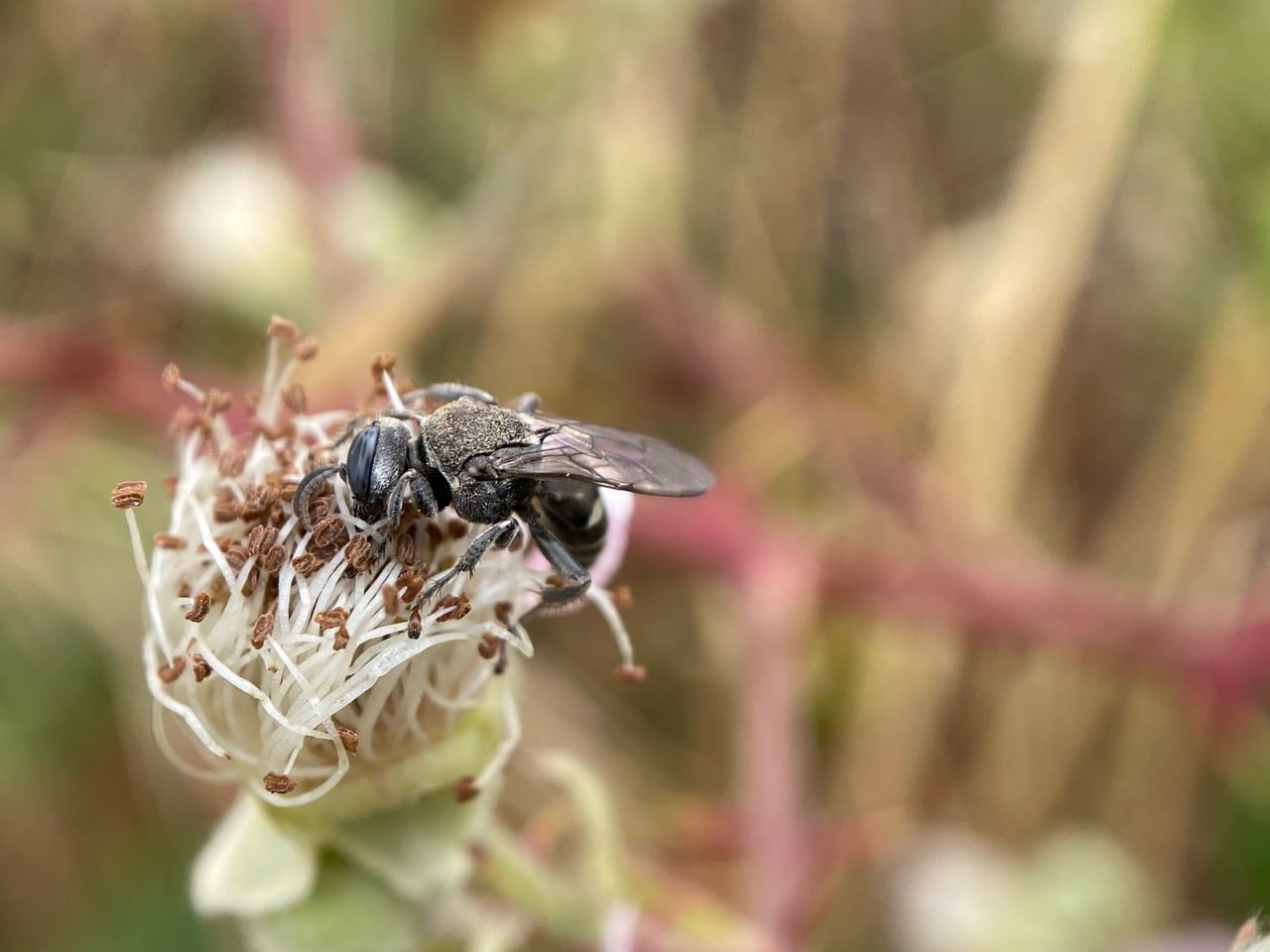
A valiant effort to reach the nectar? Is Oxybelus’ tongue long enough?

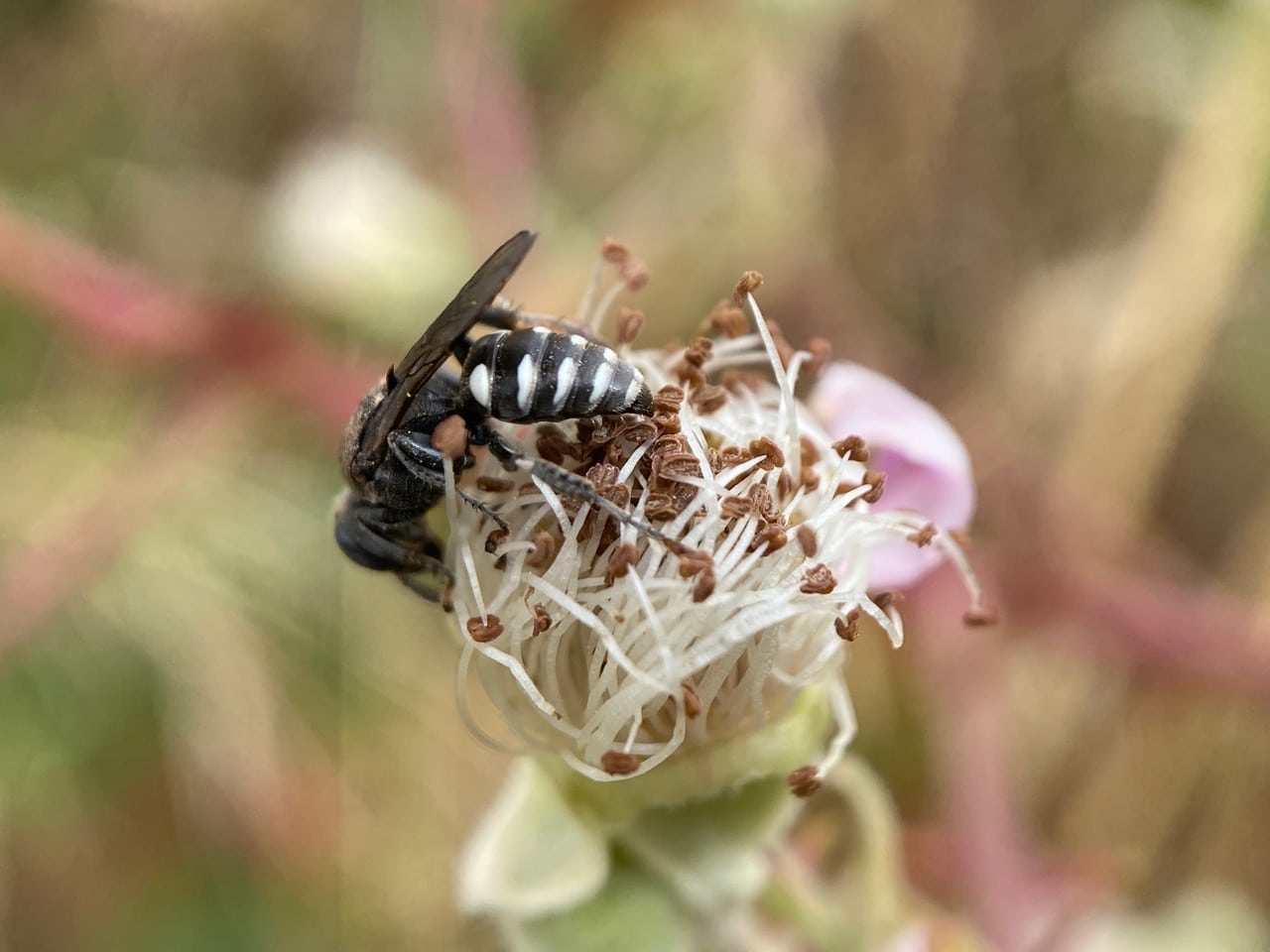
An amazing little wasp, so common on the edge of Alameda’s beaches, hunting little flies to provision its nest.