

Pollinator Post 7/29/25 (3)
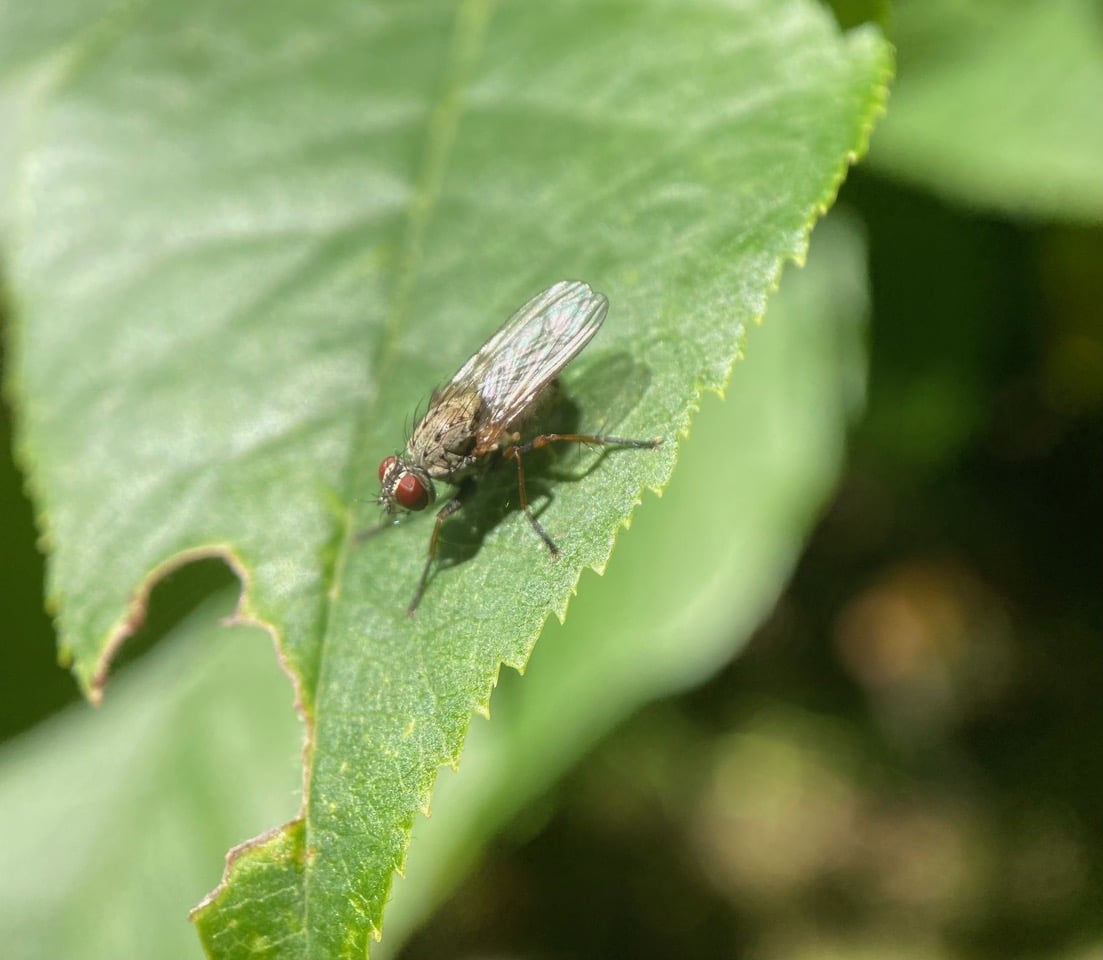
A small, chunky fly lands momentarily on a leaf. iNaturalist has helped identify it as a Tiger Fly, Coenosia tigrina (family Muscidae).
The Tiger Fly, Coenosia tigrina (family Muscidae) is also known as Hunter Fly or Killer Fly. Native to Europe, the fly was introduced in the early 1800s. Tiger Flies only attack flying prey. Potential prey are caught only in mid-air with its front legs. While holding the prey in its front legs, the Tiger Fly punctures the insect with specialized proboscis, and eats the insides of the prey, leaving the carcass behind. When food is scarce, the flies may turn on each other. Adult females lay eggs in the soil where the larvae feed on earthworms.
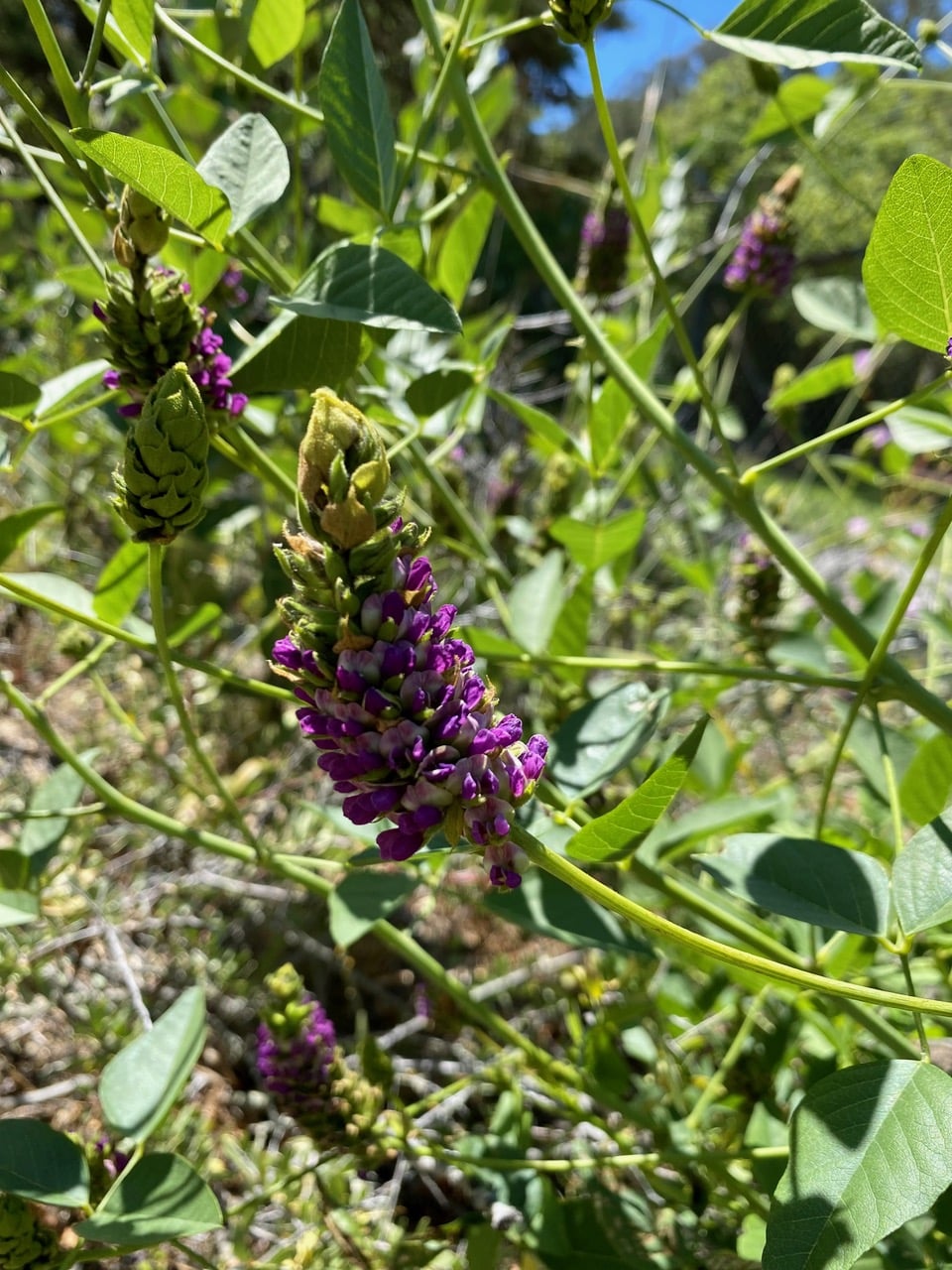
The Large Leatherroot, Hoita macrostachya is in bloom with their small purple pea-like flowers.
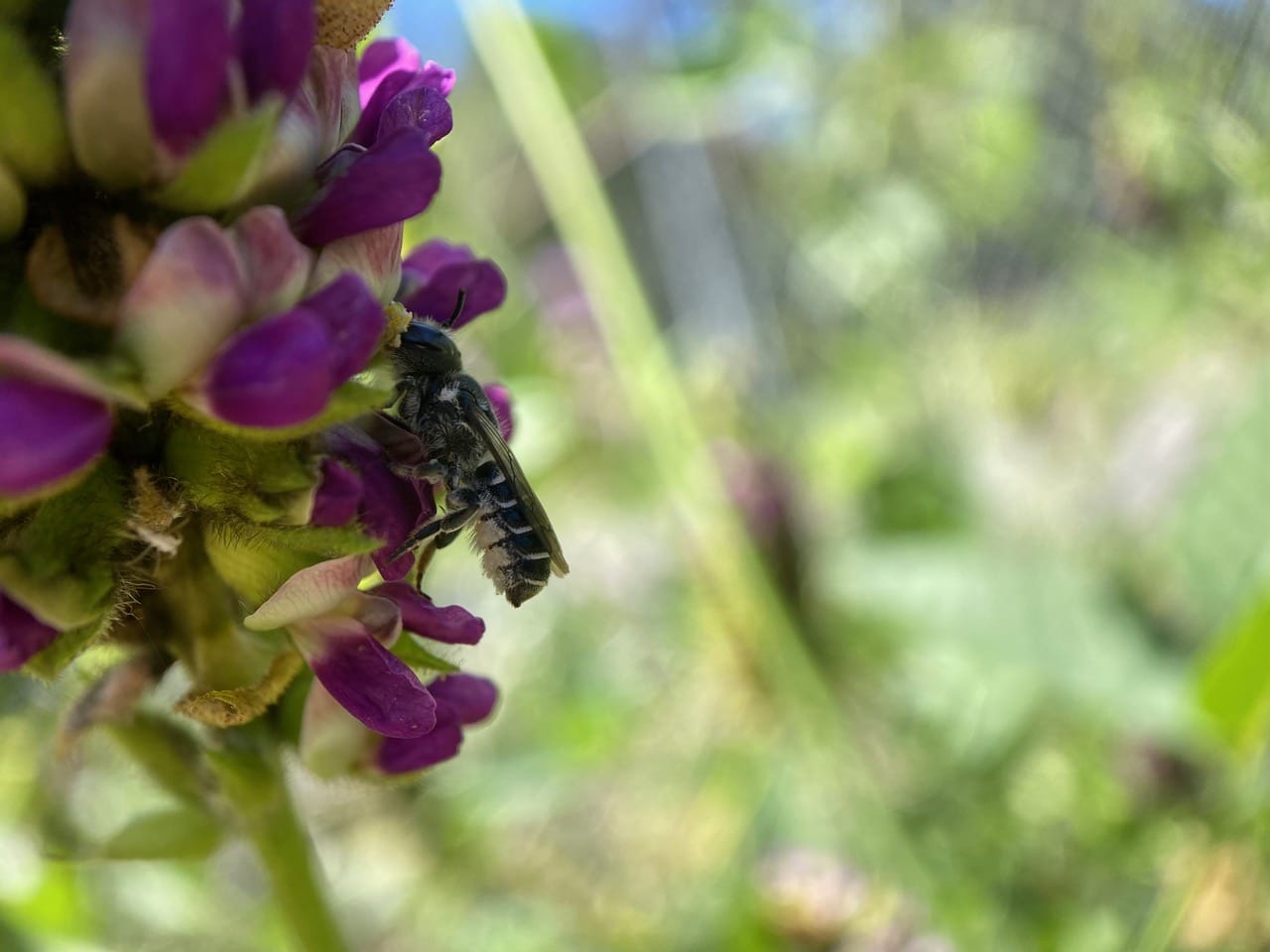
A small dark bee lands on a Leatherroot inflorescence seeking nectar. Although it is in the shadows, I can still make out the brushes of hairs on the underside of its abdomen. Immediately I know that the bee is a member of the family Megachilidae. iNaturalist has helped refined the identification to the species – the Los Angeles Resin Bee, Megachile angelarum (family Megachilidae).
The family Megachilidae includes the Leafcutter (genus Megachile), Mason (genus Osmia), and Wool Carder Bees (genus Anthidium). Females carry pollen on the underside of their abdomen.
Megachile angelarum is sometimes called the Los Angeles Resin Bee. Like most other Leafcutter Bees, they nest in cavities. But the species is unusual in that the females collect resins and gums to partition their nest cells, instead of using pieces of cut leaves or petals. The resin they use is exuded from the stems, buds, and bark of various plants, especially the conifers. Since this bee does not cut leaves, it lacks teeth on its mandibles, unlike other bees in the genus. It is a robust-sized bee, with females typically measuring 10-11 mm in length, and males a bit smaller, at 8-9 mm. The species is found in western North America, ranging from southern British Columbia, Canada to California, Arizona and New Mexico, U.S.A. and Baja California, Mexico. These bees inhabit various natural landscapes within their range, including forests, grasslands, and urban areas. Their nesting sites include cavities in wood, plant stems, and other suitable sheltered locations. The flight season is from May into September, with peak flight activity from June to August.

A Square-headed Wasp (family Crabronidae) is exploring a Leatherroot leaflet.
The Crabronidae is one of our most diverse wasp families, with over 1,200 species in the U.S., and almost 9,000 species worldwide. The common name “square-headed wasps” only applies to species in the subfamily Crabroninae. Square-headed Wasps are solitary wasps that use their impressive jaws to make nests in the ground, in hollow stems, in the pith of broken stems, and in old galleries chewed in wood by beetle larvae. Adult Crabronid wasps derive all their nutrition from flower nectar, and they are often seen in late summer on flowers. With a few exceptions, most Crabronid wasps are predatory. They paralyze prey insects including aphids, leafhoppers, flies, beetles, crickets, cicadas, spiders and caterpillars and fly them back to the nest. Mom lays an egg on one of the insect prey, closes the chamber, and moves on. The carnivorous larva hatches out into its own personal pantry stocked with enough food to get it to the pupal stage. Many Square-headed Wasps are very specific about the kinds of insects they pursue.

The large patch of Ruby Chalice Clarkia, Clarkia rubicunda is blooming profusely. I can only focus on insects that visit the flowers on the edges.
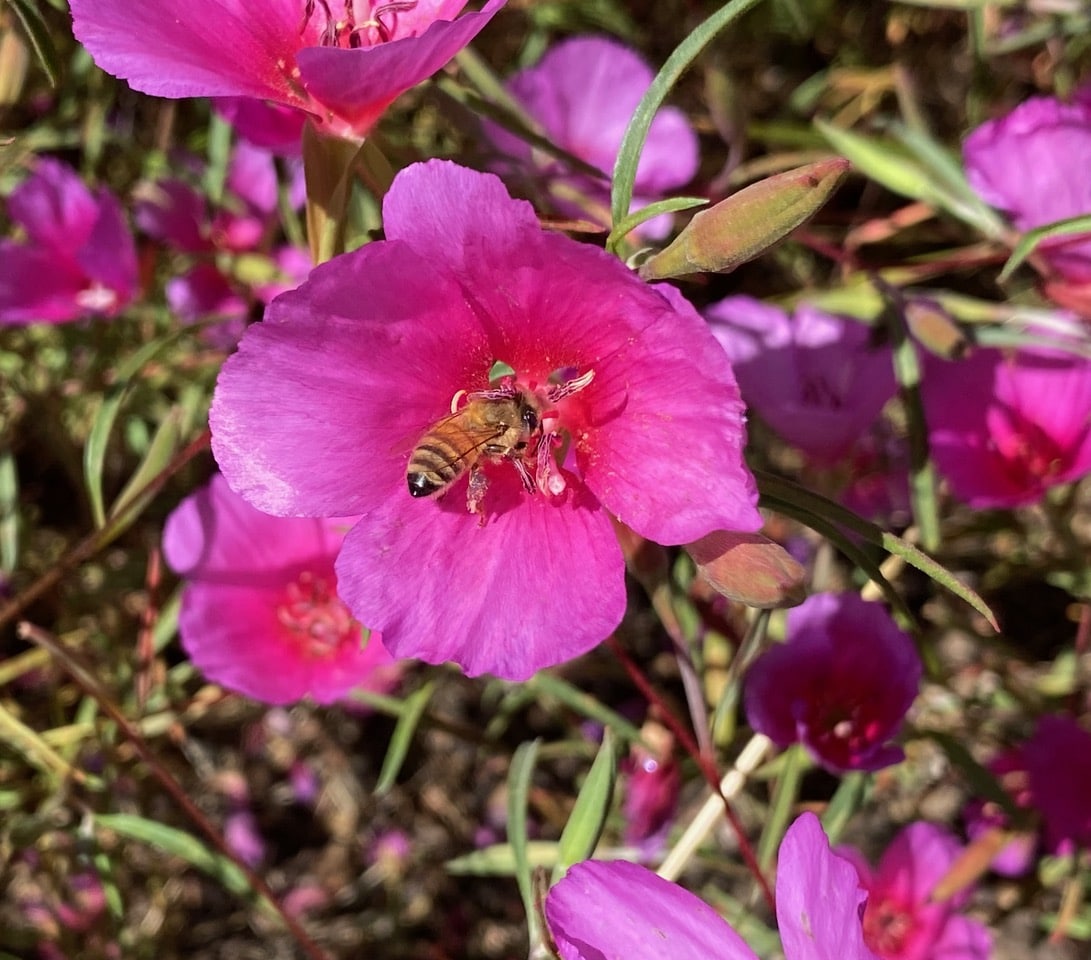
The Honey Bees, Apis mellifera (family Apidae) are the most common visitors to the Clarkia flowers. Note the color of the pollen on this bee’s corbicula (pollen basket on her hind leg). Clarkia has large, purplish pollen grains.
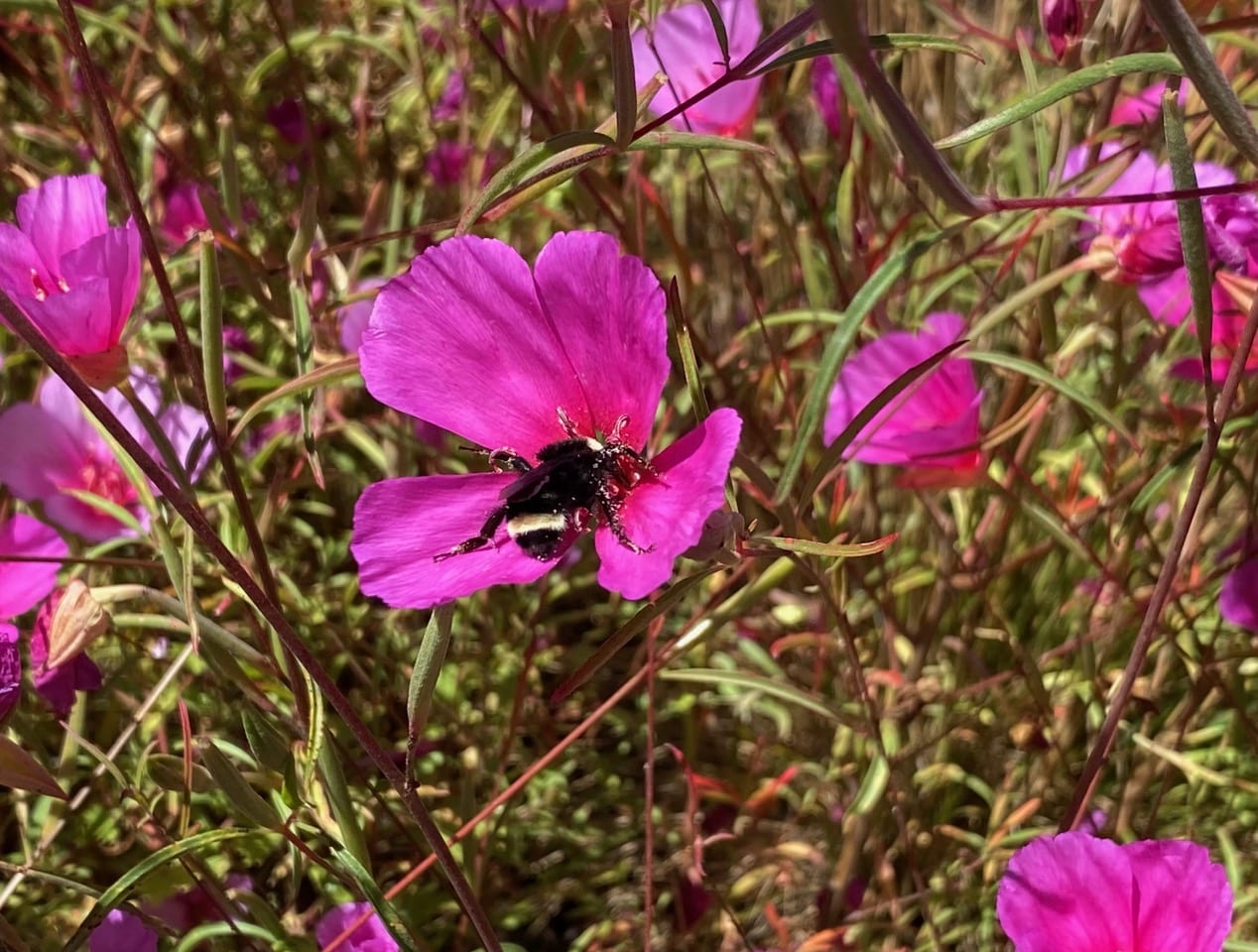
A Yellow-faced Bumble Bee, subgenus Pyrobombus (genus Bombus, family Apidae) is reaching deep into the Clarkia flower for nectar. Although not intentionally collecting pollen, the bee has the large purplish pollen grains of Clarkia adhering to her hairy legs.

The much smaller Tripartite Sweat Bee, Halictus tripartitus (family Halictidae) is collecting Clarkia pollen more discreetly, going from one anther to the next. She has chosen a rather young flower, biting open the anthers with her mandibles to extract the fresh pollen.
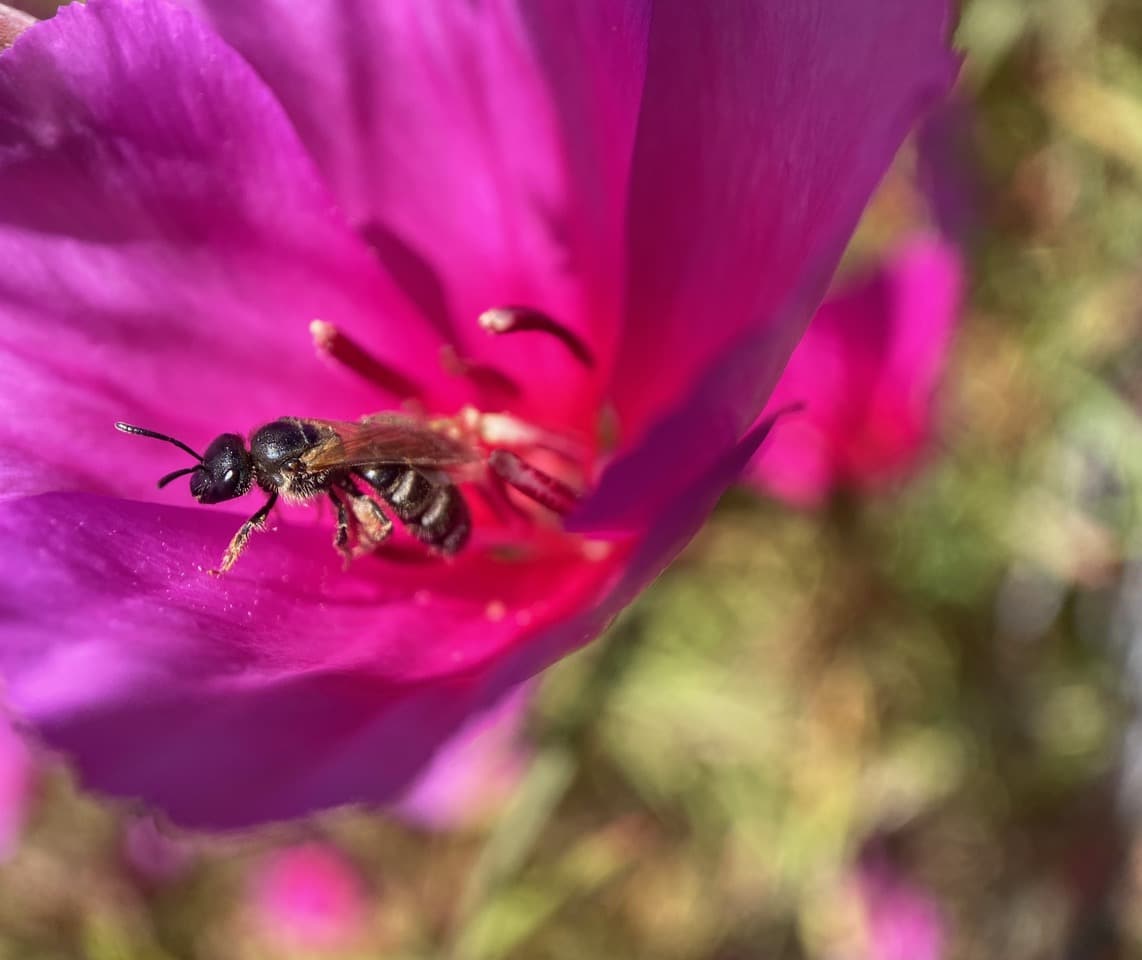
Halictus is found worldwide; they are most common in the Northern Hemisphere. All are generalists, foraging from a wide variety of flowering plants. Many species are social and produce several generations per year. This is not surprising as most blooming plants are season-specific; a bee that requires pollen and nectar across multiple seasons would not thrive as a specialist. All Halictus in North America nest in the ground, often in aggregations; and they may nest in the same area for decades.
The species Halictus tripartitus (family Halictidae) is partially eusocial, with nests connected underground and some workers capable of reproducing. It is a very successful species in our area, making up the majority of bees in many gardens right now, collecting floral resources from a large variety of plants.
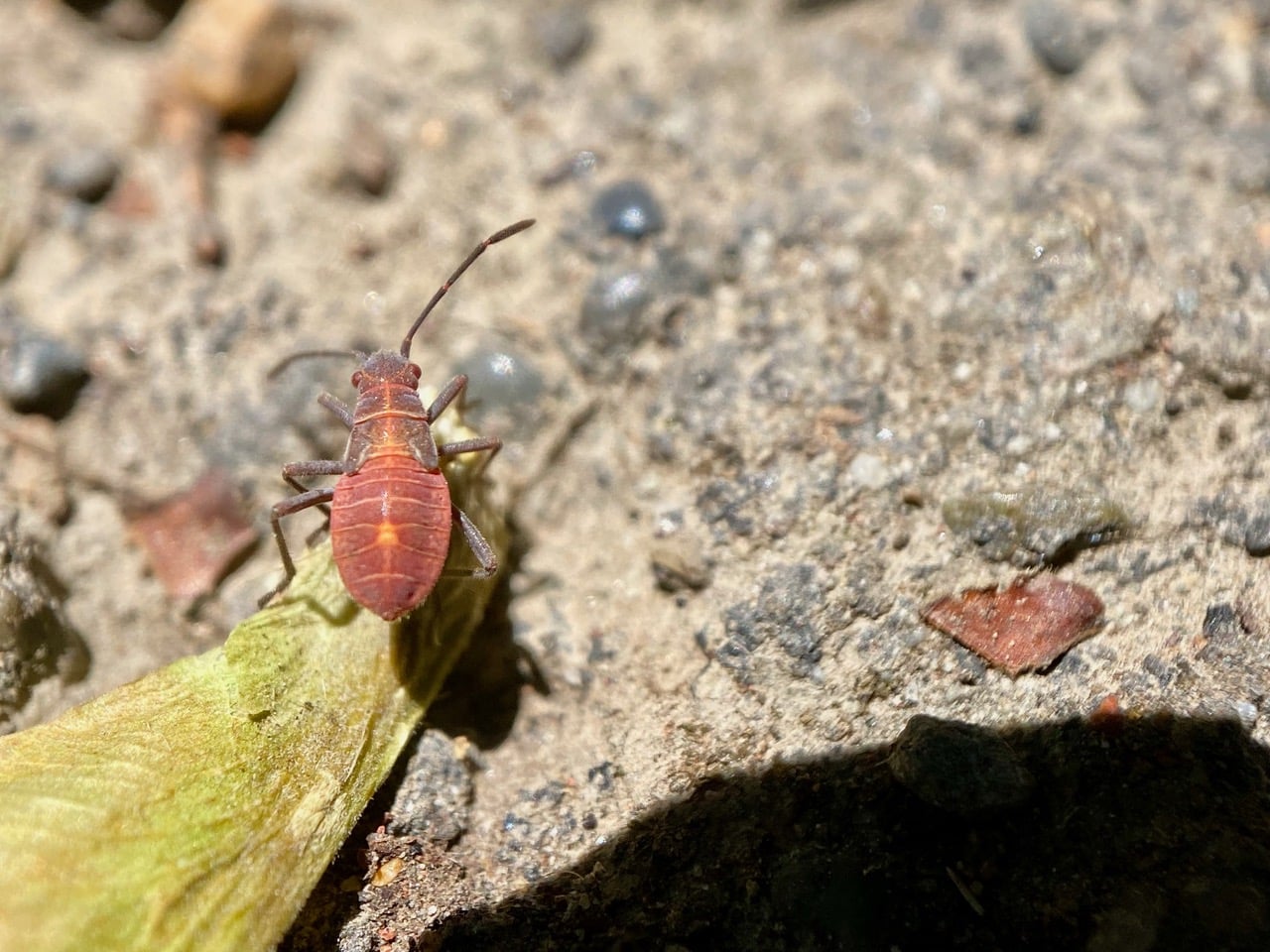
Crossing the foot bridge to the parking lot, I spot several reddish bugs running around on the path under the large Bigleaf Maple trees. They are all immature Hemipterans with wing pads. iNaturalist has helped identify the bugs as the Western Boxelder Bugs, Boisea rubrolineata (family Rhopalidae).
The Western Boxelder Bug, Boisea rubrolineata (family Rhopalidae) is found in western North America. Adults are 9-13 mm in length. The thorax and wings are black with red lines, and the abdomen is red. Nymphs are bright red and gray. The bugs prefer to live in areas where there are trees and other vegetation as food sources. This includes natural areas, but also urban, suburban, and agricultural areas. Western Boxelder Bugs are primarily frugivores and granivores. They eat fruits and seeds from trees like boxelder (Acer negundo), ash (Fraxinus), big leaf maple (Acer grandifolium), as well as orchard fruits like pear, plum, cherry, and grape.
Western Boxelder Bugs develop from eggs, laying dormant through the winter after they are laid, emerging in the spring as first instar nymphs. The nymphs go through incomplete metamorphosis consisting of five instars before becoming adults. Nymphs slowly increase in size and physiological development as they progress through each instar stage, until they reach maturity. Functional wings are acquired at the last molt.