

Pollinator Post 8/19/25 (1)
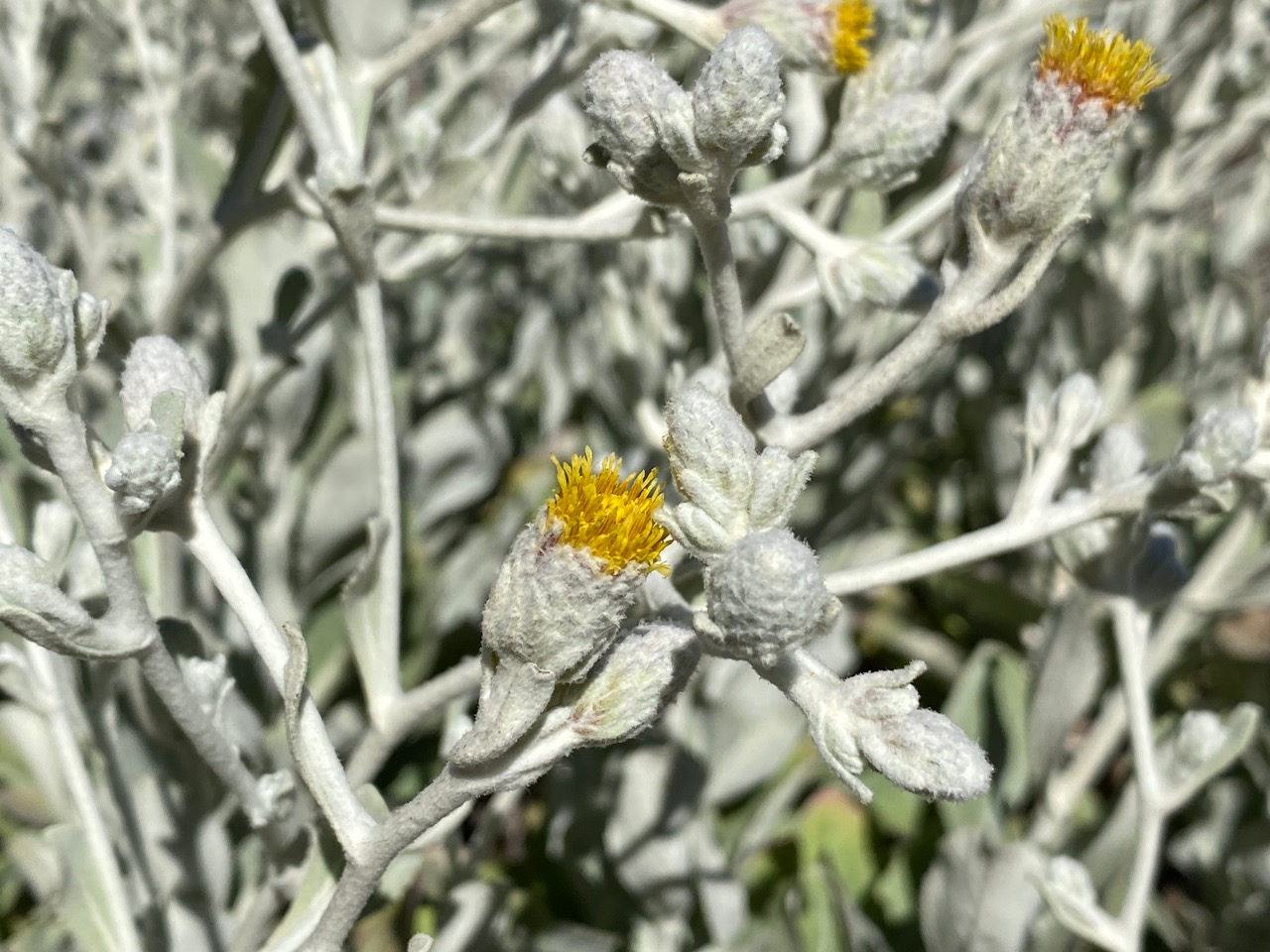
I find myself seeking clean air at the Regional Parks Botanic Garden in the Berkeley hills this morning.
From a distance these silvery-gray plants by the visitor center do not appear to be in bloom, but on closer inspection, one can find an occasional small flowerhead with yellow florets. Obviously in the family Asteraceae. The strange plant is Island Hazardia, Hazardia detonsa. It is a rare species of shrub in the family Asteraceae, endemic to the Channel Islands of California. The bushy shrub is densely woolly and hairy all over. The centimeter long flowerhead has several rows of white woolly phyllaries. The flowerhead opens to reveal disc florets and longer protruding ray floret around the rim.
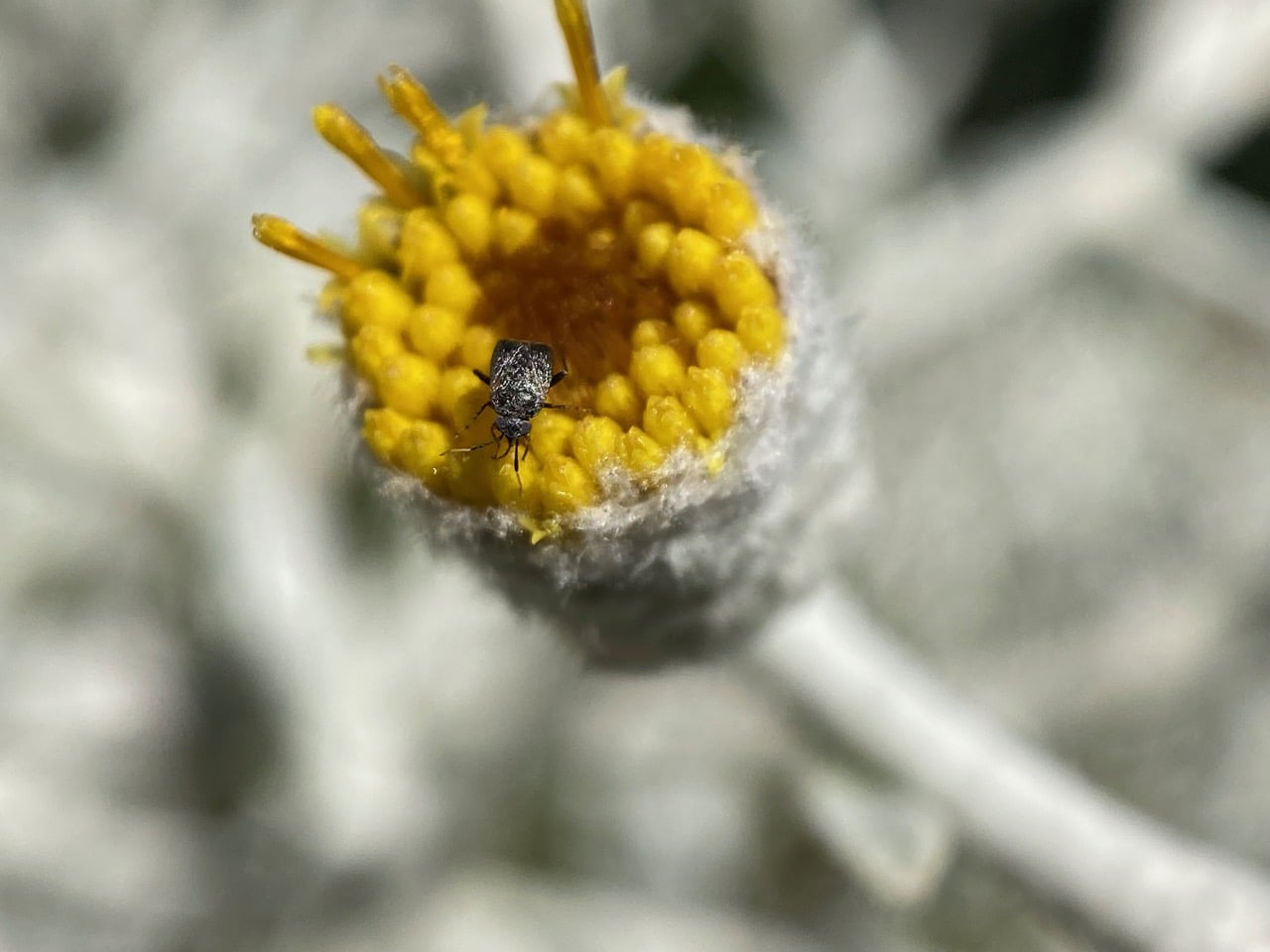
A tiny dark insect is crawling over the Hazardia florets.

Judging from the cuneus at the tips of the insect’s forewings, I gather that it is a Plant Bug in the family Miridae. It is probably the smallest Mirid I have ever seen.
Mirid bugs are also referred to as plant bugs or leaf bugs. Miridae is one of the largest family of true bugs in the order Hemiptera. Like other Hemipterans, Mirids have piercing, sucking mouthparts to extract plant sap. Some species are predatory. One useful feature in identifying members of the family is the presence of a cuneus; it is the triangular tip of the corium, the firm, horny part of the forewing, the hemielytron. The cuneus is visible in nearly all Miridae.

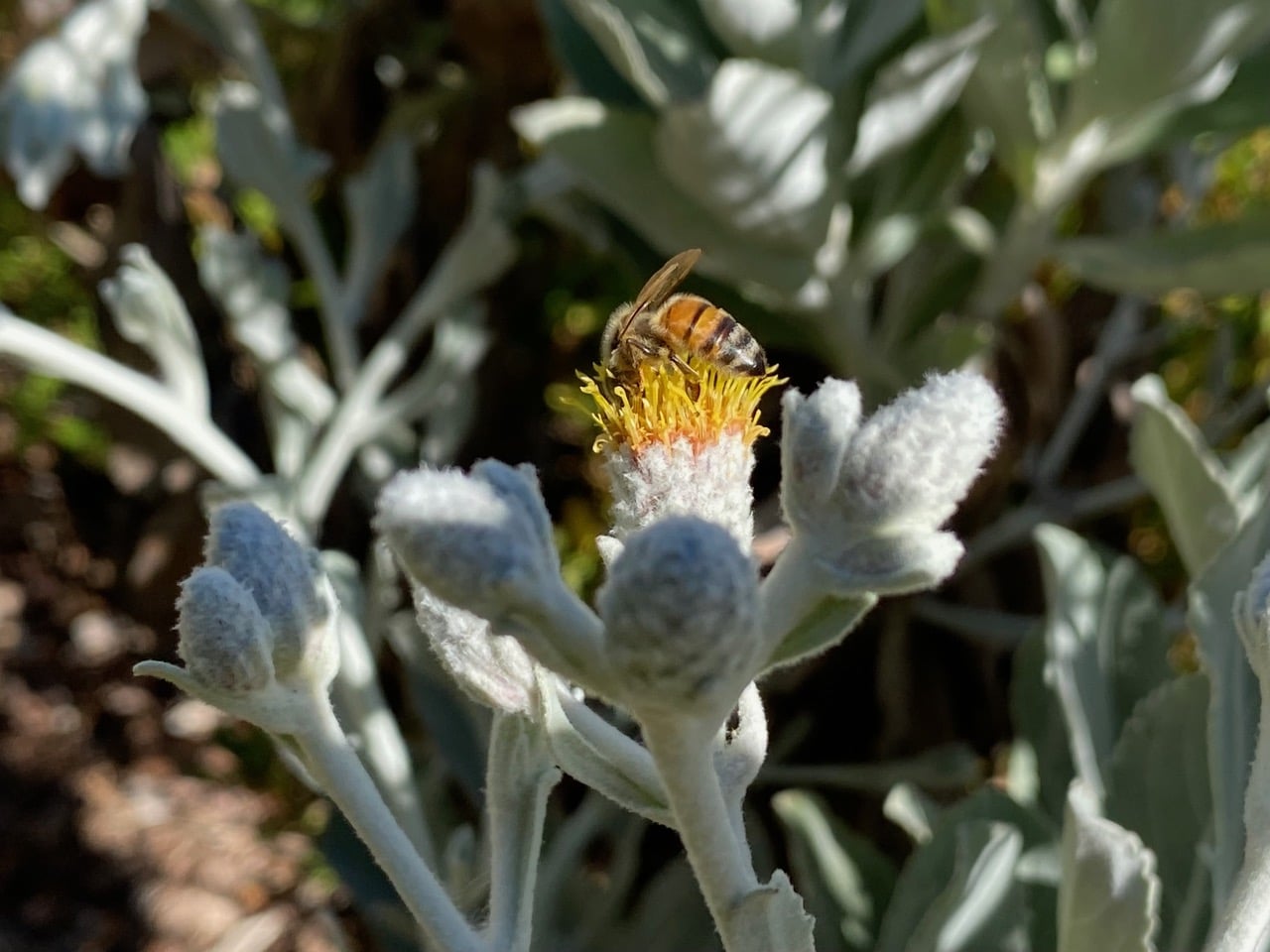
A ray of sunlight spotlights a Honey Bee, Apis mellifera (family Apidae) foraging on a Hazardia flowerhead.
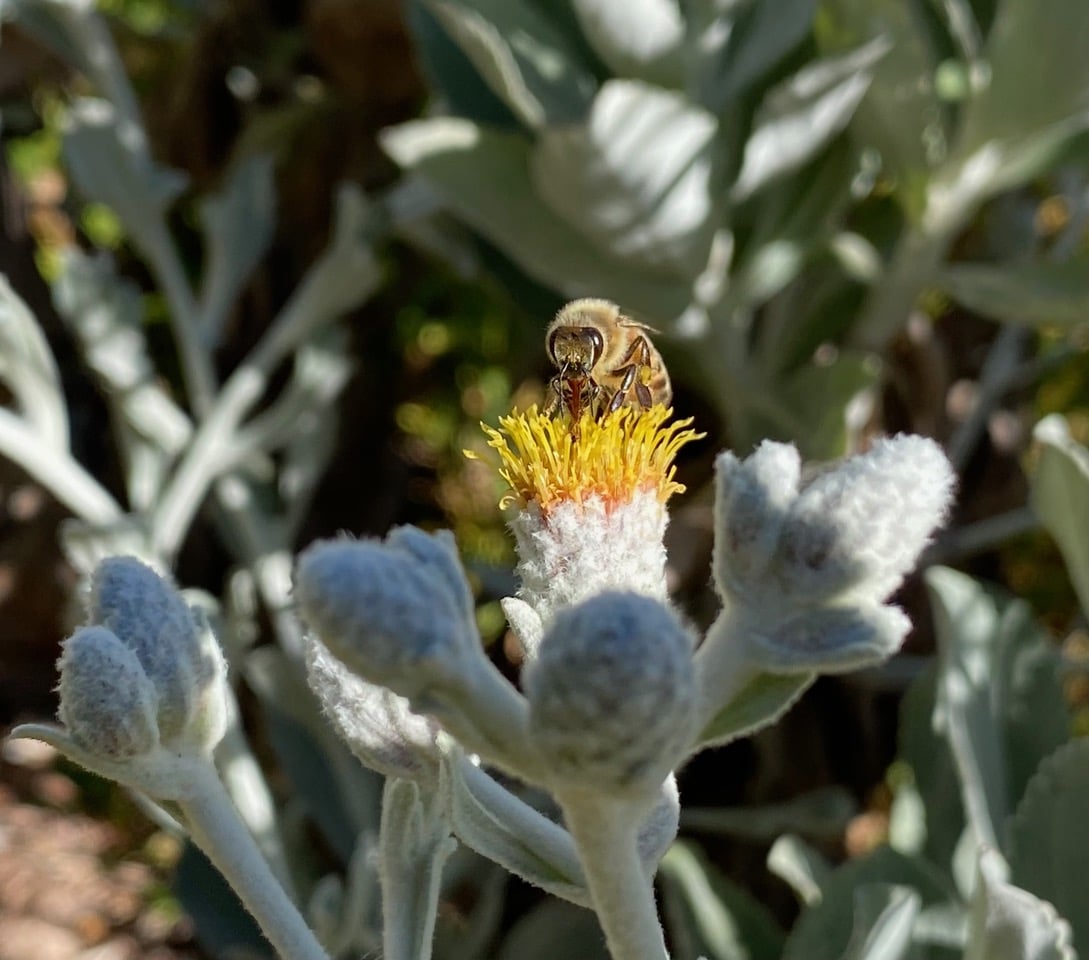
As the bee lifts her head, you can see her long tongue that she has been using to take up nectar. Honey bees are generalists that forage on a wide range of plants and plant families; they have all-purpose tongues that work in many situations. Bee’s tongues are extremely complicated, having multiple moving parts with names nobody can remember. And the parts have subparts, so do the subparts. They are vitally important to the bees. Most bees have been categorized functionally as long-tongued bees and short-tongued bees. They forage on different plants and collect nectar using slightly different methods. But it turns out that their tongues are structurally different, and the actual length of the tongue might have little to do with anything. Worldwide there are seven families of bees. Of these seven, just two are long-tongued: the Apidae and the Megachilidae. Since Honey Bees are in the Apidae, they are by definition long-tongued bees.

A male Western Calligrapher, Toxomerus occidentalis (family Syrphidae) forages on a Hazardia flowerhead.
Toxomerus is a very large genus of Hover Flies. They are found in North and South America. The majority of species are only 6-9 mm in length. They are notable for their mimicry of stinging Hymenoptera to avoid predators. Their unique abdominal patterns are diagnostic at the species level within the genus. There is marked sexual dimorphism – the females have a broader abdomen with lighter coloration and pattern. Most larvae feed on soft bodied insects, such as aphids; a few feed on pollen. Adults feed on the pollen of a wide range of flowers. A female can lay up to hundreds of eggs at a time and will place them where prey or pollen food sources are readily available. They can be found in a wide variety of habitats, often in dense ground cover.
The genus name Toxomerus comes from Greek toxon for ‘bow’ and meron for ’thigh’, referring to the bow-shaped hind femur. Colors vary with overall temperature during pupation: higher temperatures produce more yellow, while lower temperatures produce adults with darker markings.
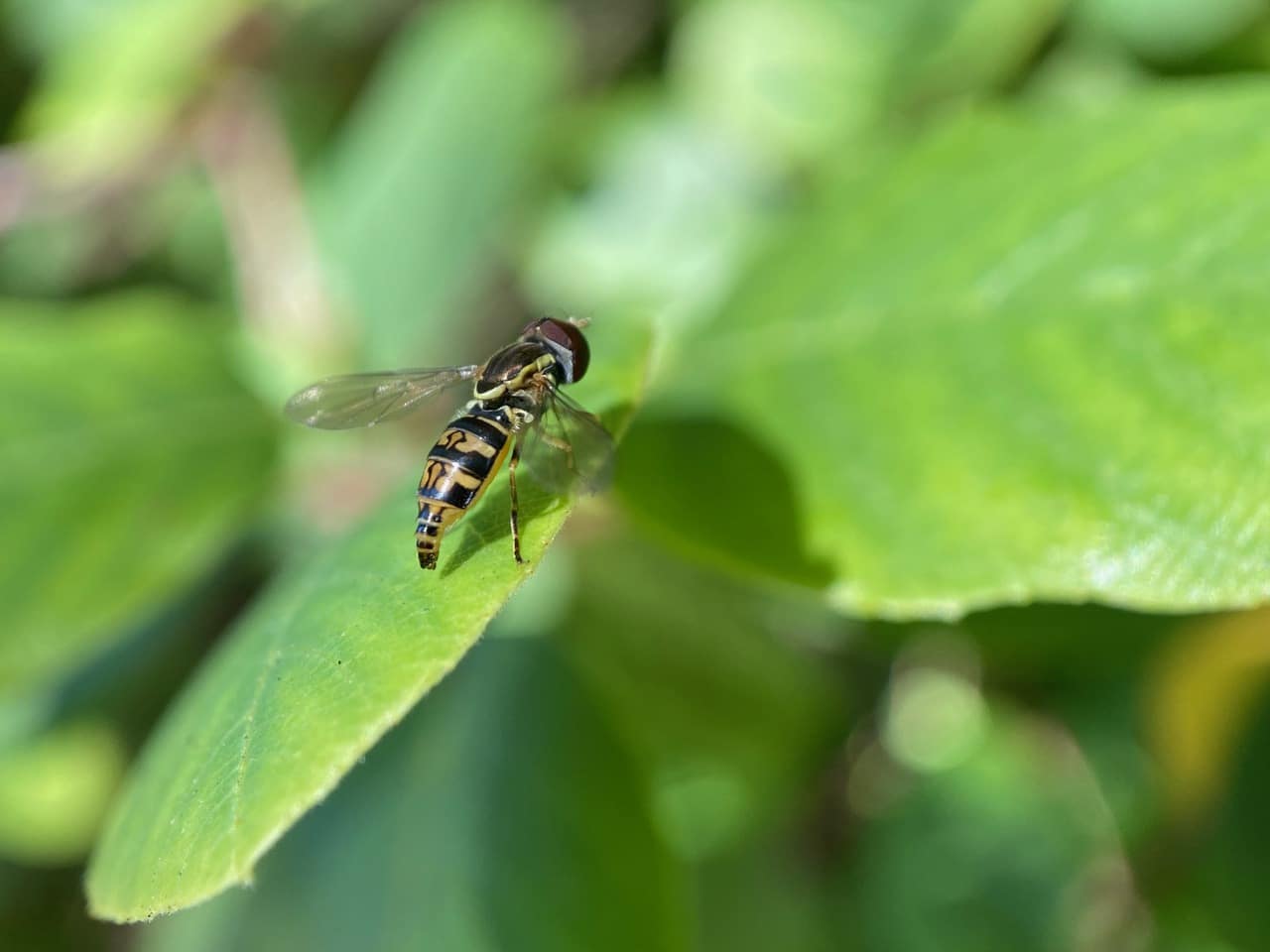
A female Western Calligrapher, Toxomerus occidentalis (family Syrphidae) has landed on a Coffeeberry leaf. Although the abdominal pattern on the males and females of the species is similar, the female’s abdomen is broader, smoother and comes to a pointed tip, giving her a more elegant appearance overall.
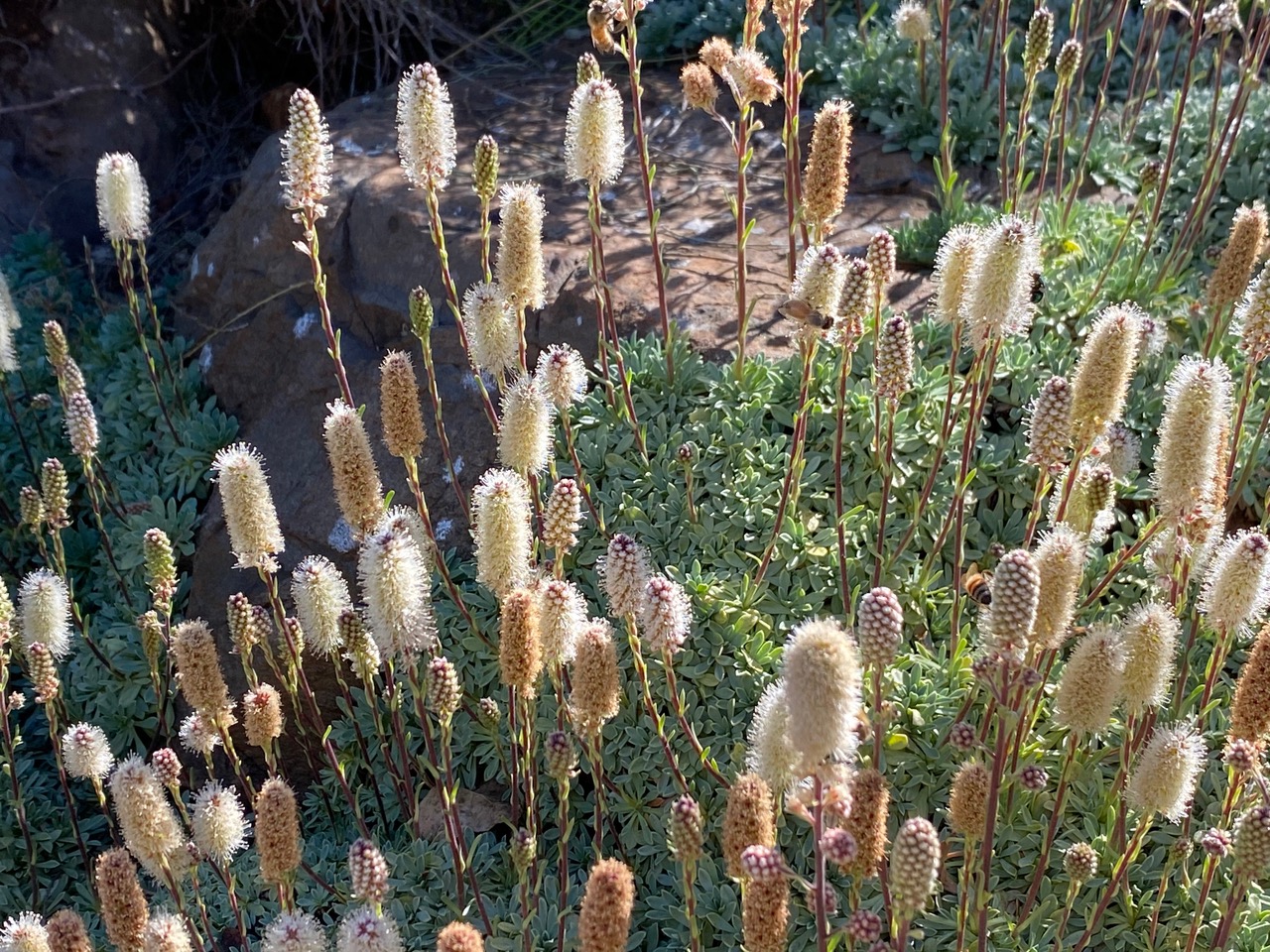
Near the front gate, a pixie garden has cropped up on the boulders. I have never seen the Rock Spiraea, Petrophytum caespitosum (family Rosaceae) in bloom, neither have I paid any attention to the small dense foliage that hugs the ground. Back-lit by the sun, the floral spikes exudes magic.
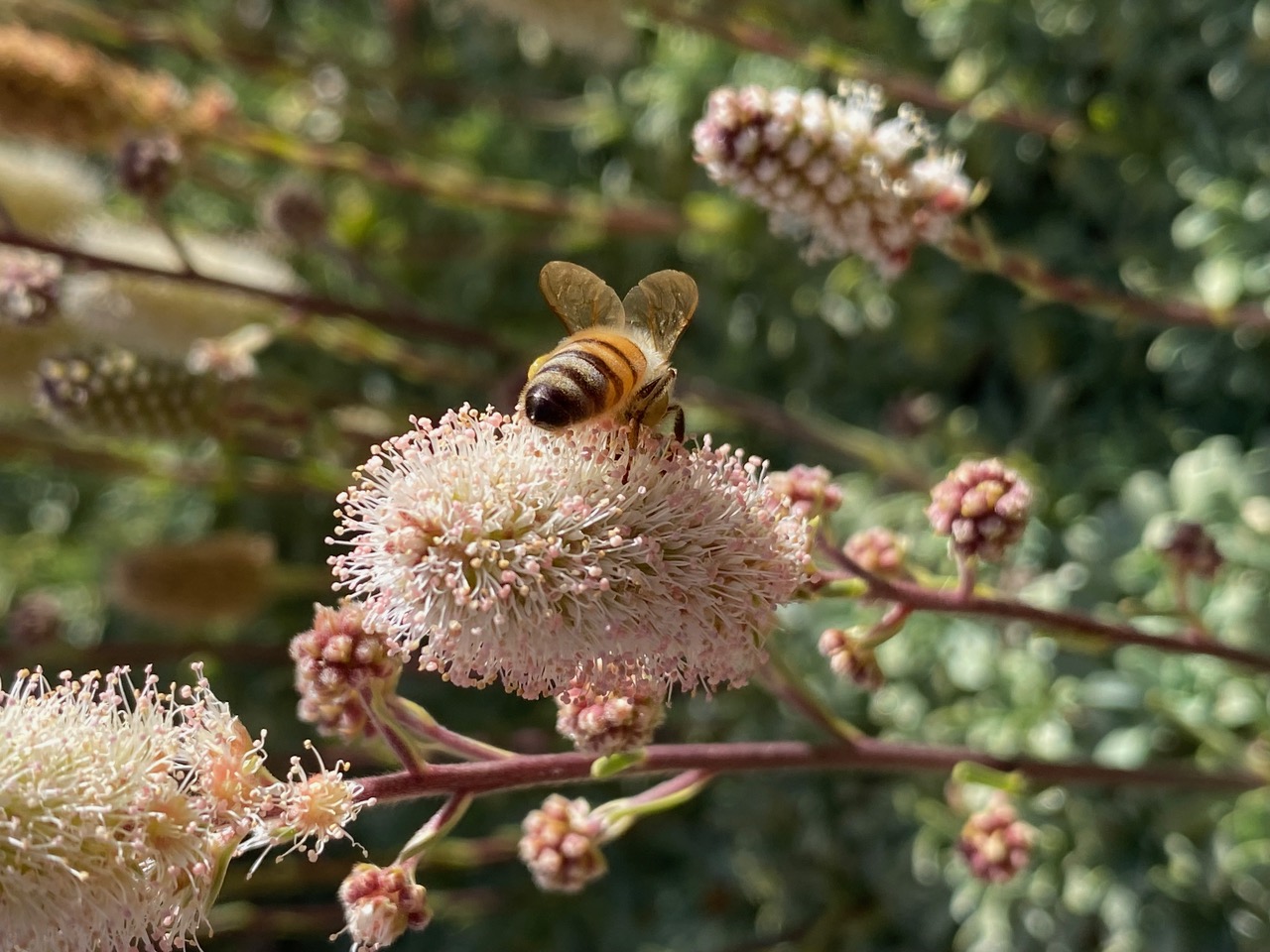
Numerous Honey Bees, Apis mellifera (family Apidae) are foraging on the spikes covered with exserted stamens.
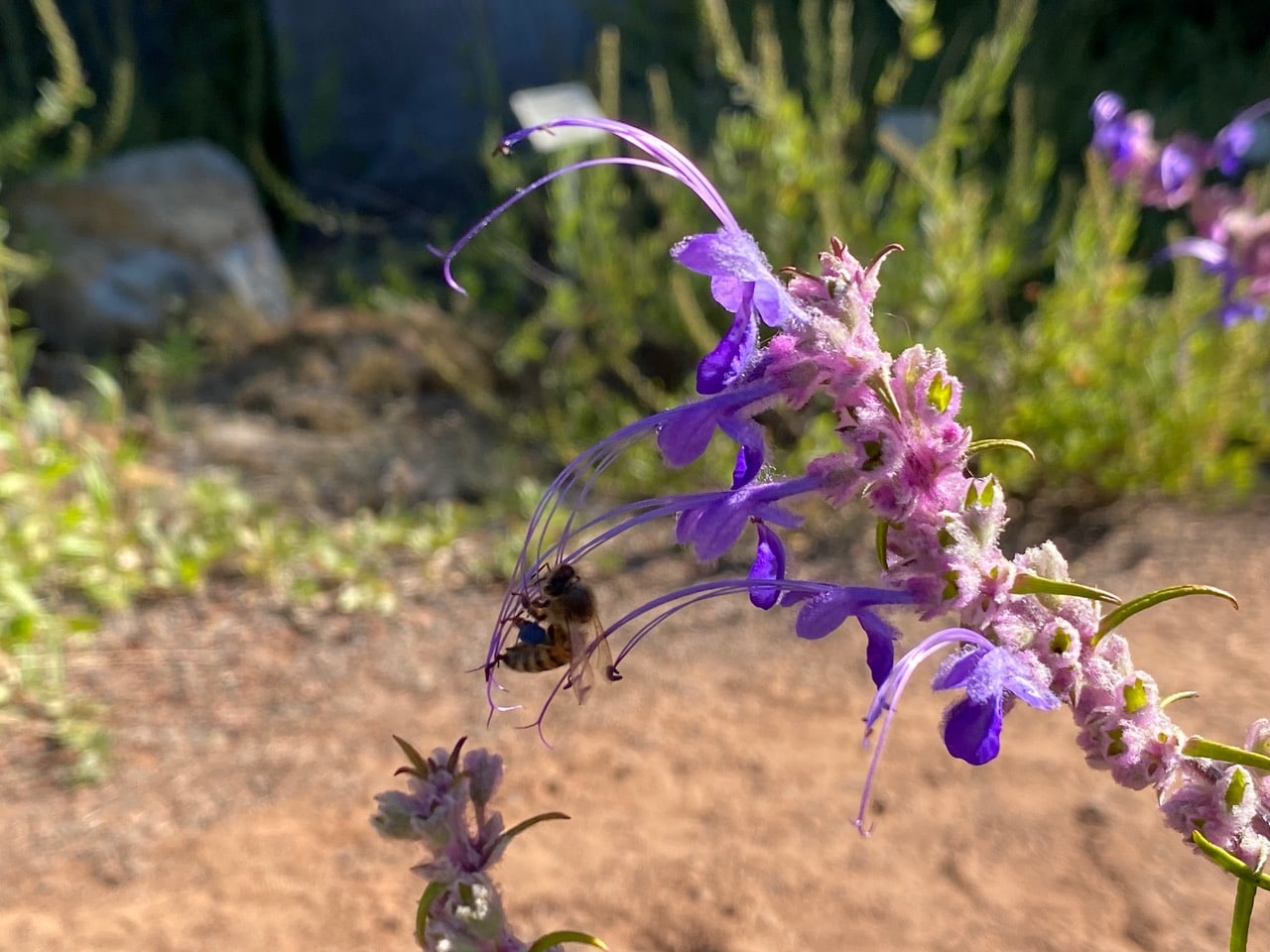
It is always a treat to watch bees collect pollen from the unusual flowers of Woolly Bluecurls, Trichostema lanatum.
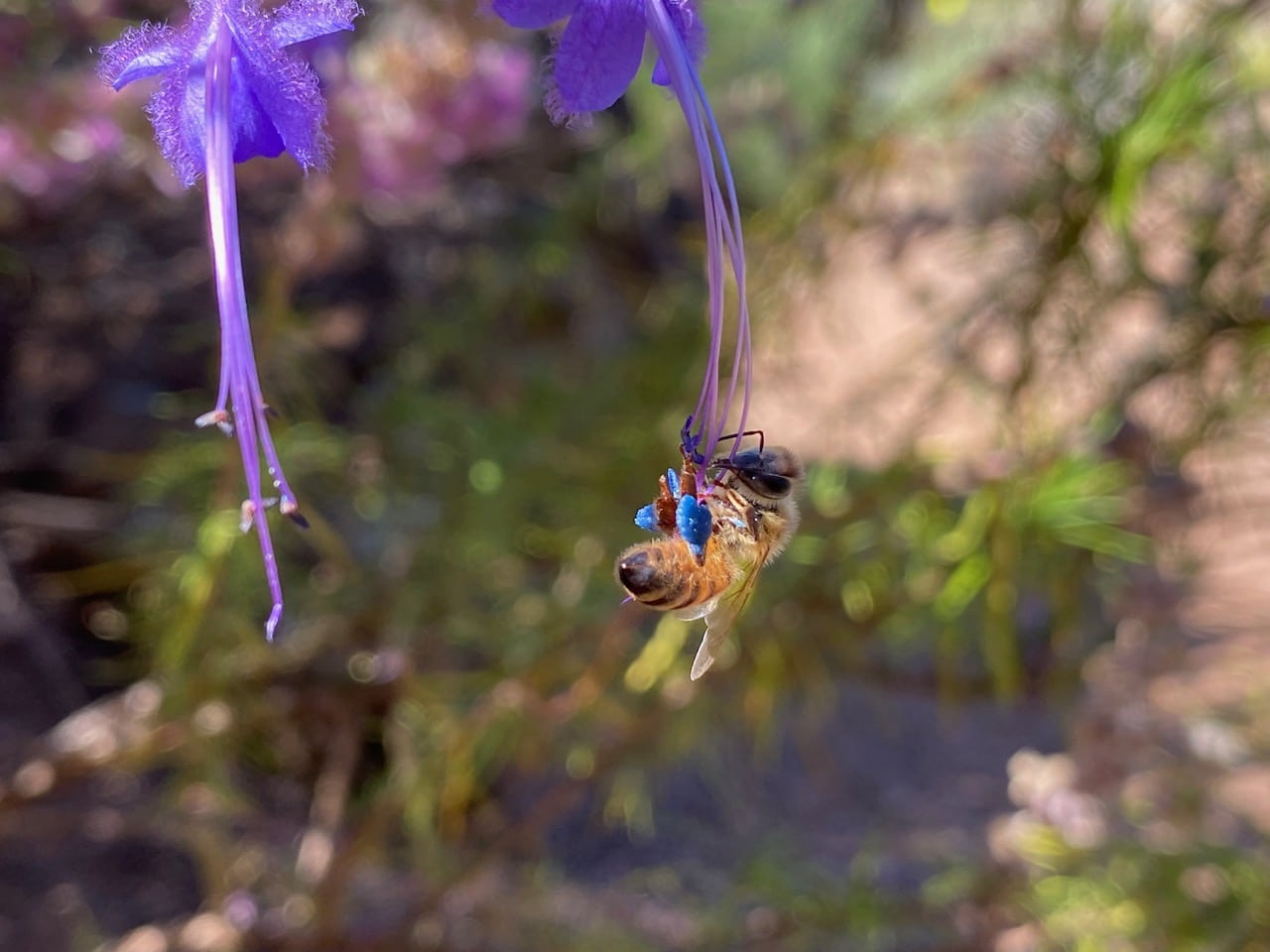
A Honey Bee, Apis mellifera (family Apidae) is holding all the four stamens and the style of a Woolly Bluecurls flower in her legs. She uses her mandibles to open the anthers and gathers the blue pollen into her corbiculae (pollen baskets). Nectar is mixed with the pollen before being packed into the corbiculae as a moist paste – this makes the sky-blue pollen appear darker on the bee’s pollen baskets.
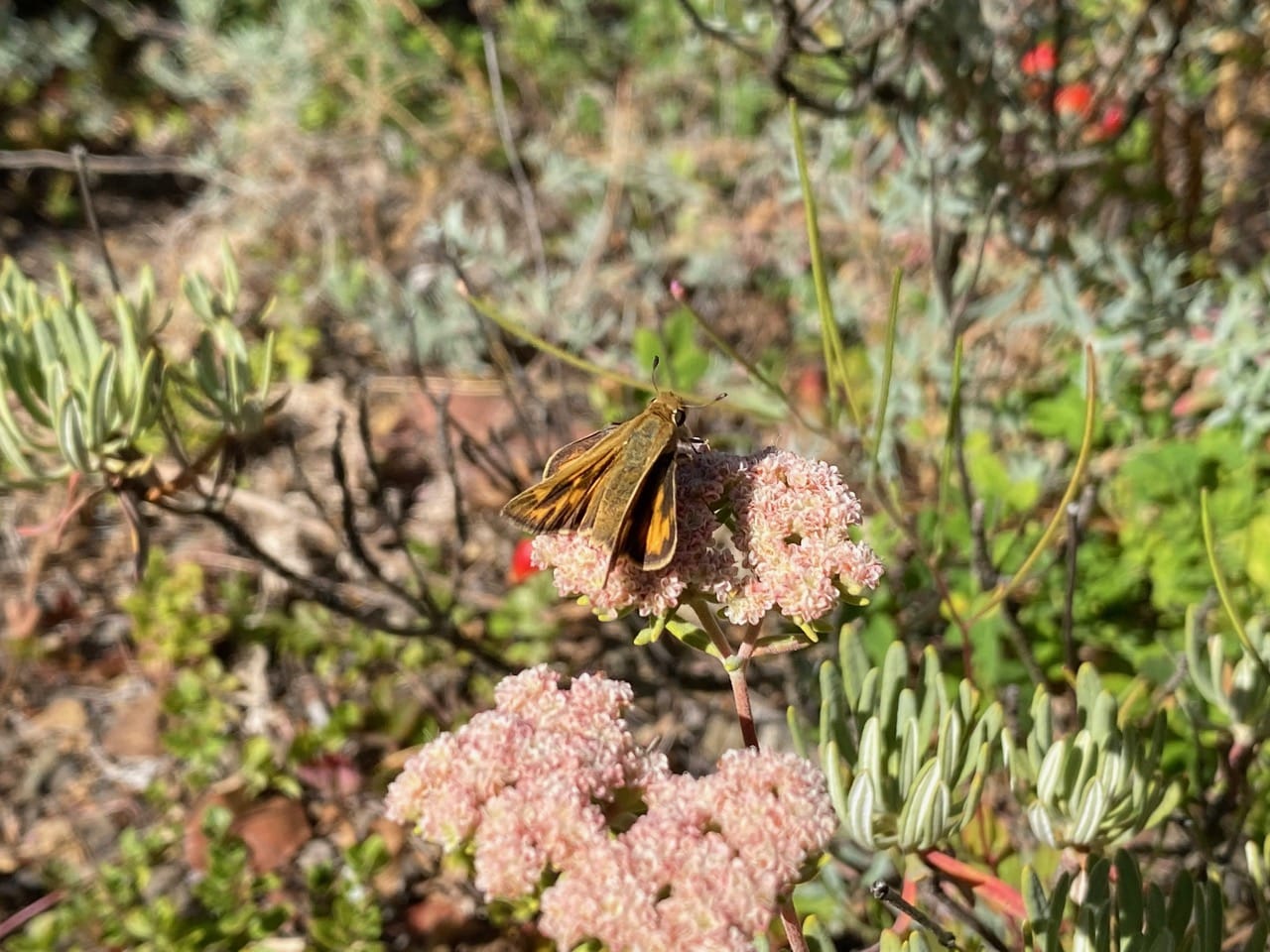
A Field Skipper, Atalopedes campestris (family Hesperiidae) is taking nectar from an inflorescence of Santa Cruz Island Buckwheat, Eriogonum arborescens.
Skippers are a family, the Hesperiidae, of the order Lepidoptera (butterflies and moths). They are named for their quick, darting flight habits. Most have the antenna clubs hooked backwards like a crochet hook. They also have generally stockier bodies and larger compound eyes than the other butterflies. Their wings are usually small in proportion to their bodies. When at rest, skippers keep their wings usually angled upwards or spread out, and only rarely fold them up completely. Californian species are mostly brown or tan, with black, orange, or yellow markings.
Skipper caterpillars are usually green or brown, sometimes yellowish, never brightly colored. They have a distinctive “collar”, a narrow ring around the body right behind the head. Caterpillars are camouflaged and often hide during the day. Many species make nests of leaves and silk for additional protection. Most North American species feed on grasses, but some common species eat shrubs and trees, especially in the bean family. Most species are limited to a single group of food plants. Adult skippers are only active during the day, but Skipper caterpillars feed mainly when it is dark or partly light.

The California Goldenrod, Solidago velutina ssp. californica is blooming nicely in this large bed, but there seems to be a dearth of insects visiting the flowers. I stand around for a while, and see only an occasional Honey Bee, and the Spotted Cucumber Beetles.
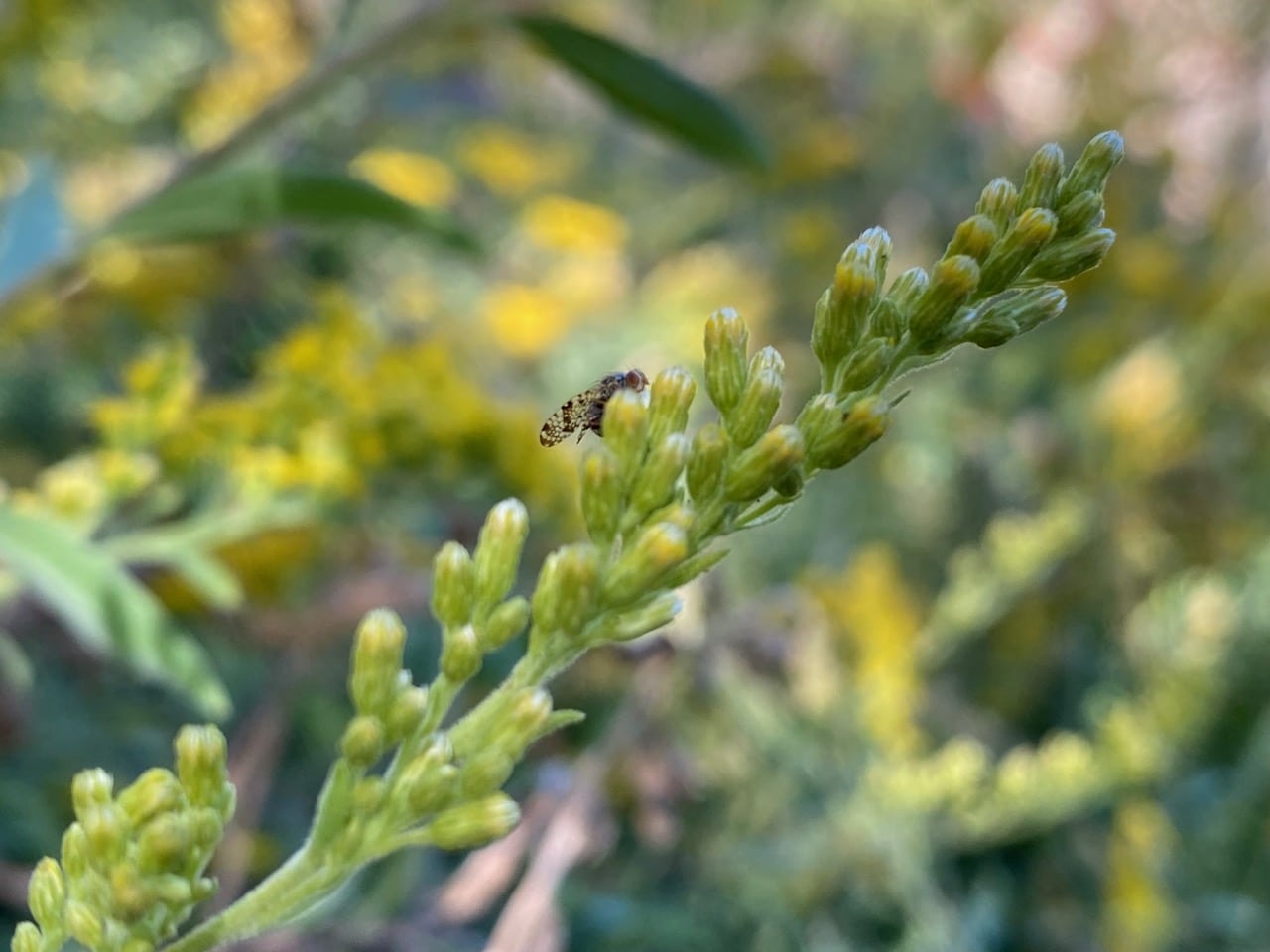
Hey, there’s a Fruit Fly on that stalk of immature goldenrod flowerheads. Something is going on here!
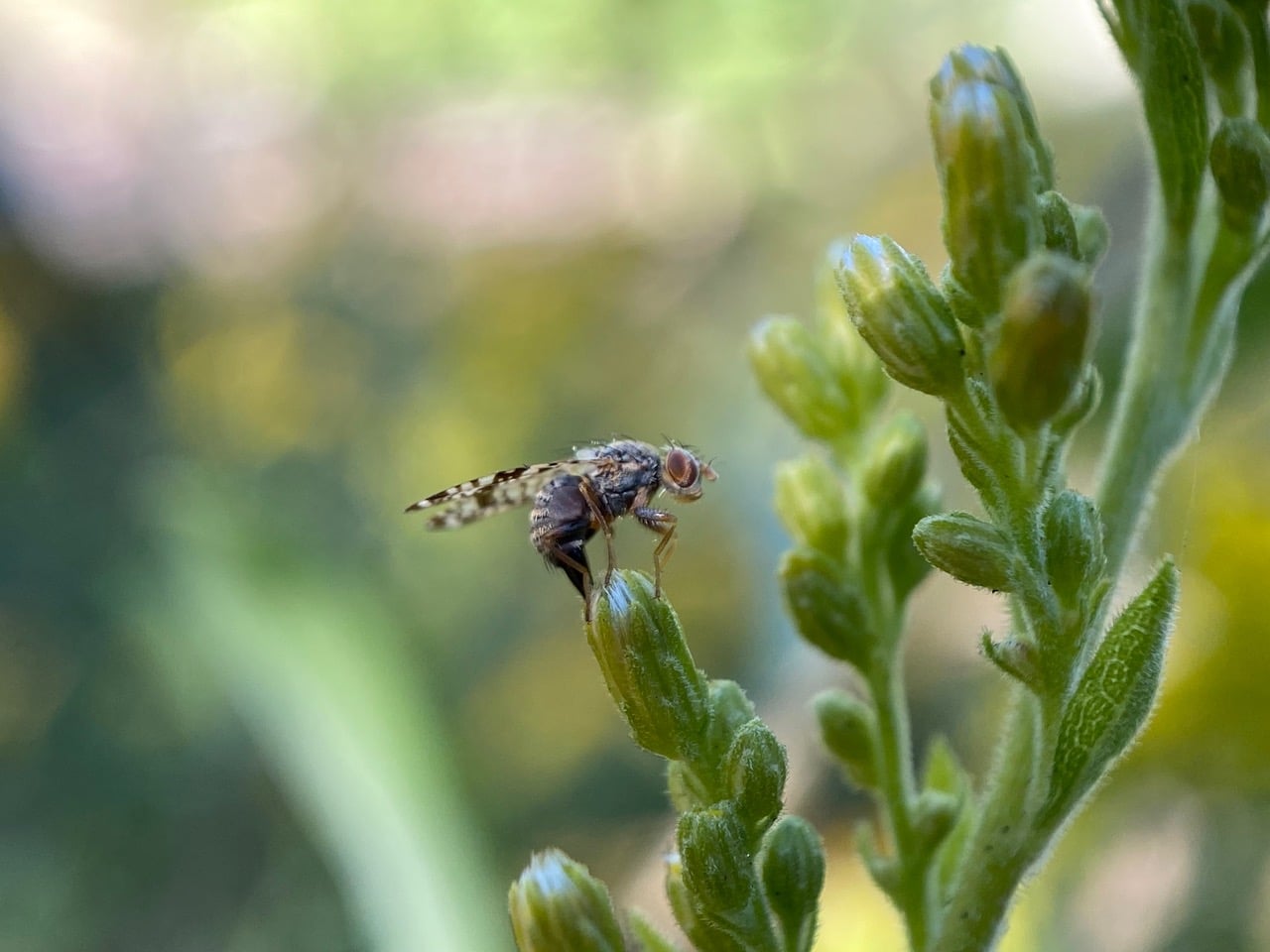
Her oviscape inserted into an immature flowerhead, the female is laying eggs!
Female Fruits Flies are easily distinguished by the presence of an oviscape – the pointy structure at the tip of their abdomen. The oviscape is the basal part of the ovipositor, the non-retractile sheath that protects the ovipositor. It remains exposed when the ovipositor is withdrawn and not in action.
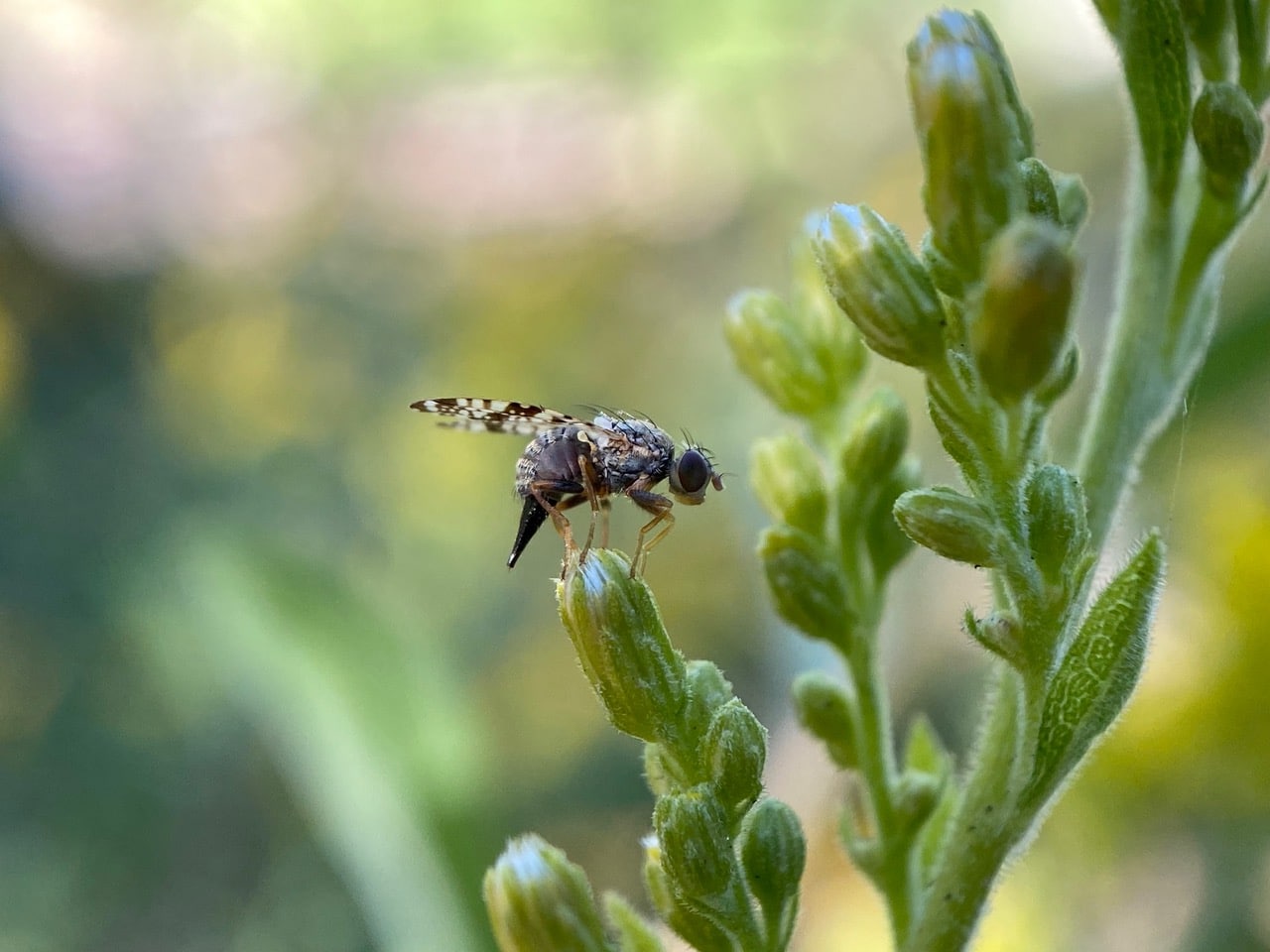
Her job done, she lifts her oviscape.

Tephritids are small to medium-sized flies that are often colorful, and usually with picture wings. The larvae of almost all Tephritidae are phytophagous. Females deposit eggs in living, healthy plant tissues using their telescopic ovipositors. Here the larvae find their food upon emerging. The larvae develop in leaves, stems, flowers, seeds, fruits, and roots of the host plant, depending on the species. Adults are often found on the host plant and feeding on pollen, nectar, rotting plant debris, or honeydew. Tephritid flies are of major economic importance as they can cause damage to fruit and other plant crops. On the other hand, some Tephritids are used as agents of biological control of noxious weeds.
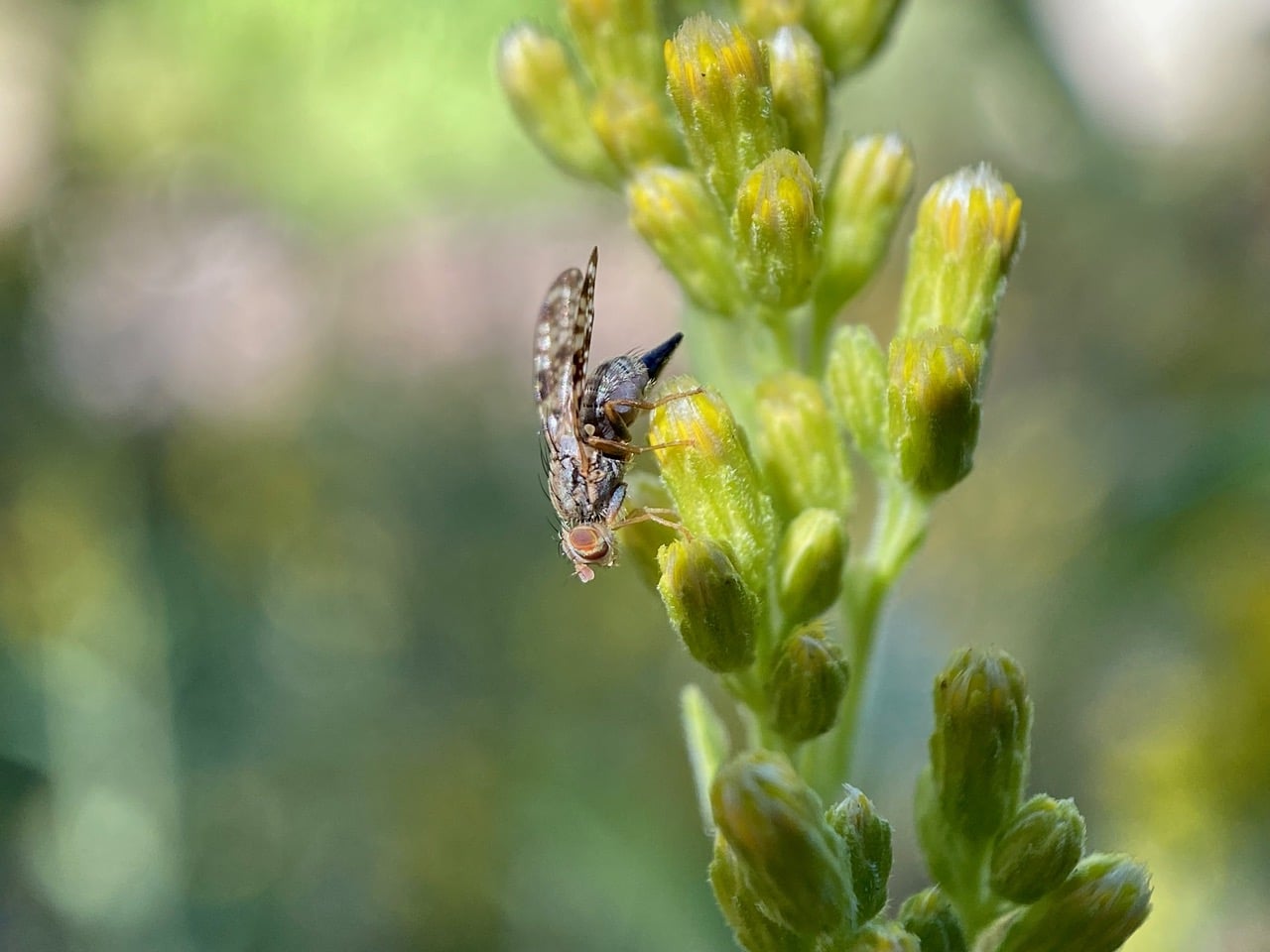
iNaturalist has helped identify this Fruit Fly as a member of the genus Campiglossa (family Tephritidae).
Fruit Flies in the genus Campiglossa has a worldwide distribution. Adult females ovipositor in flowerheads of Asteraceae. The short, stout larva of Campiglossa live in the ovaries. Many species are reported to be monophagous, some oligophagous. In entomology, a monophagous insect is one that feeds on only a single species of plant; oligophagous insects feed on a few closely related species.
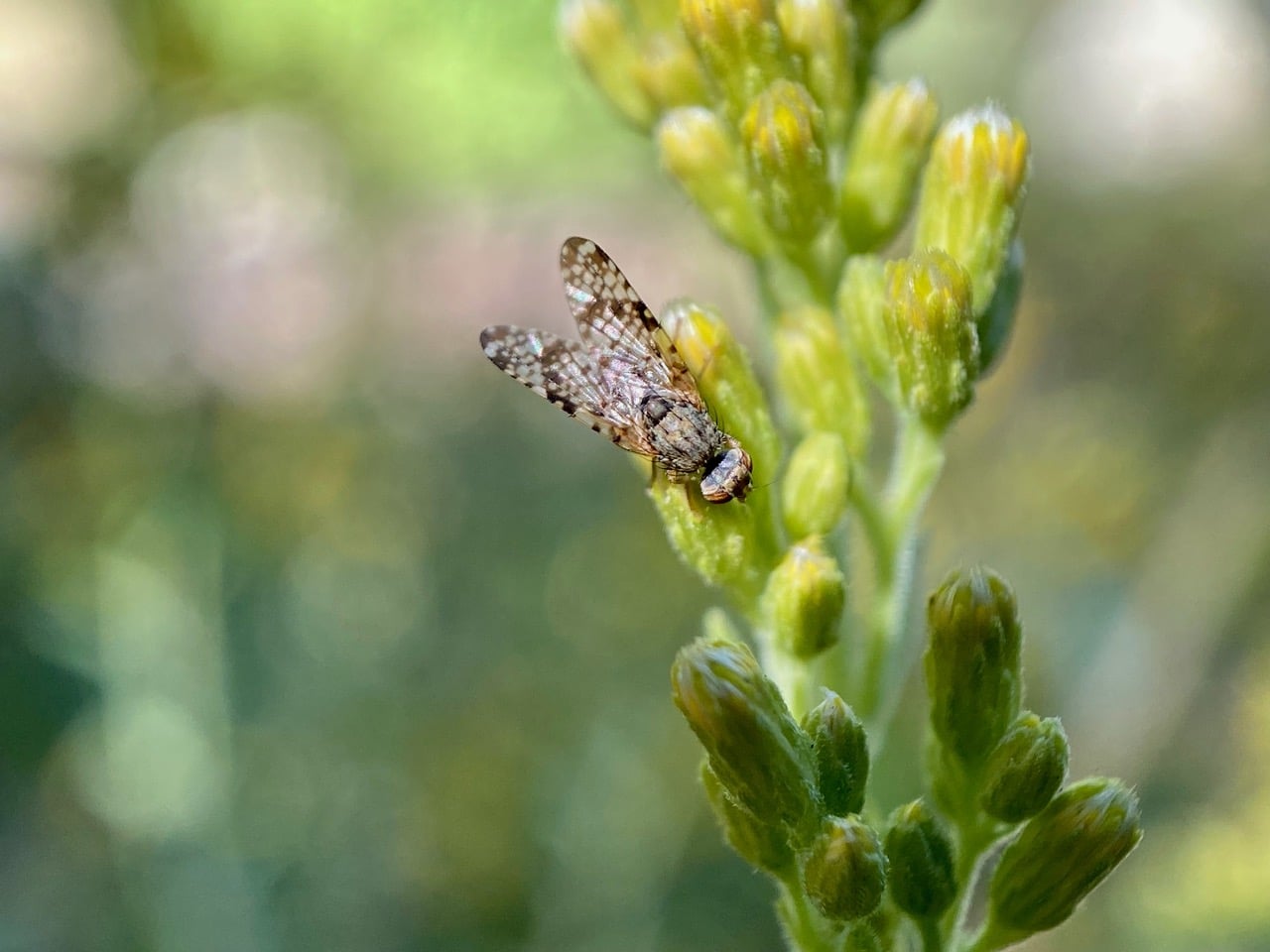
I find the easiest way to identify a Fruit Fly (family Tephritidae) is their small size and their picture wings.
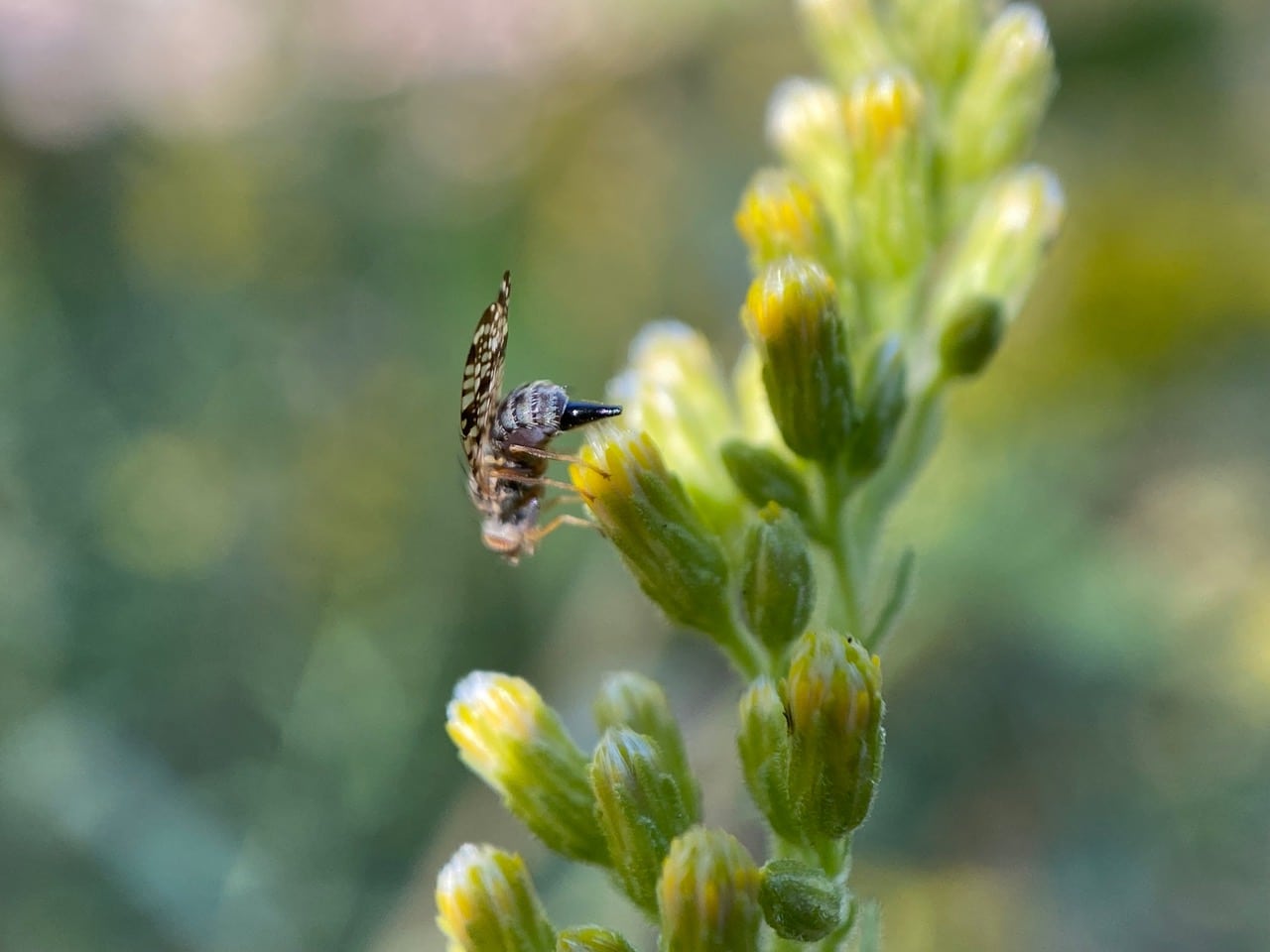
The female Fruit Fly slowly investigates numerous immature flowerheads on the stalk, stopping occasionally to lay eggs by inserting her ovipositor from the top. I wonder what mama fly is looking for? Is she selecting for the flowerhead in the optimal stage of development? Or is she making sure that no other eggs have been laid in them already?
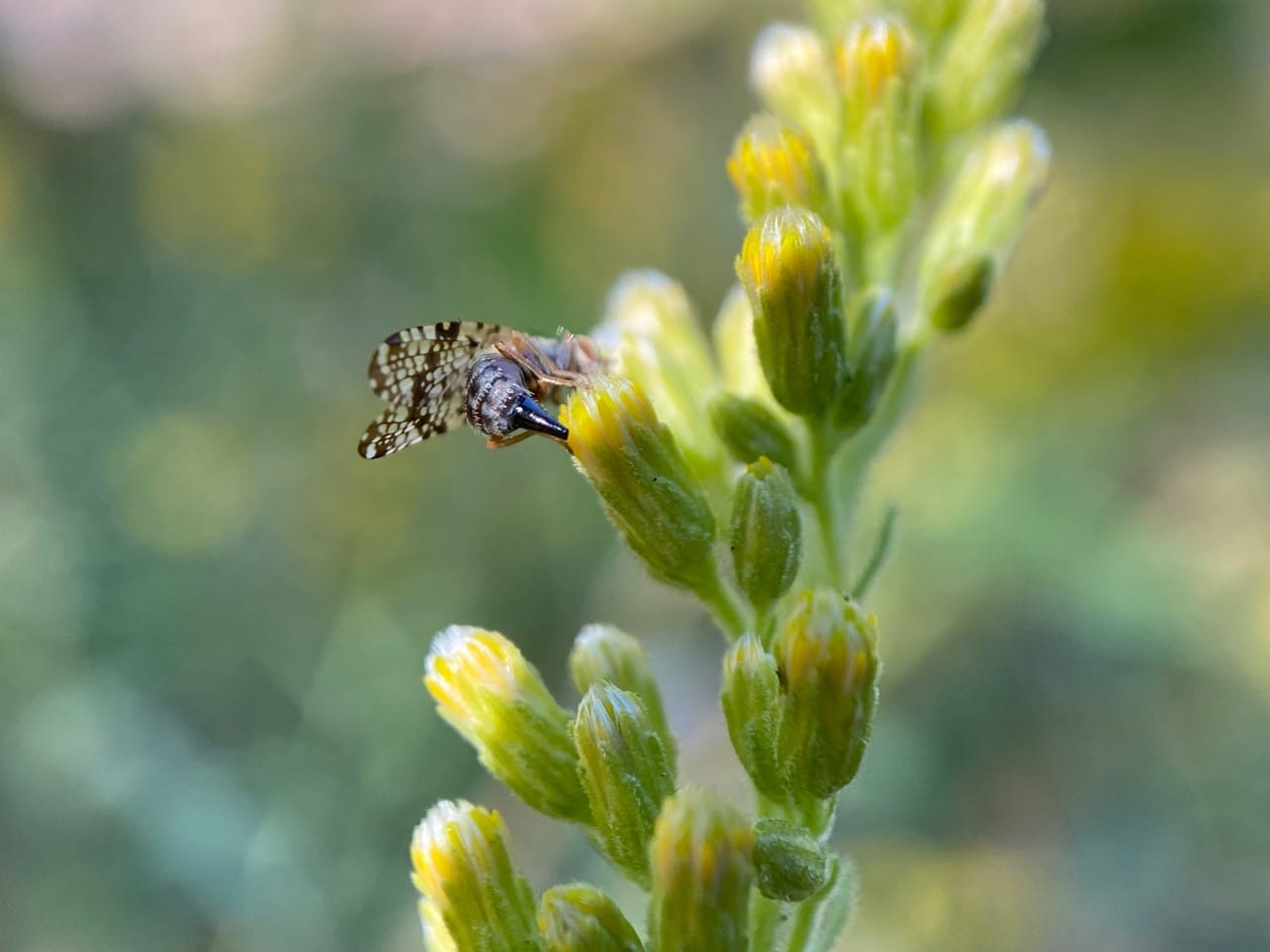
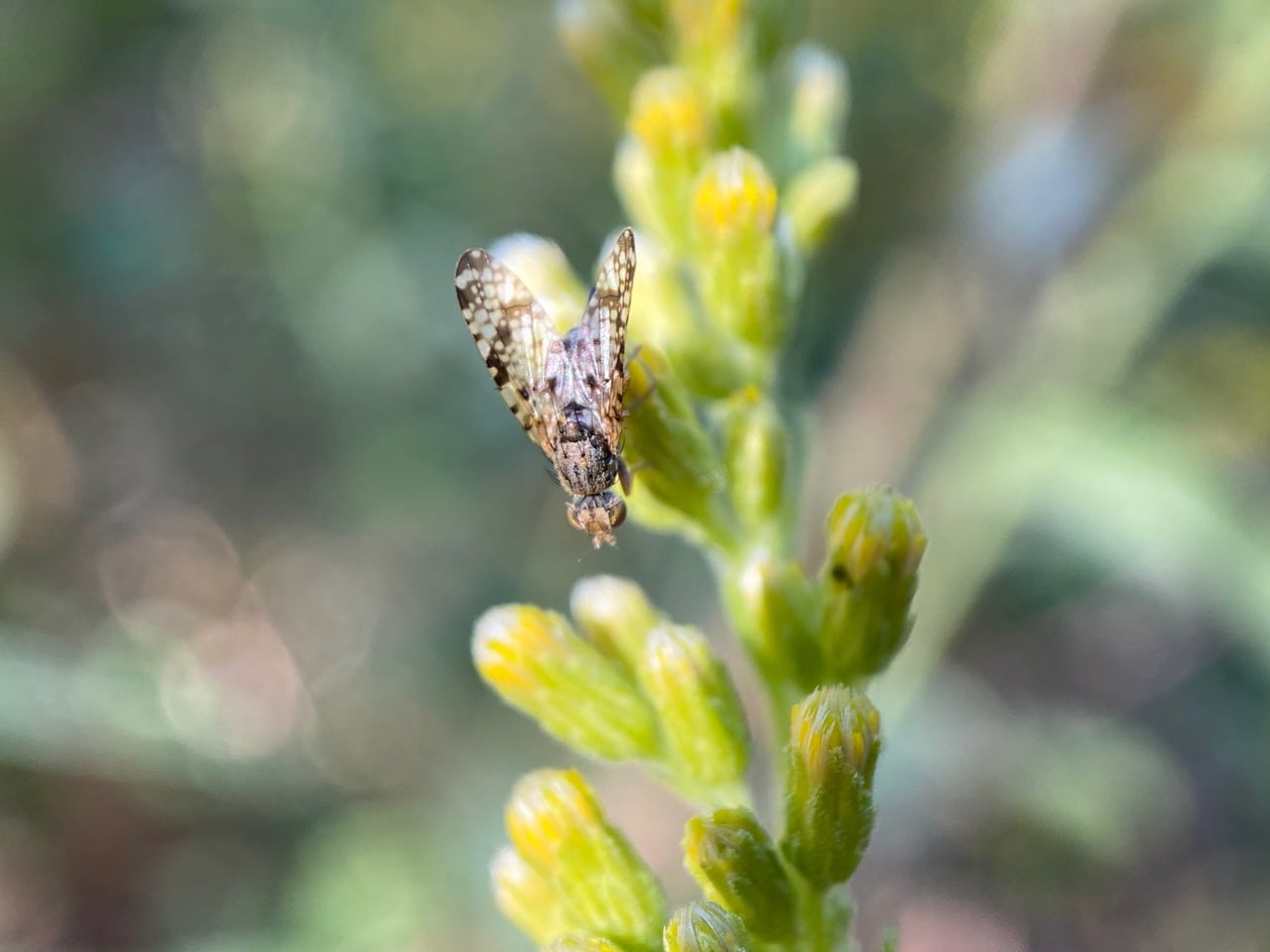
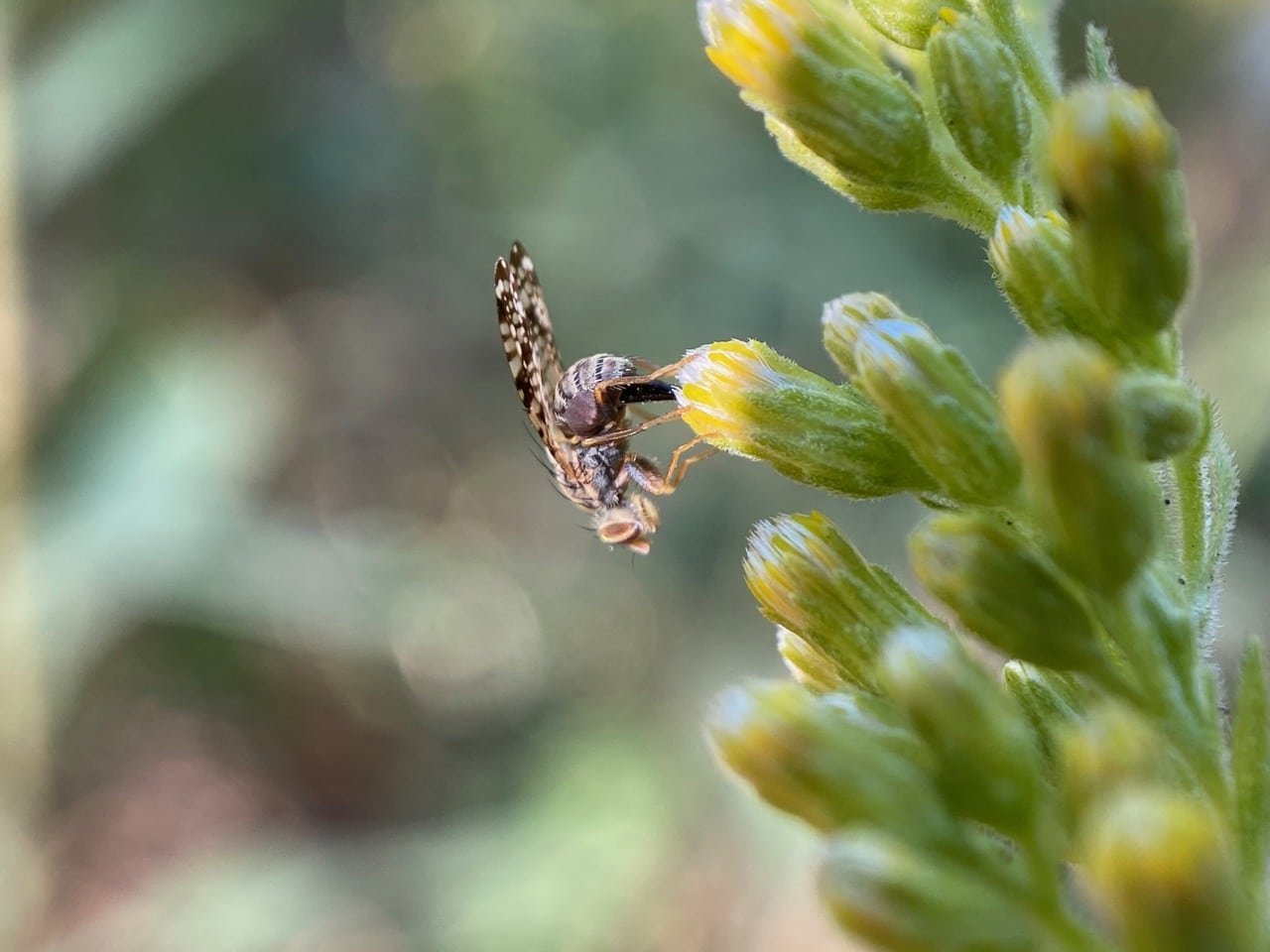
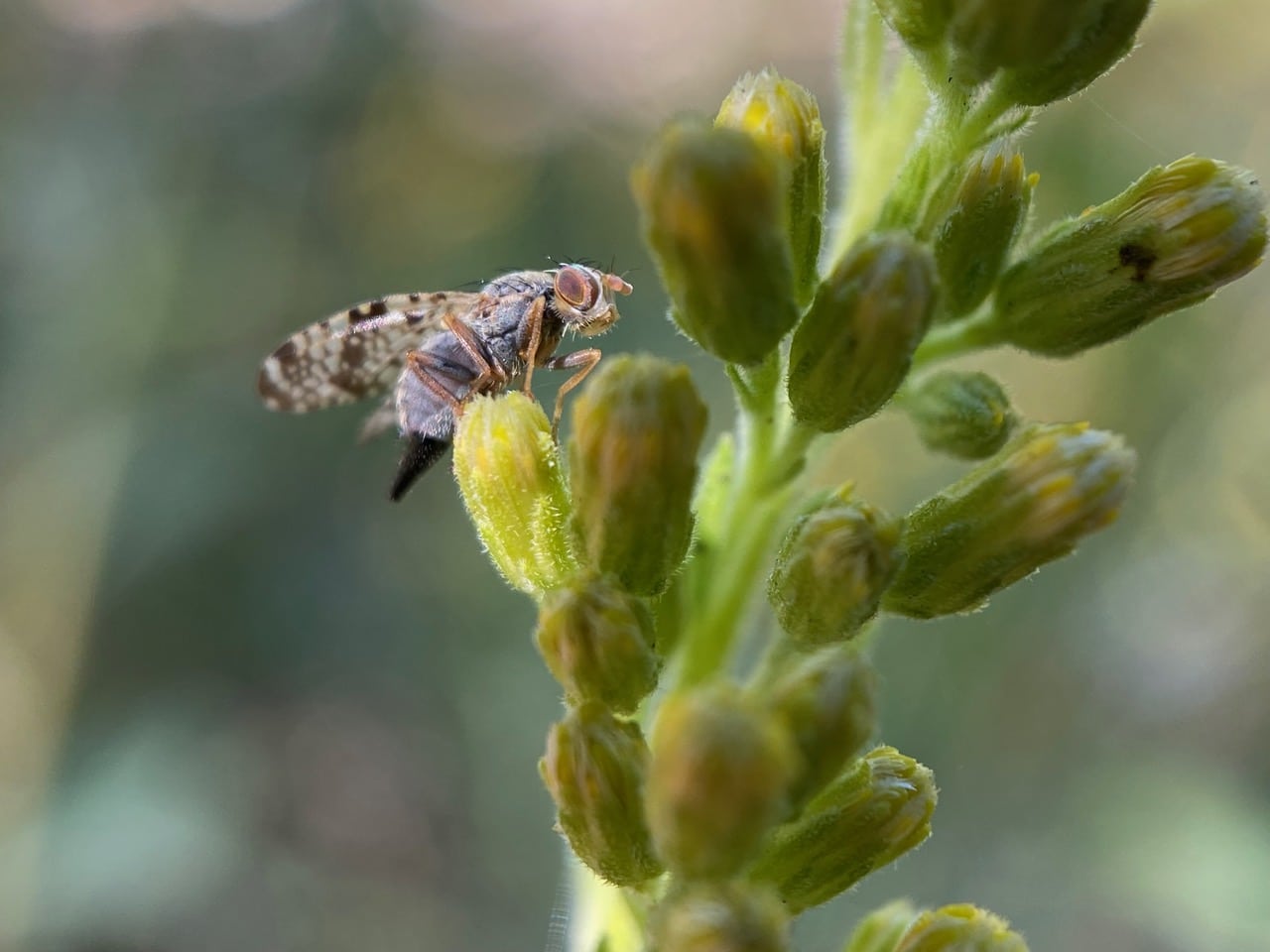
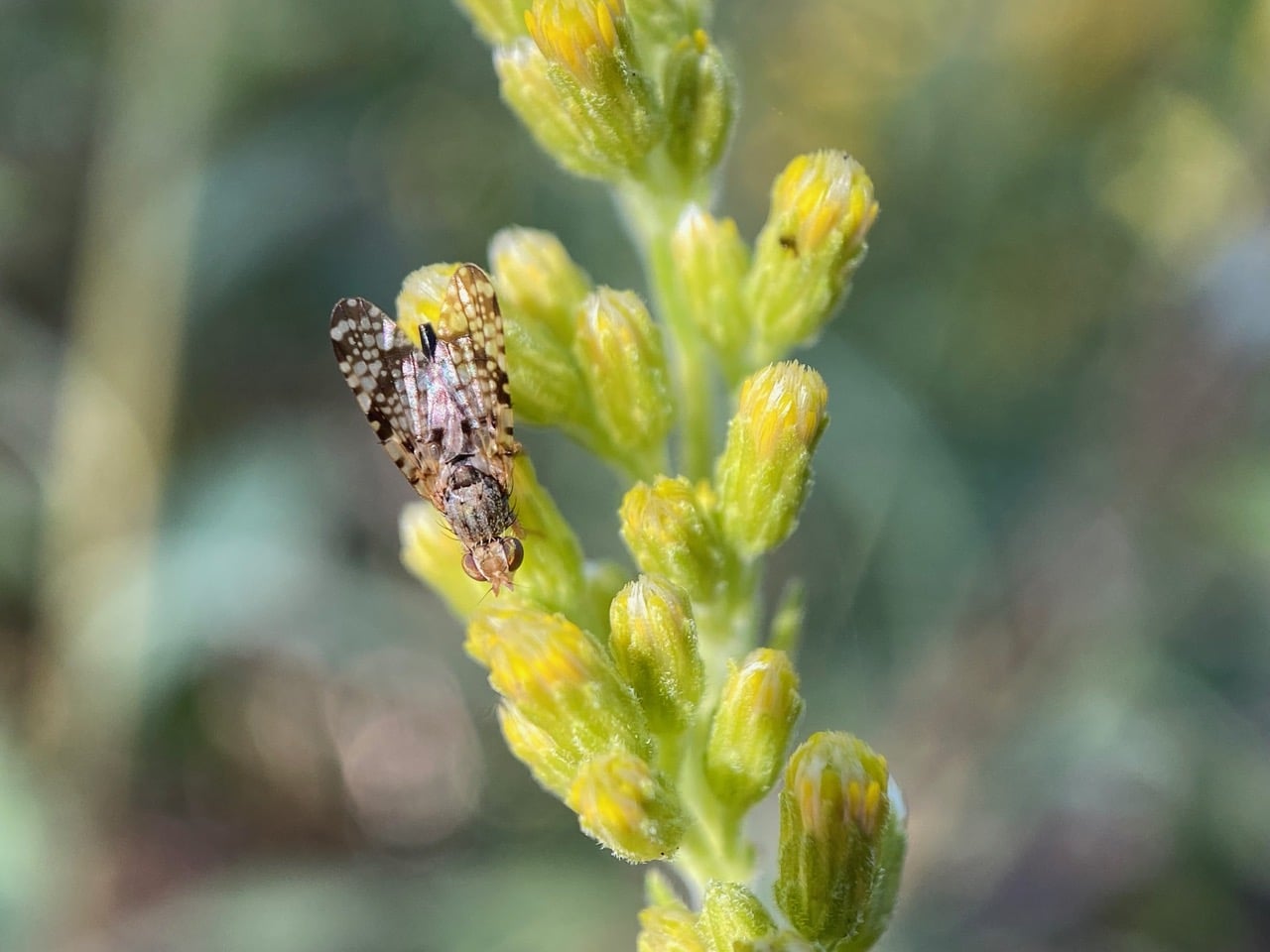
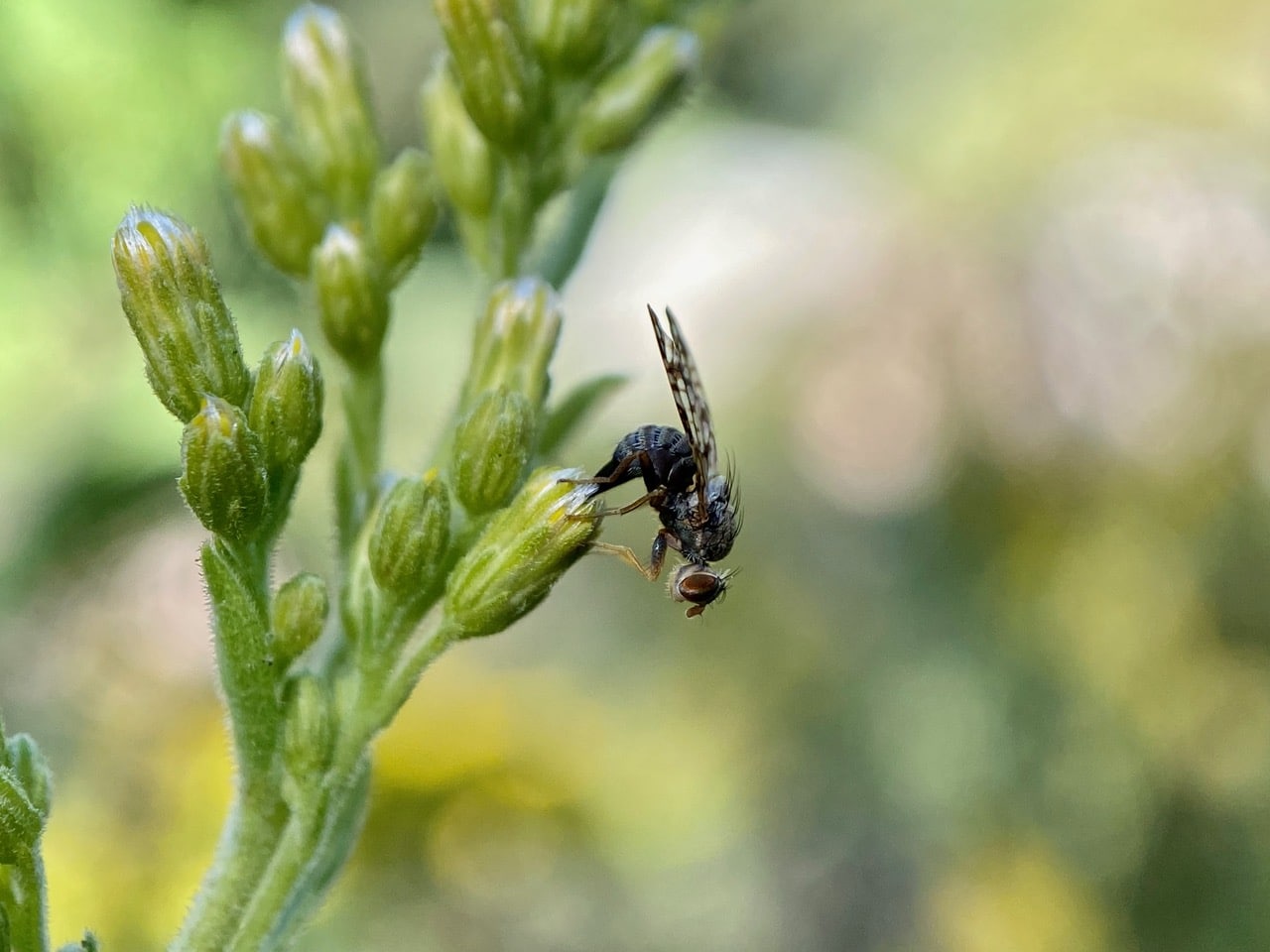
In 15 minutes, I watch the female Fruit Fly oviposit in at least 6 goldenrod flowerheads on the same stalk. Well done, Mama Fly!