

Pollinator Post 9/19/25 (2)
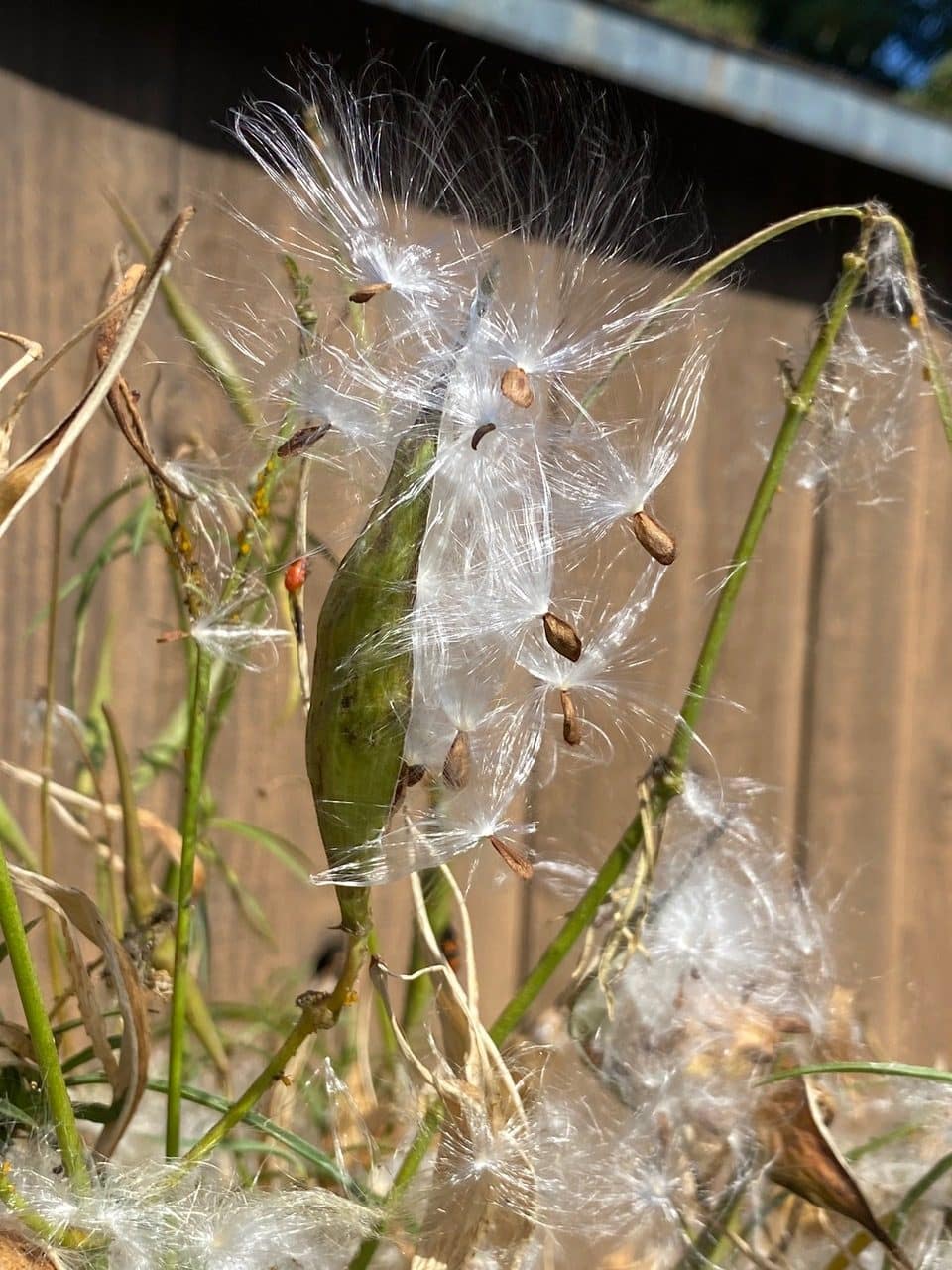
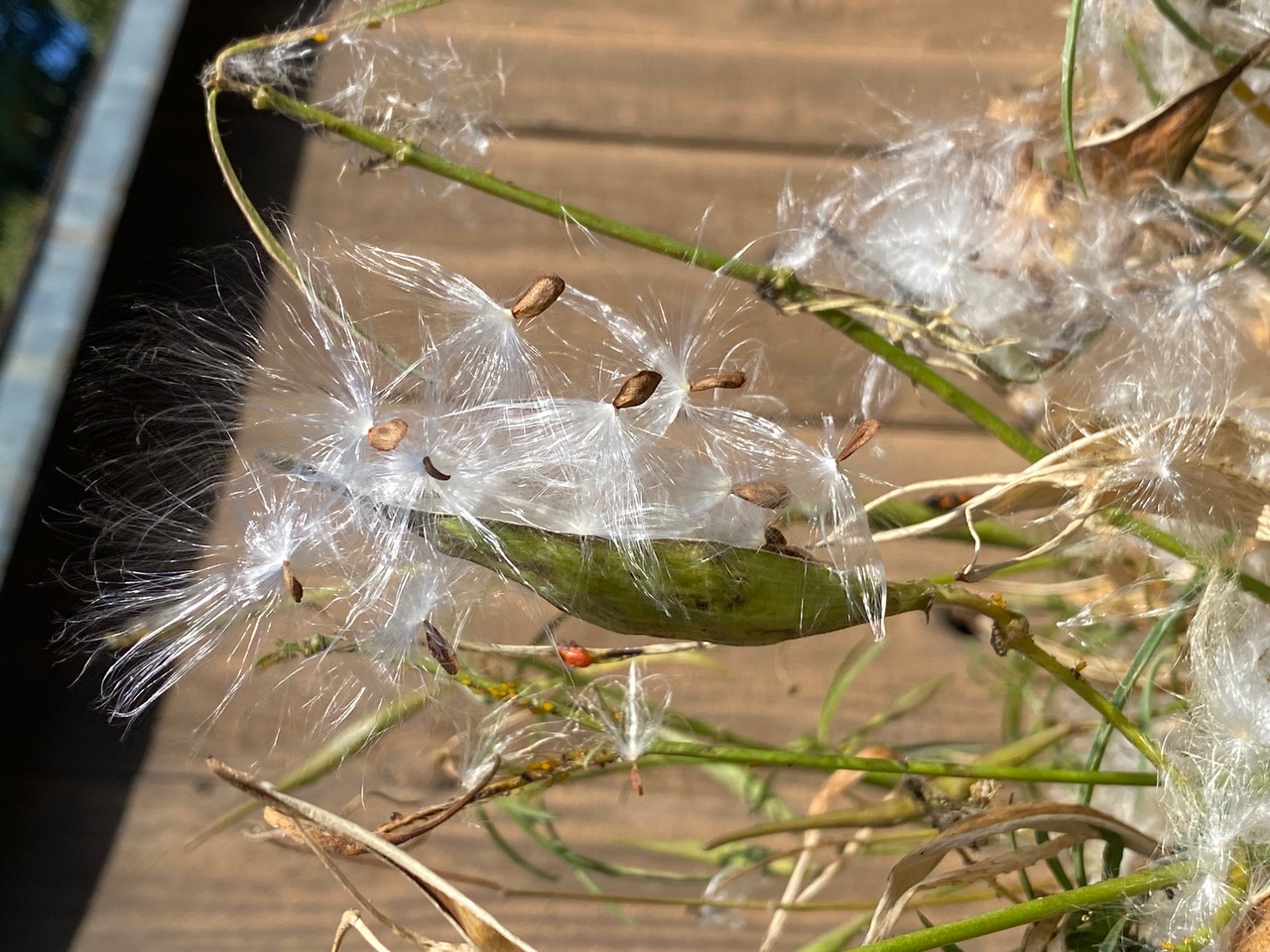
In Craig and Jenny’s backyard, a seed pod of the Narrowleaf Milkweed, Asclepias fascicularis has just split open, releasing dozens of seeds to the wind on silk plumes.
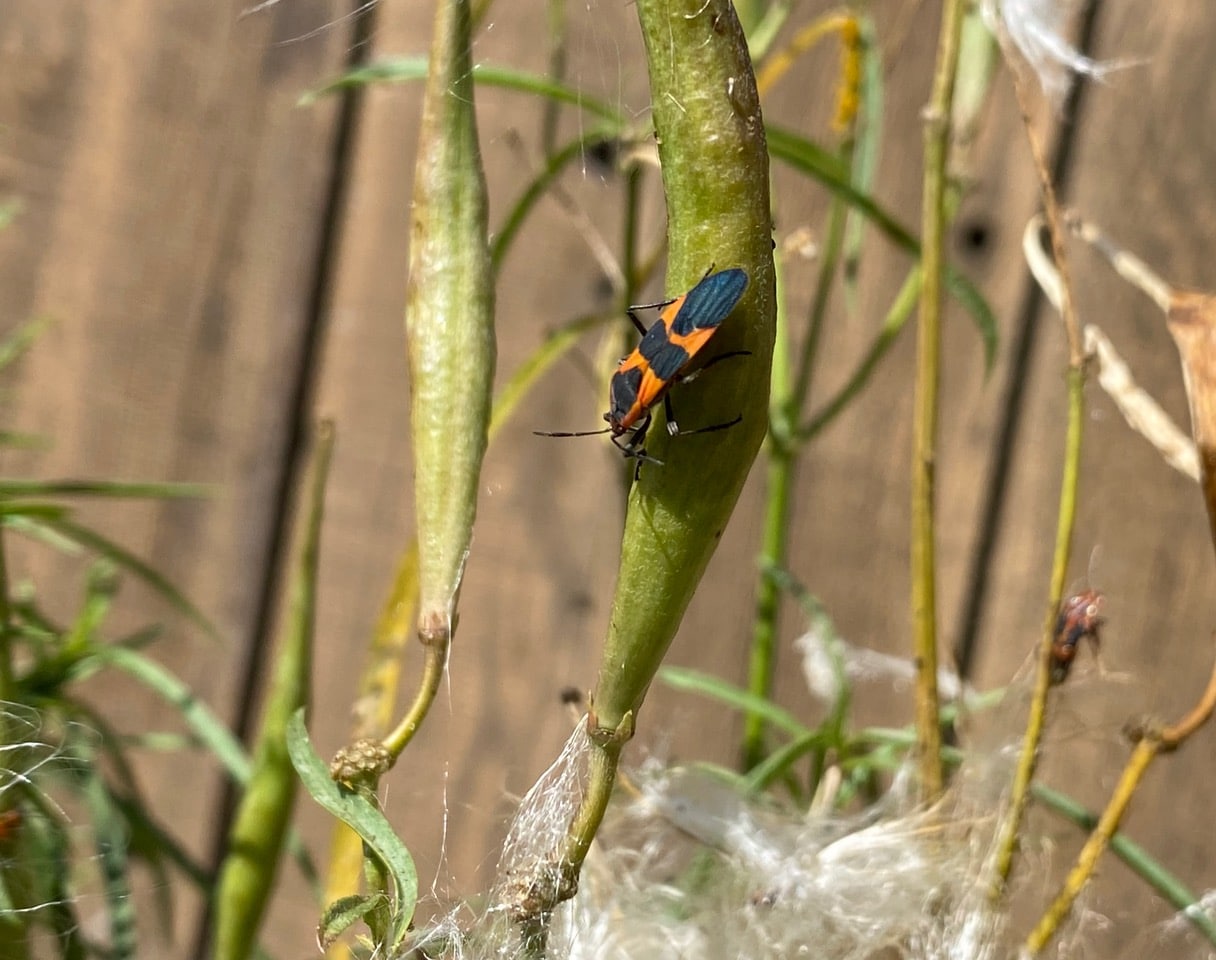
A Large Milkweed Bug, Oncopeltus fasciatus (family Lygaeidae) is perched on an immature seed pod.
Milkweed Bugs are Seed Bugs (family Lygaeidae) in the insect order of “true bugs”, Hemiptera. The bold red-and-black coloration of the bug serves as aposematic warning to potential predators of its distastefulness and toxicity. Like the Monarch butterflies, Oncopeltus sequesters the toxic compounds of milkweeds, giving the insect its toxicity. The bugs undergo incomplete metamorphosis, with five instars before reaching adulthood. The nymphs and adults all feed on milkweed using their piercing-sucking mouthparts. Adults are capable of penetrating the seed pod with their proboscis and injecting digestive juices. All stages of development can be found on the plants in mid to late summer. Adults live for about one month. The insect overwinters as an adult.
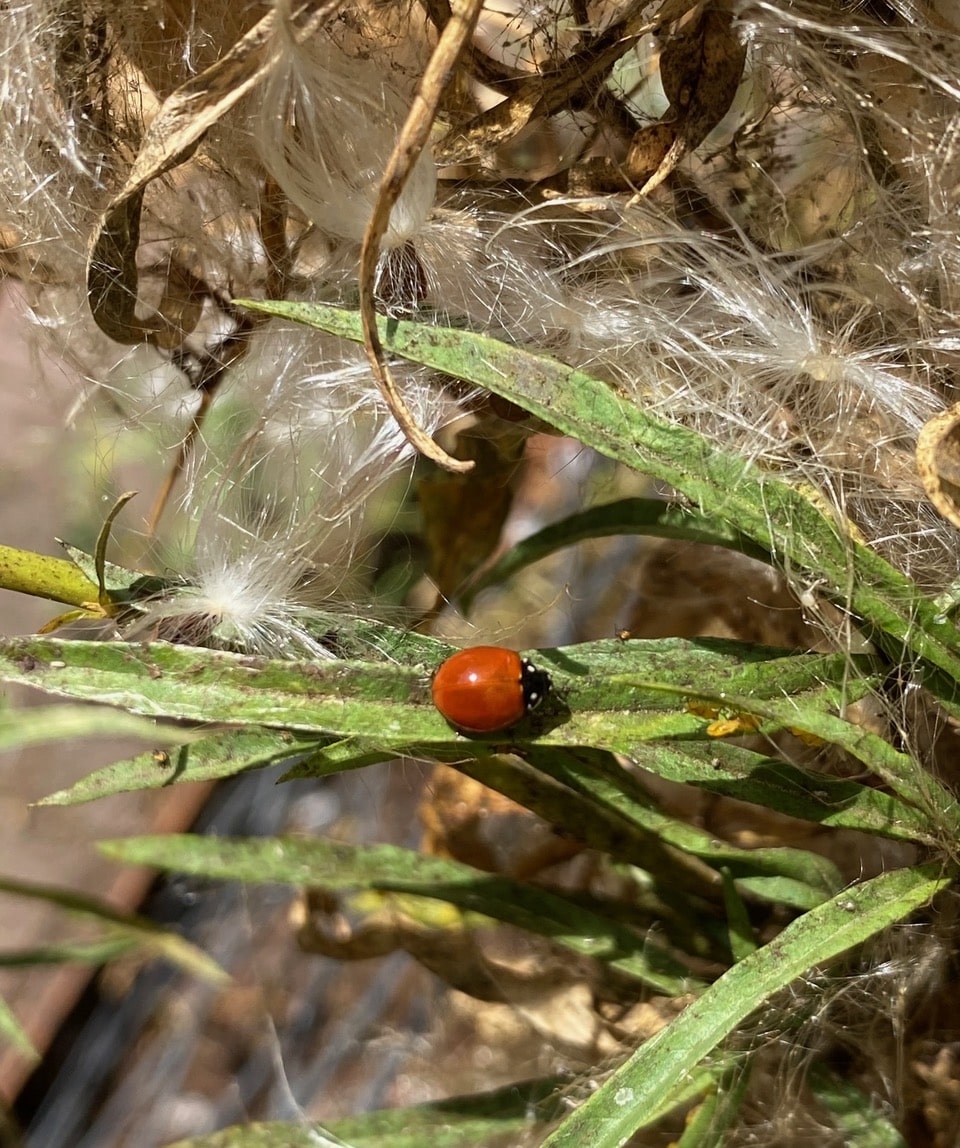
Below the tangle of milkweed plumes, a Spotless Lady Beetle, Cycloneda sanguinea (family Coccinellidae) is moving along a leaf tainted with the beginnings of sooty mold growing on aphid honeydew. The beetle has done a good job of clearing out the aphids on the leaves.
The Spotless Lady Beetle, Cycloneda sanguinea (family Coccinellidae) is a widespread species of lady beetle in the Americas. It is is a large lady beetle with red, unspotted elytra (wing covers) ranging from 4-6.5 mm long. The black and white marks on the head and pronotum are very distinctive, and they are also gender-specific. Both adult and larvae of Spotless Lady Beetles are voracious predators of aphids. They are very often found feeding on aphids on milkweeds, but also occur on a number of other plants. Adults live longer when nectar and pollen are available for nourishment when prey is scarce.
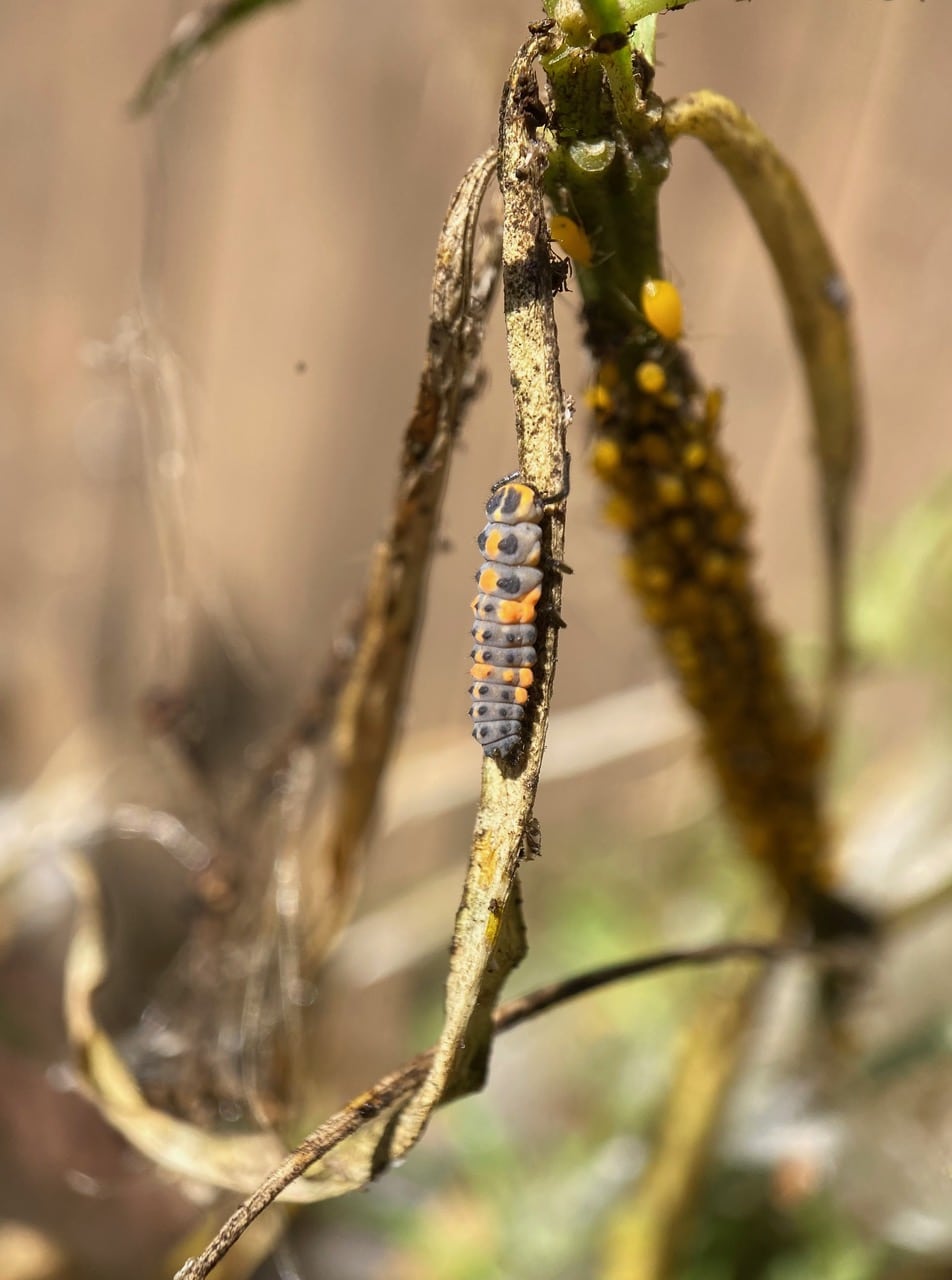
A sluggish Lady Beetle larva is perched on a dried milkweed leaf next to an aphid infested stem. I have not learned to identify lady beetle larvae to species (there is no field guides for North America), but since the only adult beetles I have seen on the plant so far have been the Spotless Lady Beetle, it is probably safe to assume that this larva belongs to that species.
Lady beetles go through complete metamorphosis, which comprises four stages: eggs, larva, pupa and adult. The larva goes through four molts during their development. Often described as miniature alligators with six legs, the larvae are voracious predators of aphids. Each larva can eat about 400 aphids in the three weeks before it pupates. Besides aphids, they also feed on soft scales, whitefly pupae, thrips, and spider mites.
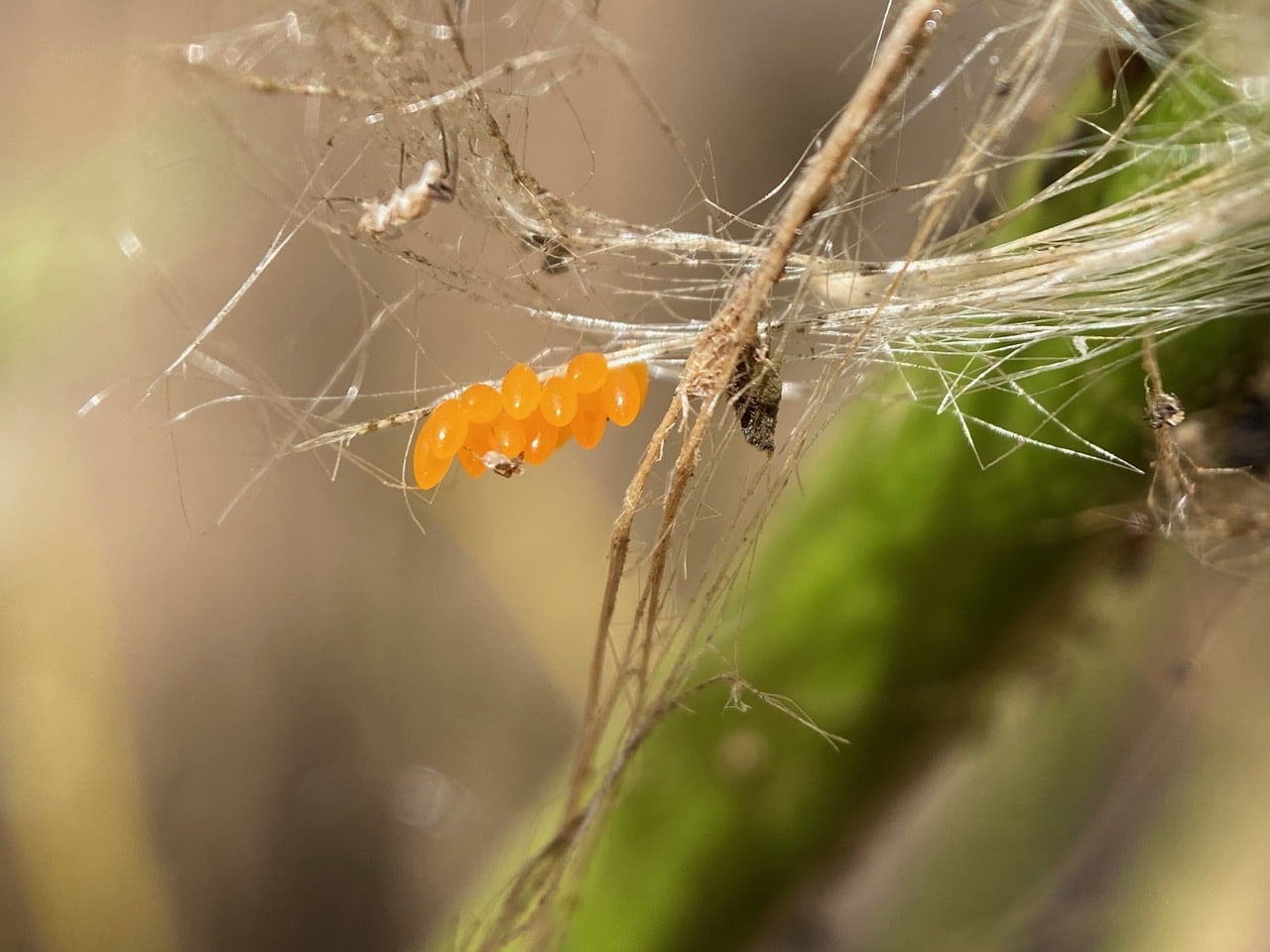
I close in on something orange on the detached silk fluff of milkweed seeds. What a delightful surprise – a dozen Lady Beetle eggs! Why would a mama beetle lay her eggs on the silk fluff that can be blown away at any moment?
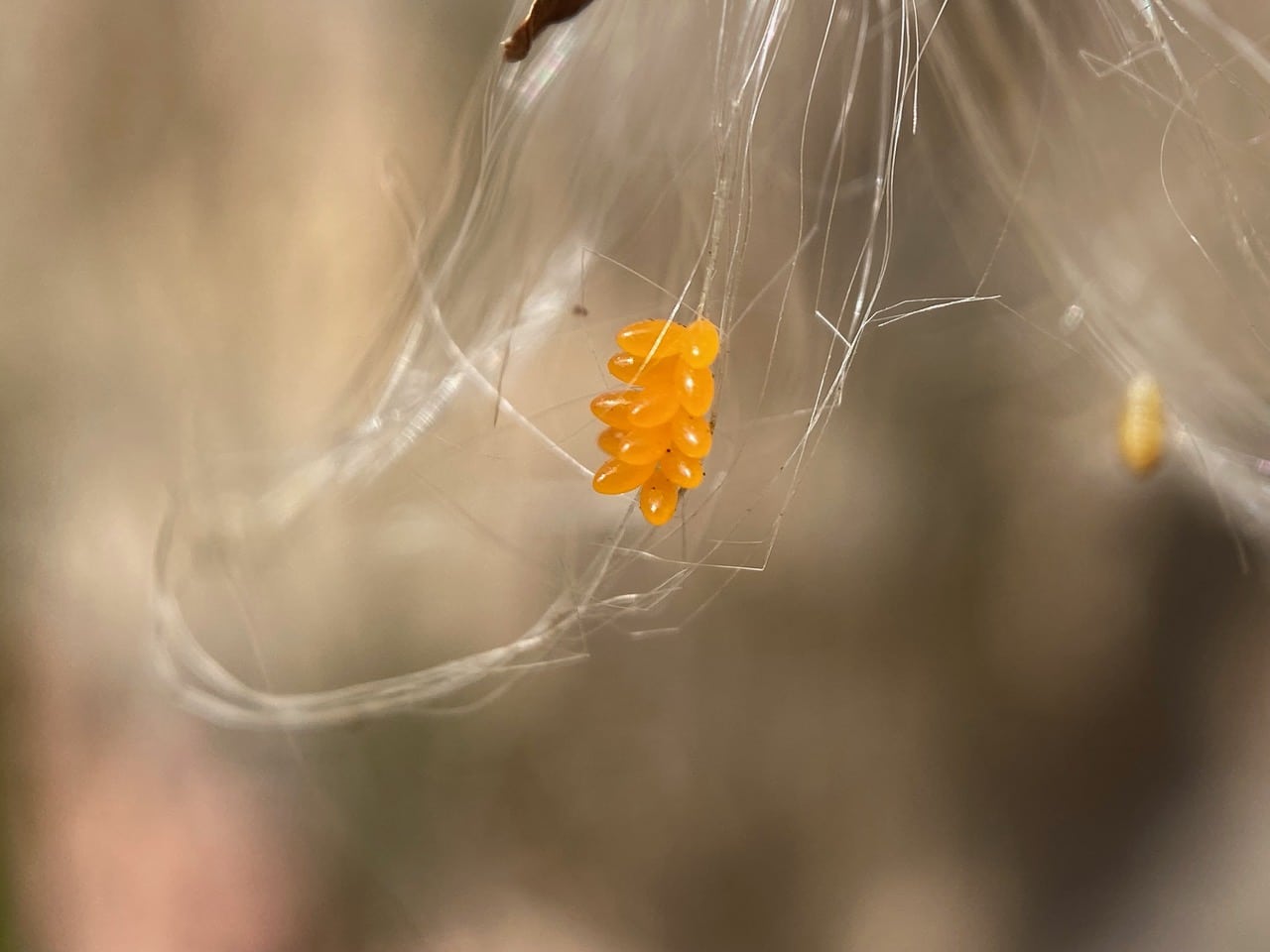
Not far away, I discover another cluster of lady beetle eggs, also hanging precariously on the silk fibers of milkweed seeds. Surely this is not for the purpose of wind dispersal? The adult beetles are perfectly capable of flying.

In the shadows, a large Monarch caterpillar is feeding on a milkweed leaf. It is about 2 inches long, probably close to pupation.
Monarch caterpillars feed exclusively on plants from the genus Asclepias, commonly known as milkweed. The plant is not only their only food source but also provides them with the cardiac poisons, or cardiac glycosides which make the caterpillars and the adult butterflies toxic to predators.
A Monarch caterpillar is approximately 2 inches when it is ready to pupate, having completed its fifth and final instar of growth. After reaching this length and size, it will leave its food source, find a suitable protected spot, and hang in a “J” shape before shedding its exoskeleton one last time to form a chrysalis. Monarch caterpillars pupate, or form a chrysalis, in a protected, secure spot away from their milkweed host plants to avoid predators. They may travel up to 10-30 feet or more to find a suitable location, which can include neighboring plants, fences, buildings, garden structures, patio furniture, or other nearby surfaces.
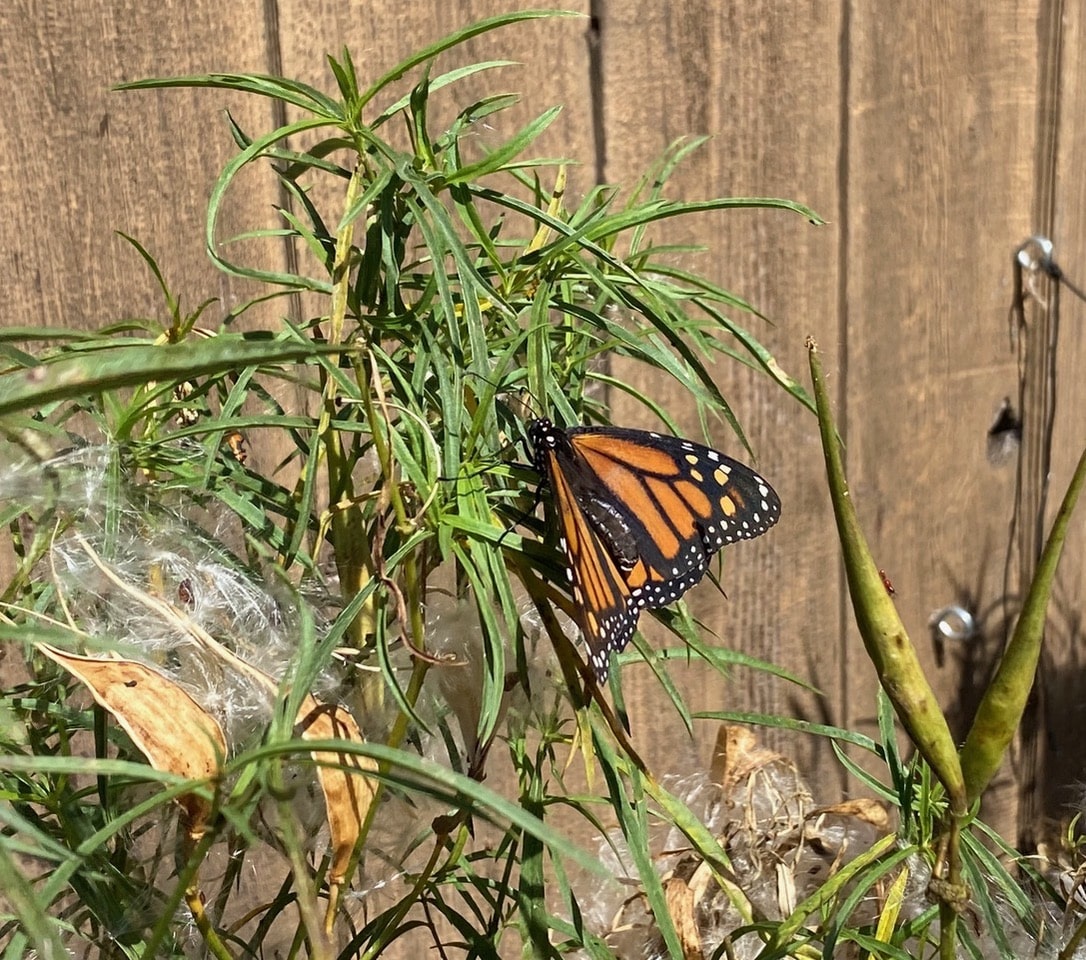
A female Monarch butterfly, Danaus plexippus (family Nymphalidae) is fluttering around the Narrowleaf Milkweed, Asclepias fascicularis by the fence. The plant is already releasing seeds and there are no longer any flowers on it. The only reason that the butterfly is checking out the plant is probably to lay eggs. Sure enough, as she lands, the butterfly curls her abdomen forward to deposit an egg on the foliage.
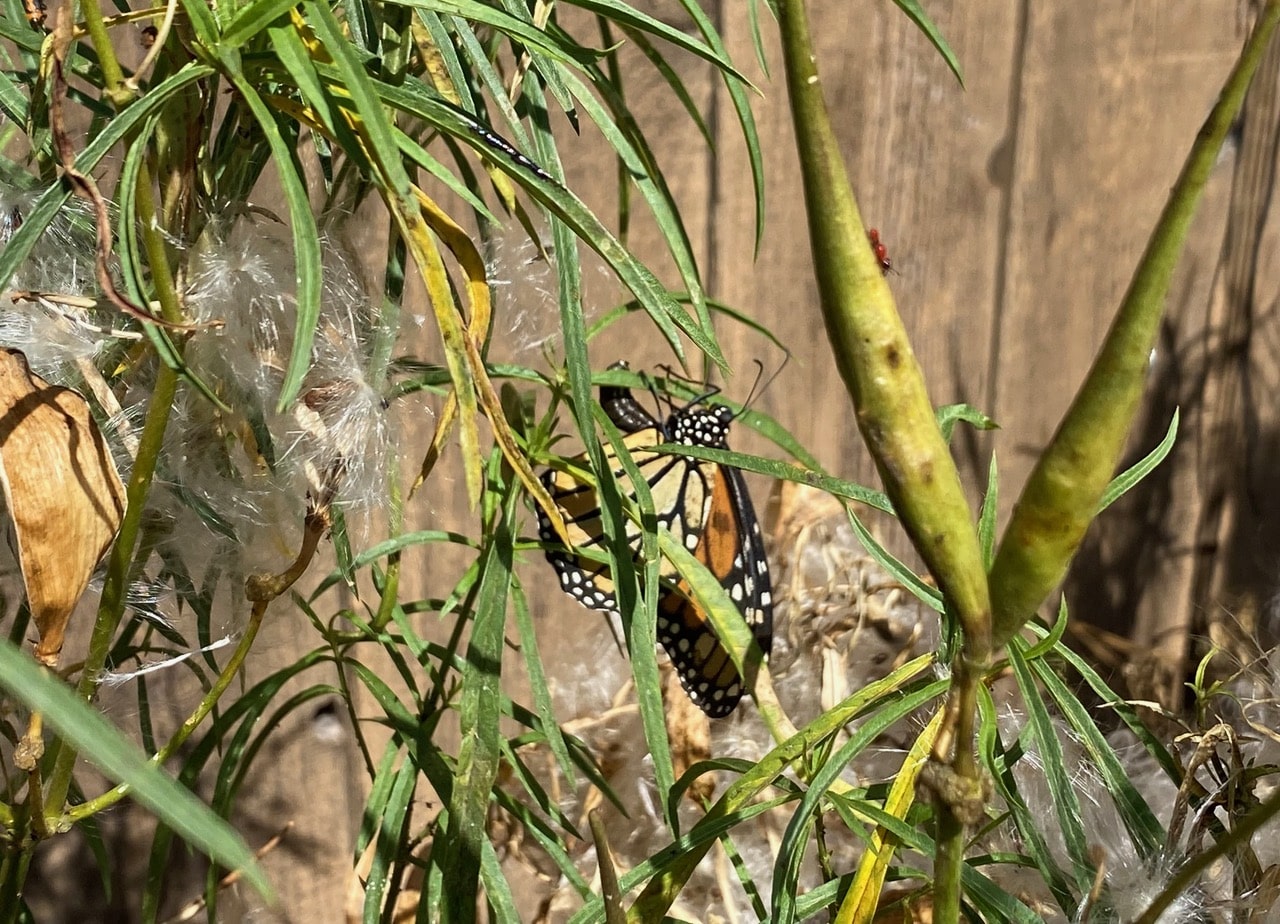
The Monarch butterfly goes on to lay eggs singly on several leaves as I watch. Will there be enough food for her caterpillars when they hatch? The plant is already senescing, and the leaves do not look very appetizing. Caterpillars produced late in the season are at risk of starvation. Every November over the last few years, I had inquiries from panicked gardeners asking where they could find fresh milkweed to feed their growing Monarch caterpillars.
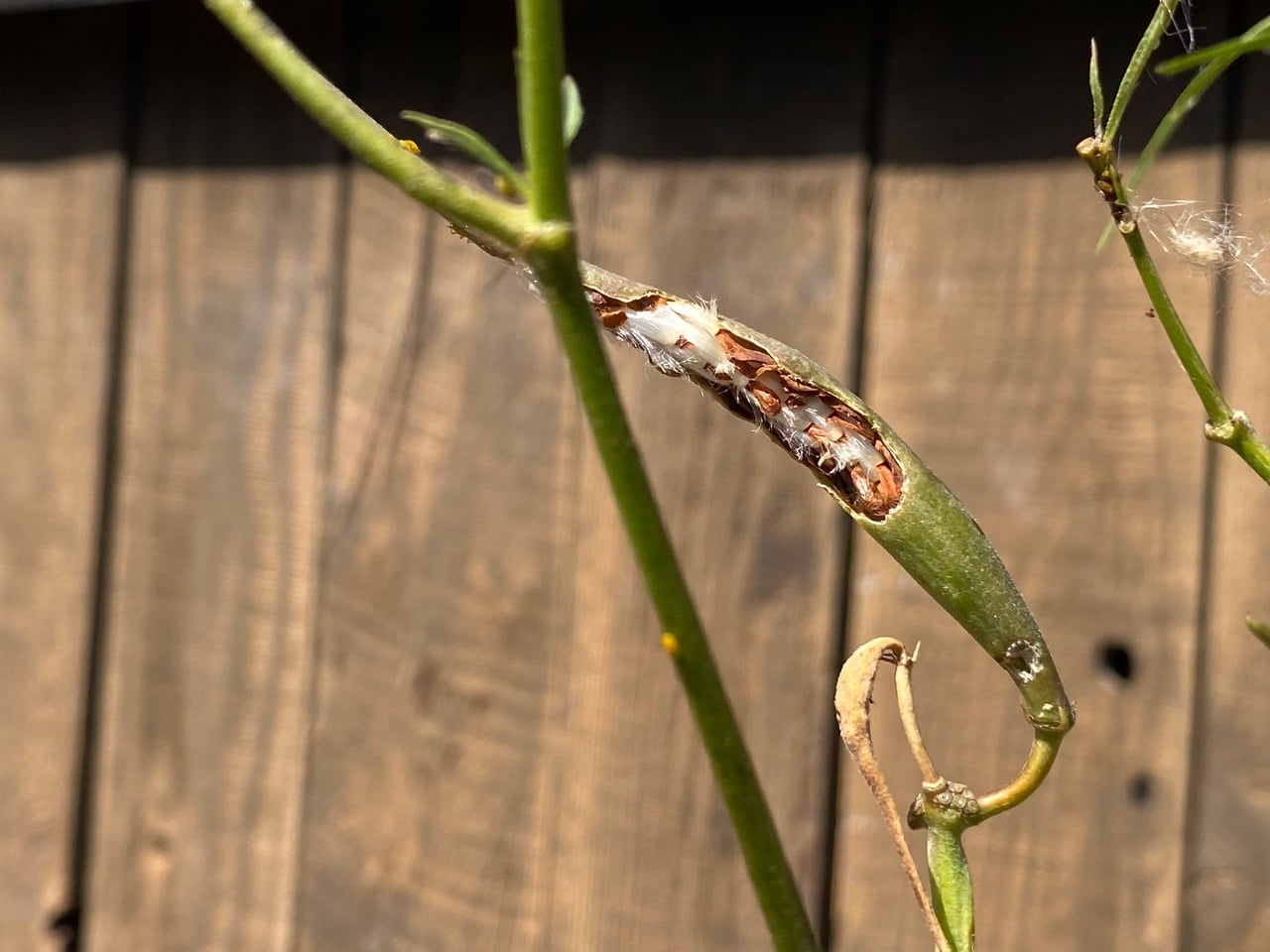
On the same milkweed plant, I find this immature seed pod that has been chewed open. Did a beetle do this to gain access to the seeds? No, most likely the damage is done by a Monarch caterpillar. I have seen late-season Monarch caterpillars feed on milkweed seed pods when the forage is scarce. It is not their preferred food, but they will eat it, push comes to shove.
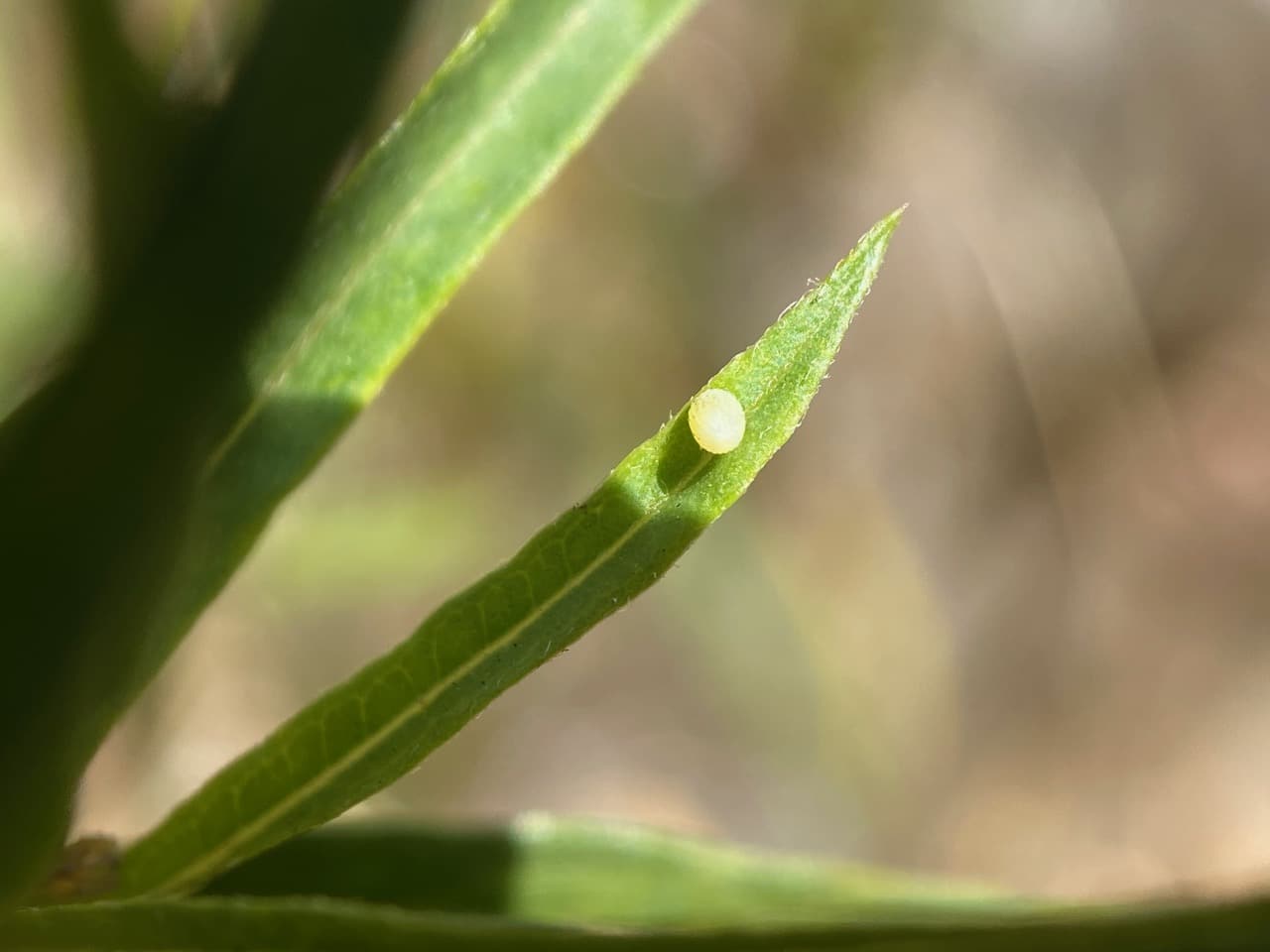
Close up of one of the eggs laid by the Monarch butterfly on the underside of a milkweed leaf.
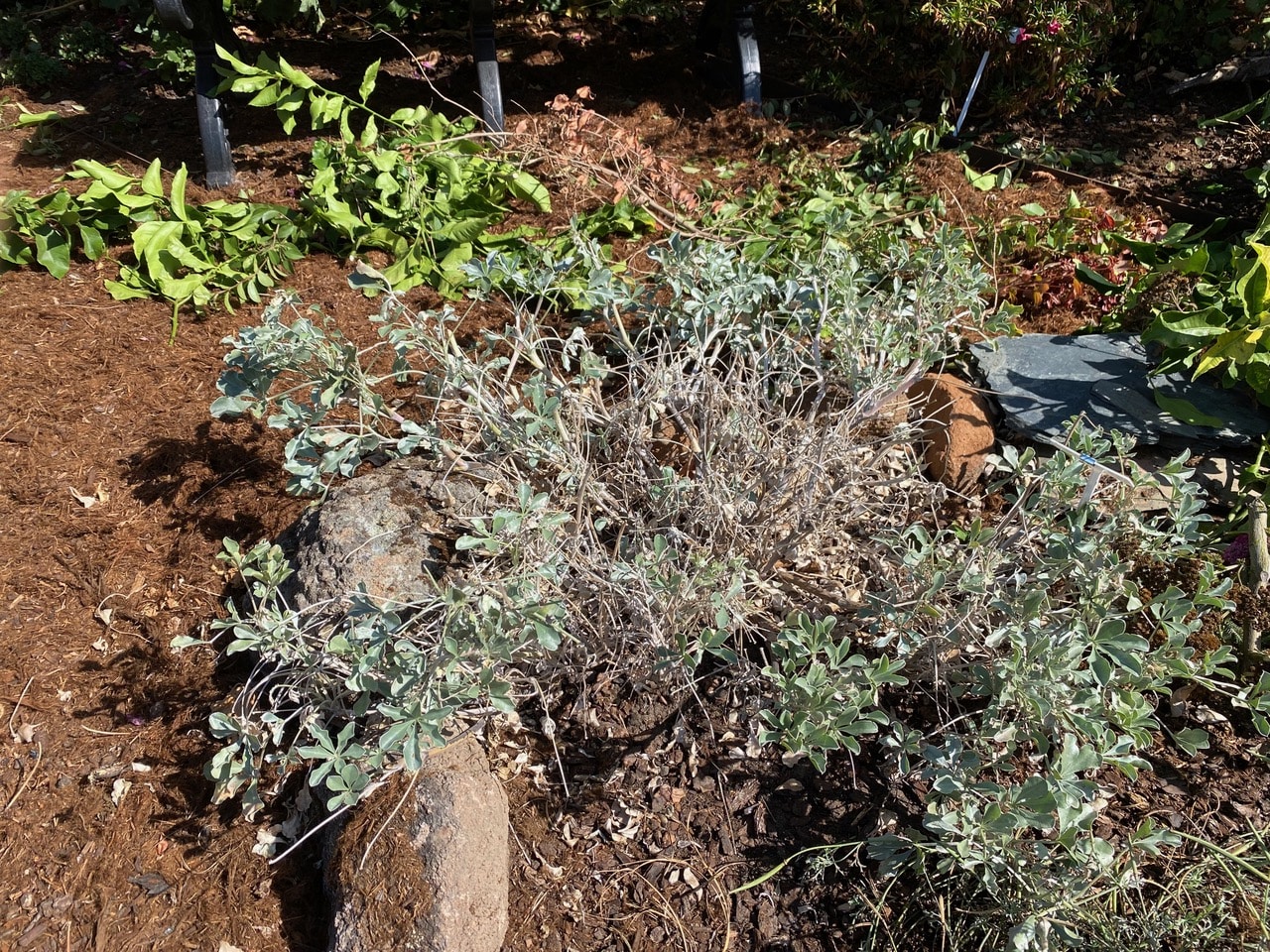
My heart sinks as I approach the Cobb Mountain Lupine, Lupinus sericatus “Cobb Mountain” in the backyard. The plant has been severely pruned back, probably because of the infestation of the Genista Broom Moth caterpillars. When I was here on 9/14, I have seen numerous Tachinid flies checking out the caterpillars. Today I have come expressly to further observe the interactions between the caterpillars and their parasitoids.
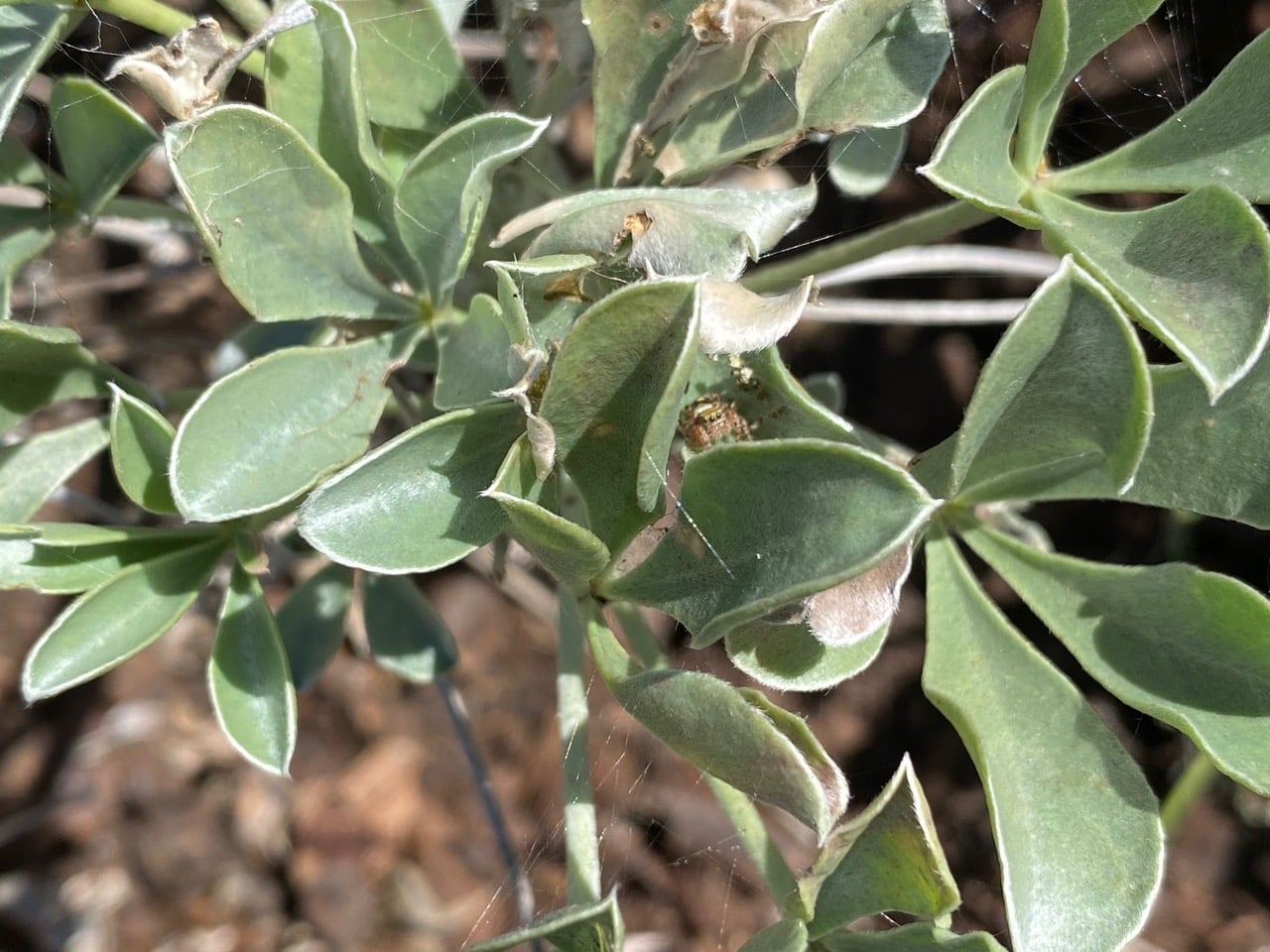
A small Jumping Spider stares back at me from the lupine foliage that has been spared, as disheartened as I. Its home and hunting ground has been much diminished .
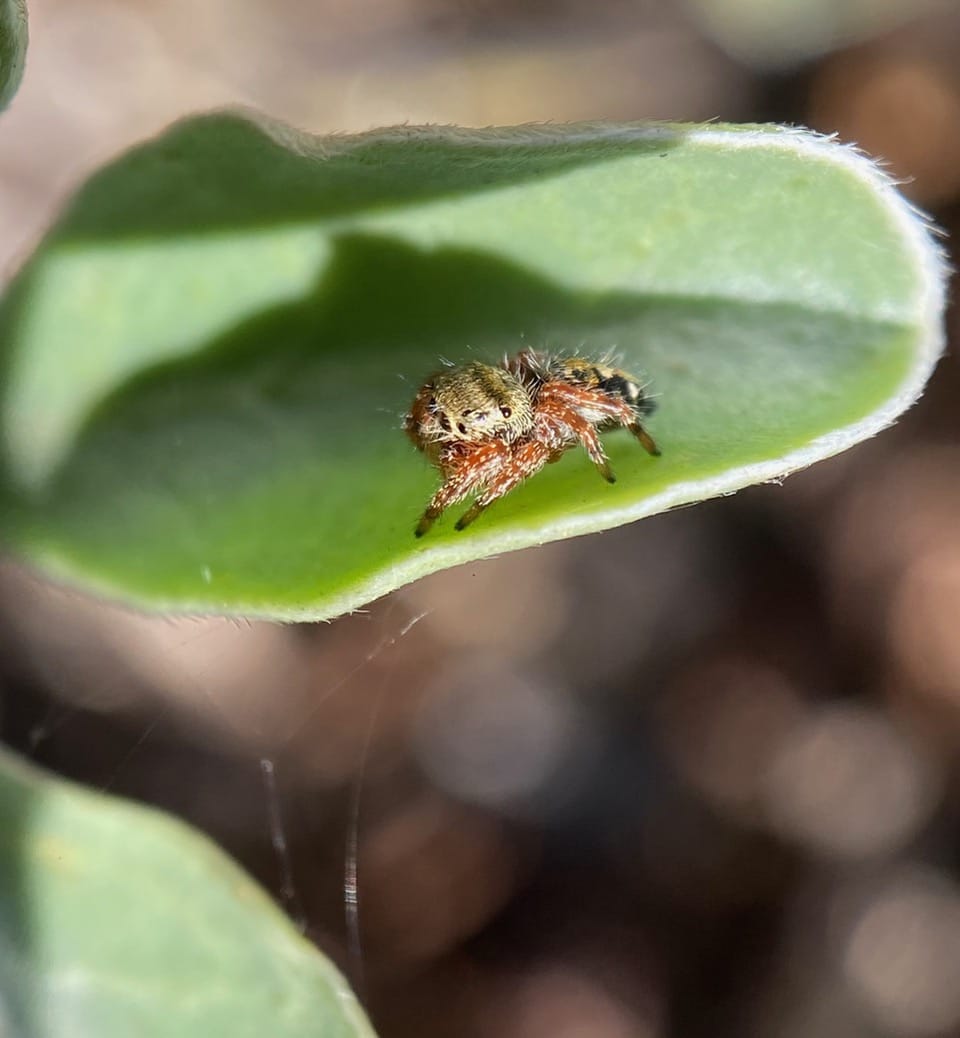
Jumping spiders (family Salticidae) are free-roaming hunting spiders. They do not weave a web to catch prey. They stalk, then pounce on their prey. Just before jumping, the spider fastens a safety line to the substrate. It can leap 10-20 times their body length to capture prey. Their movement is achieved by rapid changes in hydraulic pressure of the blood. Muscular contractions force fluids into the hind legs, which cause them to extend extremely quickly. Jumping spiders are visual hunters. Their excellent vision has among the highest acuities in invertebrates. Since all their 8 eyes are fixed in place and cannot pivot independently from the body like human eyes can, jumping spiders must turn to face whatever they want to see well. This includes moving their cephalothorax up and down, an endearing behavior.

iNaturalist has helped identify it as a Bold Jumping Spider, Phidippus audax (family Salticidae), probably a juvenile.
Phidippus audax (family Salticidae) is commonly referred to as Bold Jumping Spider. The species name, audax, is a Latin adjective meaning “audacious” or “bold”. These spiders are commonly found in grasslands, chaparrals, open woodlands, and agricultural fields. It is one of the most commonly occurring spider species within its range and is often found living in close proximity to humans. The adult female ranges from 8-15 mm in body length; the smaller males range from 6-13 mm. They are typically black with an ovoid abdomen and round cephalothorax. The presence of a large triangular white spot in the center of the abdomen with two smaller spots below it is often used to distinguish this species. These spiders are diurnal hunters, using their excellent eyesight for hunting, courtship and observational learning. They are often found hunting on fence posts and plant leaves, stems, and branches. At night, they hide in a crevice or small cavity and make a silk retreat to avoid predators. Bold jumpers prey on a variety of insects including caterpillars, dragonflies and grasshoppers, and other spiders. The species overwinters as immatures in sac-like silk shelters hidden underneath rocks and bark. Spiders emerge in the spring to complete their final molts, mating in late spring and early summer.

Jumping spiders have excellent vision, with among the highest acuities in invertebrates. The 8 eyes are grouped four on the face (the two big Anterior Median Eyes in the middle, and two smaller Anterior Lateral eyes to the side), and four on top of the carapace. The anterior median eyes provide high acuity but small field of view, while the other six eyes act like our peripheral vision, with lower resolution but broad field of view. Since all eight eyes are fixed in place and can’t pivot independently from the body like human eyes can, jumping spiders must turn to face whatever they want to see well. This includes moving their cephalothorax up and down, an endearing behavior.

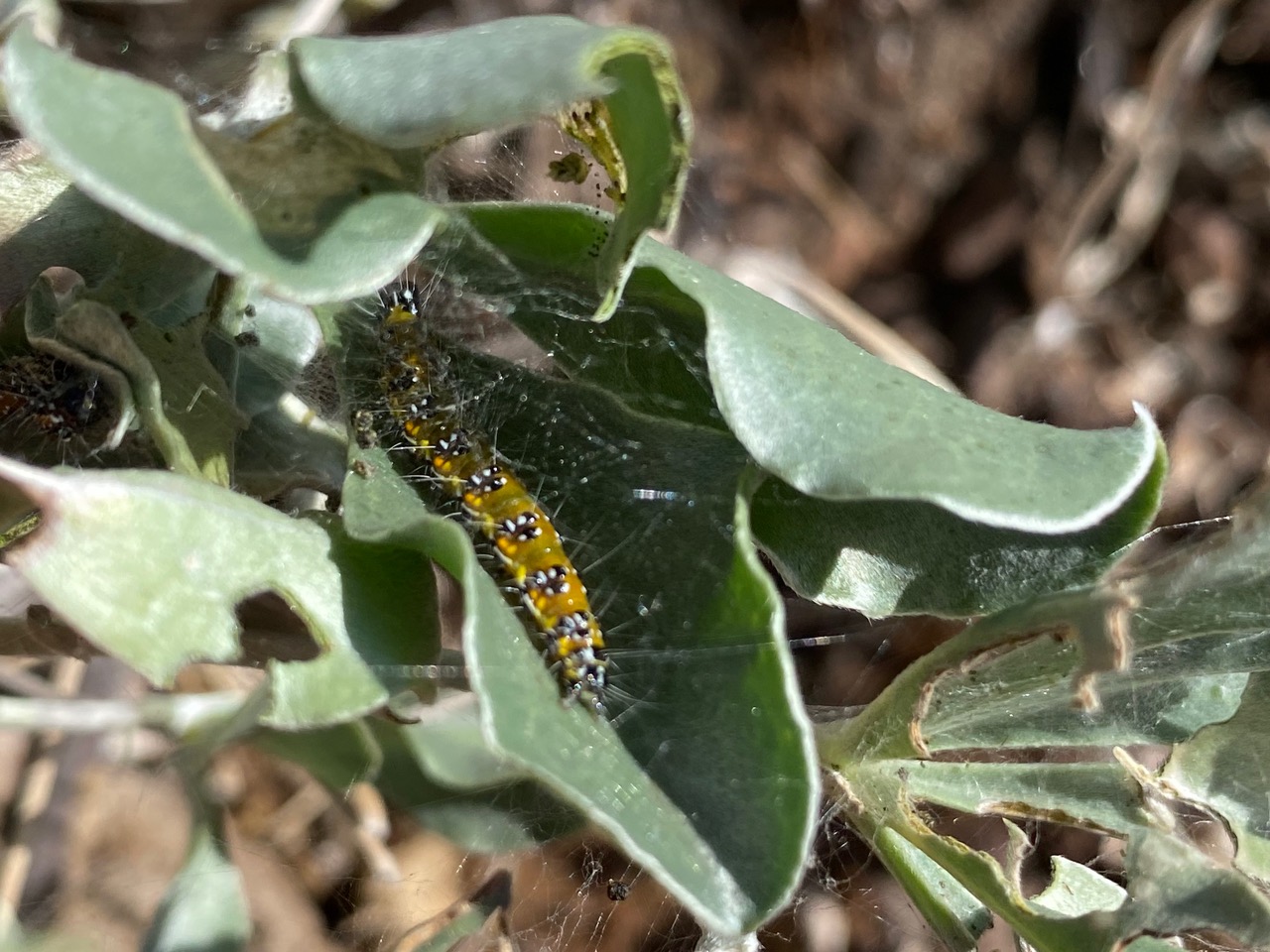
Hey, all is not lost! A few caterpillars of the Genista Broom Moth, Uresiphita reversalis (family Crambidae) have survived the cull, each frantically spinning silk webs to secure themselves on the remaining leaves.
Genista Broom Moth females lay eggs in batches of up to about 70. The tiny, newly hatched caterpillars are green and blend in with the foliage. Larger caterpillars are brownish-green with raised black spots and bright yellow patches on each segment. Each black spot has a white dot at the tip that sports sparse, long hairs. The head is black with white dots as well. Genista caterpillars ingest and store alkaloids from their host plants, which make the larvae bitter and even toxic to mammals and birds, and some insect predators. The species overwinters in cocoons on or near the base of their host plants and the adults emerge the following year. There can be 4-5 generations per year in their southern range. They can become abundant enough to cause extensive defoliation.
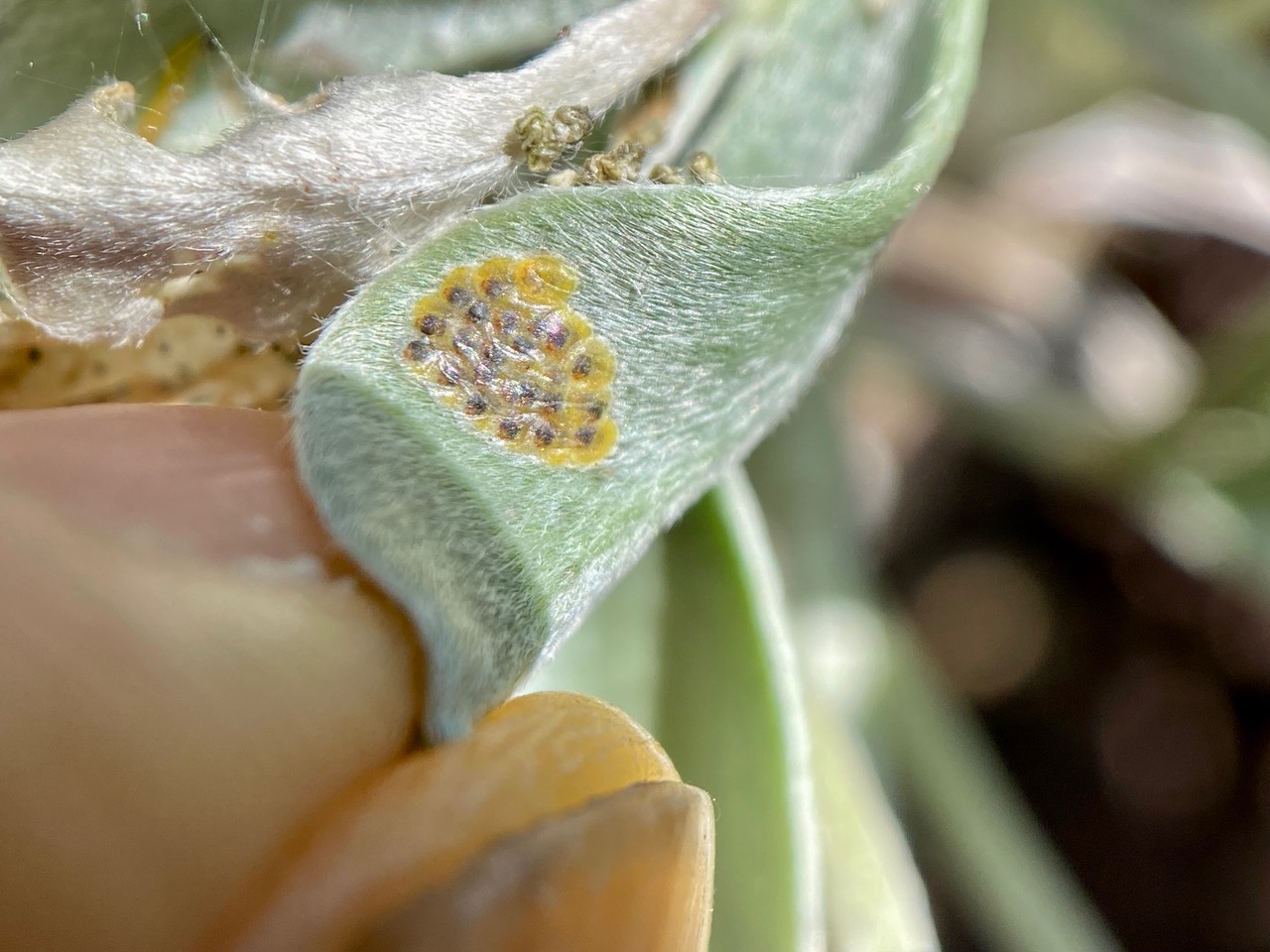
I lift a leaf to have a better look at a very tiny caterpillar, and find this strange cluster on the underside of the leaf. Are these the eggs of the Genista Broom Moth?
Genista Broom Moth eggs are laid in clusters on the underside of host plant leaves. The clusters are generally yellow, and appear like overlapping fish scales. The eggs are usually deposited on the newest growth, as the young leaves are preferred by the larvae. The newly hatched larvae will feed in groups on the leaves, forming a protective web. As the caterpillars grow larger, they become solitary feeders.

Ooh, here’s a tiny caterpillar…
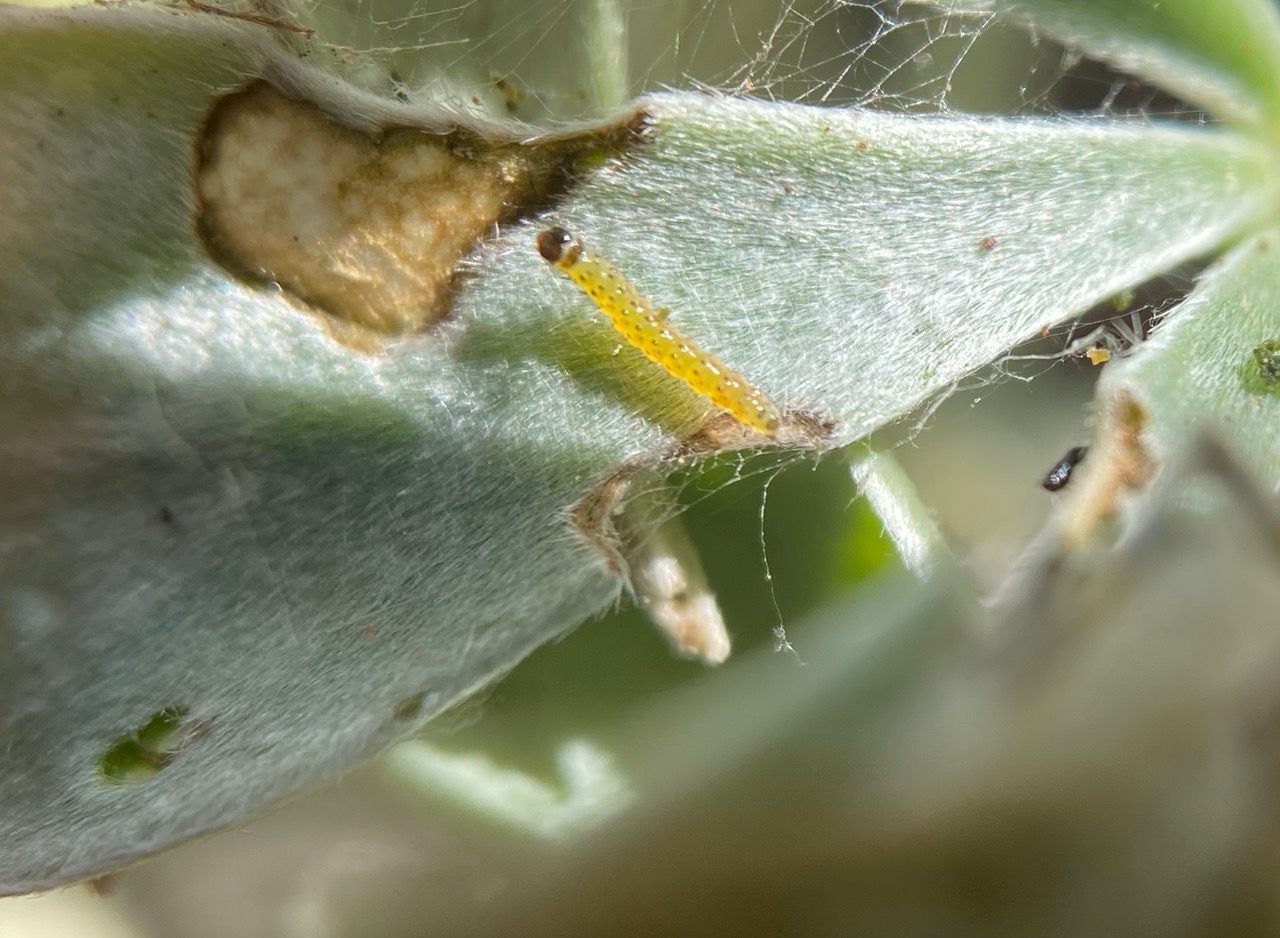
… and a slightly larger one.
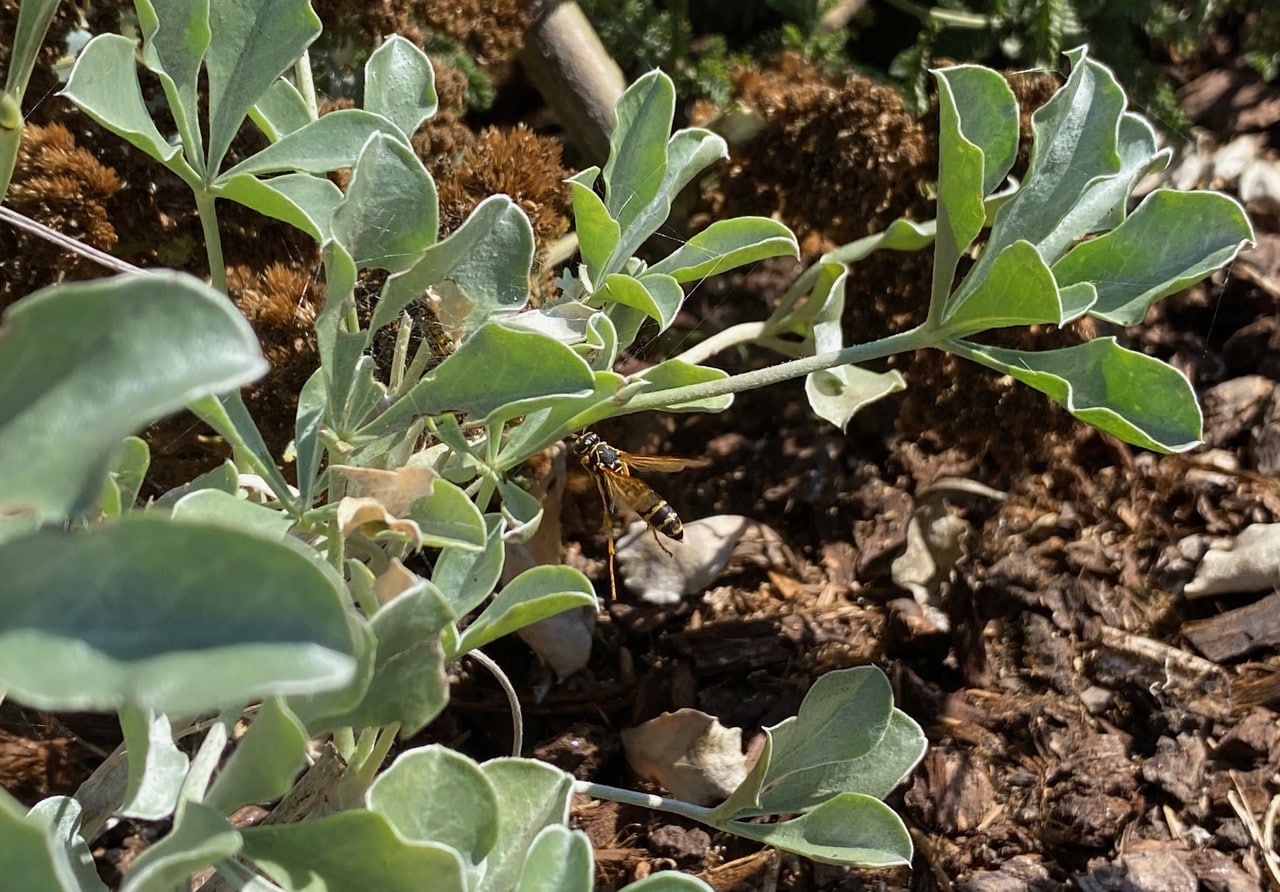
I spot a large caterpillar busy spinning silk among the terminal leaves on a branch further away. Just then, a European Paper Wasp flies in to investigate.
Native to Europe, the European Paper Wasp, Polistes dominula, is a social insect that produces an annual colony in a paper nest. Individual colonies are established anew each spring. The overwintering stage are mated females (queens). The overwintered queens emerge from sheltered spots in spring and search out sites to establish a new colony. Nests are constructed of paper, produced from chewed wood fibers of weathered fences, porch decks and other similar sources. Larvae are fed crushed insects, usually caterpillars. As the population increases, the original queen increasingly remains in the nest as new workers take over colony activities. A few of the wasps produced later in summer are males and increasing numbers of the females become sexually mature. Mating occurs and the mated females are the surviving overwintering stage. Males and non-reproductive females do not survive winter and the nest is abandoned by late fall. European Paper Wasps will sometimes feed on sweet materials, including honeydew produced by aphids. They may also feed on damaged ripe fruits. Because of their habit of hunting caterpillars, the wasps have become one of the most important natural controls of garden pests.
European Paper Wasp (Polistes dominula) · iNaturalist

The wasp lands lower down on the foliage and makes its way excitedly towards its target.
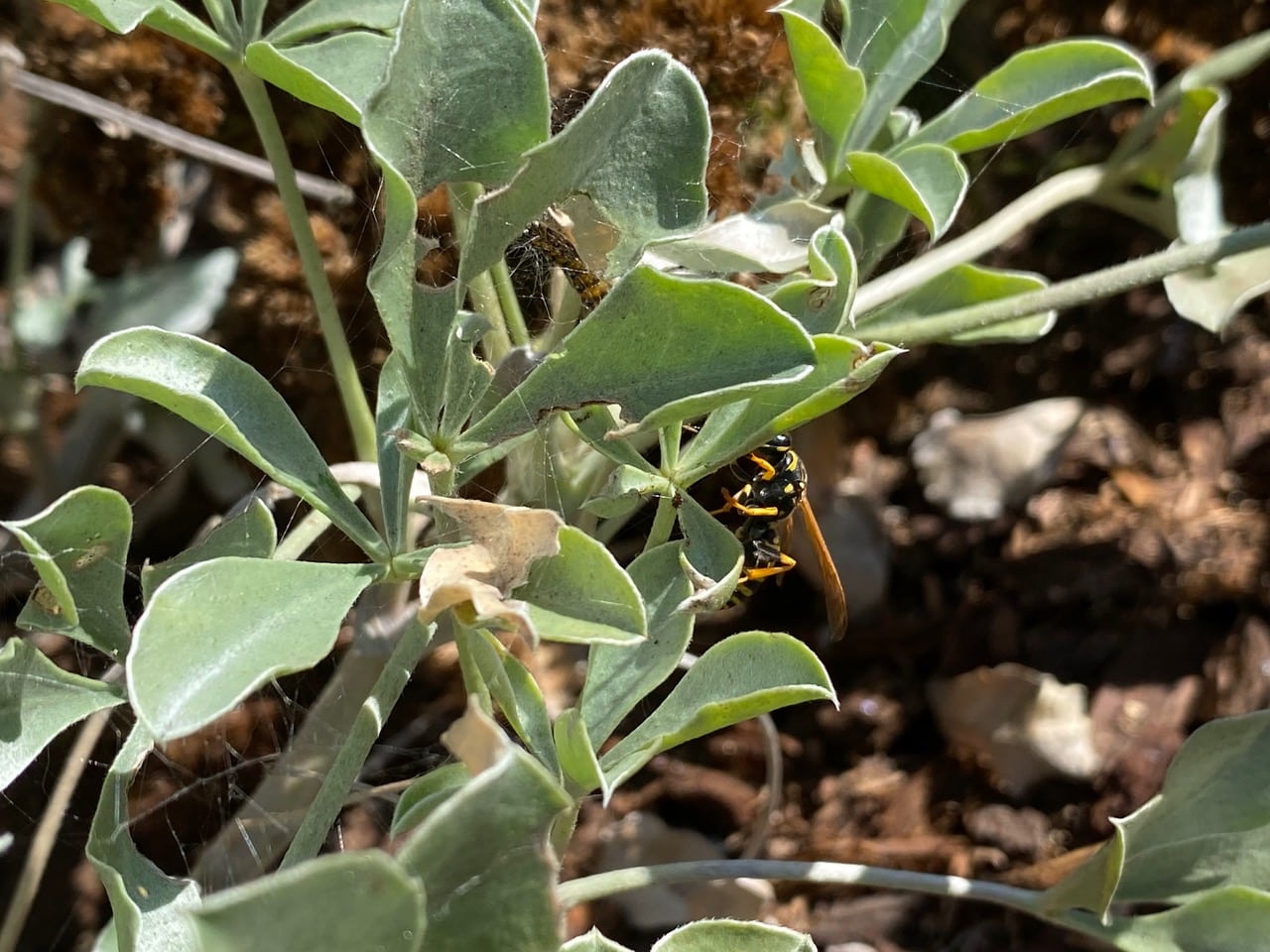
I watch with bated breath as the wasp closes in on the caterpillar.

In a split second, the caterpillar has disappeared from its perch. The wasp is now struggling with its prey, biting to subdue it.
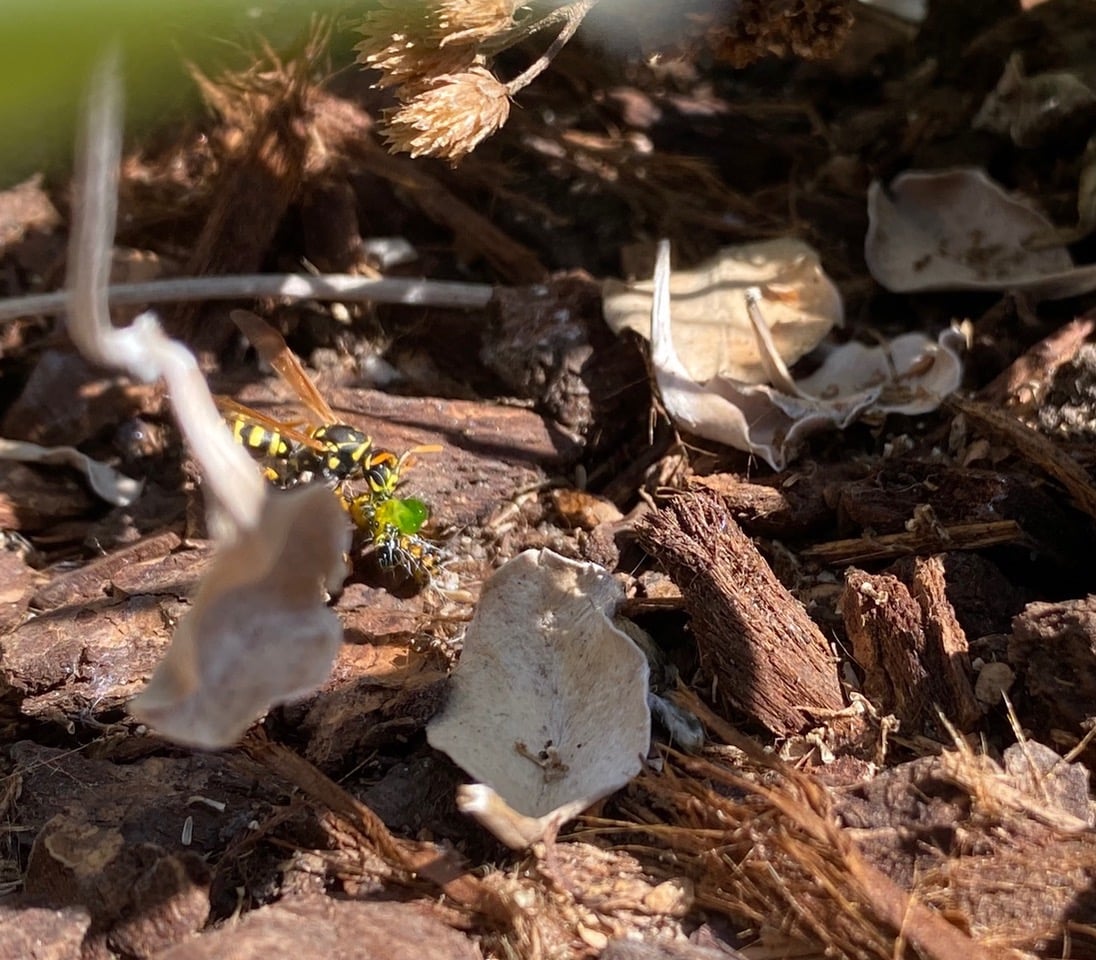
The wasp runs with the caterpillar down the stem to the ground where it dispenses more bites causing the caterpillar to bleed a bright green goo. The wasp picks up the mortally wounded caterpillar in its jaws and disappears further into the shadows. I thought that was the last I see of the pair, but about a minute later, the wasp flies out from under the bush with a bolus of minced caterpillar triumphantly held between its legs. Wow, what a spectacle!
Paper wasps have mouthparts that are well-developed with strong mandibles for capturing and chewing insects. They also have probosces for sucking nectar, fruit, and other juices. Adults feed on liquid foods rich in sugars and carbohydrates such as plant nectar, honeydew and fallen fruit. They also search for foods high in protein such as insects, particularly caterpillars. They subdue the prey, chew it into a soft, pulpy ball, and then transport this back to the nest to feed the developing larvae in the their cells. The larvae secrete a sugary substance that is eaten by the adults in an exchange known as trophallaxis. This communal feeding behavior is common in social wasps and is a form of direct communication that reinforces social bonds within the colony.
It appears that besides being targets of the parasitoid Tachinid Flies that I saw last time, the Genista caterpillars are vulnerable to predators such as the European Paper Wasps and Yellowjackets. These biological pest control mechanisms are already in place in the garden! I wonder what else might have been brewing around the infestation. Every time we intervene in the process, we lose an opportunity to study the dynamic interactions that go on in our garden ecosystem right under our noses. A little patience, humility, and detached observation can go a long way to help us learn how to better care for our piece of the planet. Oftentimes I find that no action on our part is necessary.