

Pollinator Post 10/6/25
Anticipating a hot day, I take my walk on the shady Bridal Trail in the Reinhardt Redwood Regional Park this morning. While nothing is in bloom now, there’s still plenty of insect activity on the shrubbery along the trail.
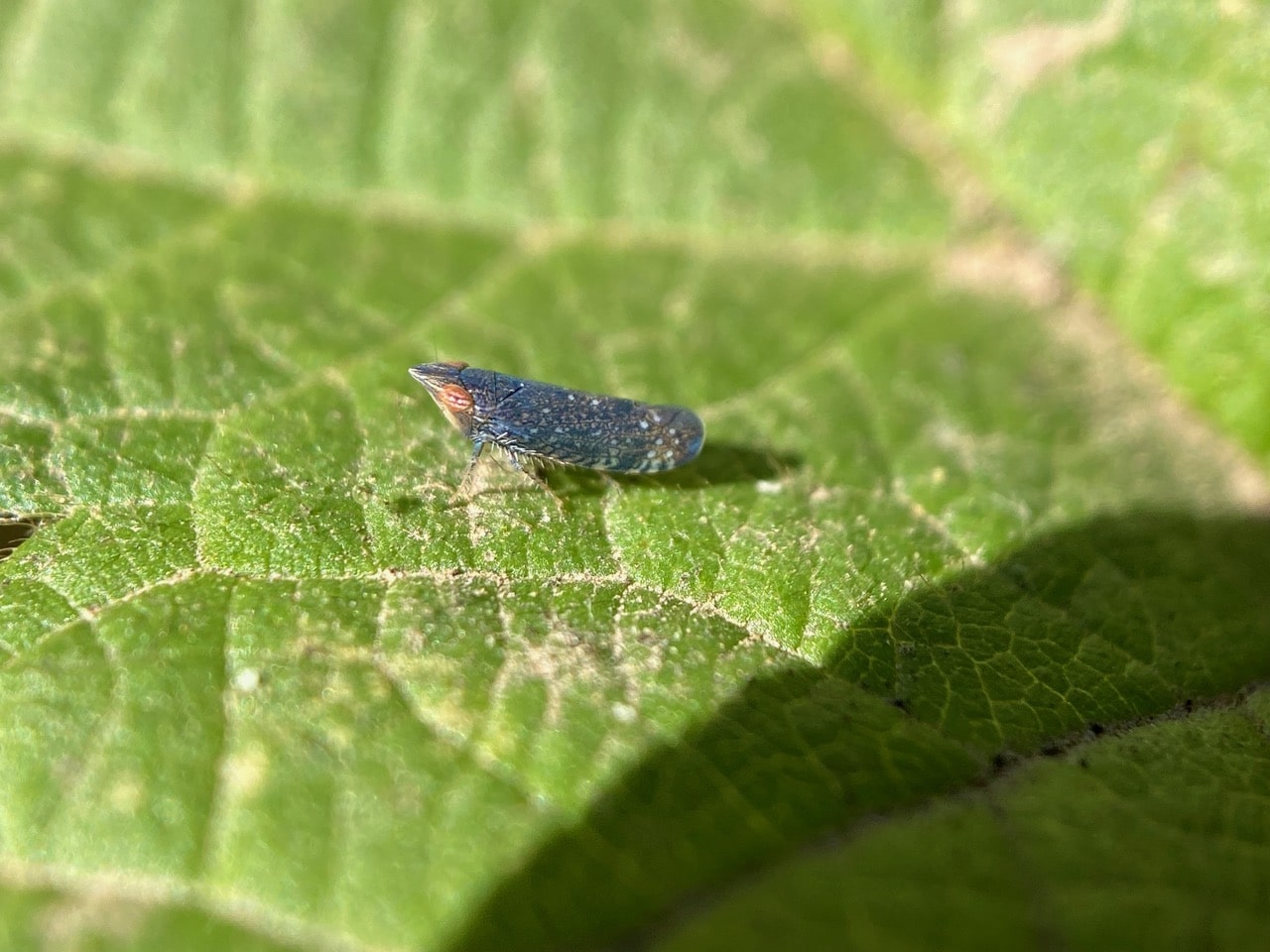
What looks at first glance like a sliver of plant debris on a Blackberry leaf turns out to be a Yellow-faced Leafhopper, Scaphytopius frontalis (family Cicadellidae). This tiny leafhopper (about 4-5 mm long) is found in grassy, weedy, brushy areas and forest habitats.
Yellow-faced Leafhopper (Scaphytopius frontalis) · iNaturalist
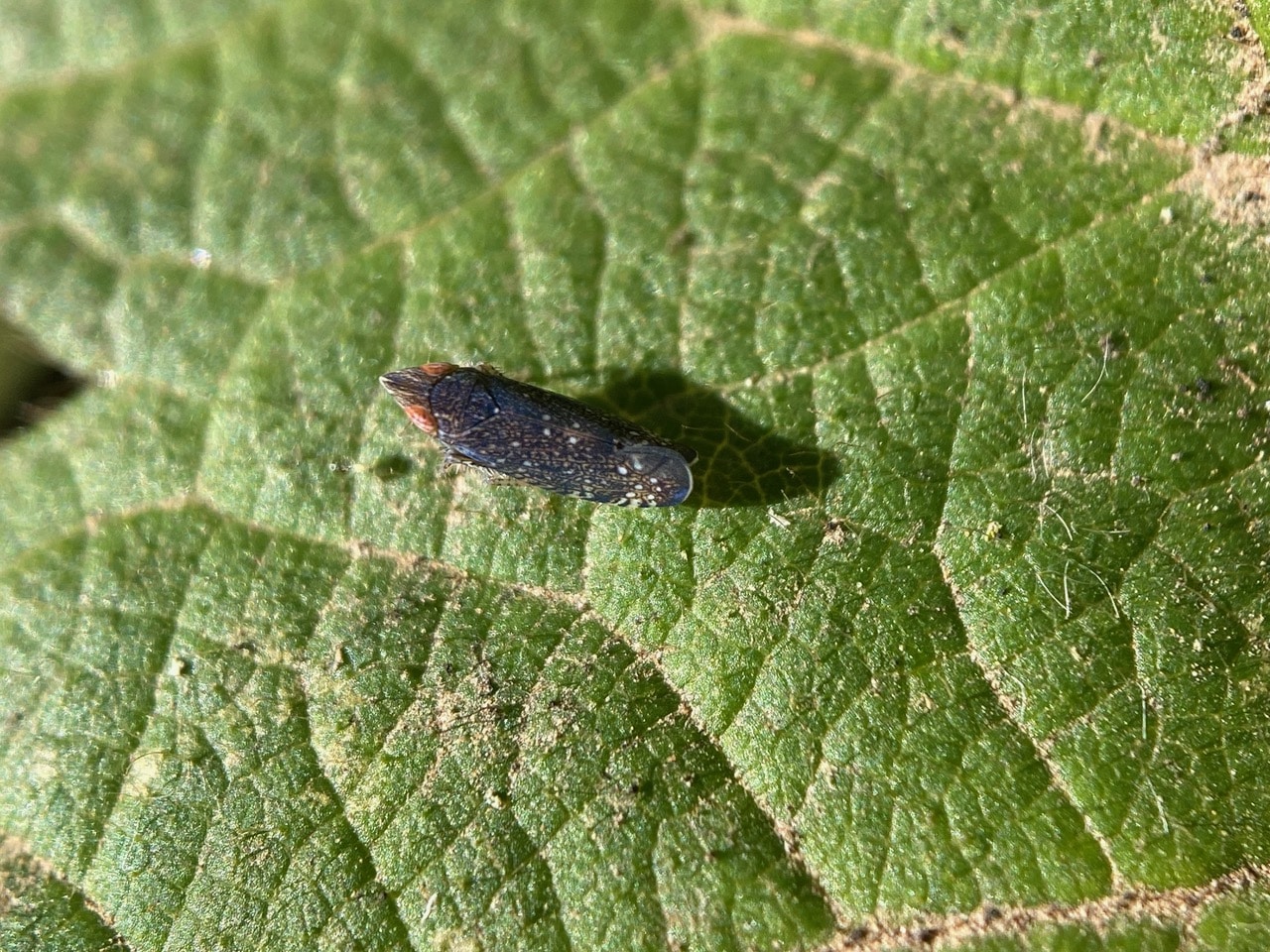



Dorsal view of the same insect.
Leafhopper is the common name given to true bugs in the family Cicadellidae. The bugs are plant feeders that suck plant sap from grass, shrubs, or trees. Their hind legs are modified for jumping, and are covered with hairs that facilitate the spreading of a secretion over their bodies that act as a water repellent and carrier of pheromones. They undergo partial metamorphosis, and have various host associations, varying from very generalized to very specific.
While sucking the sap of plants, these insects excrete any extra sugar as a sticky liquid commonly called honeydew. This is a serious hazard for small insects, possibly sticking the insect to a leaf, or gluing its body parts together. Some bugs deal with this problem by shooting the waste away from their bodies at high speed. Leafhoppers have a unique solution – they make brochosomes, a proteinaceous material within a special gland in their guts, and secrete them by the billions in a milky anal fluid, and spread them over their bodies using their legs. When the fluid dries, the brochosomes form a powdery coating, and the leafhoppers spread them even further using comb-like hairs on their legs. The brochosomal coat is superhydrophobic, and acts as a water-repellent, non-stick coating protecting the leafhoppers from their own sticky exudates.
Just two inches away on the same leaf is this golden creature, similarly shaped with a pointed snout. It has a bristly abdomen not covered by wings. Instead, it has the wing pads of a nymph. I am willing to bet that it is an immature Yellow-faced Leafhopper, Scaphytopius frontalis (family Cicadellidae).
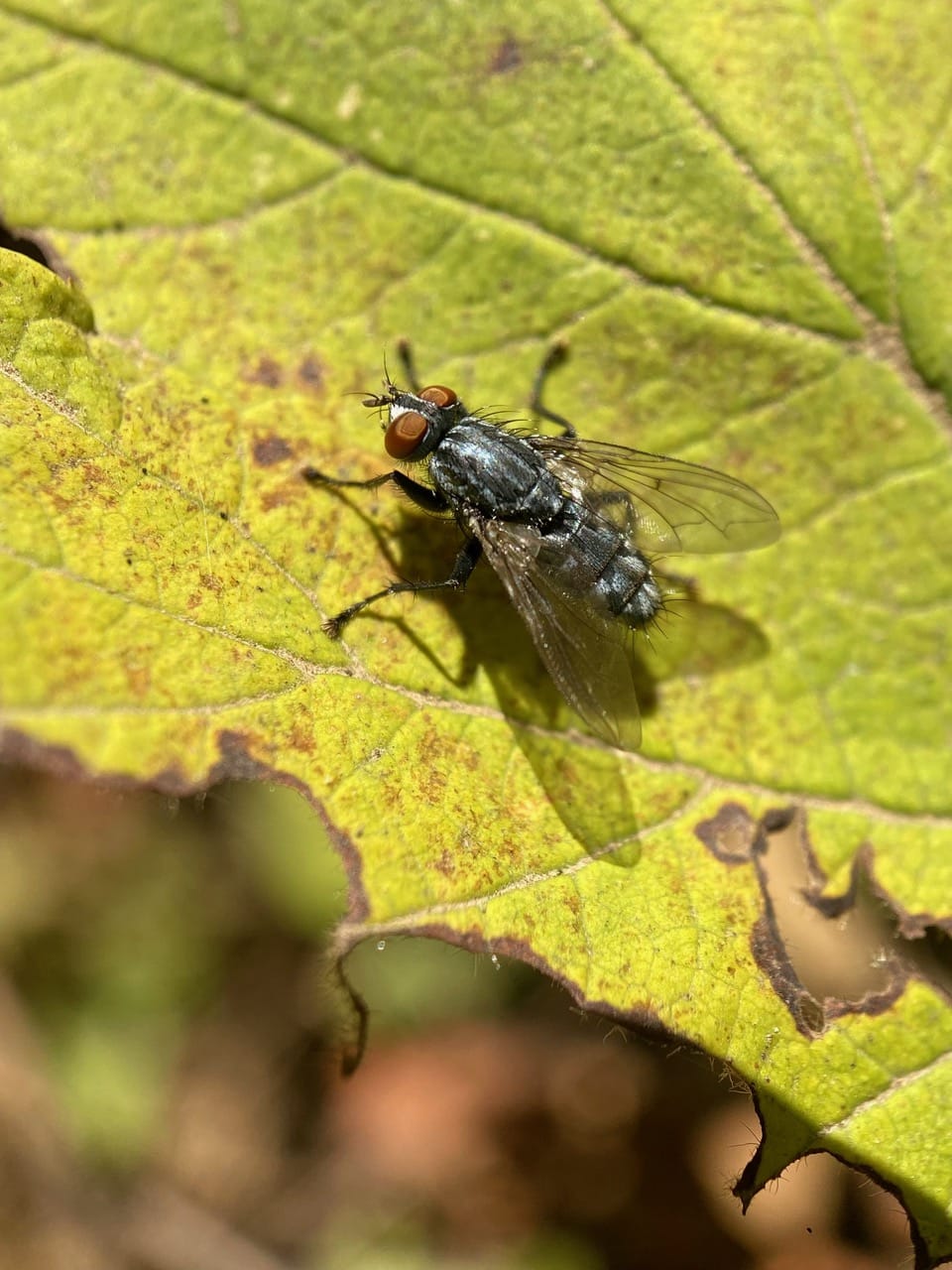
The most common insect along this stretch of sun-lit shrubbery is the Flesh Flies (family Sarcophagidae).
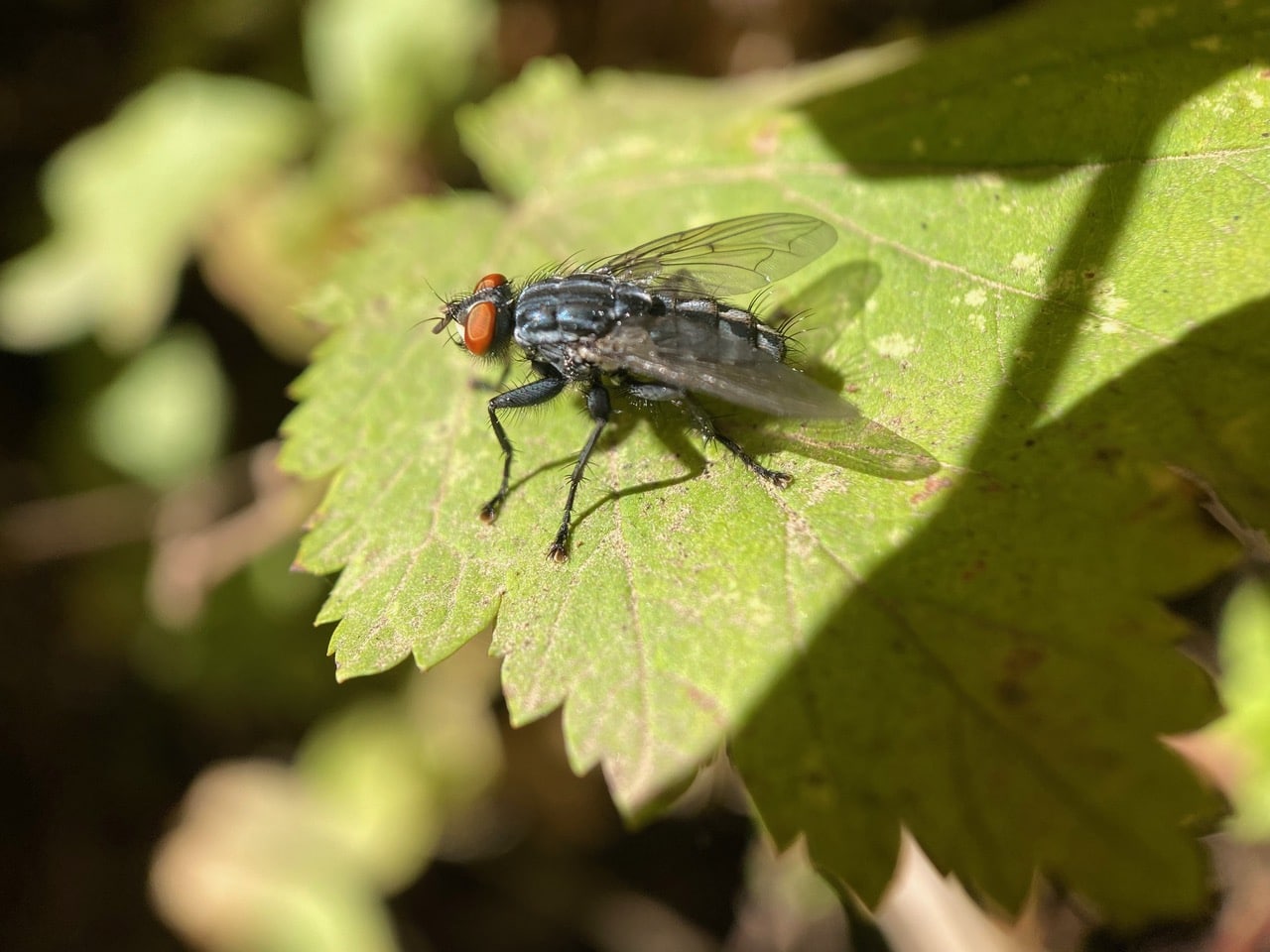
Members of the family Sarcophagidae are commonly called Flesh Flies. Many have black and gray longitudinal stripes on the thorax and checkering on the abdomen, red eyes, and a bristled abdomen sometimes with a red tip. They differ from most flies in that they are ovoviviparous, opportunistically depositing hatched or hatching maggots instead of eggs on carrion, dung, decaying material, open wounds of mammals, hence their common name. The adults mostly feed on fluids from animal bodies, nectar, sweet foods, fluids from animal waste and other organic substances. While we may find their habits disgusting, Flesh Flies perform important roles in the ecosystem – the larvae as decomposers/recyclers, and the adults as pollinators.
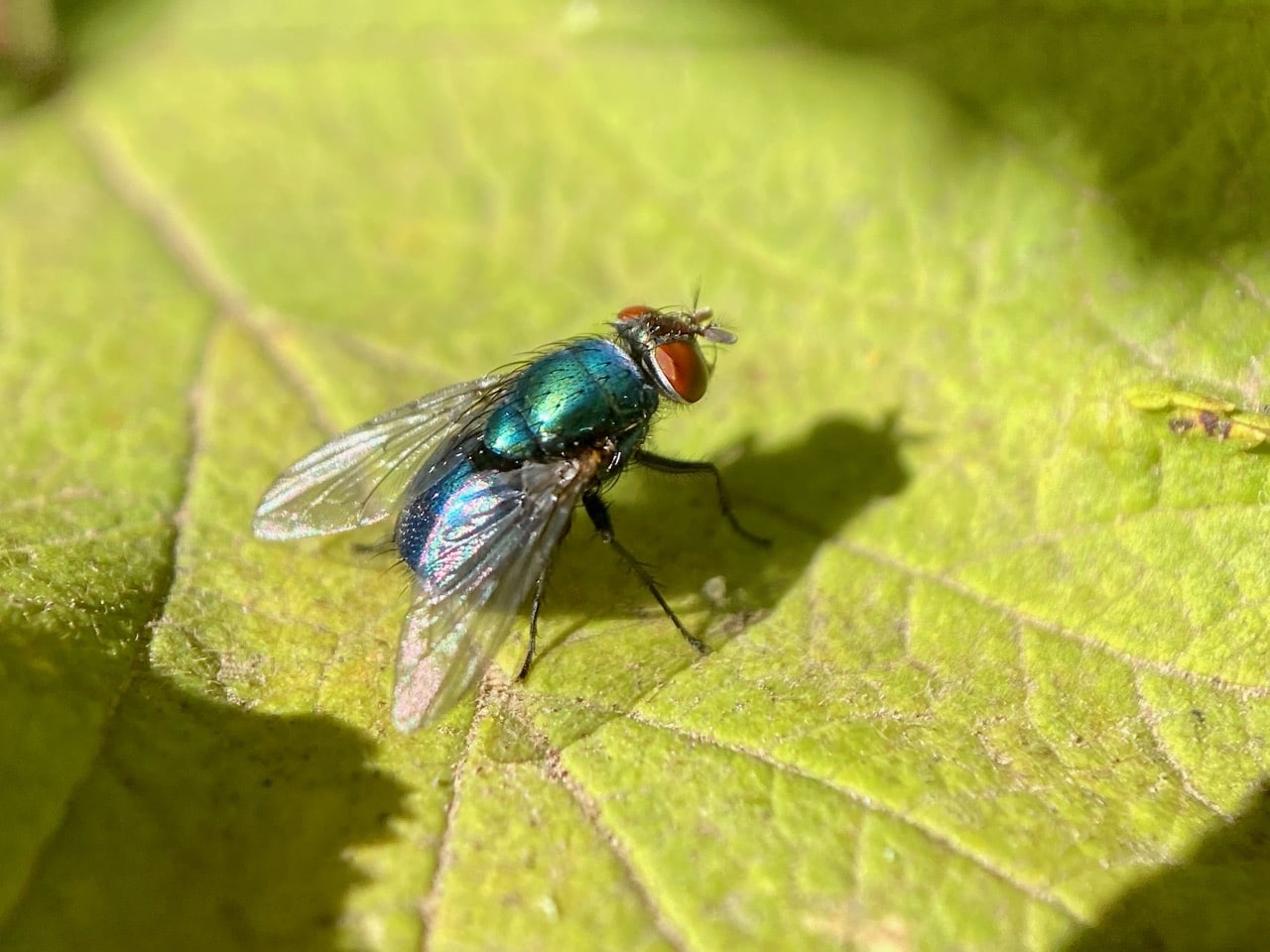
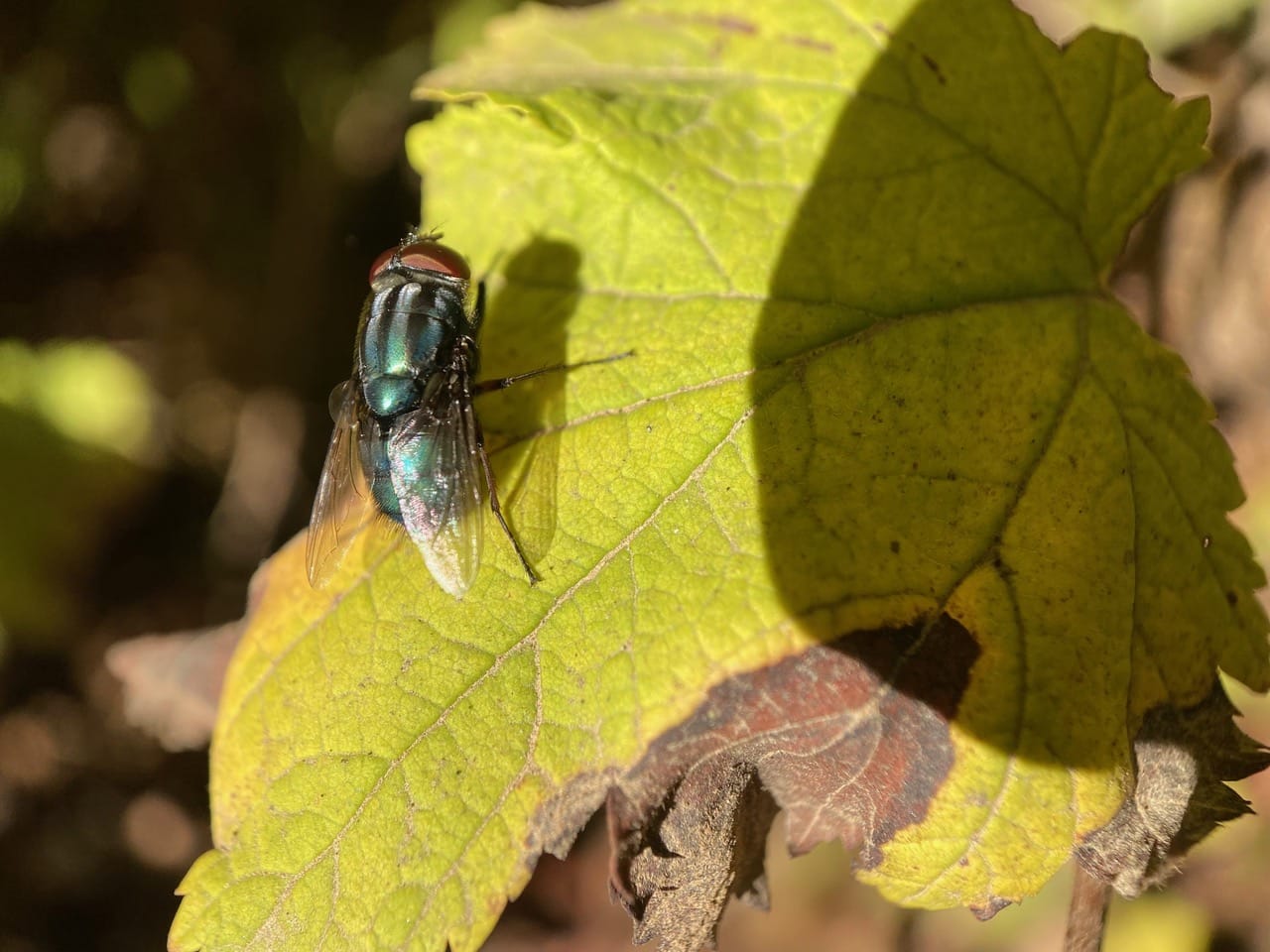
A Common European Greenbottle Fly, Lucilia sericata (family Calliphoridae) has landed on a yellowing leaf of Pacific Ninebark, Physocarpus capitatus. The fly is another important decomposer/recycler of organic matter.
The Common European Greenbottle Fly is a Blowfly found in most areas of the world and is the most well-known of the numerous green bottle fly species. The lifecycle of Lucilia sericata is typical of blowflies. Females lay masses of eggs in fresh carrion. The flies are extremely prolific – a single female may produce 2,000 to 3,000 eggs in her lifetime. The larvae feed on dead or necrotic tissue, passing through 3 larval instars. Third-instar larvae drop off the host to pupate in the soil. The adults feed opportunistically on nectar, pollen, feces, or carrion; they are important pollinators as well as important agents of decomposition. Pollen is used as an alternative protein source, especially for gravid females who need large amounts of protein and cannot reliably find carrion.
Glinting in the sunlight is another pretty Blowfly, Compsomyiops callipes (family Calliphoridae).
The Blowfly, Compsomyiops callipes is a warm weather fly that is found in southwestern parts of the United States and parts of South America. About 5-8 mm in size, the fly has a metallic blue-green sheen with three dark longitudinal stripes on the thorax. The fly is attracted to carrion, being able to smell carrion from up to 10 miles away. Much study has been done on the life cycle of the species, as it serves an important role in the field of forensic entomology, helping investigators solve crime cases involving human remains. The fly’s life cycles allow the entomologist to determine the post mortem interval (their age and how long they have been present on the corpse based on their succession pattern).
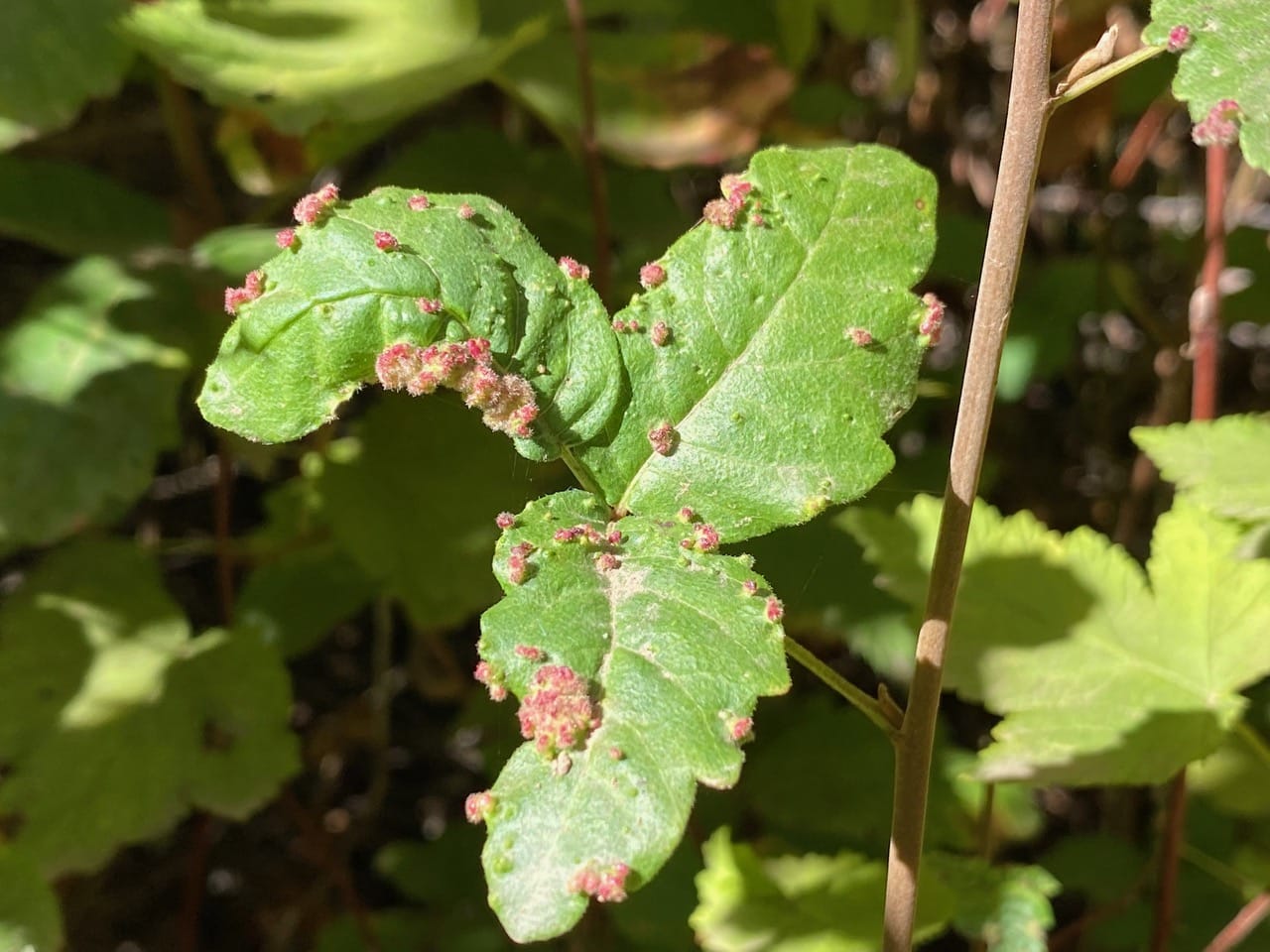
That Pacific Poison Oak, Toxicodendron diversilobum appears to be suffering from a rash. Nature has a wicked sense of humor!
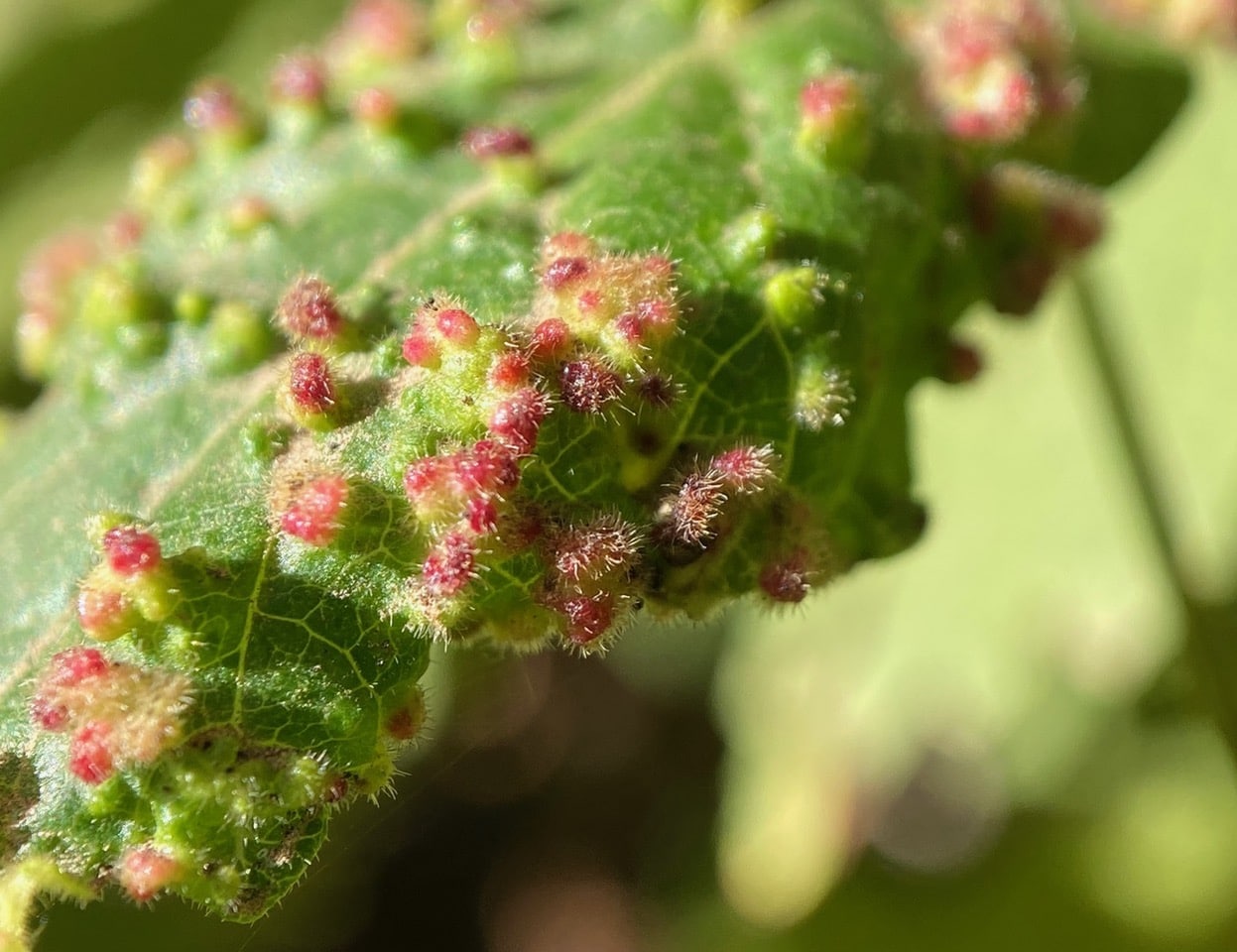
The wrinkled red growths on the Poison Oak leaf are covered with short white hairs. These growths are leaf galls induced by Gall Mites in the family Eriophyidae.
Eriophyid Mites are microscopic mites that often go undetected. Unlike most adult mites that have four pairs of legs, eriophyid mites have only two pairs. They are slow-moving, usually white or yellow in color, and have a distinctive “carrot” shape. They are very host-specific. Most eriophyid mites make their home on the surface of leaves where their feeding can cause bronzing or reddening but some are also responsible for creating galls on leaves or witches’-broom on stems and flower buds. Adult females overwinter in cracks and crevices of twigs and bud scales. Females lay eggs in the spring. The young mites that hatch out resemble the adults. Numerous generations are produced each year. They are primarily spread by wind.
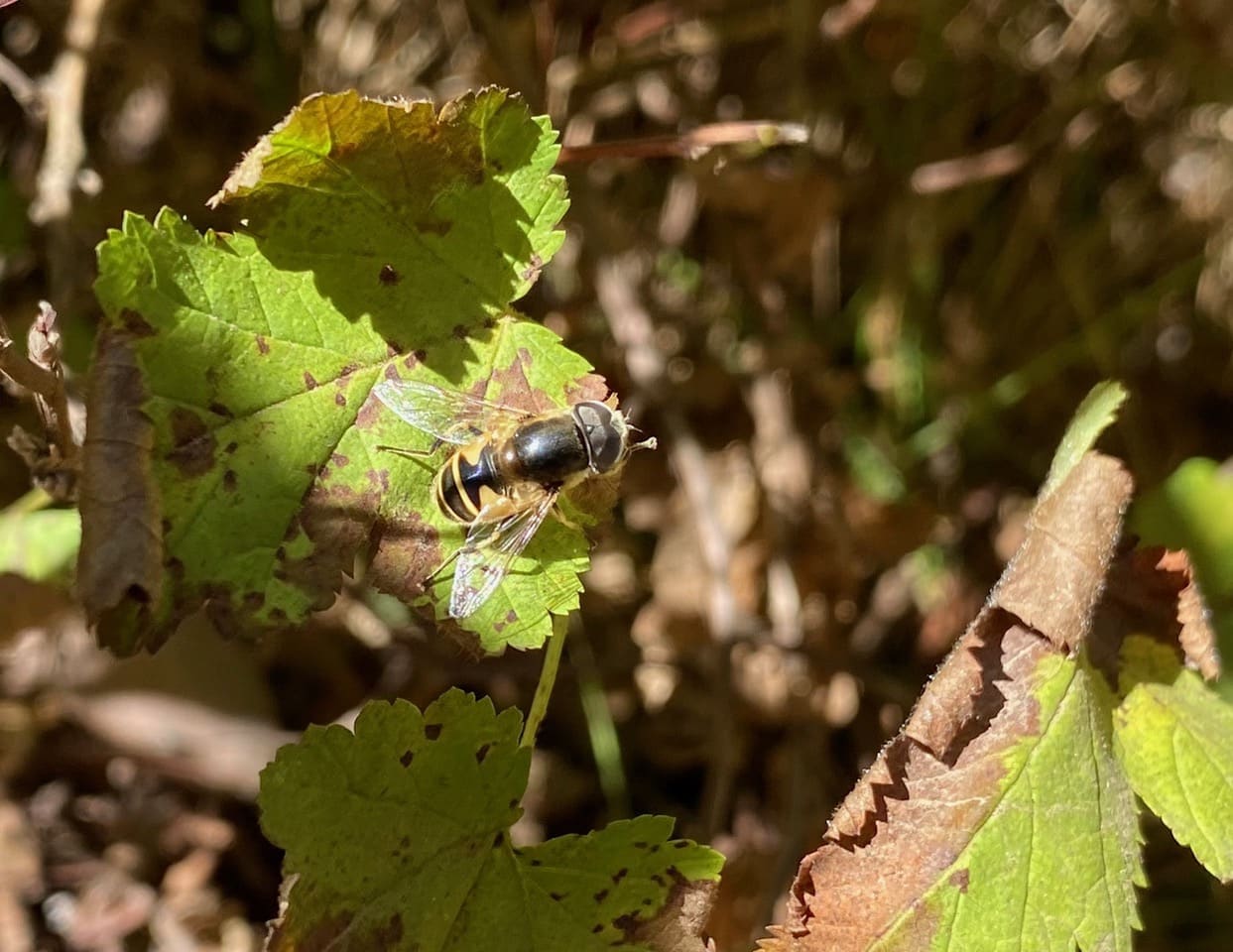
A Black-footed Drone Fly, Eristalis hirta (family Syrphidae) alights on a senescing leaf of Pacific Ninebark.
Hover flies, also called Syrphids, make up the insect family Syrphidae. They are commonly seen hovering or nectaring at flowers. The adults of many species feed mainly on nectar and pollen, while the larvae (maggots) eat a wide range of food. In some species, the larvae are saprotrophs, specifically detritivores, eating decaying plant and animal matter in the soil or in ponds and streams. In other species, the larvae are insectivores, preying on aphids and other soft-bodied insects.
The Black-footed Drone Fly, Eristalis hirta is found in Western North America and Northern Europe in raised bogs, ditches and temporary pools. The larvae are aquatic, occurring in shallow, nutrient rich standing water and in cow manure and compost heaps. Also known as “rat-tailed maggots”, the larvae have a siphon on their rear end that acts like a snorkel, helping them breathe under water. The siphon can be several times the length of the larva’s body. The larvae are saprophagous, feeding on bacteria in stagnant water rich in decomposing organic matter.
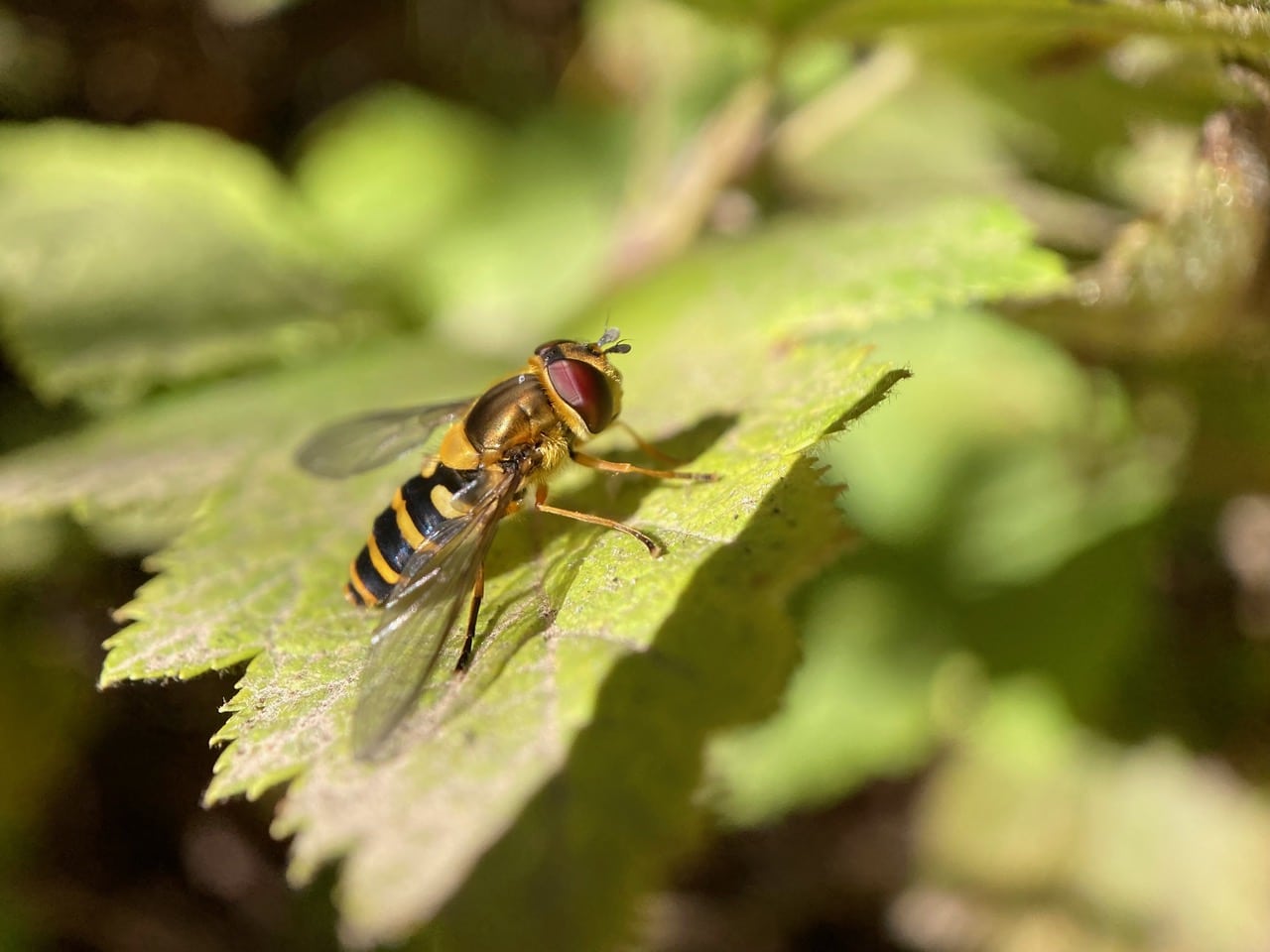
With its prominent black-and-yellow striped abdomen, the Common Flower Fly, Syrphus sp. (family Syrphidae) is a classic Batesian mimic of a bee or wasp.
Hover flies (family Syrphidae) are often mistaken for bees. This is called Batesian Mimicry after Henry Walter Bates who studied butterflies (among other things) in the Amazon and first described the phenomenon of harmless species mimicking unrelated harmful species as a form of protection from predators. Hover flies that mimic bee species make predators think twice before grabbing them.
Members of the genus Syrphus have long hairs on the lower lobe of the calypter. Adults visit flowers for nectar and pollen. Females seek out aphid colonies to lay their eggs, as their larvae feed on aphids.
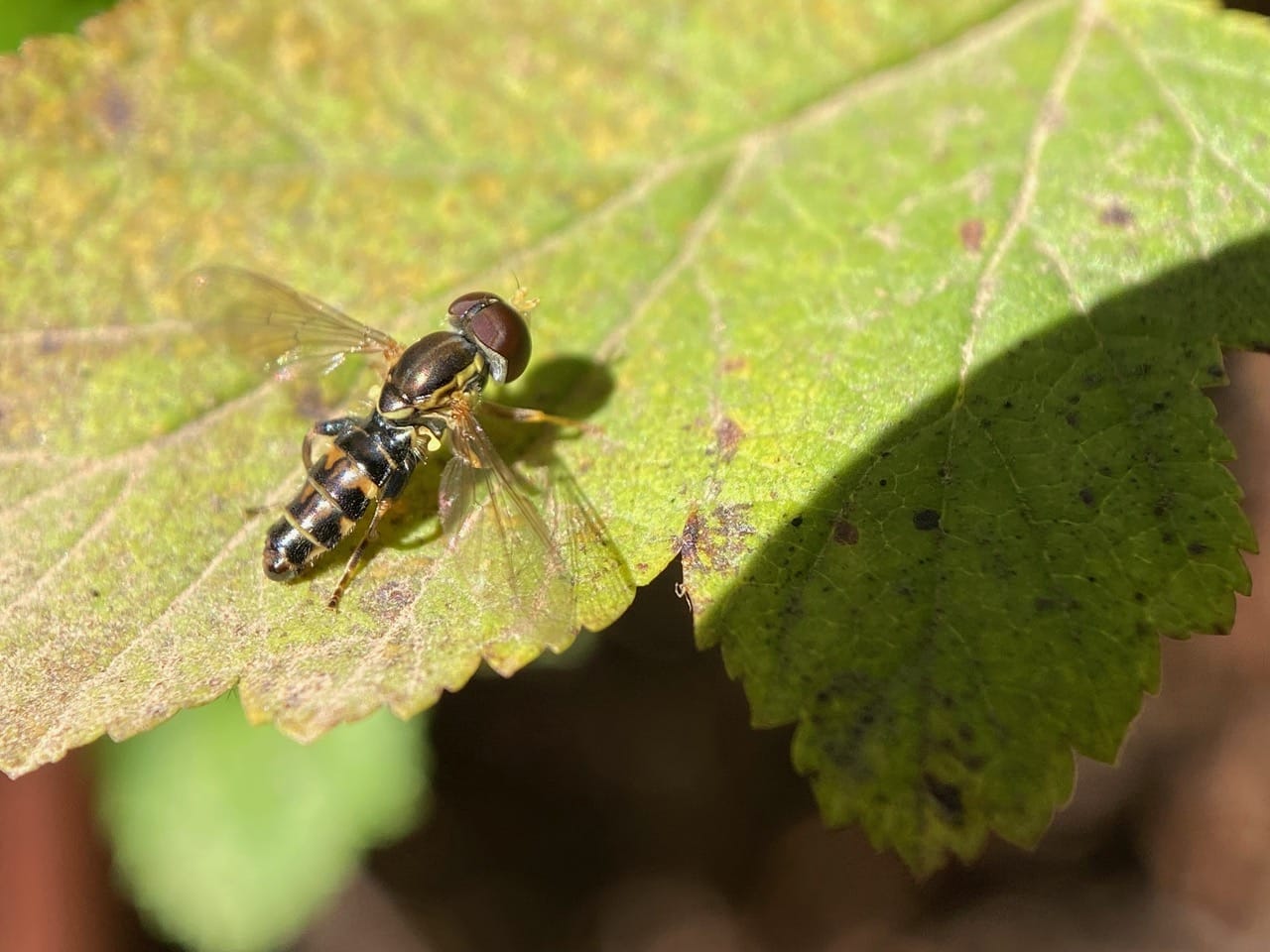
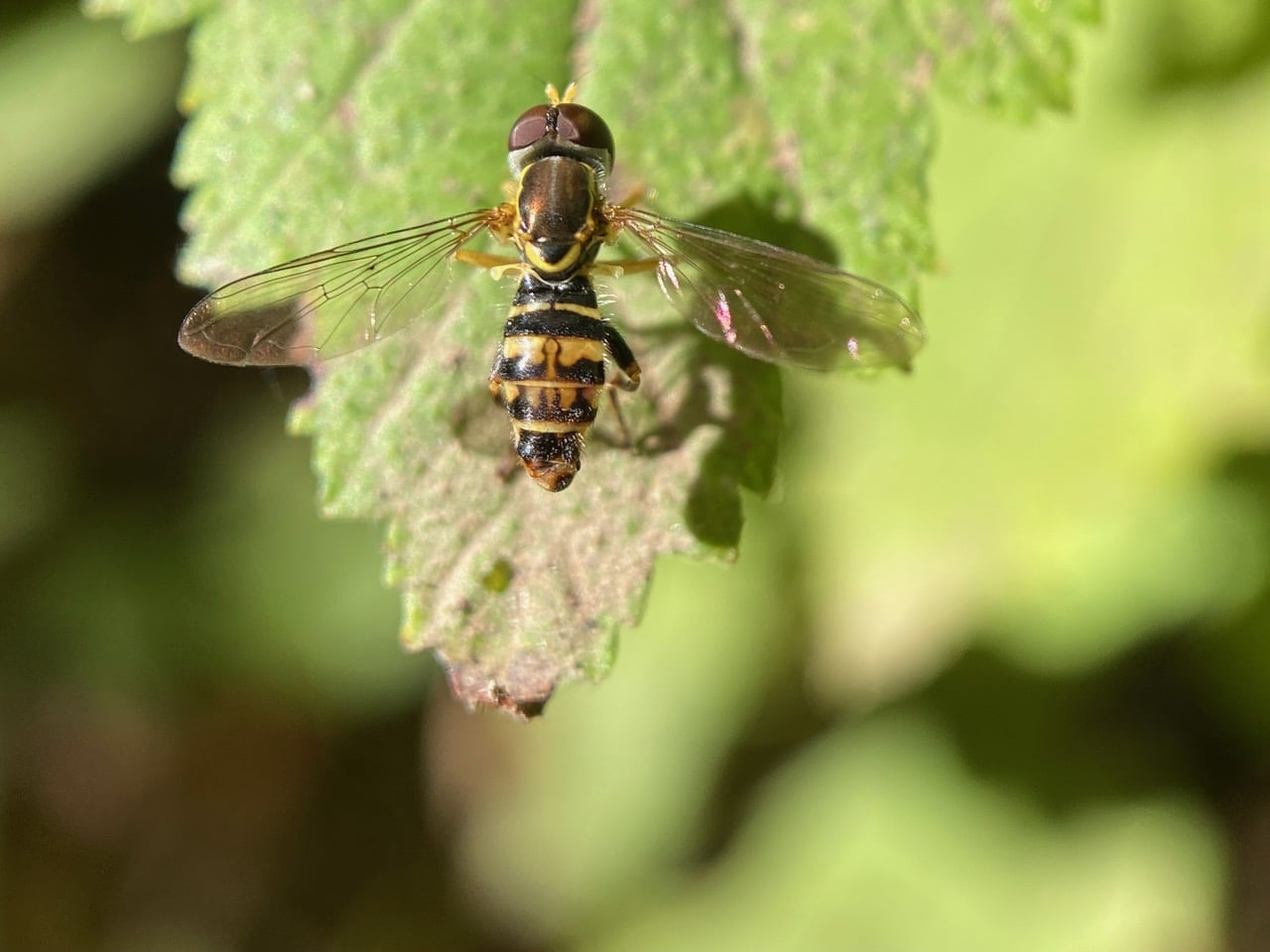
Here’s a much smaller hover fly, the Western Calligrapher, Toxomerus occidentalis (family Syrphidae). Curiously, 9 out of 10 of this species I see today are males (like this one). They are flying low over the foliage, bumping each other off their perches.
Toxomerus is a very large genus of Hover Flies. They are found in North and South America. The majority of species are only 6-9 mm in length. They are notable for their mimicry of stinging Hymenoptera to avoid predators. Their unique abdominal patterns are diagnostic at the species level within the genus. There is marked sexual dimorphism – the females have a broader abdomen with lighter coloration and pattern. Most larvae feed on soft bodied insects, such as aphids; a few feed on pollen. Adults feed on the pollen of a wide range of flowers. A female can lay up to hundreds of eggs at a time and will place them where prey or pollen food sources are readily available. They can be found in a wide variety of habitats, often in dense ground cover.
The genus name Toxomerus comes from Greek toxon for ‘bow’ and meron for ’thigh’, referring to the bow-shaped hind femur. Colors vary with overall temperature during pupation: higher temperatures produce more yellow, while lower temperatures produce adults with darker markings.
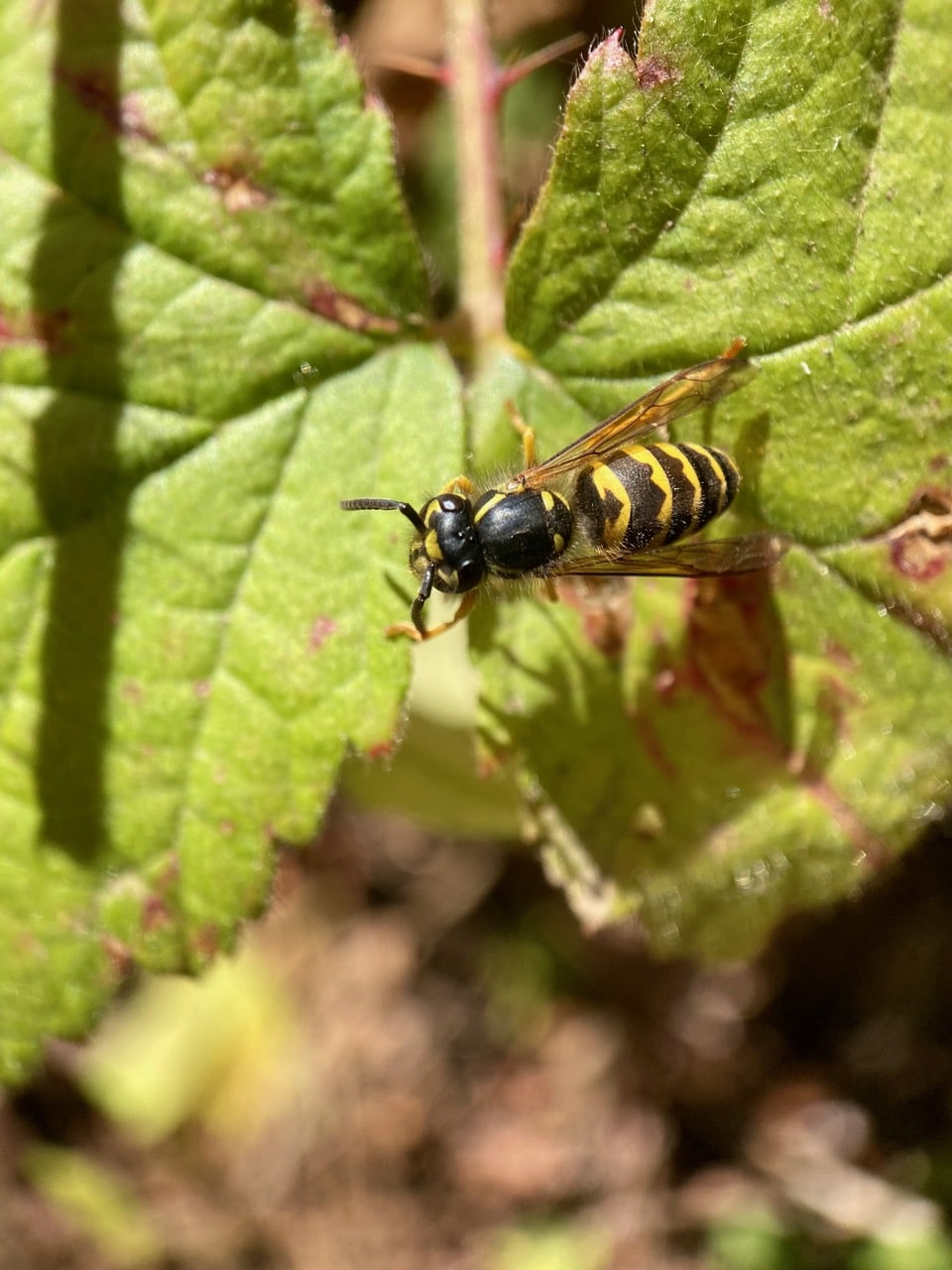
While their season is fast coming to an end, many Yellowjacket wasps are buzzing over the low vegetation on the side of the trail. Maybe there’s a nest nearby? I try to steer clear knowing that this is the time when the wasps are at their most aggressive.
Yellowjacket is the common name for predatory social wasps of the genera Vespula and Dolicovespula (family Vespidae). Yellowjackets are social hunters living in colonies containing workers, queens, and males (drones). Colonies are annual with only inseminated queens overwintering. Queens emerge during the warm days of late spring or early summer, select a nest site, and build a small paper nest in which they lay eggs. They raise the first brood of workers single-handedly. Henceforth the workers take over caring for the larvae and queen, nest expansion, foraging for food, and colony defense. The queen remains in the nest, laying eggs. Later in the summer, males and queens are produced. They leave the parent colony to mate, after which the males quickly die, while fertilized queens seek protected places to overwinter. Parent colony workers dwindle, usually leaving the nest to die, as does the founding queen. In the spring, the cycle is repeated.
Yellowjackets have lance-like stingers with small barbs, and typically sting repeatedly. Their mouthparts are well-developed with strong mandibles for capturing and chewing insects, with probosces for sucking nectar, fruit, and other juices. Yellowjacket adults feed on foods rich in sugars and carbohydrates such as plant nectar and fruit. They also search for foods high in protein such as insects and fish. These are chewed and conditioned in preparation for larval consumption. The larvae secrete a sugary substance that is eaten by the adults.
The Western Yellowjackets typically build nests underground, often using abandoned rodent burrows. The nests are made from wood fiber that the wasps chew into a paper-like pulp. The nests are completely enclosed except for a small entrance at the bottom. The nests contain multiple, horizontal tiers of combs within. Larvae hang within the combs.
During late summer and fall, colonies grow to their largest size and workers shift focus from finding food to producing new queens and males for the next year. This shift can make them more agitated and territorial. As the weather cools in the fall, Yellowjacket food sources like nectar, insects, and fruits become scarce, making them desperate for nourishment and more protective of their remaining food supplies.
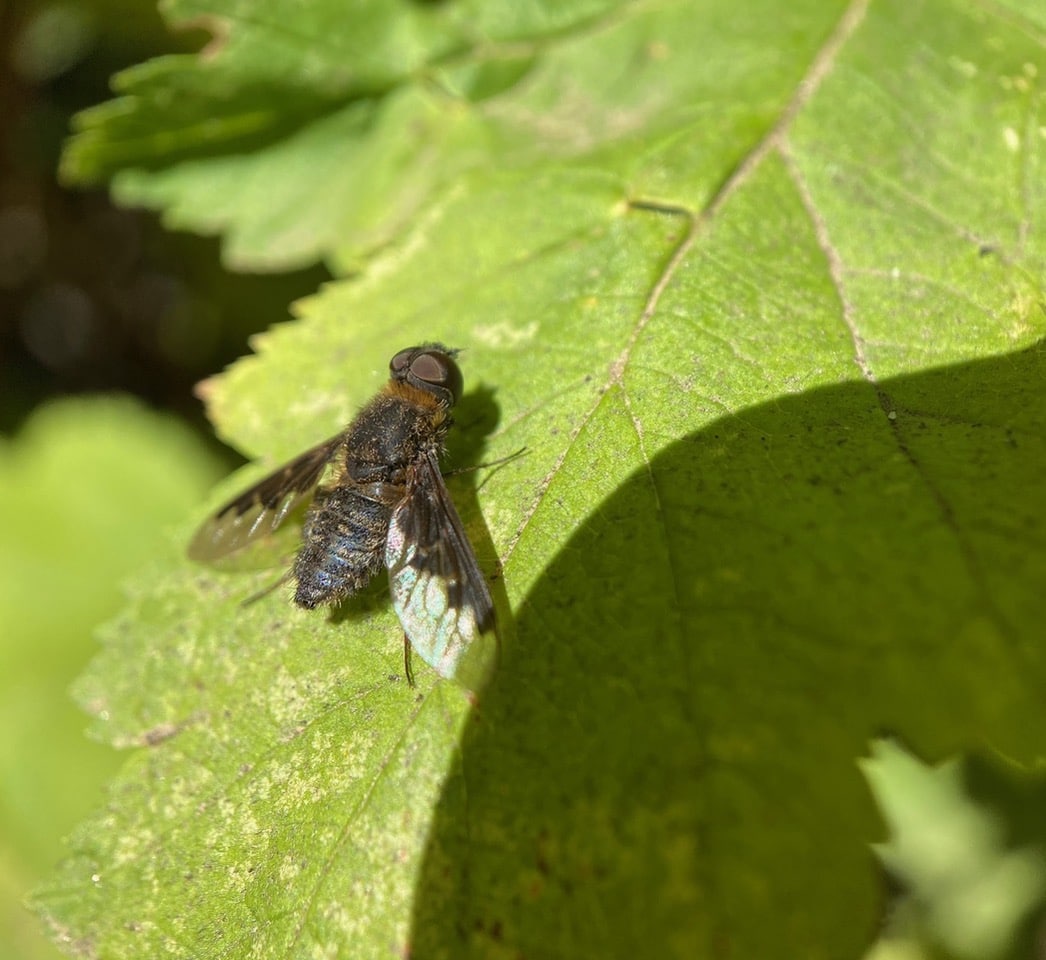
A Bee Fly lands on a Blackberry leaf. Everything about it is dark chocolate brown, almost black, including its wings. It is the Sinuous Bee Fly, Hemipenthes sinuosa (family Bombyliidae). The name sinuosa refers to the sinuous, undulating border of the dark area on the wings of the fly.
The Bee Flies belong to the family Bombyliidae. Adults generally visit flowers for nectar and pollen, some being important pollinators. Larvae generally are parasitoids of other insects. When at rest, many species of bee flies hold their wings at a characteristic “swept back” angle. The adult females usually deposit eggs in the vicinity of possible hosts, quite often in the burrows of beetles or ground-nesting bees/wasps. Bombyliidae parasitism is not host-specific, but rather opportunistic, using a variety of hosts.
The Sinuous Bee Fly is a common species throughout most of North America. Members of this genus are parasitoids and hyperparasitoids. Their larvae are parasitic on other insects, while the adults visit flowers for nectar. The term hyperparasitoid refers to the fact that the larvae of Hemipenthes sinuosa hatch within the larvae of Tachinid Flies, Ichneumonid wasps and other insects, which themselves are parasitic in other species. In other words, larvae of Hemipenthes are parasites of parasites.
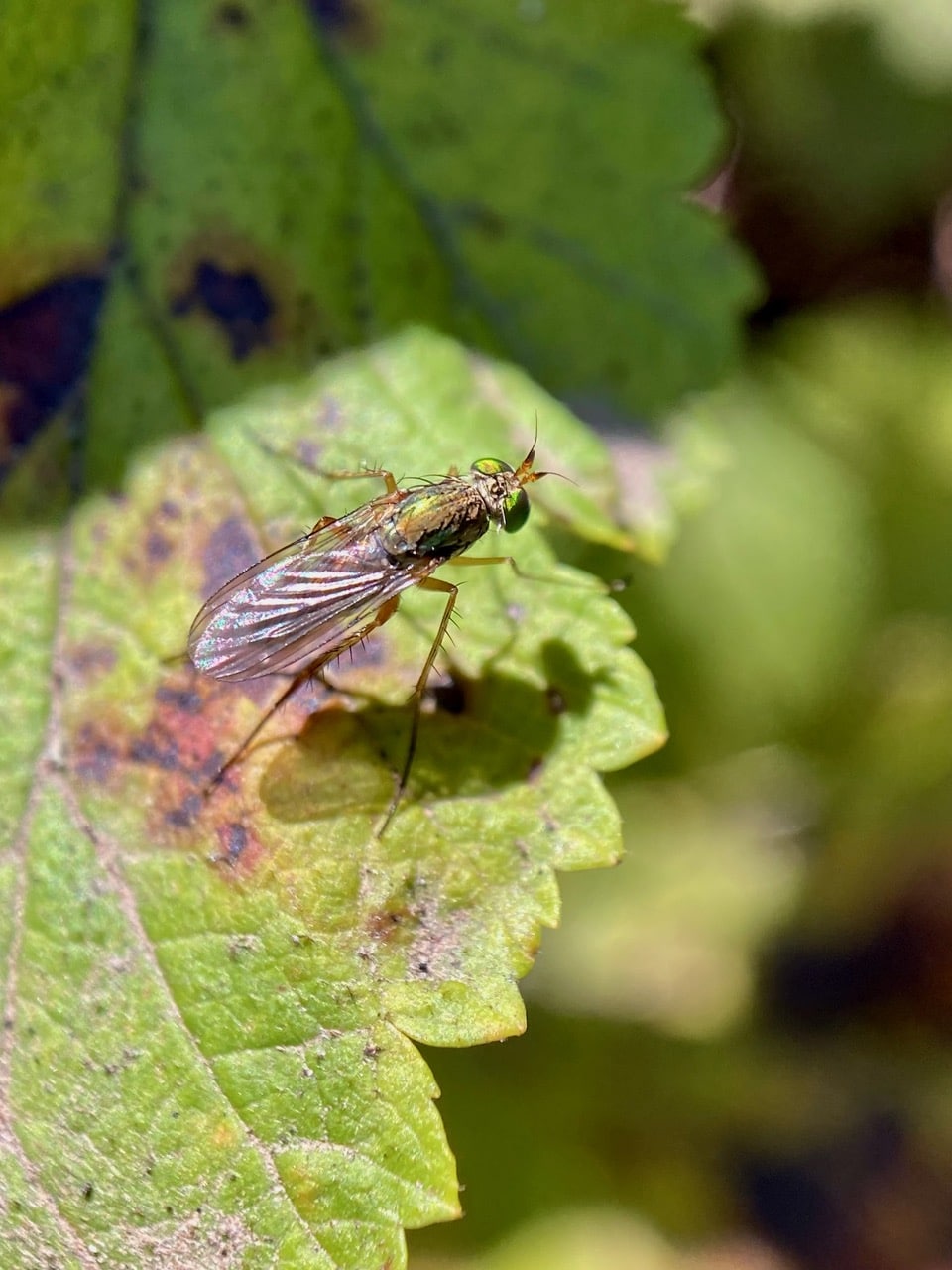
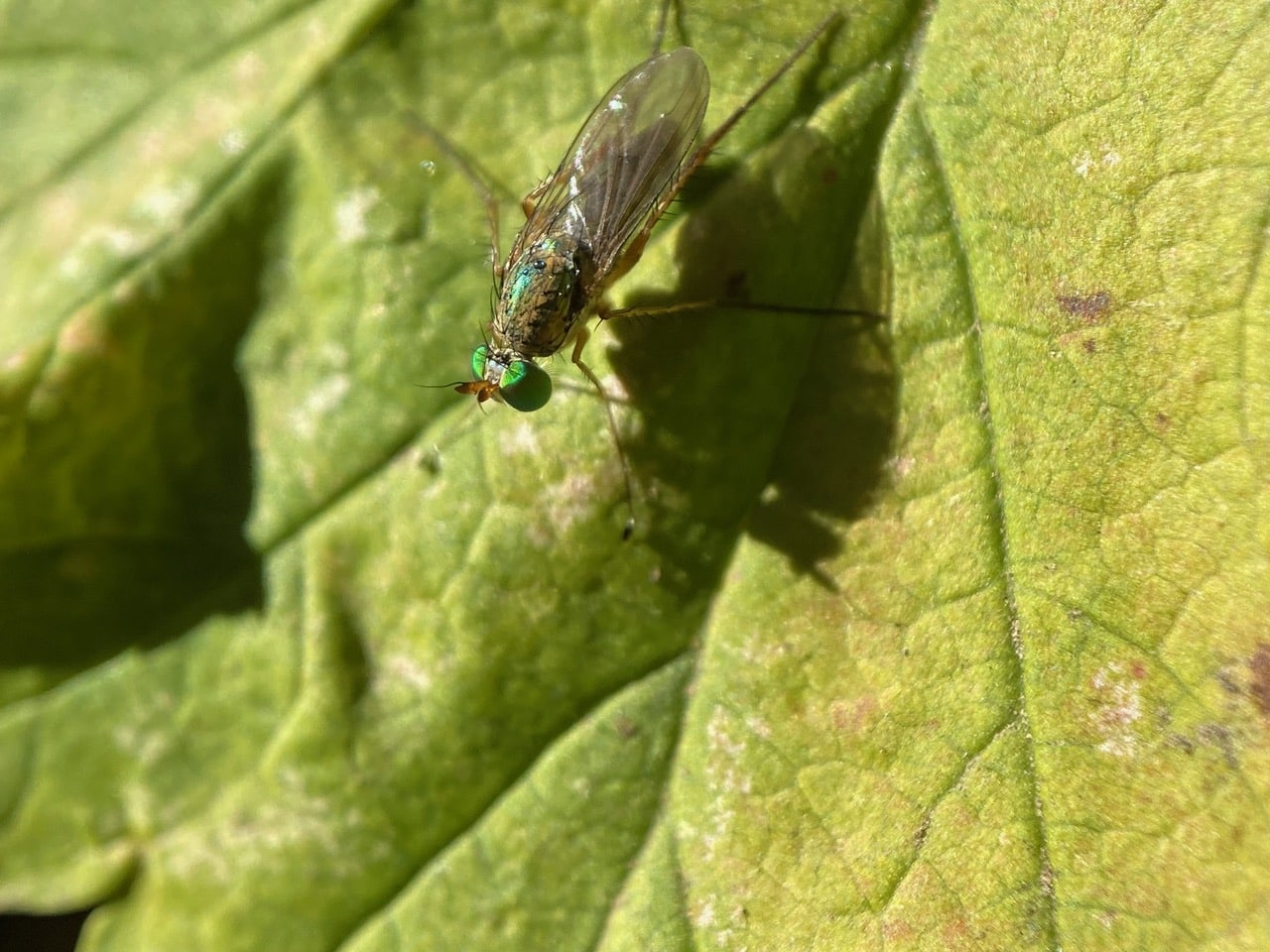
Numerous delicate small flies with long legs and bright green eyes are flitting around the Blackberry foliage, occasionally landing on the leaves. They are the Long-legged Flies (family Dolichopodidae).
The Long-legged Flies, Dolichopodidae, are a large, cosmopolitan family of true flies. The name Dolichopodidae comes from the Greek dolichos (long) and podos (foot). They generally are small flies (1-9 mm) with large, prominent eyes and a green-to-blue metallic cast to their appearance. They have characteristically long and slender legs, and their posture often is stilt-like and erect. Adults live largely in grassy places and shrubbery. The flies occur in a wide range of habitats, near water or in meadows, woodland edges and in gardens. Most adults are predators, feeding on small invertebrates such as springtails, aphids, thrips, insect larvae, and mites. Studies have shown that Dolichopodidae give visual, rather than chemical or other signals during courtship. Scales, disks, flag-like hairs, or fans adorn the legs of males of many species, and they flash these at females in a ritual called “badge-waving”. The larvae occupy a wide range of habitats. Many are predators of small invertebrates in moist environments such as soil, moist sand, or rotting organic matter. The maggots pupate in cocoons they build by gluing together tiny pieces of soil.
Ooh, another Flesh Fly (family Sarcophagidae)!
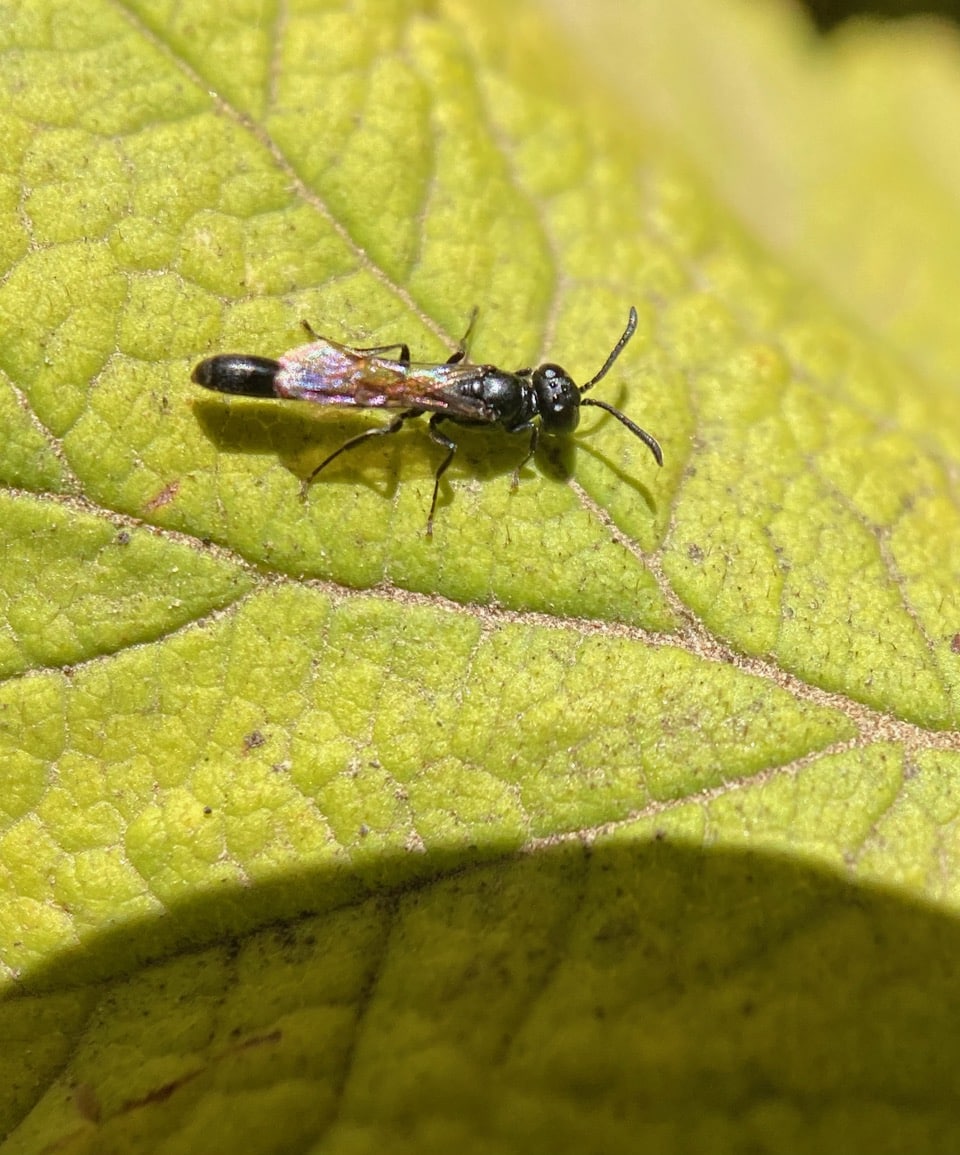
A small, elongated wasp lands on a Blackberry leaf. It is unfamiliar to me. A wasp expert on iNaturalist has helped identify it as a Keyhole Wasp, Trypoxylon sp. (family Crabronidae). Yay, a new one for me!
The Keyhole Wasp in the genus Trypoxylon (family Crabronidae) is found worldwide and throughout North America. These wasps are distinguished by a long, slender, clavate (club-shaped) abdomen; their compound eyes are notched in the middle, on the inner margin. Most species of these spider-hunting wasps nest in pre-existing cavities, such as keyholes, old nail holes, hollow twigs, beetle borings, vacated insect galls, etc. Adult females are solitary, and seek these cavities in which to nest; she provisions the nest with spiders that she paralyzes with a venomous sting. One egg is laid in each cell, and the larva that hatches consumes the cache of 5-20 paralyzed spiders. Interestingly, the males often guard the nest entrance while the female is away hunting prey or harvesting mud for partitioning the nest cells. The males also take prey brought in by the female and place it in the cell while she resumes hunting. Males may also assist in cleaning out the cavity before nesting begins, and aiding in the building of partitions and the mud plug closing the finished nest. The couples teamwork has been called “patriarchate” behavior, unusual among solitary wasps.
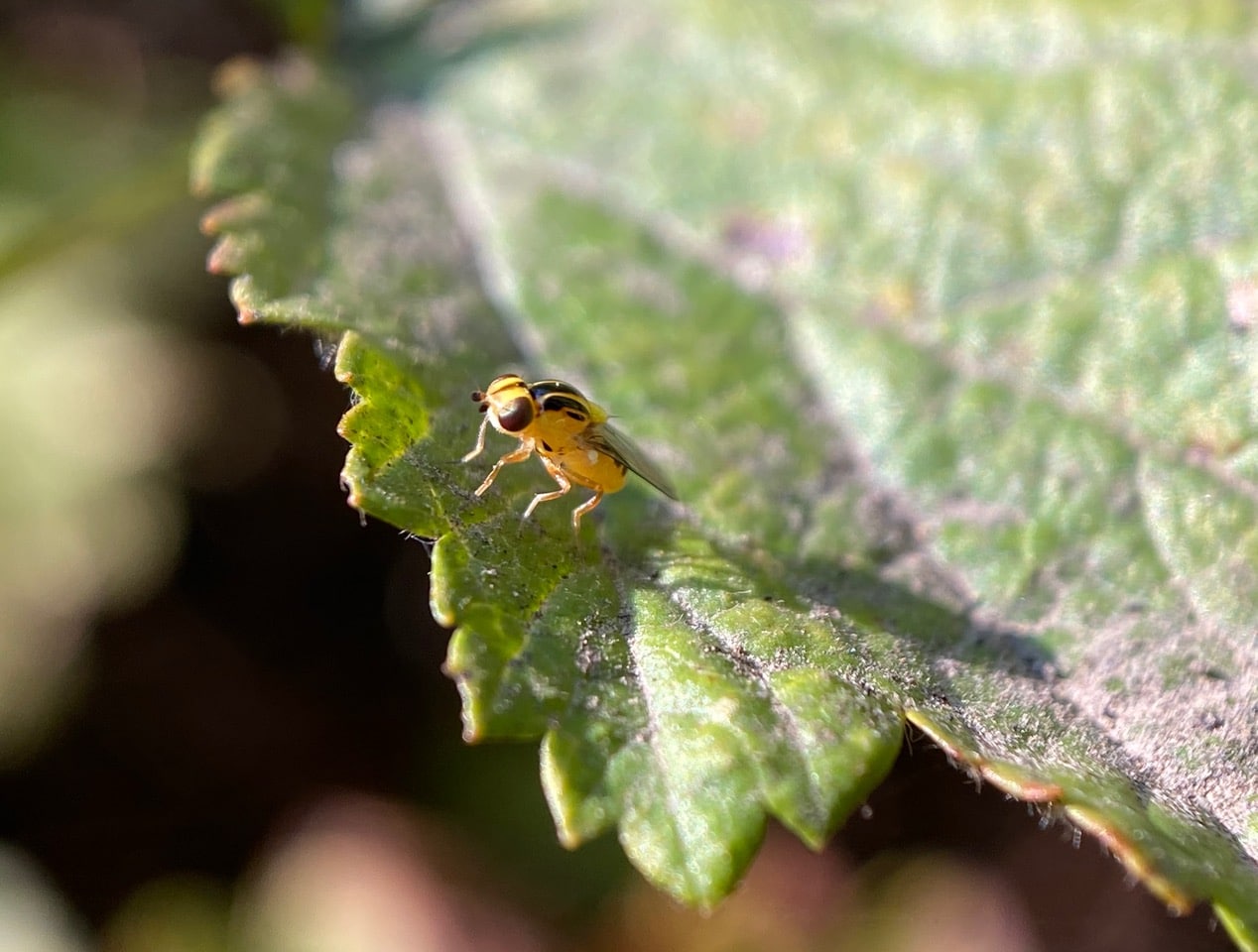
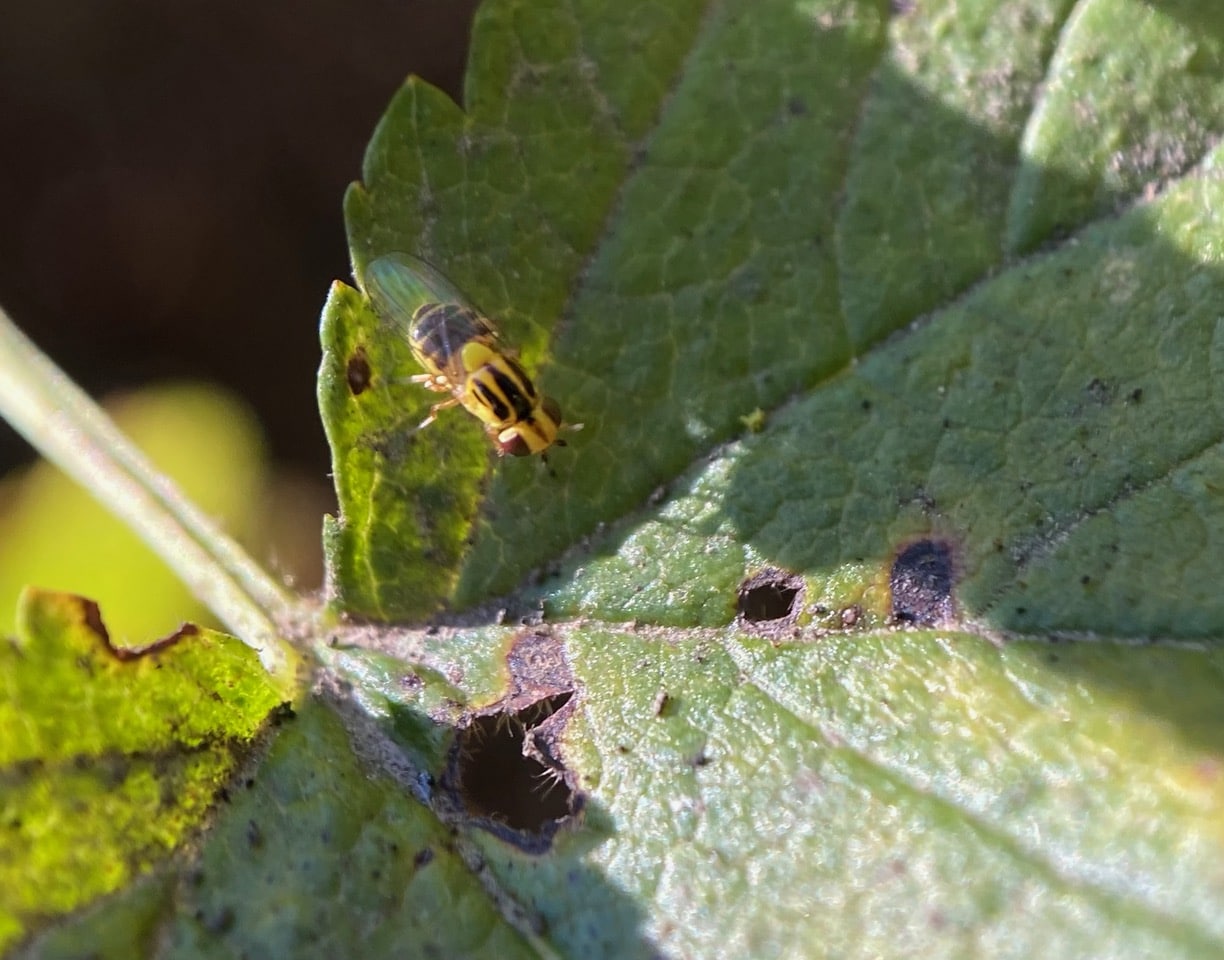
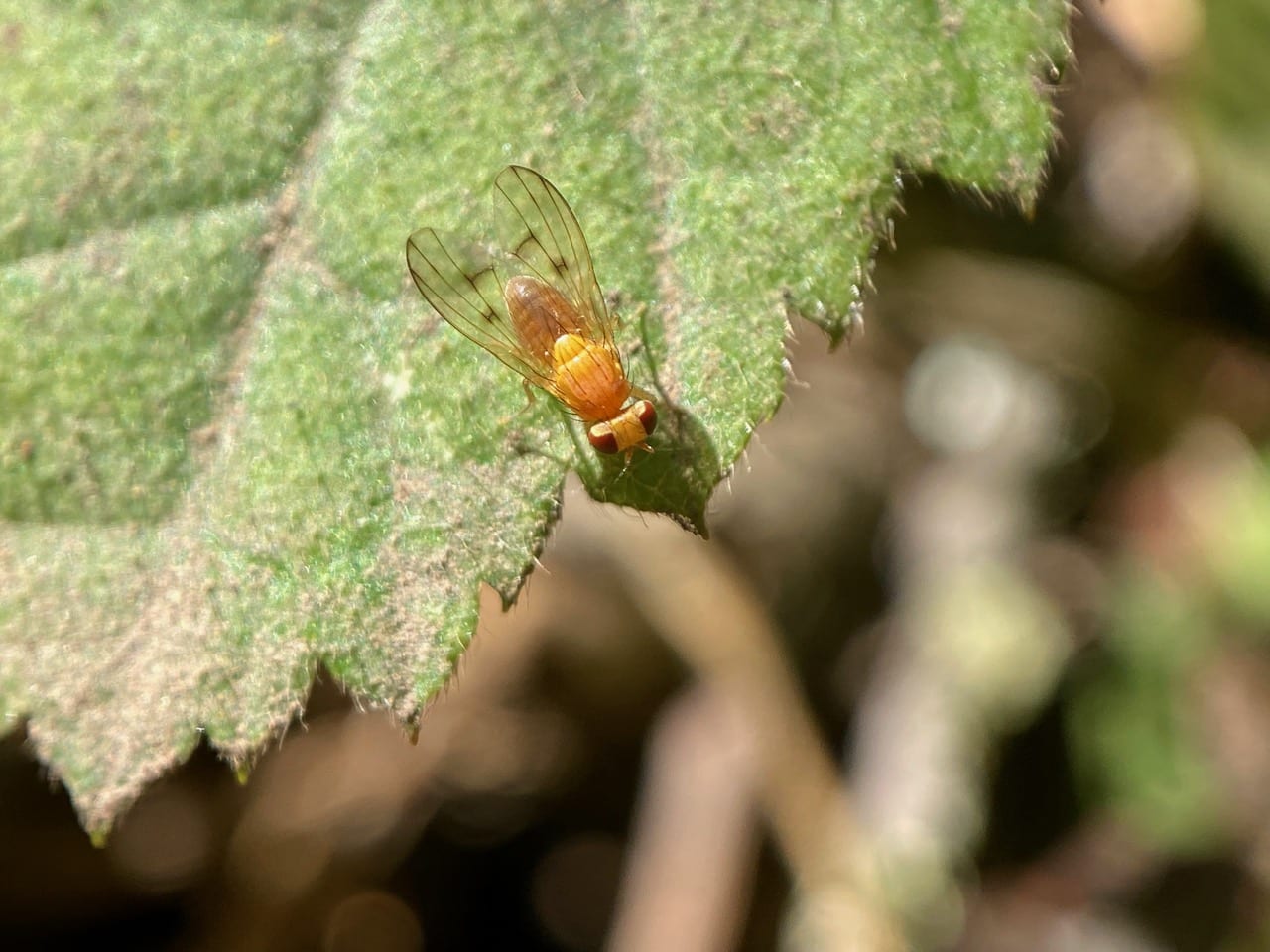
A tiny fly about 2 mm long has landed on a Blackberry leaf. The colorful creature is a Grass Fly, Thaumatomyia glabra (family Chloropidae).
Grass Flies (family Chloropidae) are minute to small flies (1-4 mm), yellow or black and appearing shiny due to the virtual absence of any hairs. The thorax often has a pattern of 3-5 dark longitudinal stripes against a light-colored background. The majority of the larvae are phytophagous, mainly on grasses, and can be major pests of cereals. However, parasitic and predatory species are known. Some species are called eye gnats for their habit of being attracted to vertebrate eyes to feed on lachrymal secretions, and can be of medical concern.
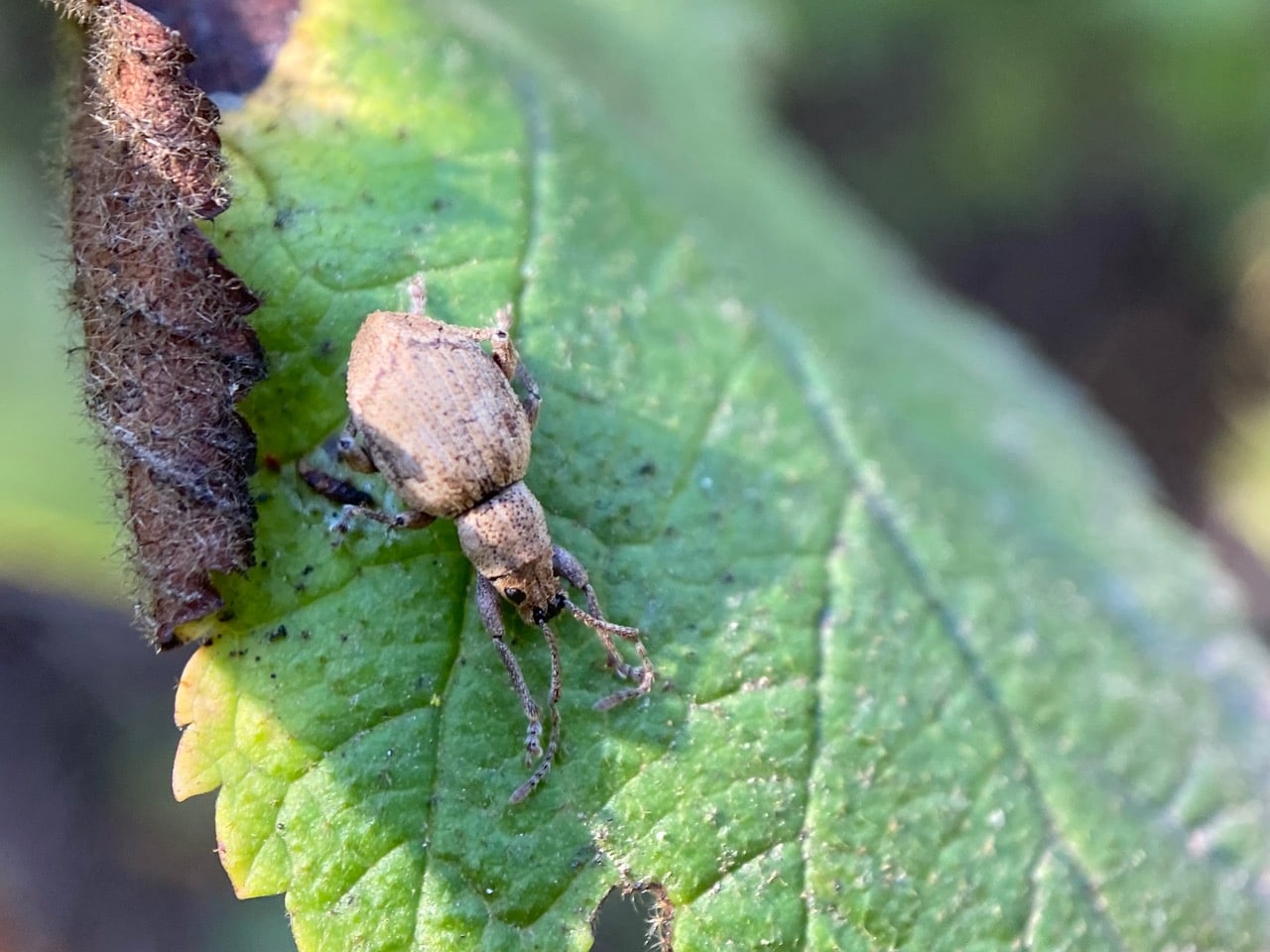
An Obscure Root Weevil, Sciopithes obscurus (Curculionidae) is resting motionless on a Blackberry leaf. Is it asleep?
The Obscure Root Weevil, Sciopithes obscurus is a species of broad-nosed weevil in the beetle family Curculionidae, found in the Pacific Northwest of North America. The weevils are 6-8 mm long, gray or brown, with a wavy line across their back. They are nocturnal, feeding on plant foliage at night. Unlike other species of weevils, they sometimes remain in the foliage during the day, rather than climbing down to the soil. Females lay up to a hundred eggs, either in the folds of leaves, or in the soil. There is one generation per year. Upon hatching, the larvae immediately crawl into the soil and begin feeding on roots. They are considered a pest in the Pacific Northwest, particularly on rhododendrons and strawberries.
A small fly, Minettia flaveola (family Lauxaniidae) is exploring the surface of a Blackberry leaf.
Some 1800 species of Lauxaniidae have been described. They have a cosmopolitan distribution. Most species inhabit forests, where the adults usually are found sitting on leaves of the moist and shady understory. Lauxaniidae are small flies (2-7 mm in length). They are often rather plump, dull, yellowish-brown or black, or partly lustrous flies. Many species have iridescent reddish/purplish or greenish eyes. Larvae are mostly saprophagous, feeding on decaying vegetation, soil, bird nests, etc. Adults may visit flowers.
Minettia flaveola occurs in western United States and British Columbia, extremely common in California. Usually all yellow, sometimes with a dark stripe on the thorax, sometimes more extensively gray. Larvae are found in decaying leaves and pine cones, but also in deserts.
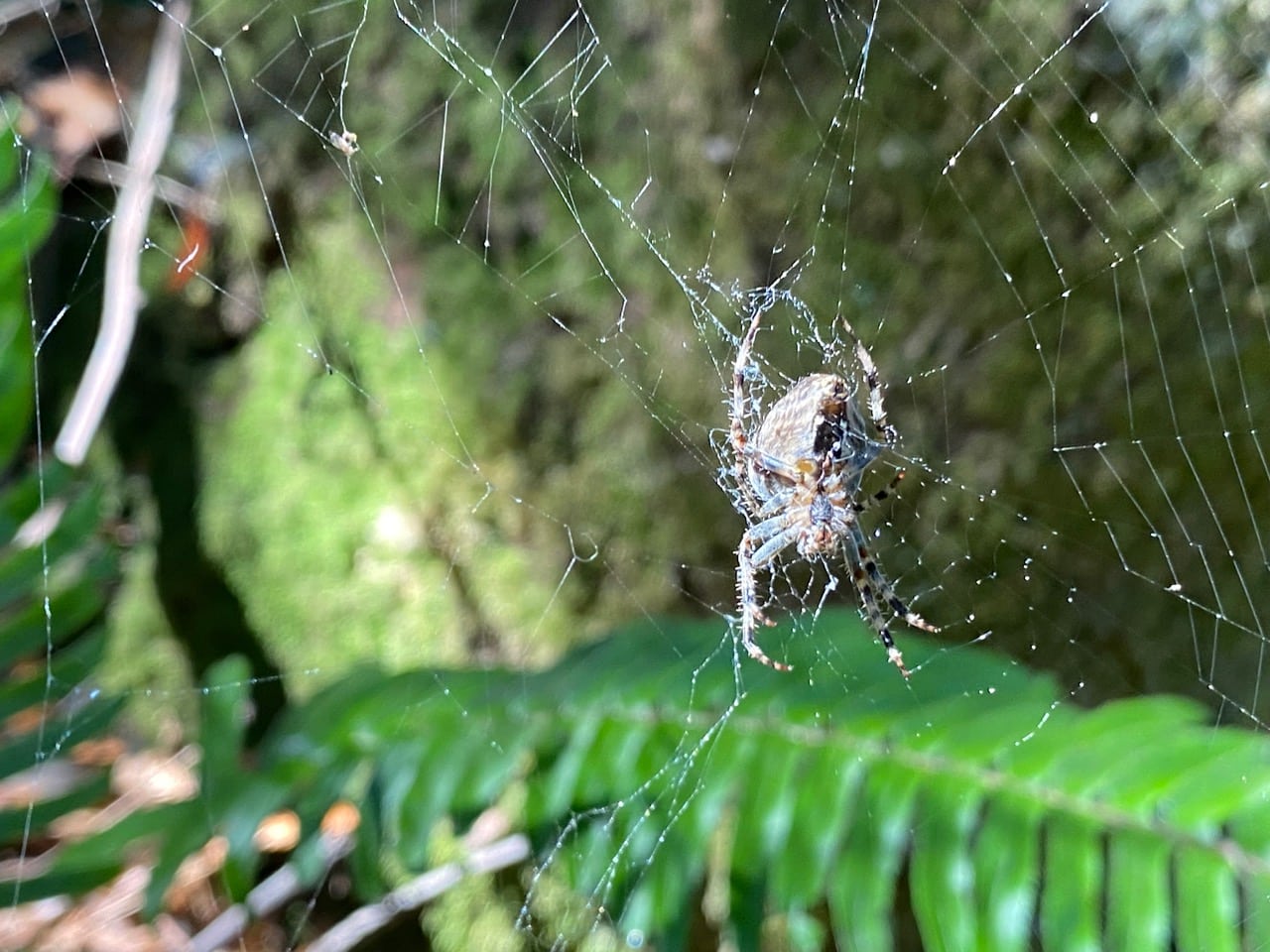
A large Orbweaver spider (family Araneidae) is resting head-down in the center of its untidy, large web, its pale underside facing the trail.
Dorsal view of the spider reveals that she is a Cross Orbweaver, Araneus diadematus (family Araneidae).
The Cross Orbweaver, Araneus diadematus, also known as the European Garden Spider, is an orb-weaving spider found in Europe, where it is native, and North America, where it was introduced. These are large spiders; adult females range in length from 6.5 to 20 mm, while males range from 5.5 to 13 mm. Individual colorings can range from extremely light yellow to very dark gray, but all A. diadematus spiders have mottled white markings across the dorsal abdomen, with four or more segments forming a cross. The markings are formed in cells filled with guanine, a byproduct of protein metabolism.
The legs of orb-weaver spiders are specialized for spinning orb webs. The webs are built by the larger females, which hang head down in the center of the web or remain hidden in nearby foliage, with one claw hooked to a signal line connected to the main orb, waiting for a disturbance to signal the arrival of prey. Prey is then quickly wrapped in silk and bitten, and the prey may be hung on the web to be stored for later consumption. The initial bite serves to paralyze the prey and minimize the danger of the spider herself being stung or bitten, and the enzymes thus injected serve to begin liquefaction of the prey’s internal structures. These spiders are also cannibalistic and prey on each other. Occasionally, the female eats the male directly after mating.
I come across several more large orbwebs strung among the Blackberry branches along the trail. Most do not have the owners on the web, but I always manage to find them hidden in nearby vegetation. Do you see this one? She is very well camouflaged among the dead leaves. This is a much safer spot for her to be ambushing prey, rather than on an open web.