

Pollinator Post 10/27/25 (1)

I was thrilled to read about a pollinator garden installed on the grounds of the Bay Farm Island Library. Since it is not far from Shoreline Park where Fred and I take our regular walks, I decide to stop by the library to take a look this fine morning.
Blessed with open, park-like surroundings, the little library has ample, flat ground on three sides of the building for a native habitat garden. The plantings look very young, probably no more than a year old. I can confidently enter the garden’s spacious mulched areas without trampling on the young plants. The low clumps of prostrate Fuchsia are still in bloom, but there are no insects visiting their red blossoms.

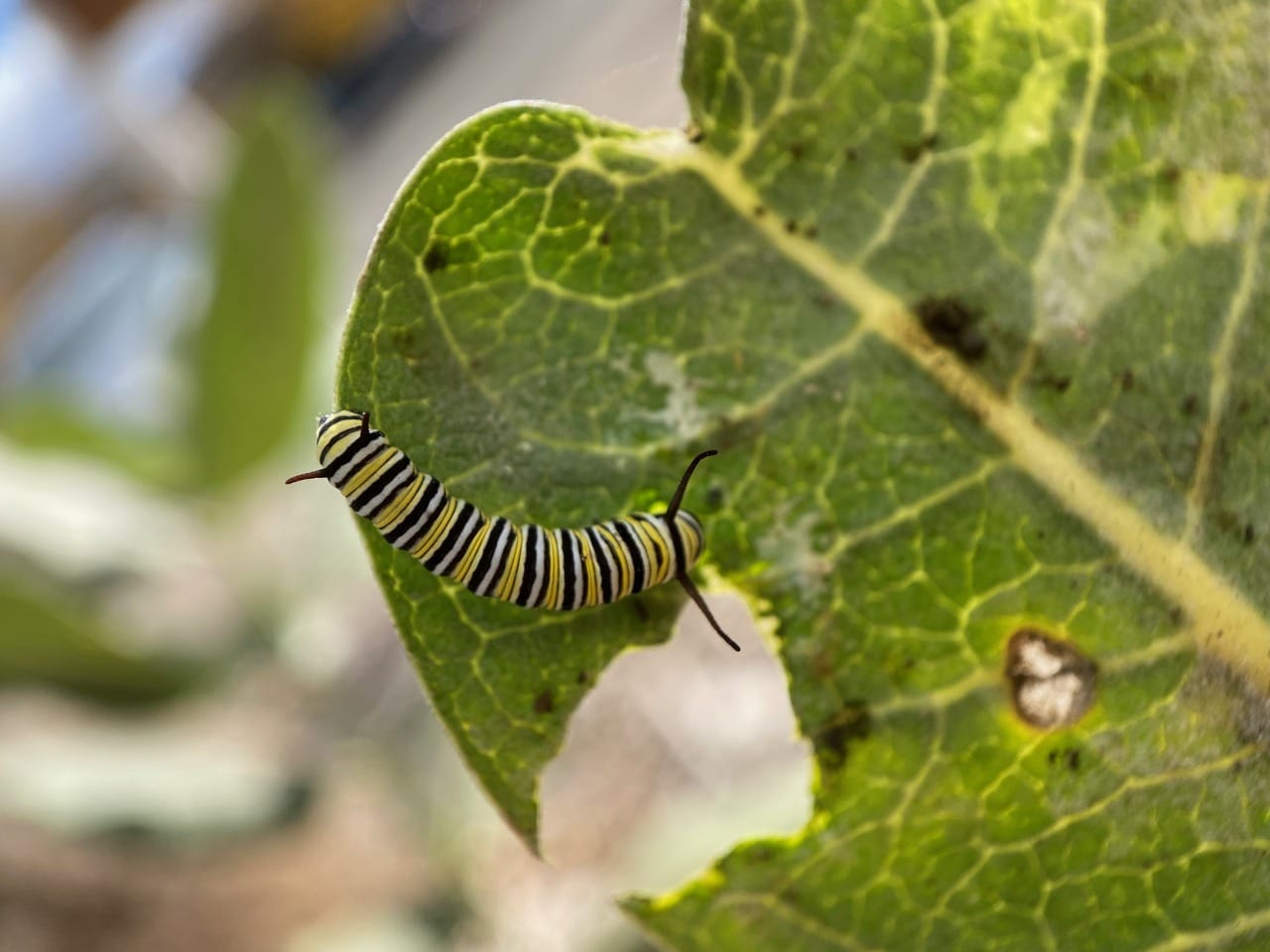



I am immediately attracted to the Showy Milkweed, Asclepias speciosa in the middle of the front garden. Hey, there’s actually a Monarch caterpillar, Danaus plexippus (family Nymphalidae) feeding on the underside of a leaf! It is about an inch and a half long, not far from pupation.
Monarch caterpillars feed exclusively on plants from the genus Asclepias, commonly known as milkweed. The plant is not only their only food source but also provides them with chemical protection. The caterpillars sequester toxic compounds called cardiac glycosides from the milkweed they eat, storing them in their bodies as a defense mechanism against predators. These toxins remain in the caterpillar even after metamorphosis, making both the caterpillar and the adult monarch poisonous.
A monarch caterpillar molts five times before it transforms into a chrysalis, shedding its skin to accommodate its rapid growth. Each time it molts, the caterpillar enters a new developmental stage, known as an instar.
A smaller Monarch caterpillar is munching on the leaf of another Showy Milkweed. It is less than 1/2 inch long, and still has a long way to grow. Will there be enough food for the caterpillar on this senescing milkweed this late in the season?
The western population of Monarchs overwinter in large, conspicuous aggregations in the tall trees along the coast of California. Curiously, there are currently non-migratory or resident populations of these western Monarchs present in coastal California. Over the last few years, resident populations are found in rising numbers in areas with mild winters and year-round milkweed growth, such as southern California and the Bay Area. It is believed that the resident populations use non-native milkweed species planted by misguided home gardeners wishing to help the butterflies. Unlike the native milkweeds (such as the Showy Milkweed), these milkweeds do not die back in winter. Not only do the non-native milkweeds encourage the butterflies to stay around and breed year-round, they also harbor a virulent pathogen of the butterfly. It is not completely clear whether the migratory and the resident populations are genetically distinct, or whether there is significant exchange between them that might jeopardize the migratory instincts of the species in the long run. This is a conundrum that the Xerces Society is having to deal with.
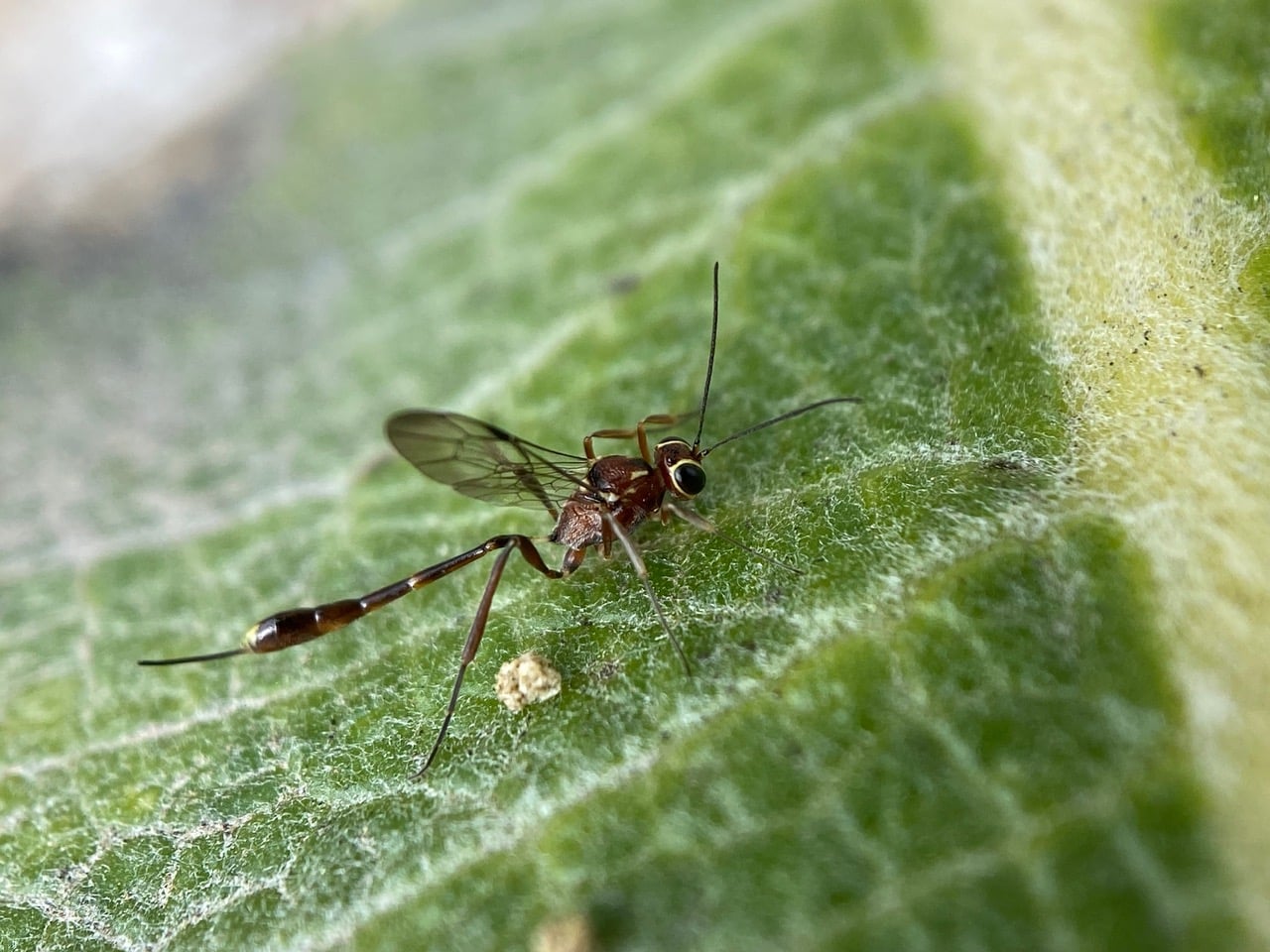
A tiny, slender wasp is resting on a milkweed leaf. With the aid of my macro lens, I see its distinct yellow eye rings. Ah, an Ichneumonid Wasp in the genus Anomalon (family Ichneumonidae)! Note the ovipositor on the tip of its abdomen – it’s a female!
The Ichneumonidae, also known as the Ichneumon Wasps, or Ichneumonids, are a family of parasitoid wasps. They are one of the most diverse groups within the Hymenoptera (the order that includes the ants, wasps and bees) with about 25,000 species and counting. Ichneumon Wasps attack the immature stages of insects and spiders, eventually killing their hosts. They play an important role in the ecosystem as regulators of insect populations.
The Ichneumon Wasps have longer antennae than typical wasps, with 16 segments or more as opposed to 13 or fewer. Ichneumonid females have an unmodified ovipositor for laying eggs. They generally inject eggs either directly into their host’s body or onto its surface, and the process may require penetration of wood. After hatching, the Ichneumonid larva consumes its still living host. The most common hosts are larvae or pupae of Lepidoptera (butterflies and moths), Coleoptera (beetles) and Hymenoptera. Adult Ichneumonids feed on plant sap and nectar. Females spend much of their active time searching for hosts while the males are constantly on the look out for females. Many Ichneumonids are associated with specific prey, and Ichneumonids are considered effective biological controls of some pest species.
Anomalon is a large genus of parasitoid wasps in the family Ichneumonidae. The wasps are found worldwide, but most diverse in tropical regions. In the Americas they are mostly found in very wet rain forests. Recorded hosts include tenebrionid (darkling beetle) or elaterid (click beetle) larvae, and noctuid and tortricid moth larvae.
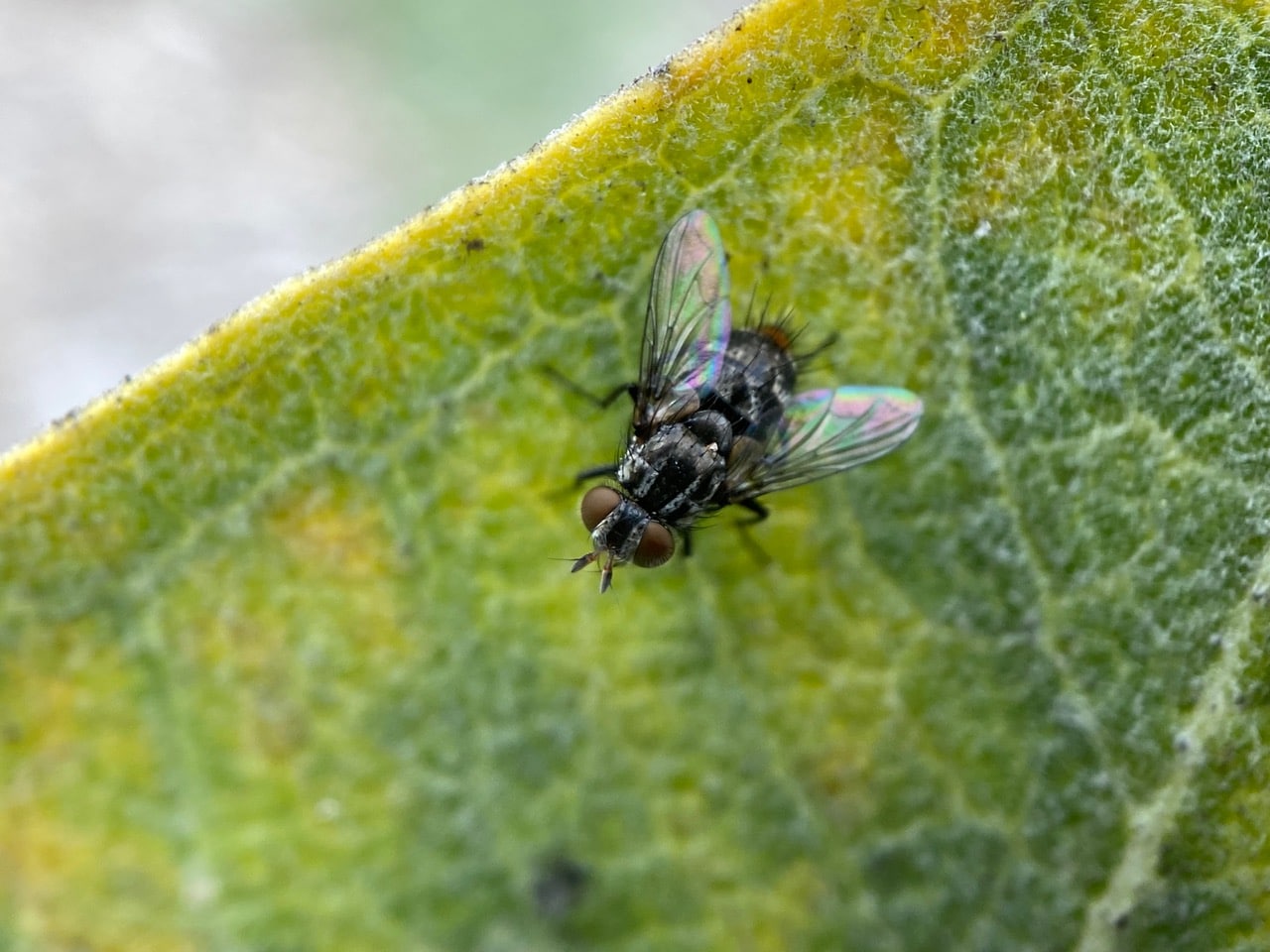
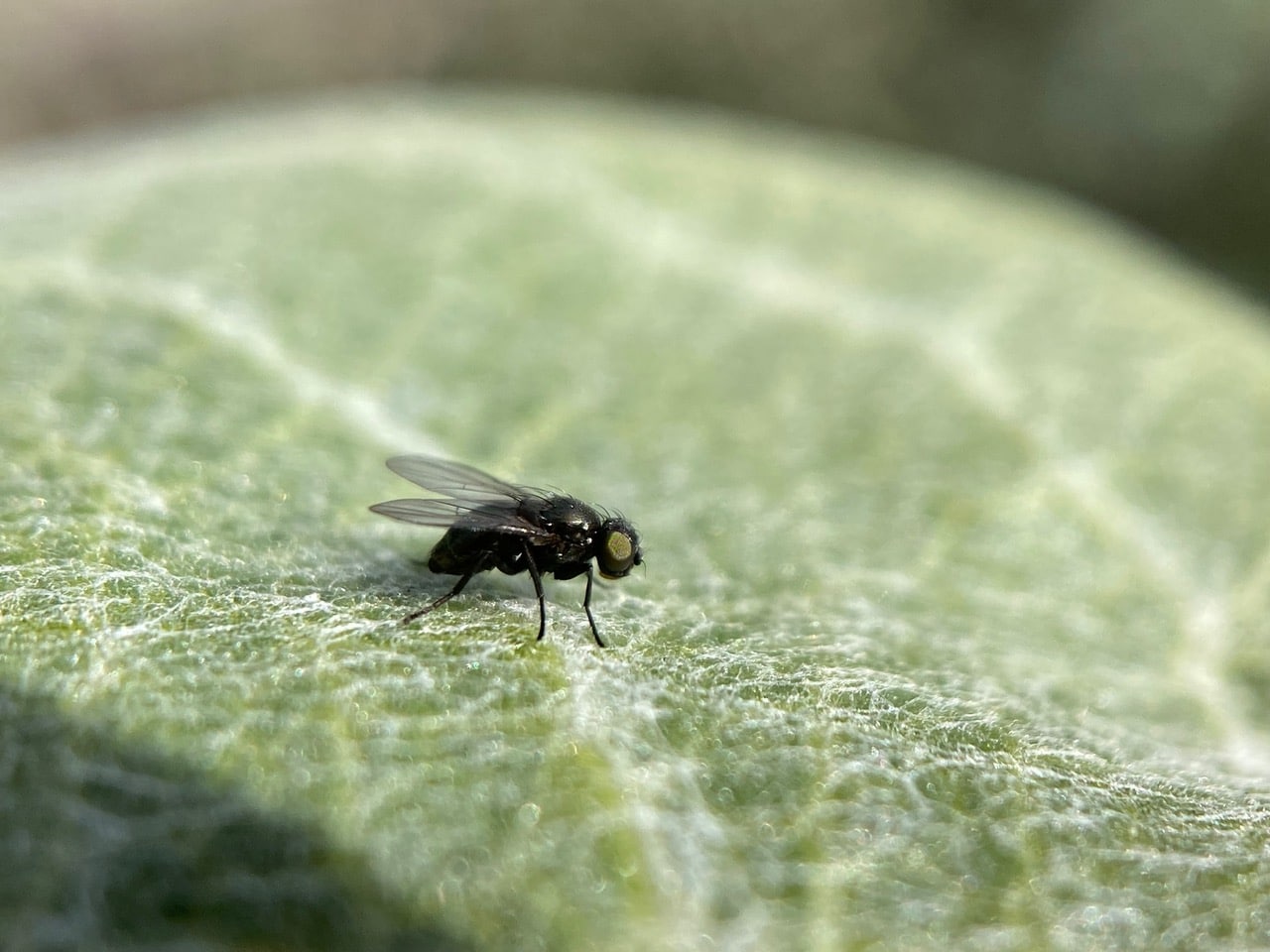
A small, furtive fly has landed on a milkweed leaf. iNaturalist has helped identify it as a Satellite Fly, Metopia sp. (subfamily Miltogramminae, family Sarcophagidae).
Members of the family Sarcophagidae are commonly called Flesh Flies. Many have black and gray longitudinal stripes on the thorax and checkering on the abdomen, red eyes, and a bristled abdomen sometimes with a red tip. They differ from most flies in that they are ovoviviparous, opportunistically depositing hatched or hatching maggots instead of eggs on carrion, dung, decaying material, open wounds of mammals, hence their common name. The adults mostly feed on fluids from animal bodies, nectar, sweet foods, fluids from animal waste and other organic substances. While we may find their habits revolting, Flesh Flies perform important roles in the ecosystem – the larvae as decomposers/recyclers, and the adults as pollinators.
Metopia is not your ordinary Flesh Flies (family Sarcophagidae). Its larvae occupy a special niche. As kleptoparasites, they develop in the nests of bees and wasps, feeding on the provisions that the females have prepared for their own young. The female Metopia enters the nest of its host to deposit its larvae. Females of some Metopia species have a prominent silvery snout.
A Common European Greenbottle Fly, Lucilia sericata (family Calliphoridae) is moving sluggishly on a milkweed leaf, perhaps slowed down by the low morning temperatures.
The Common European Greenbottle Fly is a Blowfly found in most areas of the world and is the most well-known of the numerous green bottle fly species. The lifecycle of Lucilia sericata is typical of blowflies. Females lay masses of eggs in fresh carrion. The flies are extremely prolific – a single female may produce 2,000 to 3,000 eggs in her lifetime. The larvae feed on dead or necrotic tissue, passing through 3 larval instars. Third-instar larvae drop off the host to pupate in the soil. The adults feed opportunistically on nectar, pollen, feces, or carrion; they are important pollinators as well as important agents of decomposition. Pollen is used as an alternative protein source, especially for gravid females who need large amounts of protein and cannot reliably find carrion.
While we may find the blowflies disgusting for their association with filth and carrion, they are important decomposers/ recyclers in the ecosystem. What’s more, their larvae are used in maggot therapy to clean wounds by consuming only dead and infected tissue, helping to promote faster healing and prevent infection.
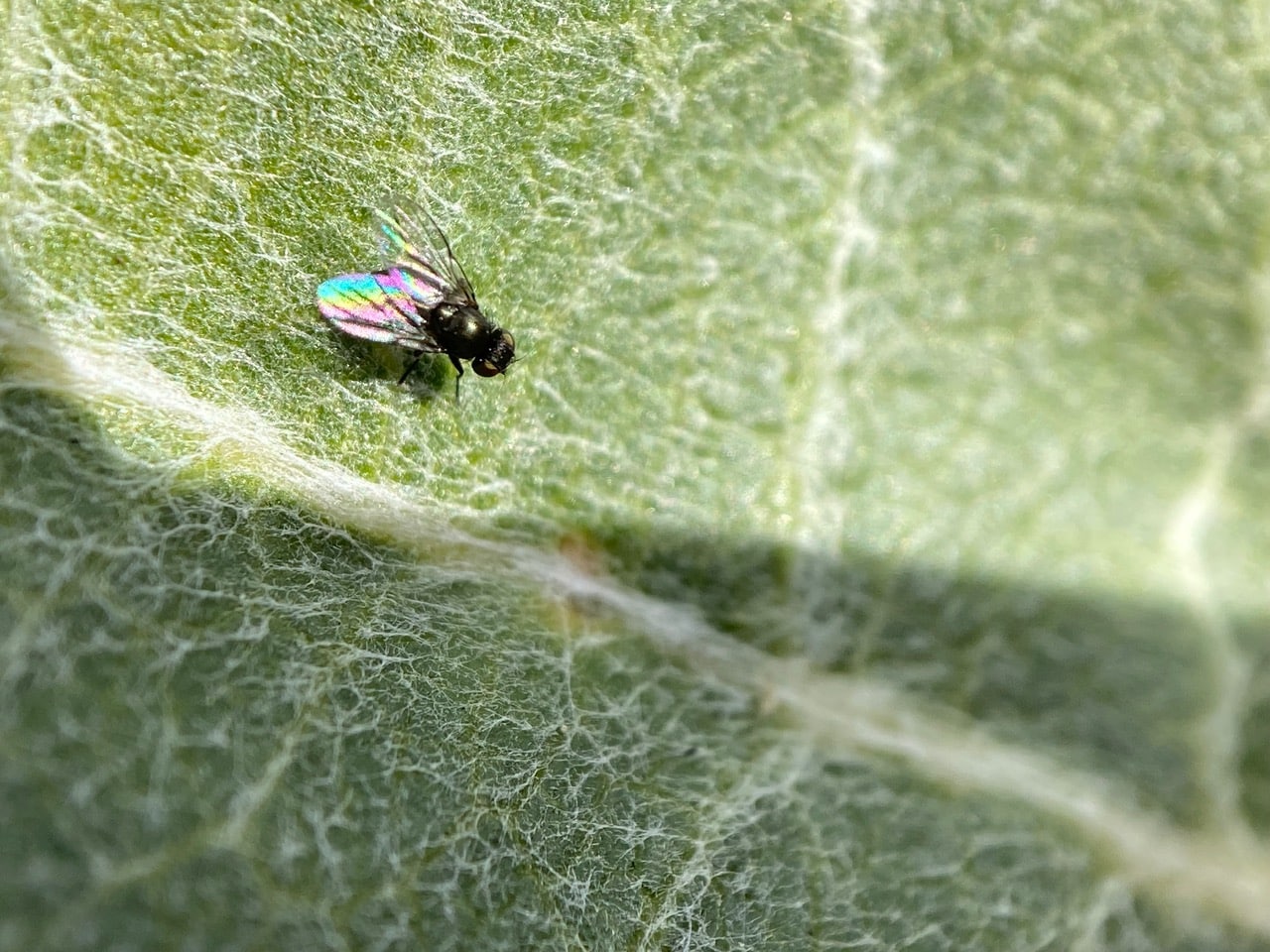
A tiny fly, barely 2 mm long, is perched on a milkweed leaf to warm up in the morning sun. iNaturalist has helped identify it as a Leaf-miner Fly in the genus Melanagromyza (family Agromyzidae).
The Agromyzidae are a family commonly referred to as the Leaf-miner Flies, for the feeding habits of their larvae, most of which are leaf miners on various plants. They are small flies, most species in the range of 2-3 mm. Agromyzidae larvae are phytophagous, feeding as leaf miners, less frequently as stem miners or stem borers. A few live on developing seeds, or produce galls. There is a high degree of host specificity. A number of species attack plants of agricultural or ornamental value, so are considered pests. The shape of the mine is often characteristic of the species and therefore useful for identification. Adults occur in a variety of habitats, depending on the larval host plants.
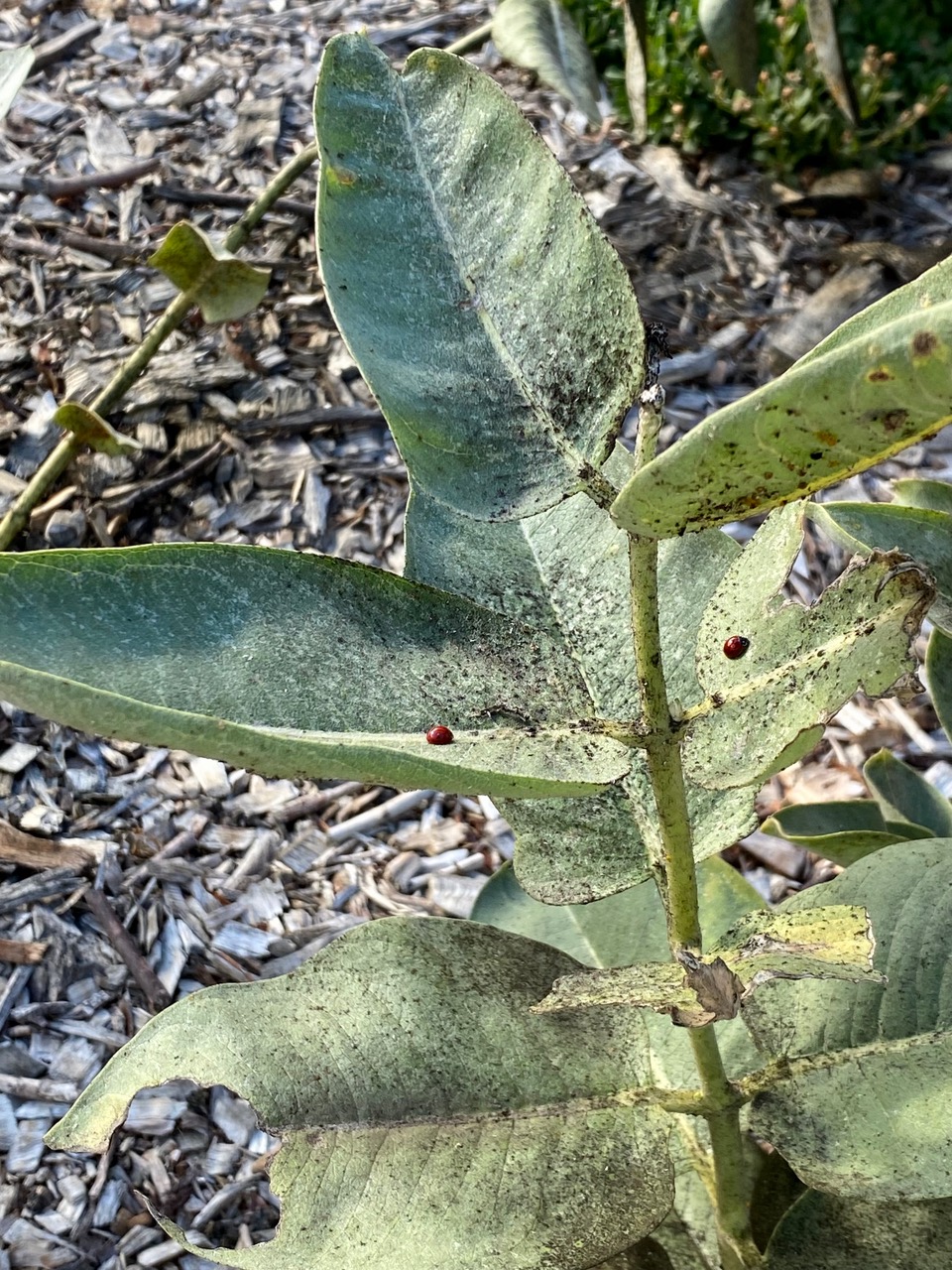
The leaves of this Showy Milkweed plant is covered with a fine layer of black Sooty Mold. A few Lady Beetles are resting on the leaves. Both are tell-tale signs of aphid infestation.
Aphids (family Aphididae) are small sap-sucking insects in the order Hemiptera. Aphids usually feed passively on phloem of plants. Once the phloem vessel is punctured, the sap, which is under pressure, is forced into the aphid’s food canal. Aphids produce large amounts of a sugary liquid waste called “honeydew”. A fungus called sooty mold can grow on honeydew deposits that accumulate on leaves and branches, turning them black.
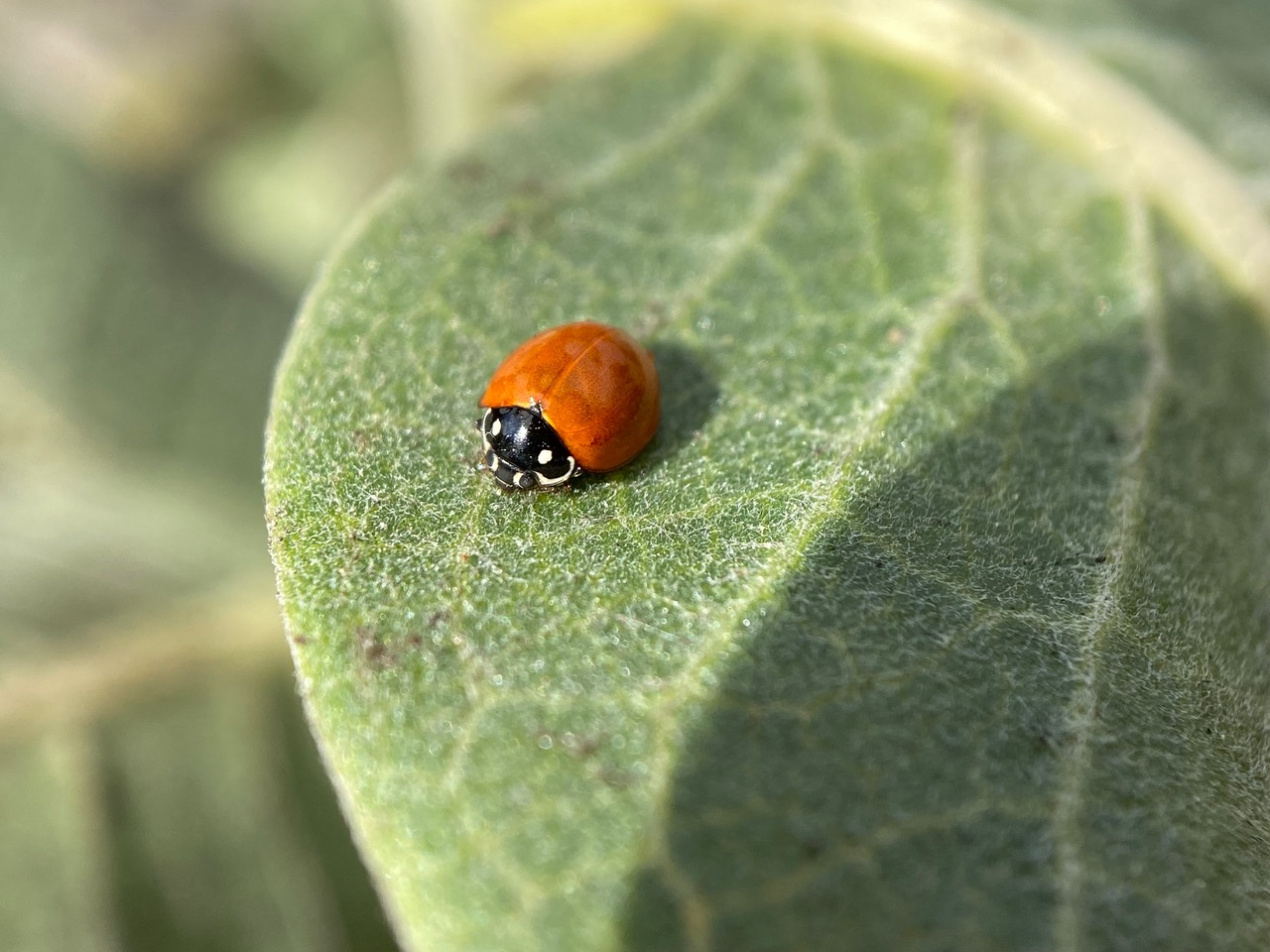
All the Lady Beetles I see on the milkweeds here are the Spotless Lady Beetles, Cycloneda sanguinea (family Coccinellidae).
The Spotless Lady Beetle, Cycloneda sanguinea (family Coccinellidae) is a widespread species of lady beetle in the Americas. It is is a large lady beetle with red, unspotted elytra (wing covers) ranging from 4-6.5 mm long. The black and white marks on the head and pronotum are very distinctive, and they are also gender-specific. Both adult and larvae of Spotless Lady Beetles are voracious predators of aphids. They are very often found feeding on aphids on milkweeds, but also occur on a number of other plants. Adults live longer when nectar and pollen are available for nourishment when prey is scarce.
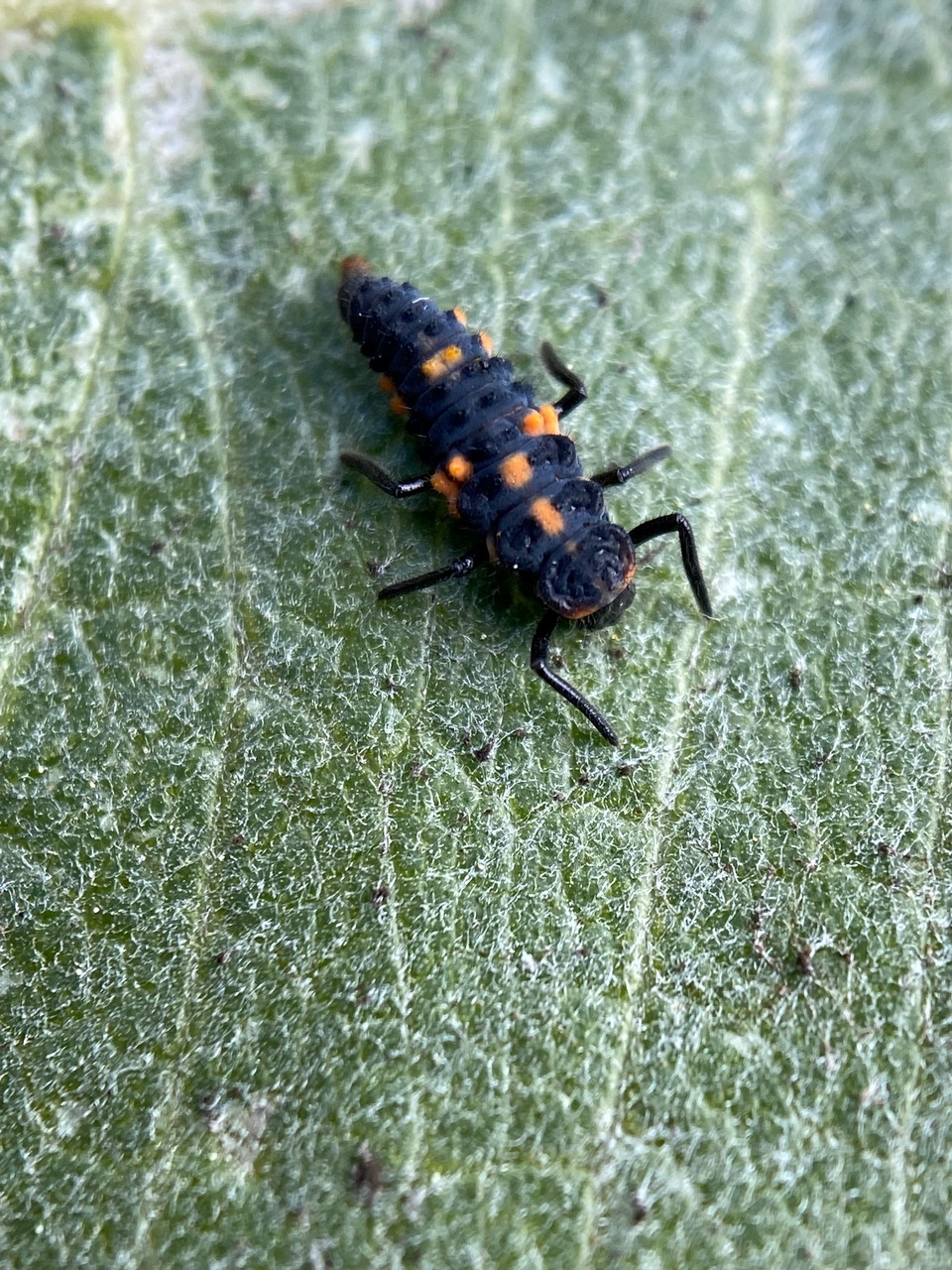
A Lady Beetle larva is sprawled motionless on a milkweed leaf.
Lady beetles (family Coccinellidae) go through complete metamorphosis, which comprises four stages: eggs, larva, pupa and adult. The larva goes through four molts during their development. Often described as miniature alligators with six legs, the larvae are voracious predators of aphids. Each larva can eat about 400 aphids in the three weeks before it pupates. Besides aphids, they also feed on soft scales, whitefly pupae, thrips, and spider mites.
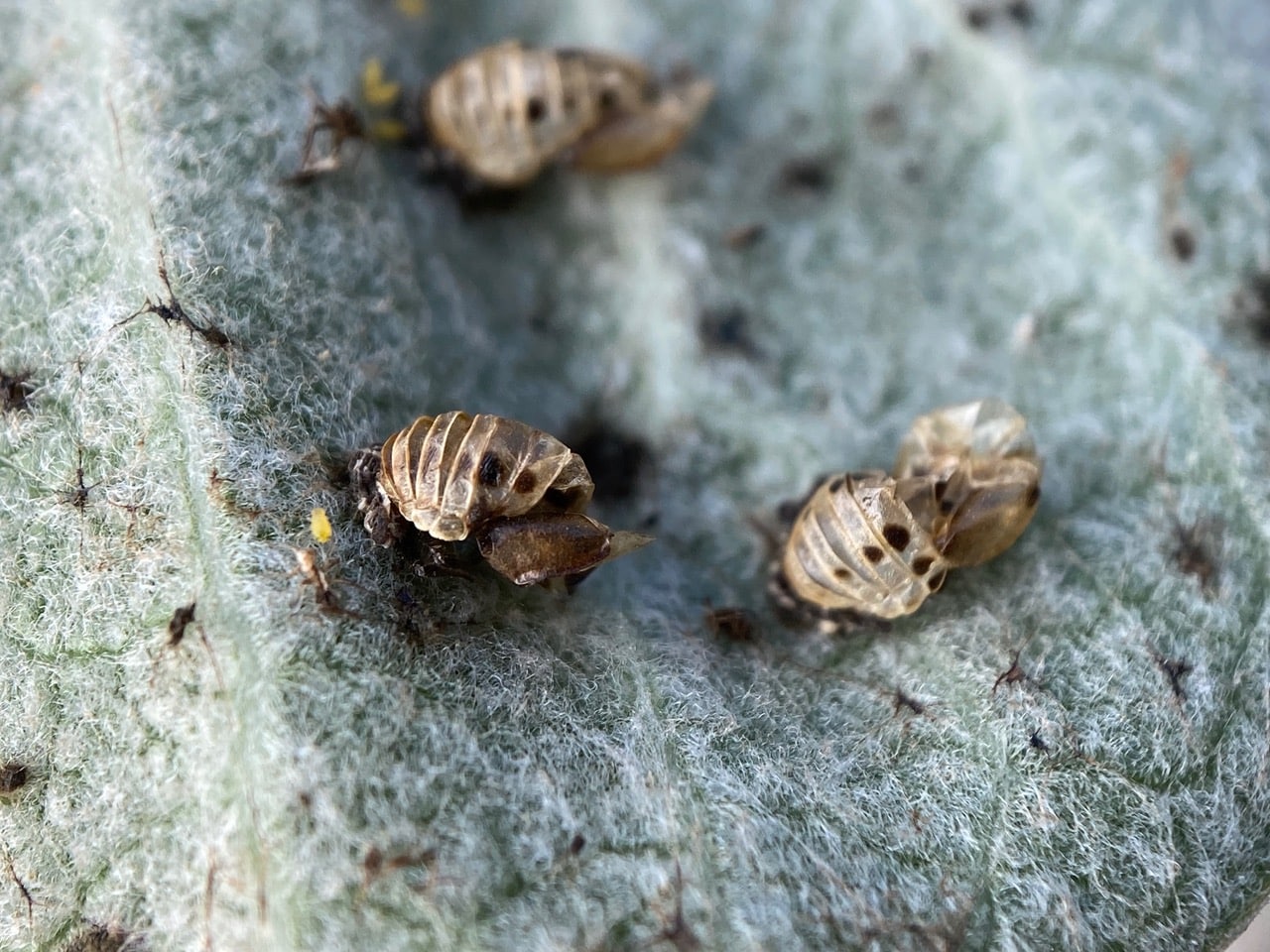
Turning over a milkweed leaf, I find three spent lady beetle pupa cases still attached to the fuzzy surface. The lady beetles have obviously been busy reproducing on the plant.
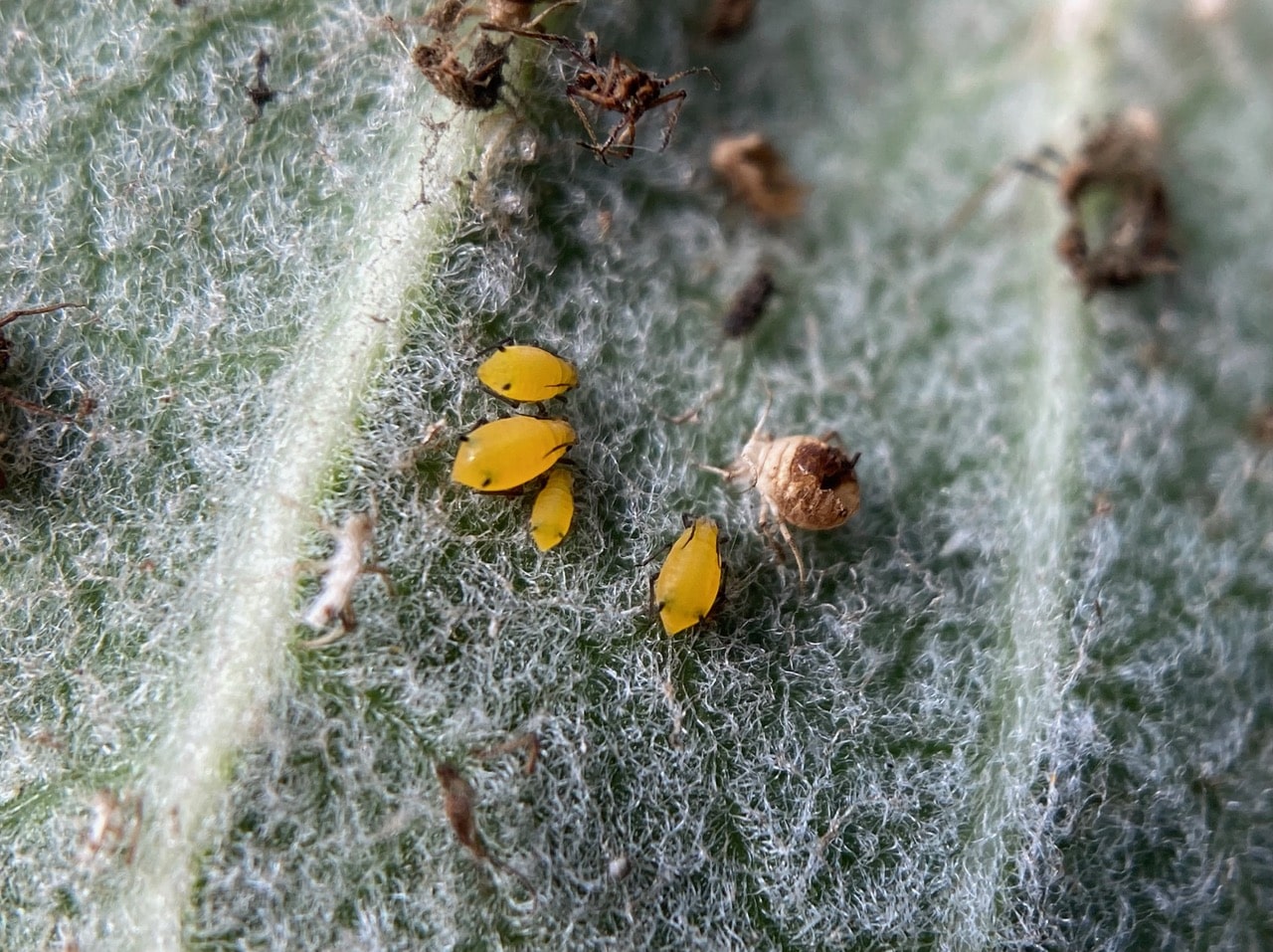
Hey, an aphid mummy next to a small cluster of Oleander Aphids, Aphis nerii (family Aphididae)!
Aphis nerii is also known as Milkweed Aphid. The species is widespread in regions with tropical and Mediterranean climates. The species probably originated in the Mediterranean region, the origin of its principal host plant, oleander. This bright yellow aphid, measuring 1.5-2.6 mm, has black legs, antennae and cornicles (“tail pipes”). The aphids feed primarily on the sap of plants in the dogbane family, Apocynaceae, including Milkweeds, Oleander and Vinca.
Females are viviparous and parthenogenetic, meaning that they give birth to live young instead of laying eggs, and that the progeny are produced by the adult female without mating. The nymphs feed gregariously on the plant terminal in a colony that can become quite large. Nymphs progress through five nymphal instars without a pupal stage. Normally wingless adults are produced but alate adults occur under conditions of overcrowding and when plants are senescing, allowing the aphids to migrate to new host plants. The parthenogenetic mode of reproduction, high fecundity, and short generation time allow large colonies of Oleander Aphids to build quickly on infested plants.
The Oleander Aphid ingests sap from the phloem of its host plant. The damage caused by aphid colonies is mainly aesthetic due to the large amounts of sticky honeydew produced by the aphids and the resulting black sooty mold that grows on the honeydew. The terminal growths of host plants may be deformed, resulting in stunted growth in heavy infestation.
Oleander Aphids sequester cardiac glycosides, a toxin from their host plants. They also fortify their cornicle secretions with these bitter, poisonous chemicals. Their bright aposematic (warning) coloration and possession of toxins protect them from predation by certain species of birds and spiders. Aphid populations are usually kept under control by natural biological agents such as parasitoid wasps, and predators such as Syrphid larvae, Lacewing larvae, and Lady Beetles.
What about the straw-colored aphid mummy? It’s an aphid that has been decimated by a parasitoid wasp. Aphid Mummy Wasps, Aphidius sp. (family Braconidae) are small wasps, typically less than 1/8 in. long. The female wasp lays a single egg in an aphid. When the egg hatches, the wasp larva feeds inside the aphid. As the larva matures the aphid is killed and becomes bloated and mummified, usually turning tan or golden in color. The adult wasp chews its way out of the mummy leaving a circular hole. That’s a Halloween-worthy horror story for you!
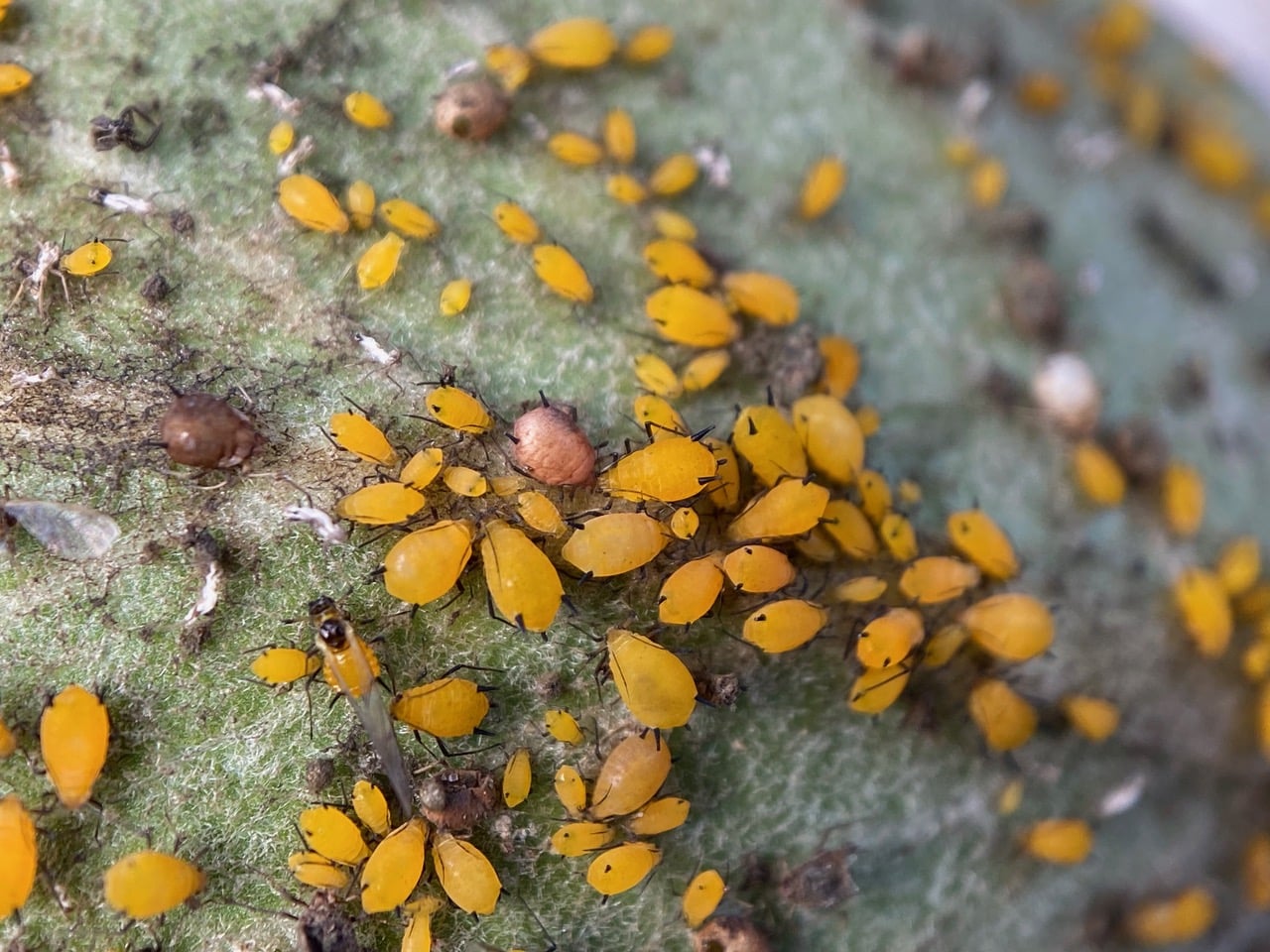
I find a thriving colony of the Oleander Aphids on the underside of yet another milkweed leaf near the bottom of the plant. Among the healthy yellow aphids are some bloated, brown mummies. The white flakes strewn about are the exuvia, or shed exoskeletons of the aphids after they molt. Hey, there’s even an alate, a winged aphid on the lower left. It’s difficult to see its wings from this angle, but the alate has a conspicuous black thorax.
A typical life cycle involves flightless females giving live birth to female nymphs, – who may also be already pregnant, an adaptation called telescoping generations – without the involvement of males. Maturing rapidly, females breed profusely so that the population multiplies quickly. Winged females may develop later in the season, allowing the insects to colonize new plants. In temperate regions, a phase of sexual reproduction occurs in the autumn, with the insects often overwintering as eggs.
Hey, there’s a freshly emerged alate in the midst of those wingless aphids. Its appendages and wings are still pale. It will take some time for full adult coloration to set in and for the insect to be able to fly.
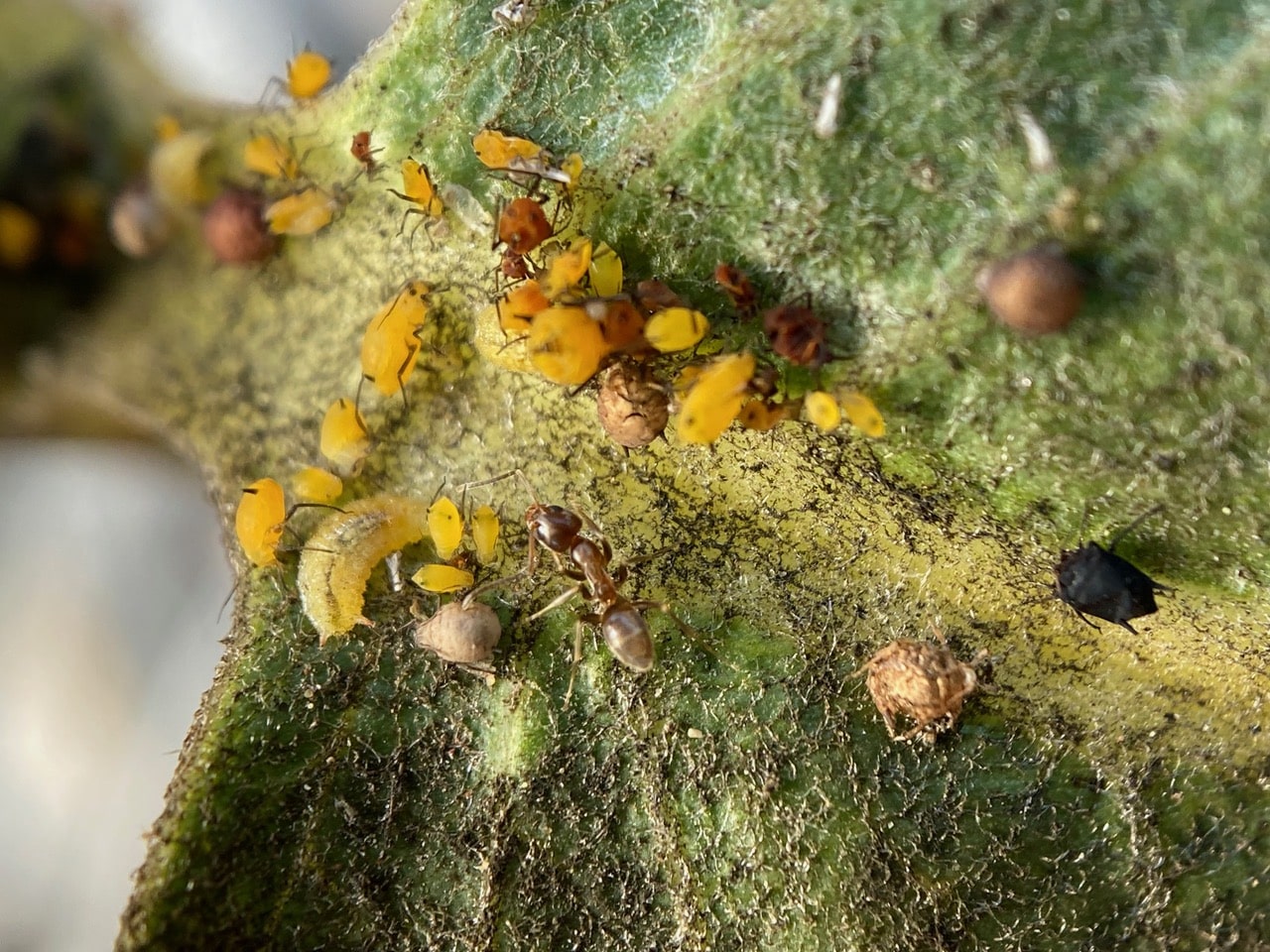
Here’s an even more complex scene under a milkweed leaf. See the brown aphid mummies? The Argentine ant? The ant is probably foraging for honeydew. Many aphid species have a mutualistic relationship with ants, whereby the aphids gain protection from the attendant ants in exchange for honeydew excreted on demand by the aphids. However, the Oleander Aphid is not known to be one of them. This ant is probably taking excreted honeydew from the leaf surfaces, and not directly from the aphids.
Do you see the slug-like critter to the left of the ant and the aphid mummy? It is actually a Hover Fly larva. The pair of antenna-like structures are actually the breathing tubes located at the rear end of the hover fly larva. Many species of hover flies have larvae that feed on aphids and other soft-bodied insects. The females seek out aphid colonies on plants to lay their eggs, to ensure that their offspring will have plenty to eat. Syrphid larvae have no eyes and no legs. They swing their tapered head from side to side in search of prey. When they make contact with a prey, they grab hold of it with their mouthpart, then suck out the victim’s body contents. Depending on species, a Syrphid larva can feed on 100 to 400 aphids before it pupates.
Young as this garden may be, there’s already a complex ecosystem assembled on the milkweed, centered around the humble aphids.