

Pollinator Post 10/27/25 (2)

In the habitat garden of the Bay Farm Island Library the Bush Sunflower, Encelia californica is still in bloom.

An American Sand Wasp, Bembix americana (family Crabronidae) is taking nectar on an Encelia flowerhead.
Sand wasps in the genus Bembix are familiar and common throughout North America, digging their burrows in dunes, on beaches, and other habitats with loose, deep sand. The female rapidly kicks out large quantities of sand using a “tarsal rake” of spines on each front leg. The burrow is excavated before the wasp goes hunting. Bembix are generalist, opportunistic hunters. True flies in the order Diptera are the usual prey. A victim is paralyzed or killed by the wasp’s sting, and is then flown back to the nest. Most species will lay an egg on the first victim, while some species lay an egg in the empty cell before starting to hunt. Once the egg hatches, mama wasp brings flies to her larva as needed. This “progressive provisioning” is rare in the insect world. When the larva reaches maturity, mama wasp closes the cell. Inside, the larva spins an oblong cocoon, weaving sand grains into the structure and resulting in a hardened capsule. Overwintering takes place as a prepupa inside this cocoon, but there are usually two generations a year.
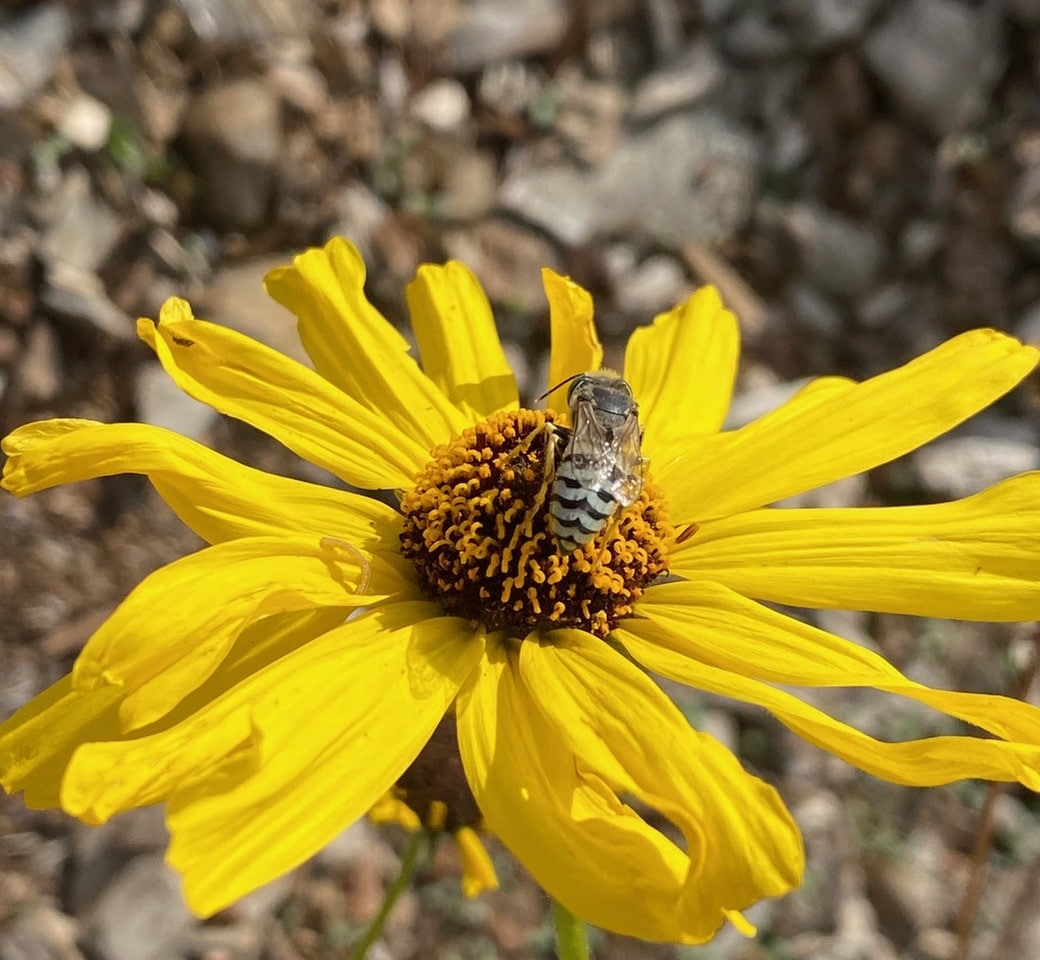
The wavy black-and-white stripes on the abdomen is an easily recognizable feature of the American Sand Wasp, Bembix americana (family Crabronidae).
The wasp is common and abundant in and around Alameda, probably due to the prevalence of sandy soils on the island that the wasp prefers for nesting.
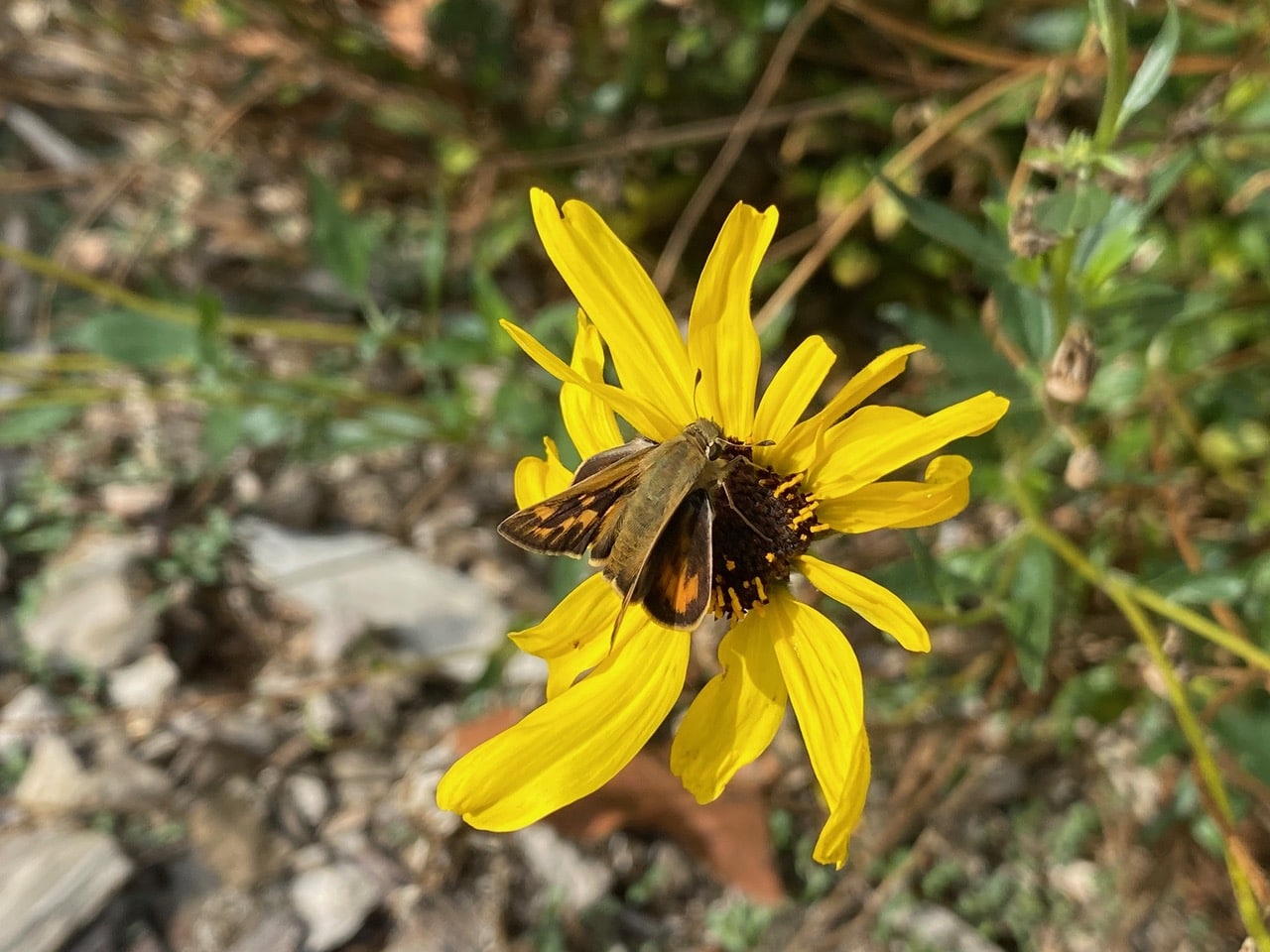
A Fiery Skipper, Hylephila phyleus (family Hesperiidae) lands on an Encelia flowerhead in search of nectar.
Skippers are a family, the Hesperiidae, of the order Lepidoptera (butterflies and moths). They are named for their quick, darting flight habits. Most have the antenna clubs hooked backwards like a crochet hook. They also have generally stockier bodies and larger compound eyes than the other butterflies. Their wings are usually small in proportion to their bodies. When at rest, skippers keep their wings usually angled upwards or spread out, and only rarely fold them up completely. Californian species are mostly brown or tan, with black, orange, or yellow markings.
Skipper caterpillars are usually green or brown, sometimes yellowish, never brightly colored. They have a distinctive “collar”, a narrow ring around the body right behind the head. Caterpillars are camouflaged and often hide during the day. Many species make nests of leaves and silk for additional protection. Most North American species feed on grasses, but some common species eat shrubs and trees, especially in the bean family. Most species are limited to a single group of food plants. Adult skippers are only active during the day, but Skipper caterpillars feed mainly when it is dark or partly light.
Fiery Skippers, Hylephila phyleus (family Hesperiidae) is a small butterfly, with a wingspan of 1.25 to 1.5 in. It can be seen from March to November. Host plants include various species of grasses.
Fiery Skipper is the most abundant grass skipper in California, mostly due to its dominance in urban areas, thanks to the ubiquity of the Great American Lawn. Originally found only in North and South America, it has been introduced into Hawaii and Bali.
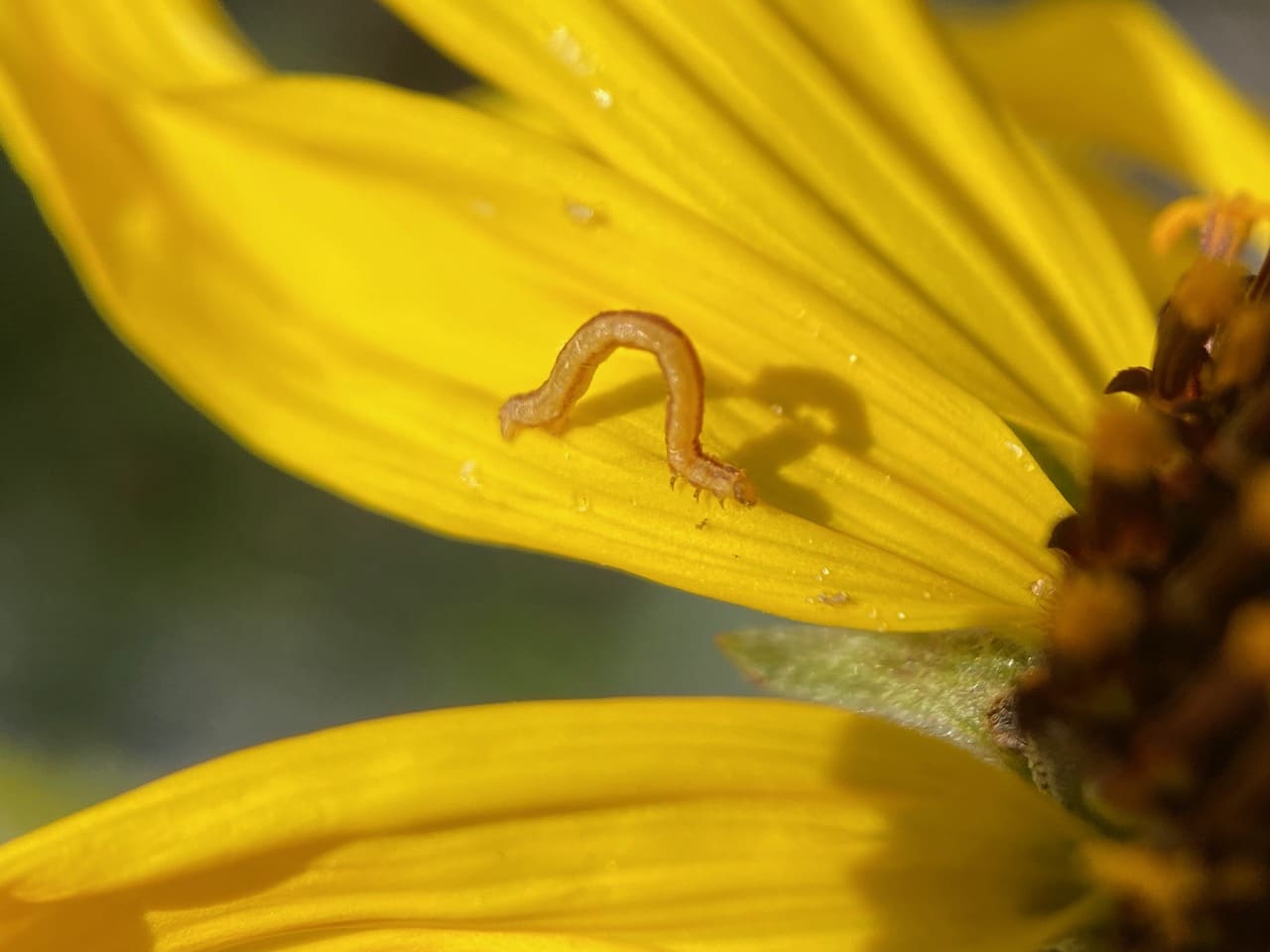
An Inchworm is “inching” its way on an Encelia ray petal. It is the larva of the Pug Moth, Eupithecia sp. (family Geometridae). Note the three pairs of true legs behind the caterpillar’s head.
Inchworms are also called loopers and measuring worms. The majority of the inchworms are the larvae of moths in the family Geometridae. The name comes from the Greek “geo” for earth and “metro” from measure, because the caterpillars seem to be measuring the surface on which they are walking.
All caterpillars have three pairs of jointed legs behind their heads. These legs are called true legs because they will become the six legs of the adult butterfly or moth. There are additional appendages, called prolegs, along their bodies. Prolegs are not true legs, they are just outgrowths of the body wall and will be lost at metamorphosis. They have little hooks on their soles to help the caterpillar walk and grip onto things.
Most caterpillars have five sets of prolegs, four in the middle of the body and one pair at the hind end. Inchworms have the normal six true legs but only two or three pairs of prolegs, all located at the tail end of the body, with none in the middle. When an inchworm walks, it moves its tail-end prolegs up behind its true legs, causing the center of its body to loop upward. Then it stretches its front end forward to take another step.
Eupithelia is the largest genus of moths of the family Geometridae. Occurring worldwide except for Australasia, species in the genus are commonly known as pugs. The caterpillars move in a looping manner and are commonly called inchworms. Adults are typically small, 12 – 35 mm, with muted colors. Most species rest with forewings held flat at right angles to the body, while the hindwing are largely covered by the forewings. They are generally nocturnal. Larvae mostly feed from the flowers and seeds of their food plants rather than the foliage. Many species have a very specific food plant.
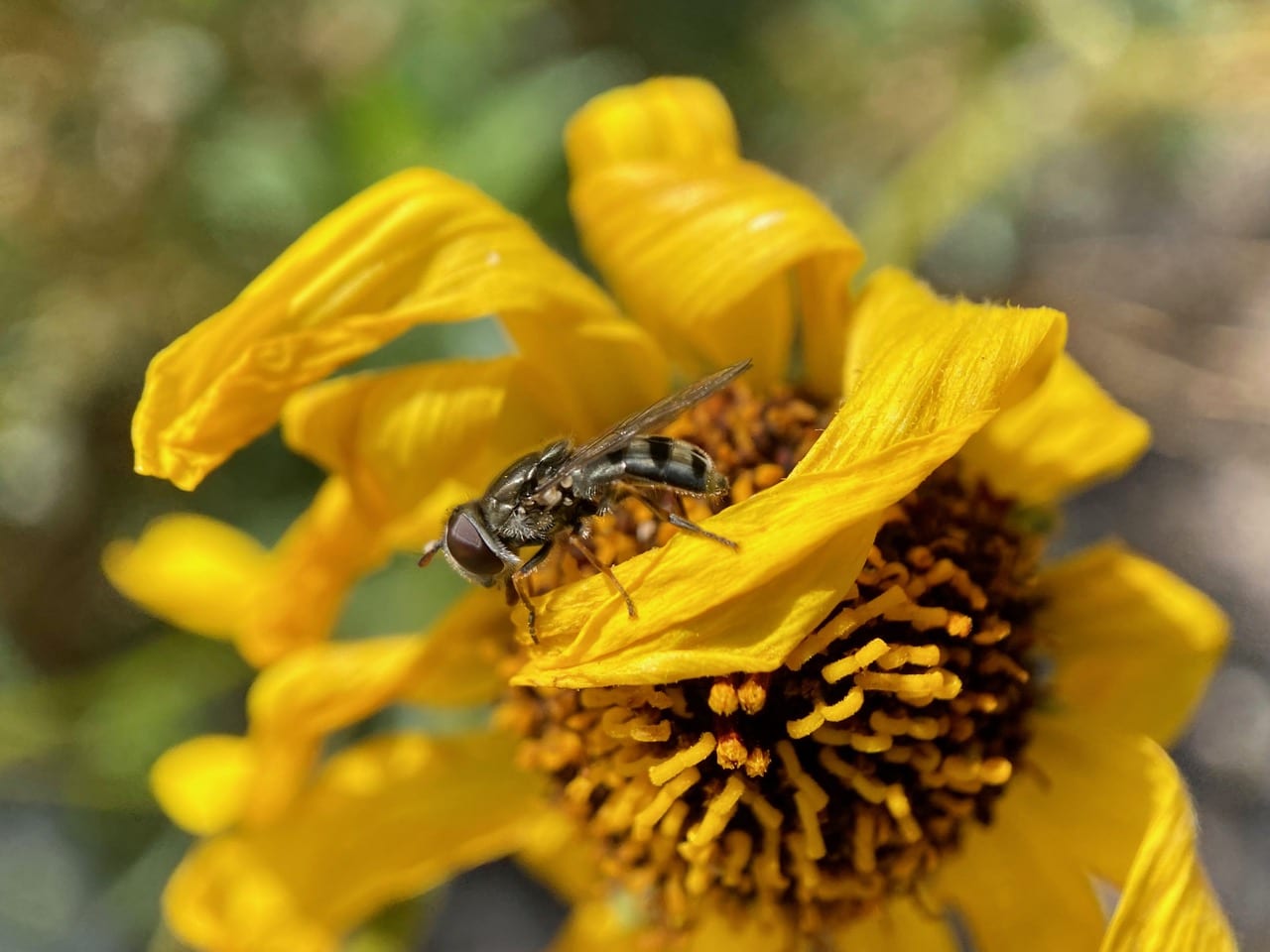
A Sedgesitter, Platycheirus sp. (family Syrphidae) has landed on a fading ray petal of an Encelia flowerhead. Its dusky metallic luster distinguishes this common hover fly from most others.
The Sedgesitter, Platycheirus sp. (family Syrphidae) is found in grass and herb vegetation. Adults of many species feed on pollen of wind-pollinated plants, such as Salix, Plantago, Poaceae, Cyperaceae, but they also visit other flowers. Many stay active during cold and rainy weather. Larvae feed on aphids.
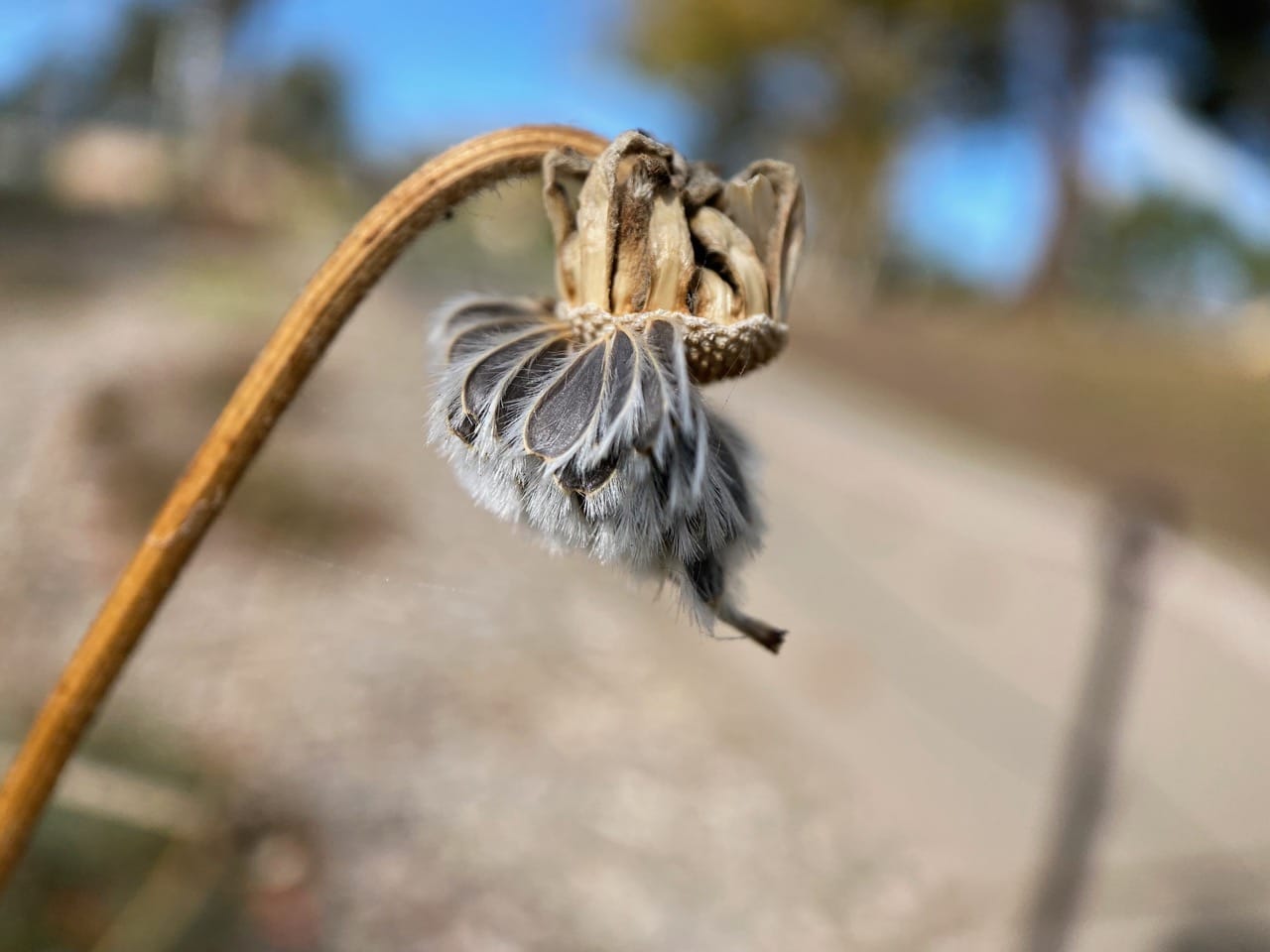
This nodding Encelia seed head is shedding its beautiful, fringed fruits. The fruits, known as achenes (dry one-seeded fruits that do not open to release the seed), have long white hairs on their edges. This feature is part of the plant’s strategy for survival and dispersal in arid environments. The seeds are attached to the dried, cup-like flower heads and are easily blown away by the wind once mature. The hairy edges act as a pappus, a modification of the sepals in plants of the sunflower family (Asteraceae). While less elaborate than the fluff of dandelion seeds, the hairy edges of Encelia achenes serve to aid in long distance dispersal.

Another Encelia seed head in the process of shedding its hairy achenes. Good time to be collecting seeds!
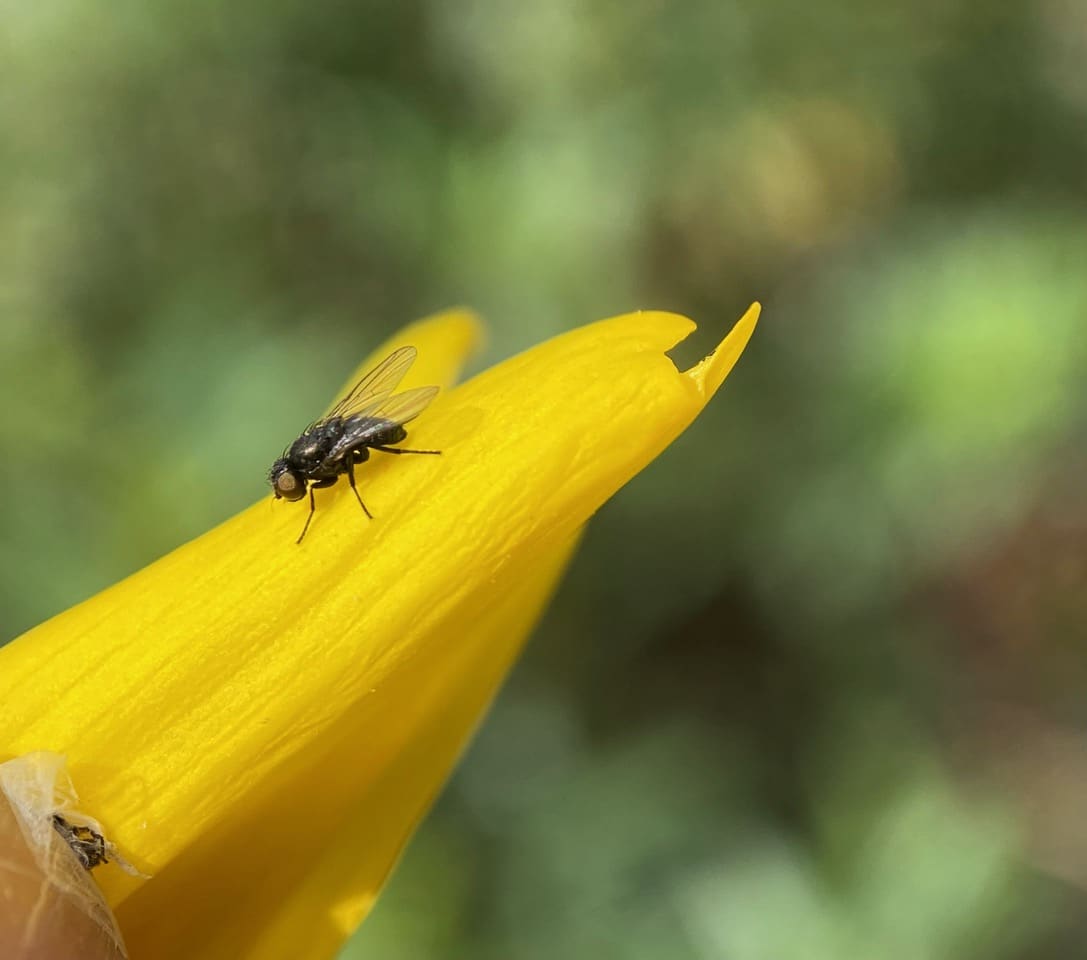
Who is this tiny fly on the Encelia ray petal? iNaturalist has suggested a Freeloader Fly, Desmometopa sp. (family Milichiidae).
“Freeloader”? Milichiidae are a family of very small flies, usually 1-3 mm in length, typically black or at least dark. The adult flies exhibit kleptoparasitic behavior, meaning they steal food from other predators. They do this by waiting near predators like spiders or assassin bugs and then feeding on the fluids of the prey once it has been captured and injured by the larger predator. The flies use their long proboscis to feed on the liquefied tissues of the prey that have been broken down by the predator’s enzymes. This behavior provides protein for the female flies to produce eggs. The flies are attracted to the kill by chemical signals released from the injured prey. Larvae primarily feed on rotting plant materials or decaying wood, carrion, or feces, earning them another unflattering common name of “filth flies”.
.jpg)
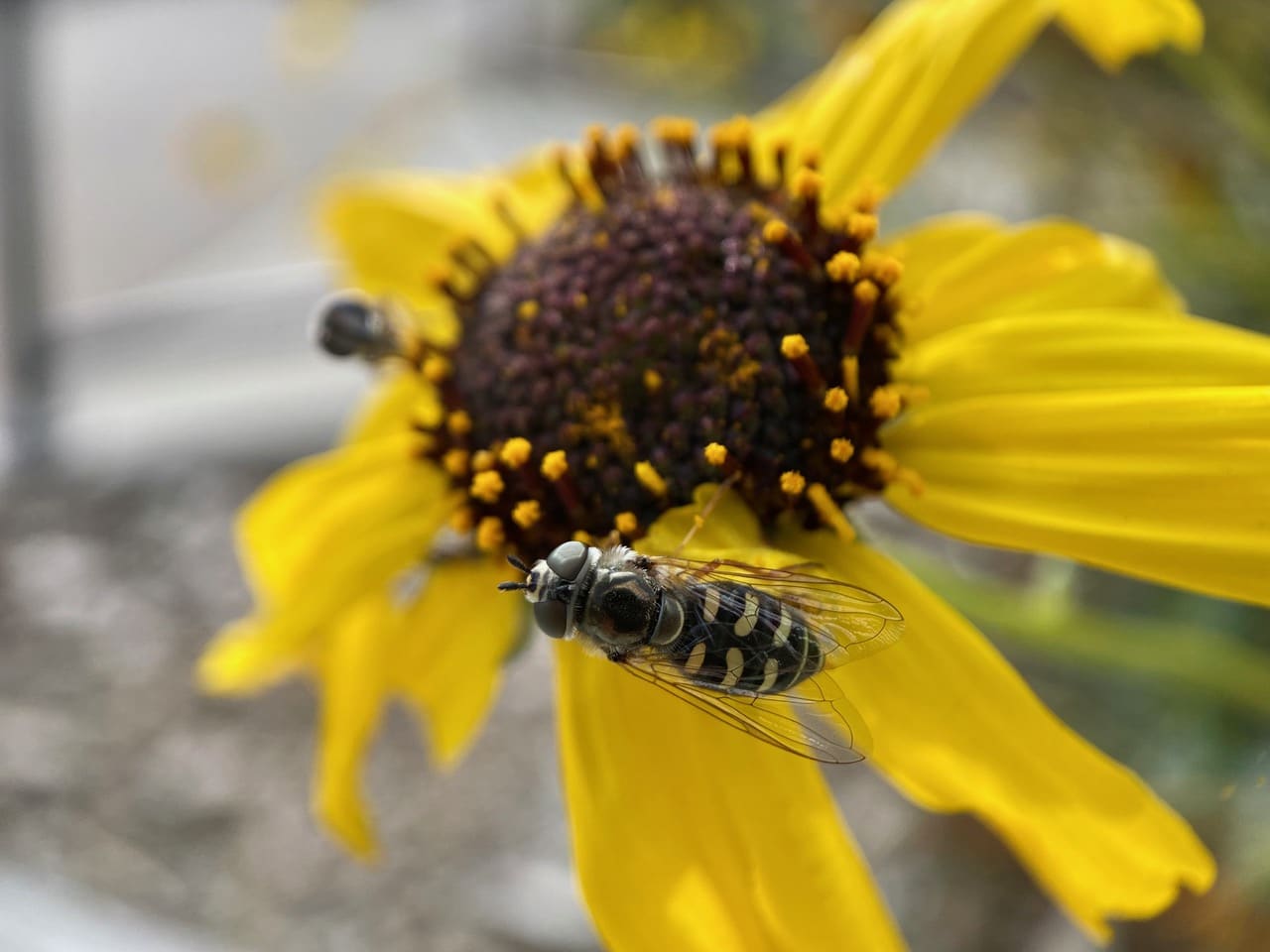
A female Large-tailed Aphideater, Eupeodes volucris (family Syrphidae) visits an Encelia flowerhead. How do I tell it is a female? The genders of hover flies are easily distinguished by their eyes. In most species, the male’s eyes meet on top of the head (holoptic), while the female’s eyes are separated by a gap (dichoptic).
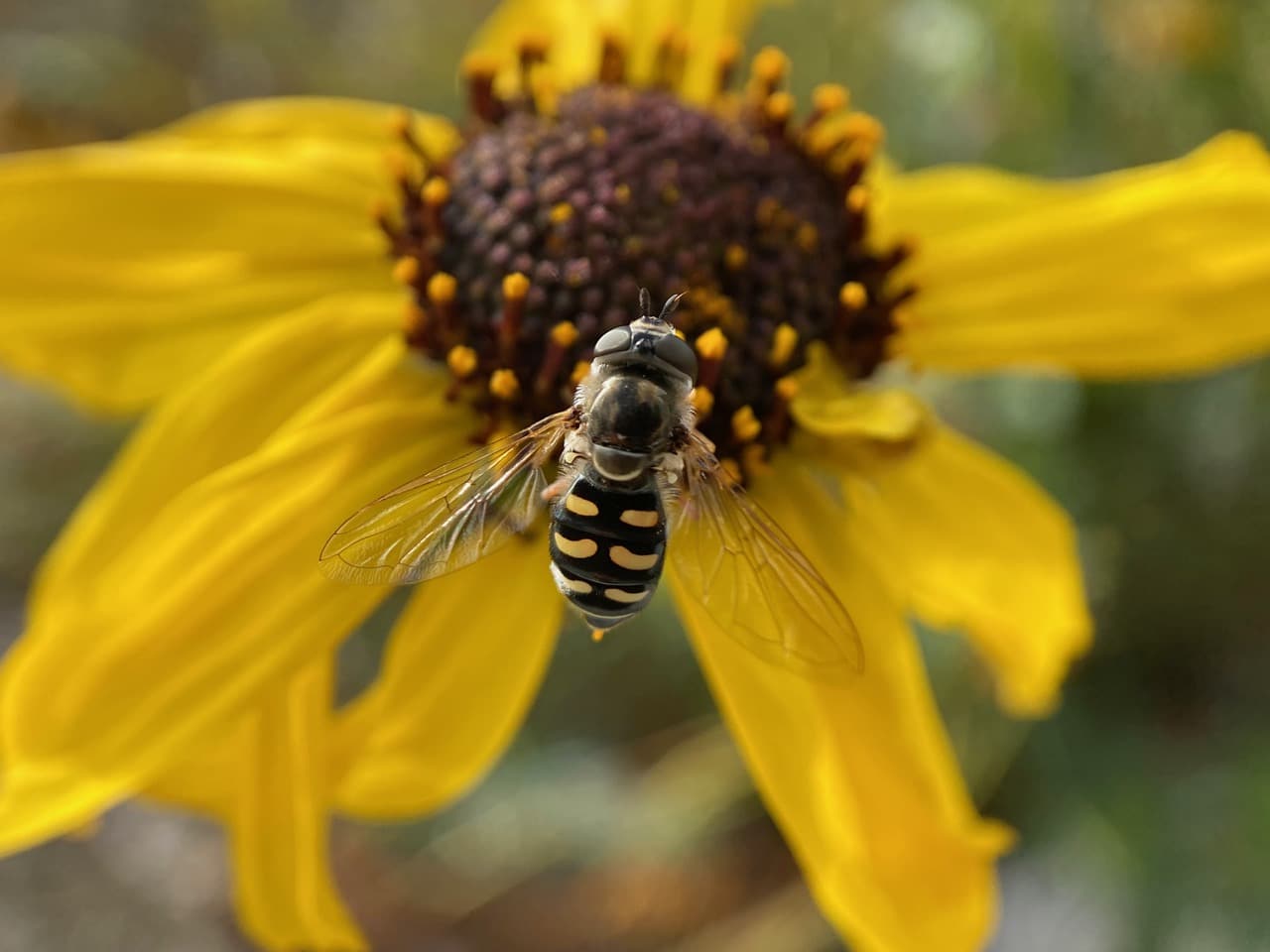
The Large-tailed Aphideater, Eupeodes volucris (family Syrphidae) is found in western North America, and is active March through November. The common name of the species refers to the distinctive “large tail” or projecting cylindrical abdomen of the males. As the rest of the common name implies, the larvae of the species are voracious predators of small plant-sucking insects such as aphids. Females seek out dense aphid colonies on plants to lay eggs among them. Adults visit flowers for nectar and pollen.
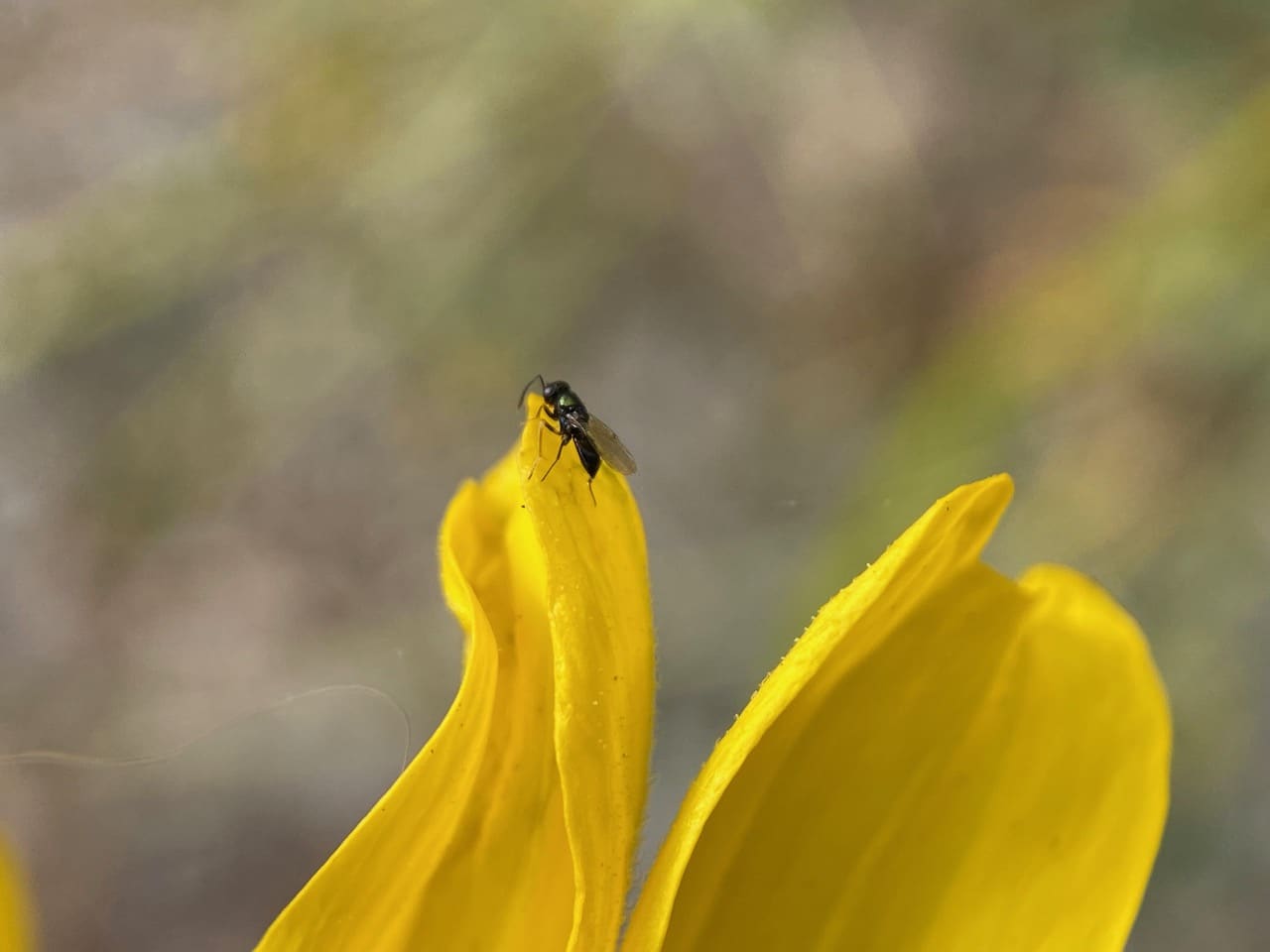
A tiny wasp, barely 2 mm long is perched on a ray petal of Encelia. Immediately I suspect a parasitoid wasp in the superfamily Chalcidoidea.

The wasp probes the substrate constantly with its antennae. What might it be searching for?
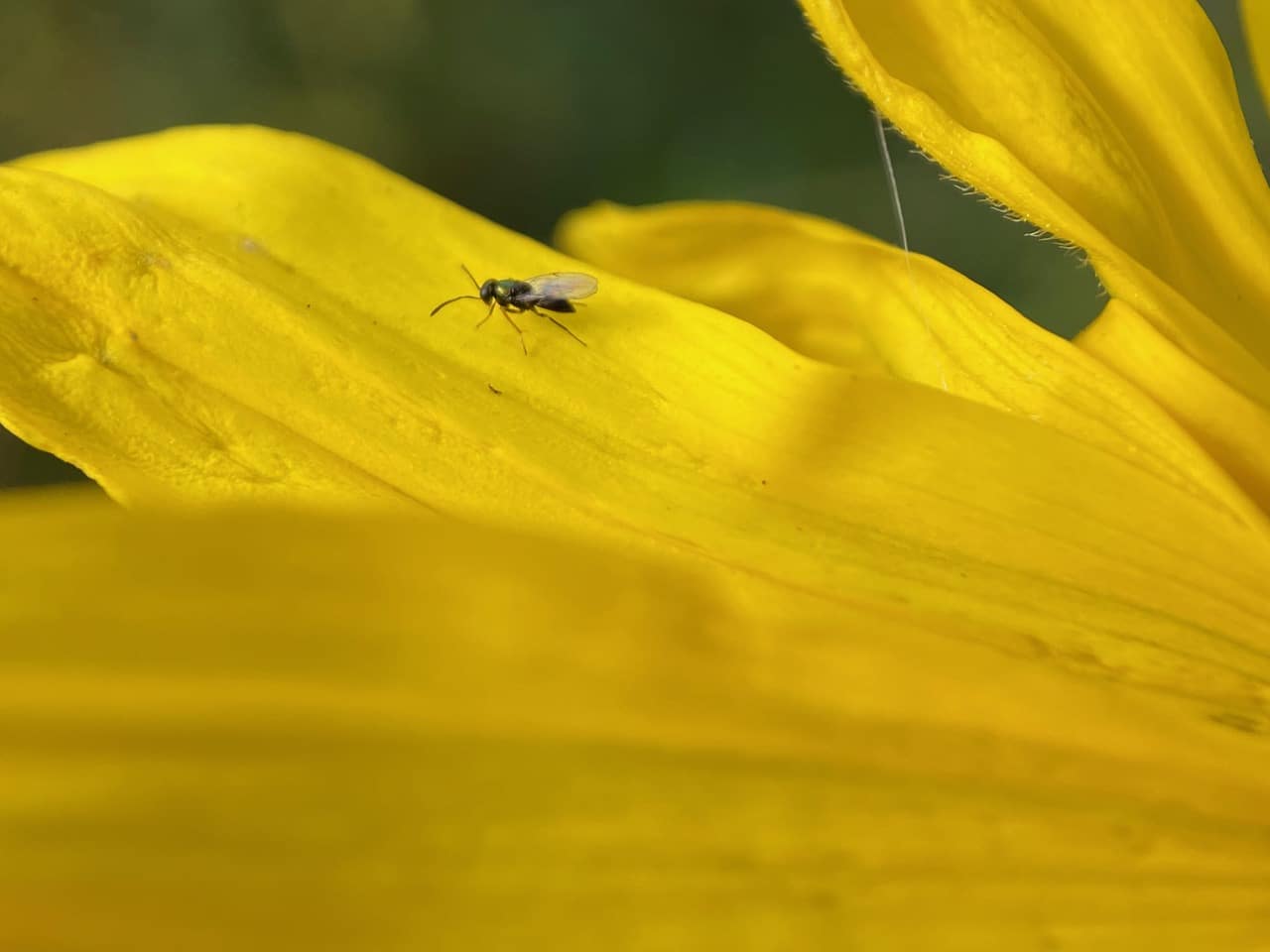
The wasp moves back and forth excitedly on the same patch of ray petal. Has it picked up the scent of a potential host?
Most Chalcid species are parasitoids of other insects, attacking the eggs or larval stage of their host, though many other life cycles are known. These hosts are to be found in at least 12 different insect orders including Lepidoptera (butterflies and moths), Diptera (true flies), Coleoptera (beetles), Hemiptera (true bugs), and other Hymenoptera, as well as two orders of Arachnida. When the host is itself a parasitoid, the wasps are referred to as hyperparasitoids. Generally beneficial to humans as a group, chalcidoids help keep various crop pests under control, and many species have been used as biocontrol agents.
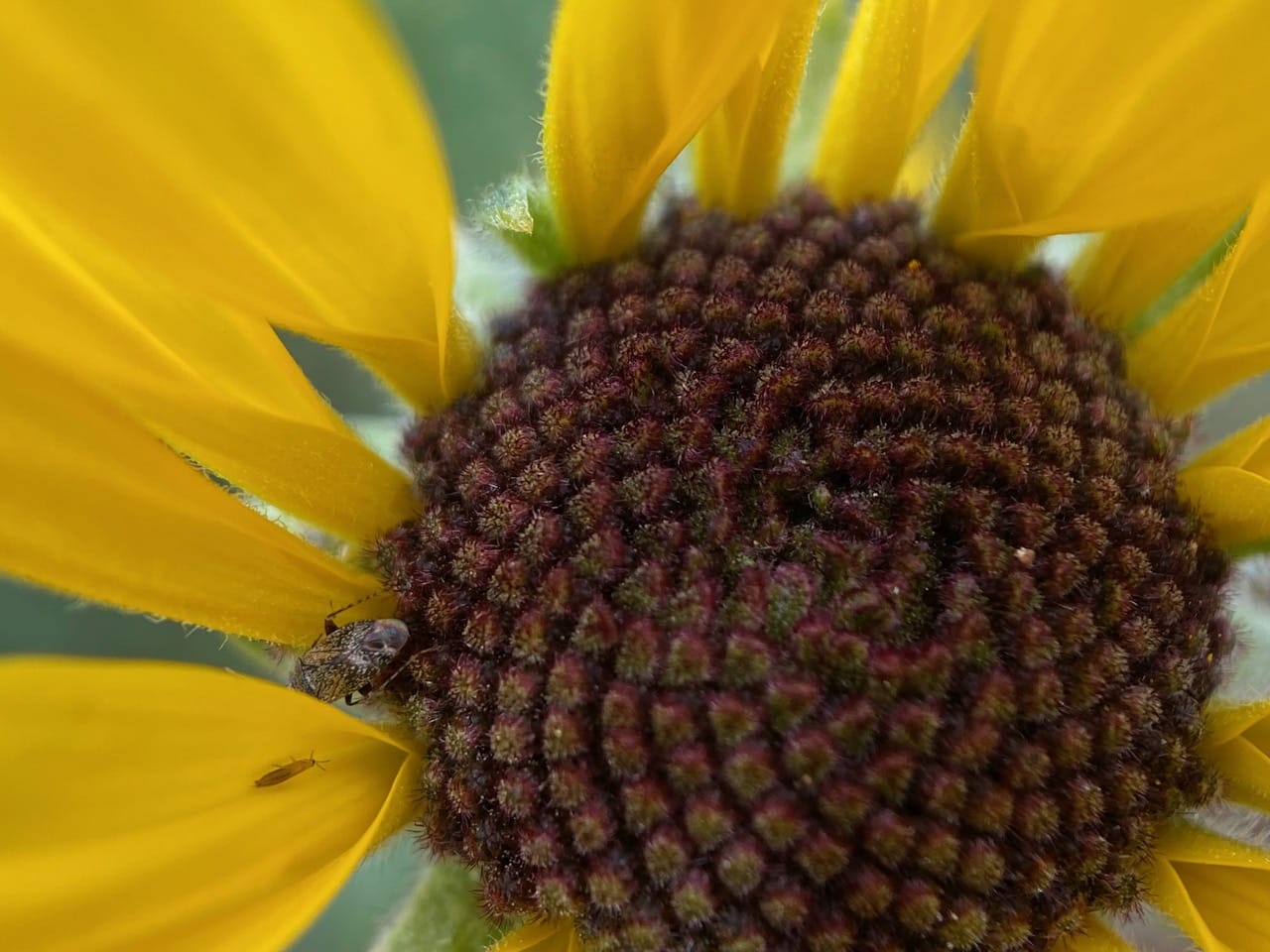
Fleeing from my camera, a small dark insect slips over the edge of an Encelia flowerhead. Hey, I had a glimpse its cuneus – it is a Plant Bug in the family Miridae! Wait, there’s an even smaller insect on the adjacent ray petal. It’s a Thrips!
Thrips (order Thysanoptera) are minute (mostly 1 mm long or less), slender insects with fringed wings and unique asymmetrical mouthparts. They feed mostly on plants by puncturing and sucking up the contents, although a few are predators. Some flower-feeding thrips pollinate the flowers they are feeding on, and some scientists believe that they may have been among the first insects to evolve a pollinating relationship with their host plants. A genus is notable for being the specialist pollinator of cycads. Thrips are likewise the primary pollinators of heathers in the family Ericaceae, and play a significant role in the pollination of pointleaf manzanita. Electron microscopy has shown thrips carrying pollen grains adhering to their backs, and their fringed wings are perfectly capable of allowing them to fly from plant to plant.
BTW, there’s no such thing as a “thrip”. It’s always “thrips”, singular or plural!
OK, back to the Plant Bug. So, what’s the cuneus anyway?
Mirid bugs are also referred to as plant bugs or leaf bugs. Miridae is one of the largest family of true bugs in the order Hemiptera. Like other Hemipterans, Mirids have piercing, sucking mouthparts to extract plant sap. Some species are predatory. Others are opportunistic omnivores. One useful feature in identifying members of the family is the presence of a cuneus; it is the triangular tip of the corium, the firm, horny part of the forewing, the hemielytron. The cuneus is visible in nearly all Miridae.

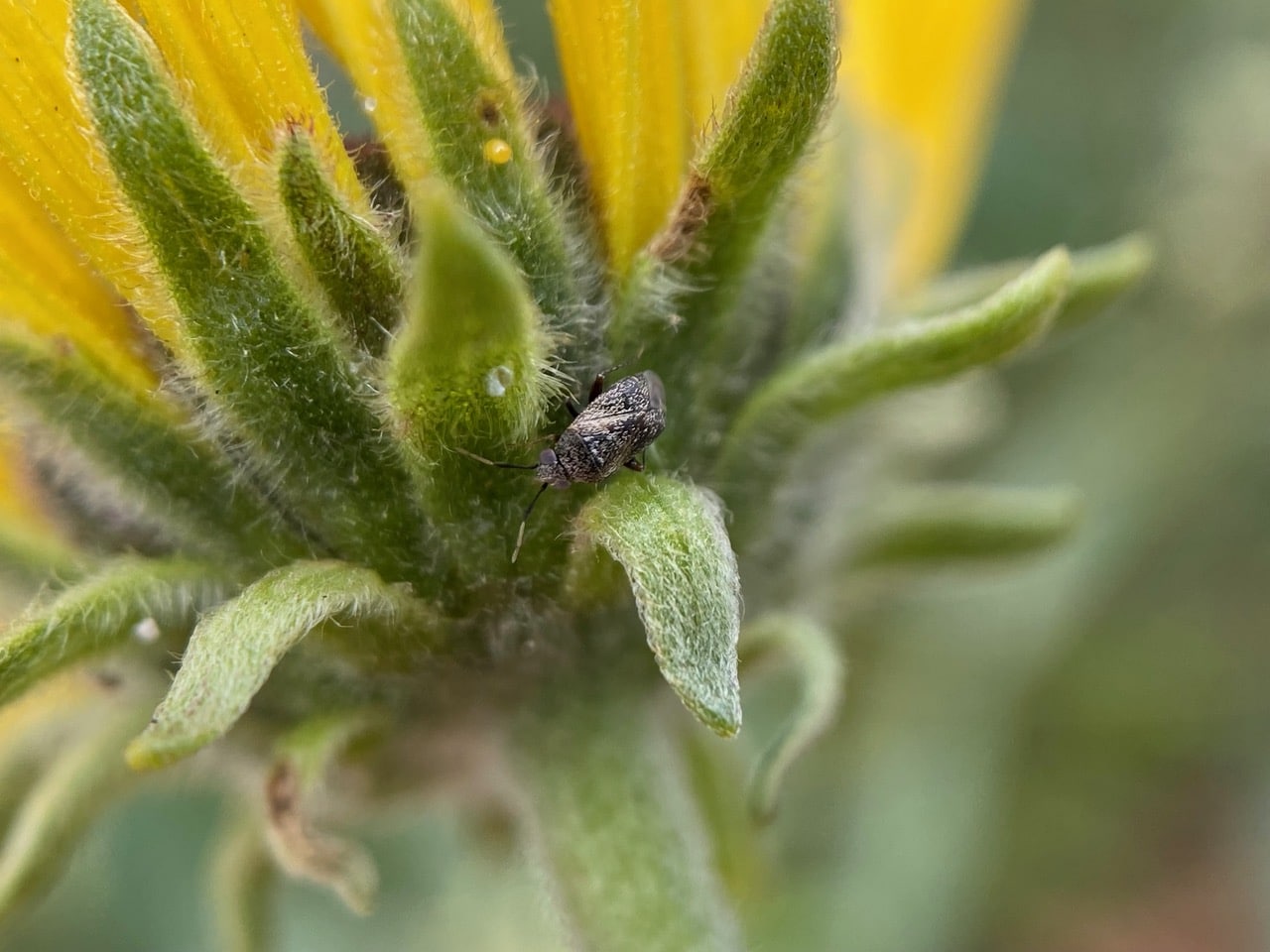
The Plant Bug runs through the phyllaries at the base of the flowerhead. Note its bicolored antennae. iNaturalist has helped identify it as the Western Plant Bug, Rhinacloa forticornis (family Miridae). Yay, a new one for me!
The species is found in North America, Central America, South America, the Caribbean, and Oceania. In the US, it is found mostly in the southwest (CA to TX). Measuring 1.4-1.8 mm, the bug is recognized by its small size, generally dark coloration, including the basal antennal segments. The specific epithet forticornis means ‘with sturdy antennae’. There’s precious little information out there on the species other than that it is polyphagous, feeding on a variety of plants.
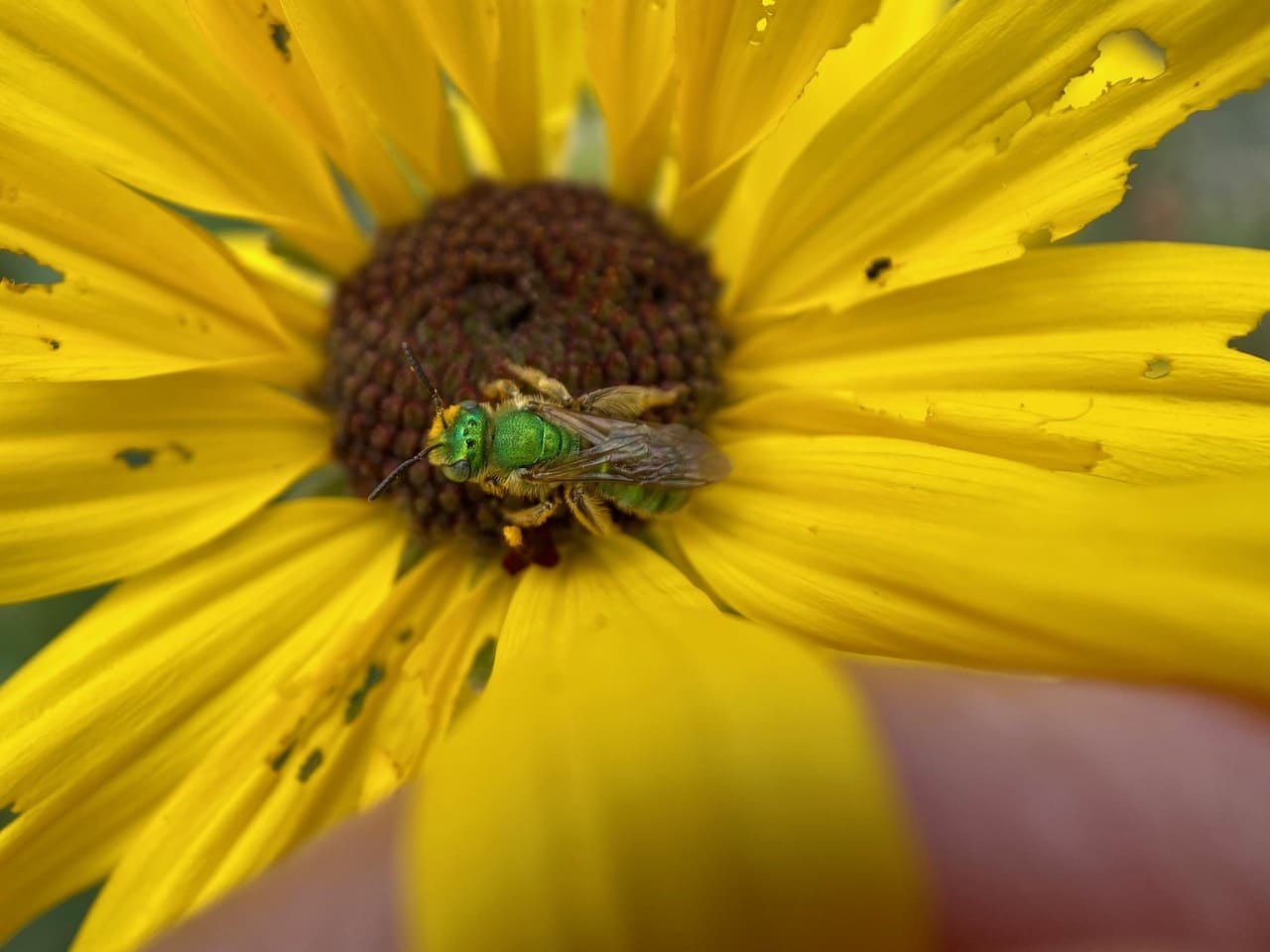
A female Fine Striped Sweat Bee, Agapostemon subtilior (family Halictidae) is moving sluggishly on an Encelia flowerhead. She must have been probing some flowers as there’s yellow pollen adhering to her face.
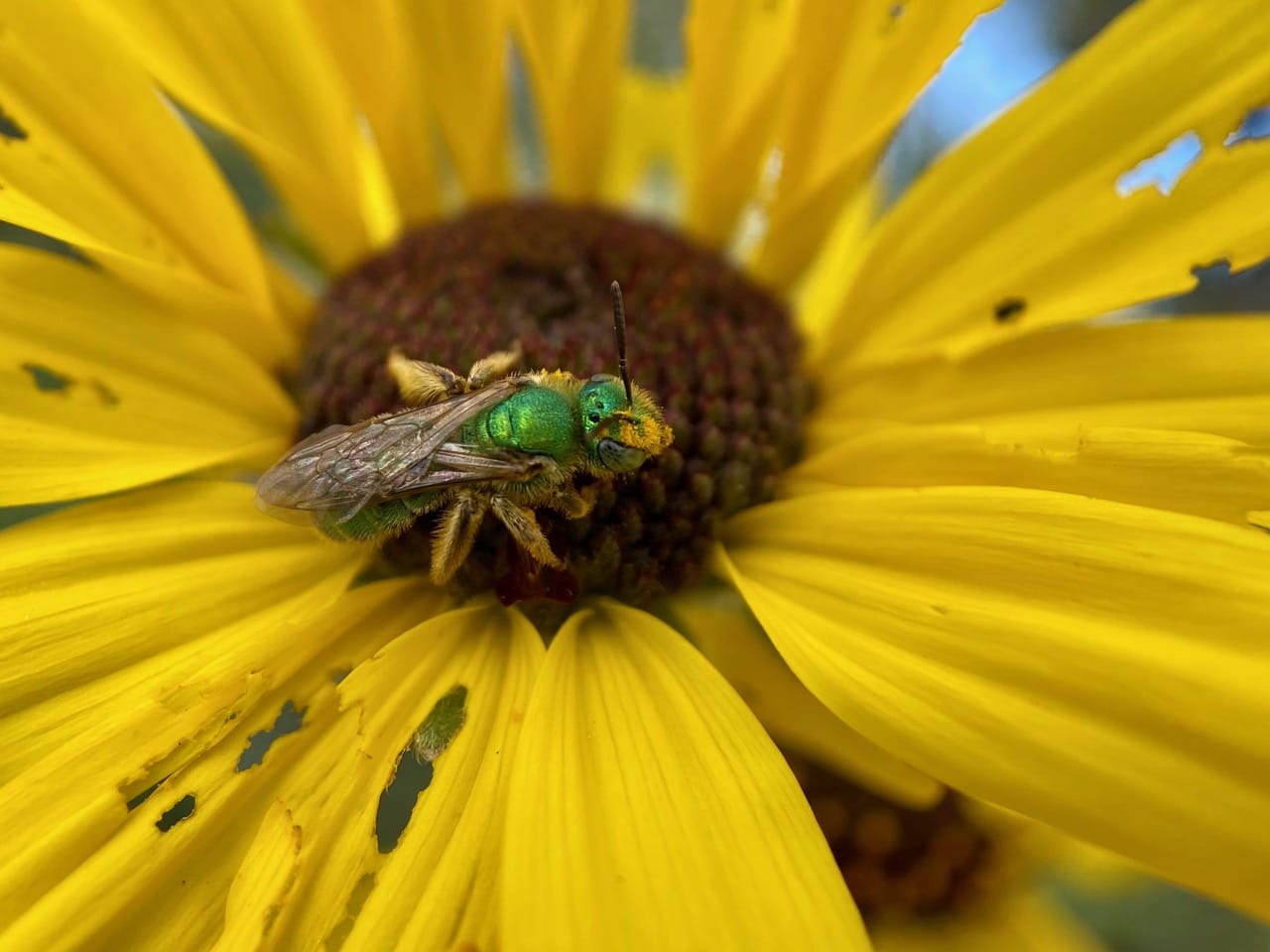
Agapostemon are brightly colored metallic green or blue bees measuring 7 to 14.5 mm long. Most species have a metallic green head and thorax, and black-and-yellow striped abdomen; some females are entirely bright green or blue. Females carry pollen on scopal hairs located on their hind legs. Agapostemon are generalists. Like other members of the family Halictidae, they are short-tongued and thus have difficulty extracting nectar from deep flowers. Males are often seen flying slowly around flowers looking for females. The bees favor flowers with high densities. Females excavate nests in the ground. These are summer to fall bees.
Fine striped sweat bee (Agapostemon subtilior) · iNaturalist

The female’s scopa (special pollen collecting hairs) on her hind legs are empty – she has not been collecting pollen.
Agapostemon females dig deep vertical burrows in flat or sloping soil, or sometimes in banks. Most species are solitary, but some species nest communally. Up to two dozen females may share a single nest entrance, but each individual builds and provisions its own cluster of brood cells. Where a communal nest gallery shares a single entrance, one bee usually guards the hole, with only her head visible from above ground. Unlike other social bees, in communal bees there is no reproductive division of labor. In cool temperate regions, there is one generation per year, with females active in the early summer and males and pre-diapausing females active in the late summer. Only mated females survive the winter. This is probably because unmated females cannot enter diapause (insect version of hibernation).
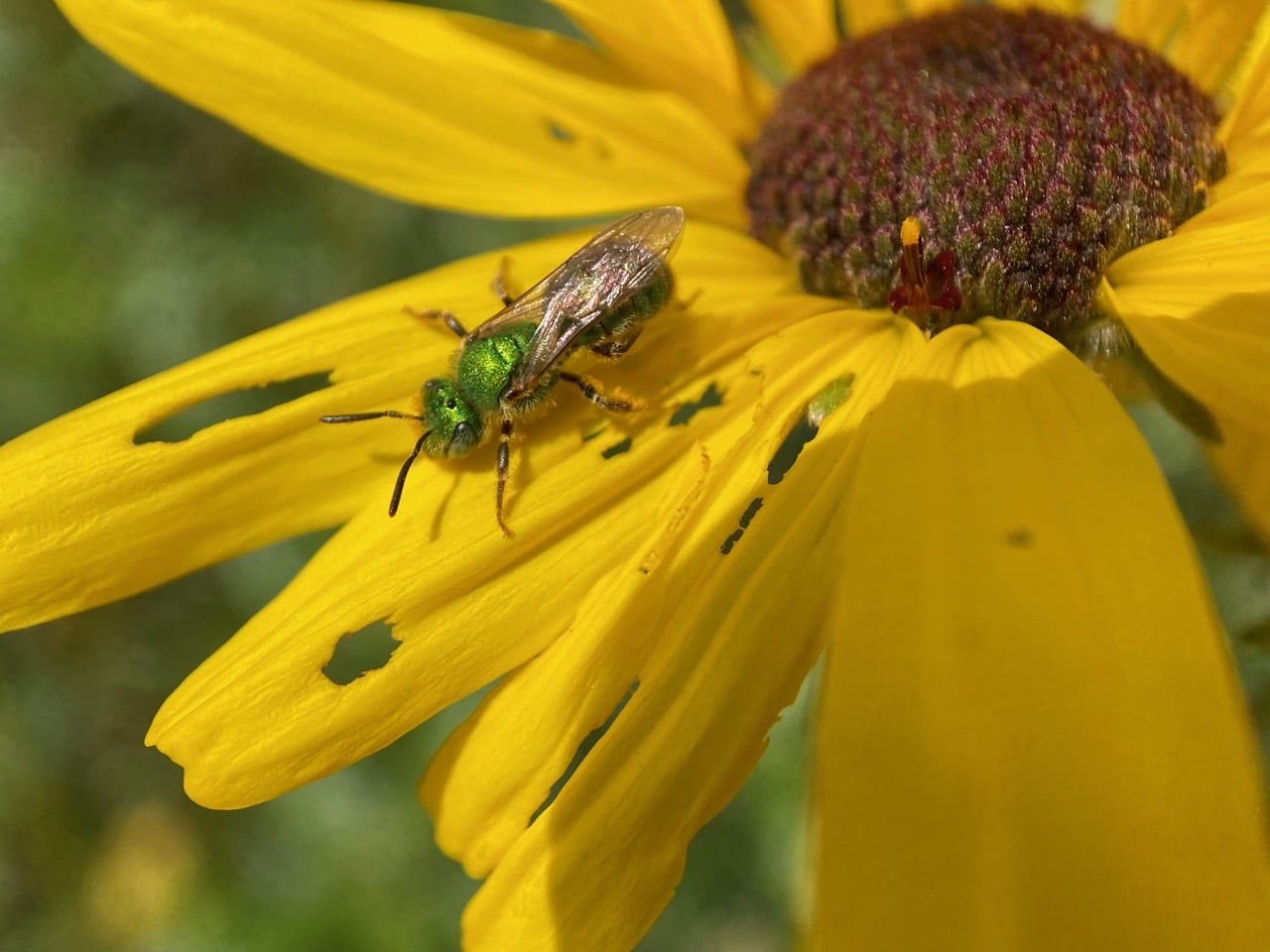
The sweat bee moves onto the ray petals and, lifting her abdomen, proceeds to groom herself. She brushes her abdomen and wings with her hind legs. She also cleans her face and antennae with her front legs. It appears she’s just getting ready for the day. At 11 am? A rather late start! Is she a pre-diapausing female, destined to hibernate through the winter? I have never observed such sluggish behavior in these bees.
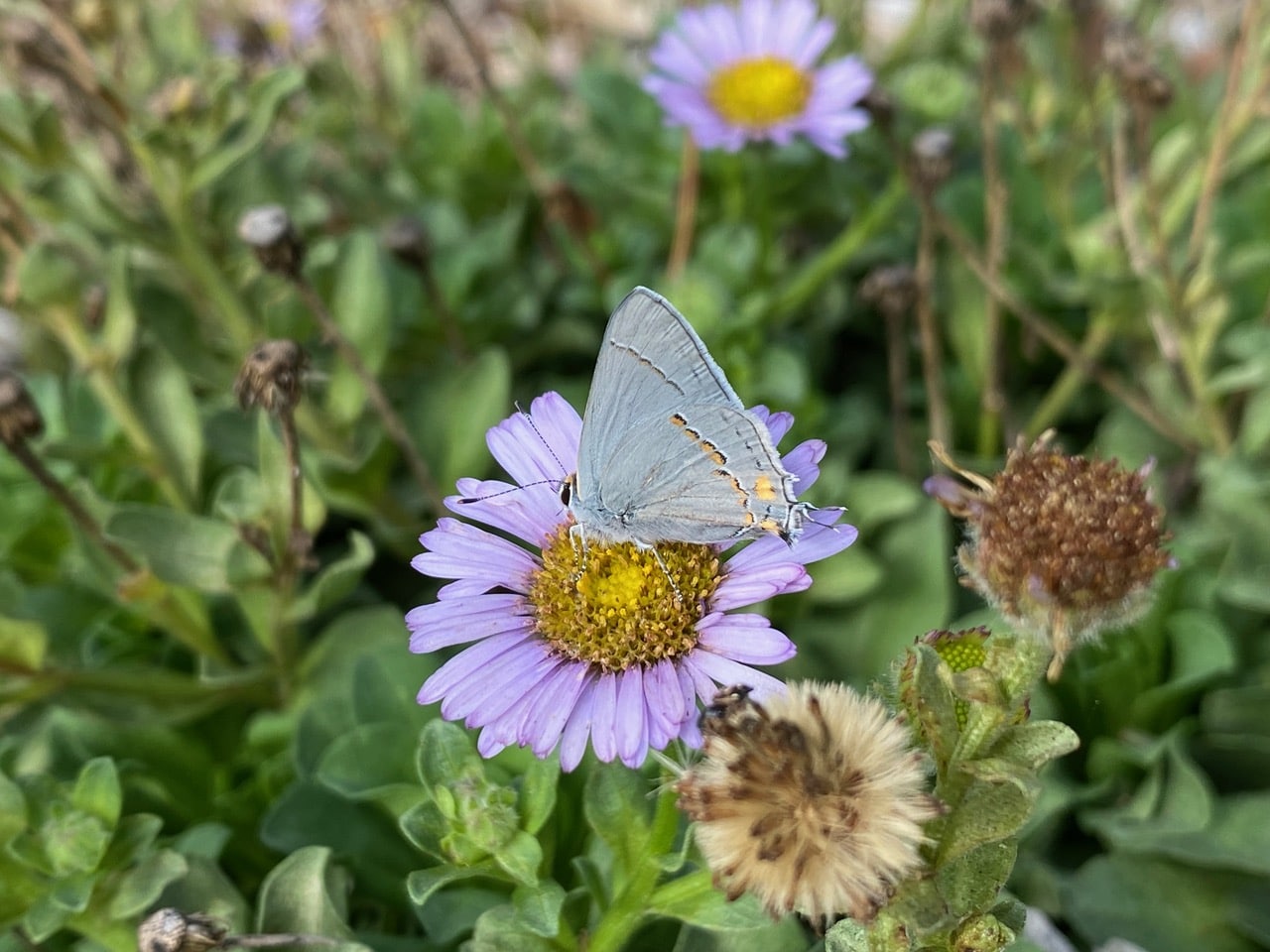
A Gray Hairstreak, Strymon melinus (family Lycaenidae) lands on a Seaside Daisy flowerhead, Erigeron glaucus. While the butterfly probes for nectar, it constantly rubs its hind wings together.
Why the name “hairstreak”? These small butterflies have a slim, hair-like tail on the lower corner of each hindwing. Gray Hairstreak also has colorful false eyespots near the base of each tail. The eyespots and antenna-like tails are believed to fool predators into mistaking its tail for its head. Hairstreaks even add a behavioral component – a nectaring hairstreak often rubs its wings up and down, simulating the movement of twitchy antennae. This may fool birds, lizards, and spiders into attacking the wrong end, sparing the life of the butterfly.
Female Gray Hairstreaks lay eggs singly on the flowers, flower buds, young fruits and nearby leaves of a host plant. Host plants include a wide variety of plants, notably from the pea (Fabaceae) and mallow (Malvaceae) families. The caterpillars are greenish at the start, but older individuals range in color from gray to pink. As in many species of Lycaenidae, Gray Hairstreak larvae are myrmecophiles (ant-lovers) – often tended by ants. Ants harvest a sweet liquid from the caterpillar’s dorsal nectary organ (“honey gland”) and in exchange may protect them from predators. Larvae of many Lycaenidae species also communicate with ants via ant-like sounds (clicks and hums) or by sending vibrations through the substrate.